Pillar · Class of body · Updated October 2026
Dwarf planets.
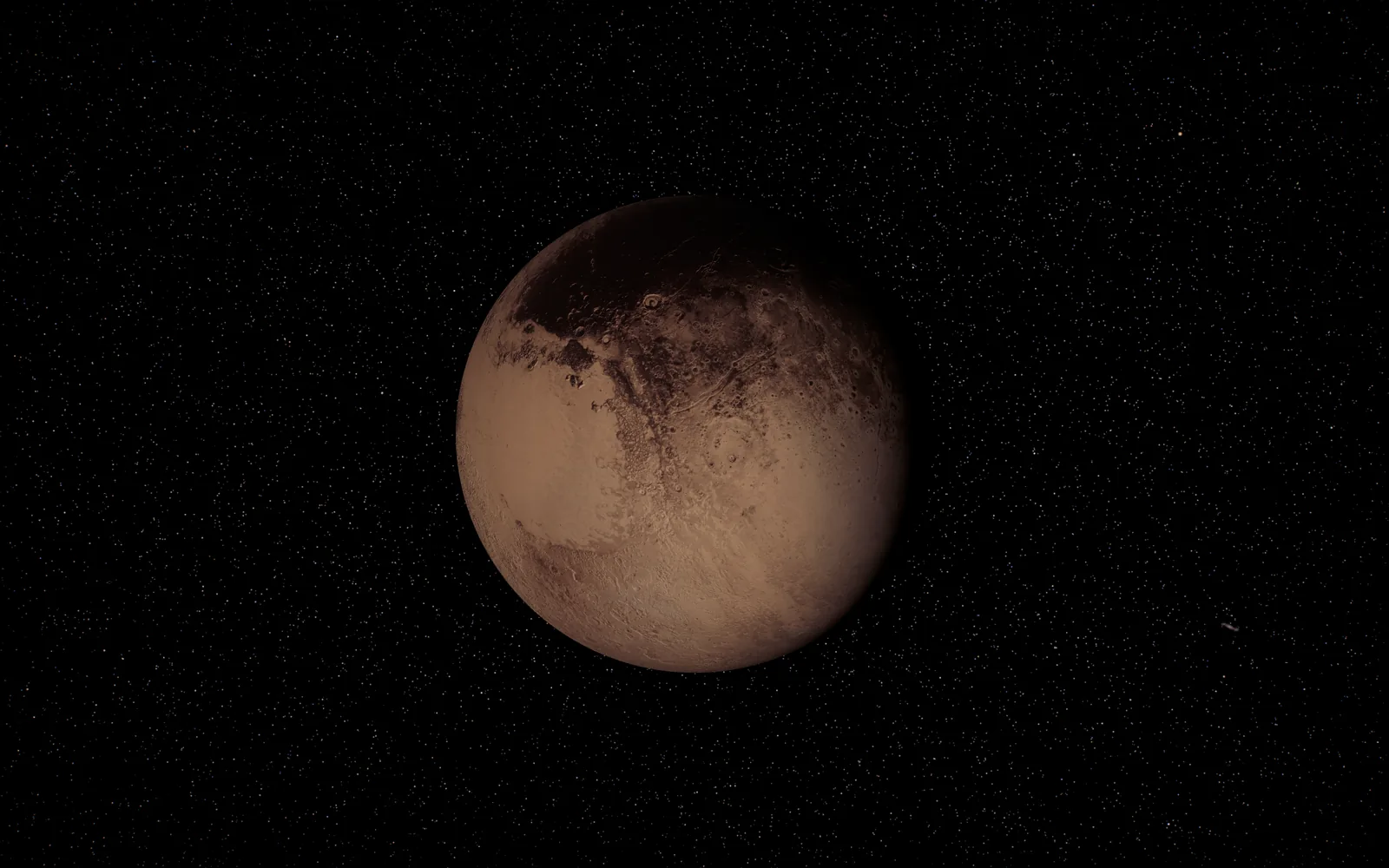
A dwarf planet is a body that orbits the Sun and is massive enough for self-gravity to pull it into a roughly spherical shape, but has not "cleared its neighbourhood" of other debris. The International Astronomical Union recognises five — Pluto, Eris, Haumea, Makemake (all in the Kuiper Belt or beyond) and Ceres (in the asteroid belt). Dozens more candidates are likely.
Open the 3D viewer →The IAU's 2006 definition
When the International Astronomical Union met in Prague in 2006 they redefined what counts as a planet. To qualify, a body must (1) orbit the Sun, (2) have enough mass to assume hydrostatic equilibrium (a near-round shape), and (3) have "cleared the neighbourhood" of its orbit. Pluto failed the third criterion and was reclassified. The category "dwarf planet" was created for bodies that pass (1) and (2) but fail (3).
The five recognised dwarf planets
Pluto (2,377 km diameter, in the Kuiper Belt). Eris (2,326 km, scattered disc, slightly more massive than Pluto). Haumea (1,632 × 996 km, an extreme football shape spinning every 4 hours). Makemake (1,430 km, Kuiper Belt). Ceres (940 km, asteroid belt, the only dwarf planet in the inner solar system).
Probably many more
Astronomers estimate the Kuiper Belt and the scattered disc contain dozens to hundreds of objects that meet the dwarf-planet criteria. Candidates include Sedna, Quaoar, Orcus, Gonggong, and Salacia. The IAU has been cautious about adding new ones until size and shape are confirmed by direct observation.
Why the demotion mattered
Pluto's reclassification was controversial. New Horizons' 2015 flyby revealed a geologically active world with mountains of water ice, nitrogen-ice plains, possible cryovolcanoes, and a thin nitrogen atmosphere — more "planet-like" than many predicted. The textbook still says nine planets in many parts of the world. The question is more about classification than about the world itself.
Bodies in this category
Frequently asked questions
Why is Pluto not a planet?
Because it shares its orbital region with thousands of other Kuiper Belt objects — it has not cleared its neighbourhood, the third IAU criterion for full planet status.
Is Ceres a planet?
No — it's a dwarf planet. It's the largest object in the asteroid belt and roughly spherical, but shares the belt with millions of smaller bodies.
How many dwarf planets are there?
Five officially recognised by the IAU: Pluto, Eris, Haumea, Makemake, and Ceres. Astronomers estimate dozens more candidates exist in the outer solar system.