
Dwarf Planet
Pluto.
A dwarf planet at the edge of the Kuiper belt, with a heart of nitrogen ice.
Pluto right now
- From Earth right now
- 5,276,834,550 km
- Its light reaches us after
- 4 h 53 min
- From the Sun
- 5,328,426,865 km
- Speed around the Sun
- 5.23 km/s
- Around its orbit
- 15% of the way from perihelion
Worked out in your browser from JPL's orbital elements, the same maths that moves the planets in the 3D viewer. How far Pluto is from Earth right now, with miles, AU and the next close approach.
Overview
Pluto at a glance
Pluto is a dwarf planet in the Kuiper Belt, the first such object ever discovered, and the largest known. With a diameter of 2,377 km it is smaller than Earth's Moon. Its 248-Earth-year orbit is so eccentric (e = 0.249) that for 20 years of every orbit Pluto is closer to the Sun than Neptune. Reclassified from "planet" to "dwarf planet" by the IAU in 2006, it has five moons; the largest, Charon, is so massive that the two orbit a barycentre outside Pluto itself.
- Diameter
- 2,377 km
- From the Sun
- 5.9B km
- Year
- 248 years
- Axial tilt
- 122.53°
- Moons
- 5
- Type
- Dwarf Planet
Size, to scale
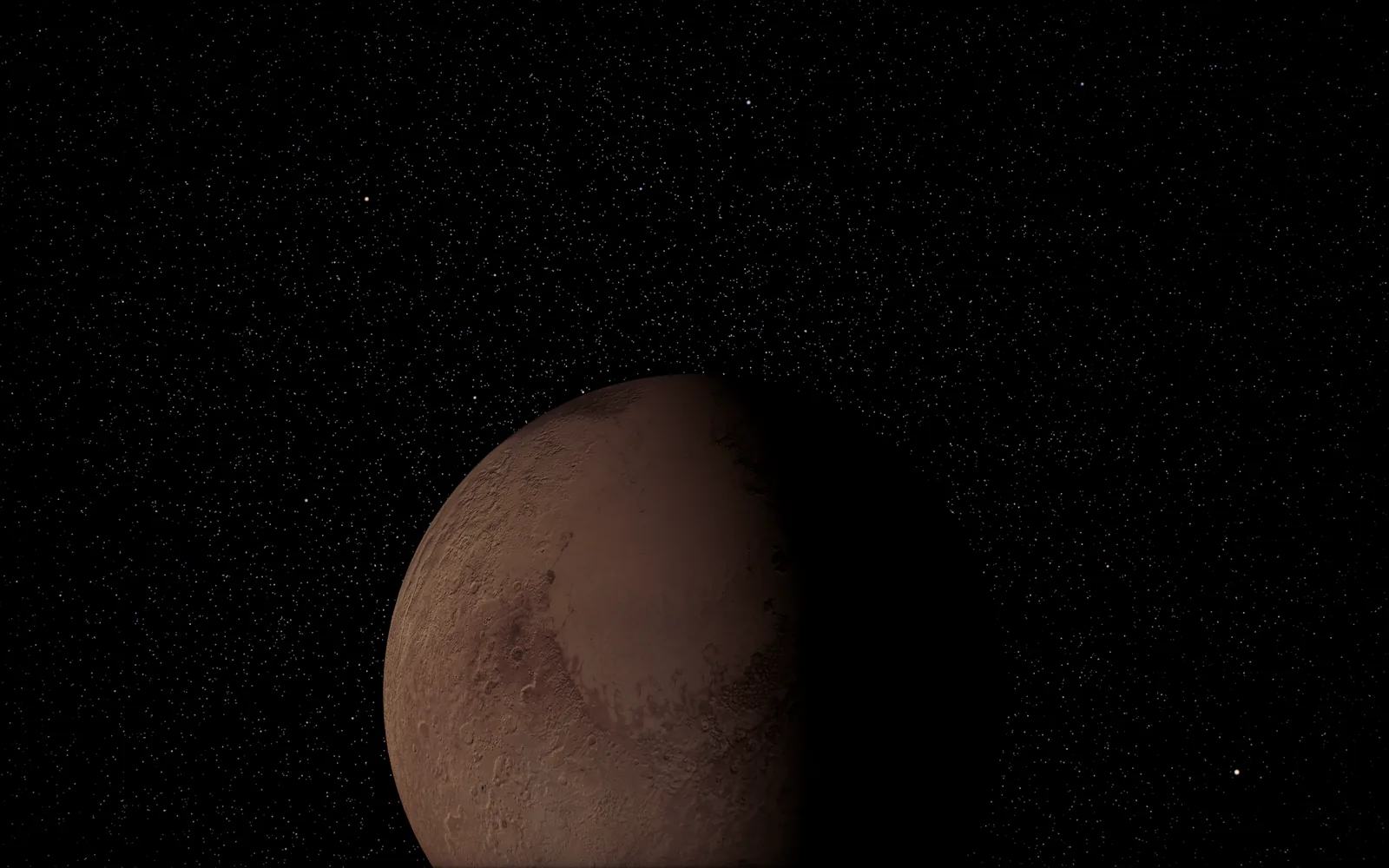
Atmosphere
A thin, seasonal haze
Thin nitrogen-methane atmosphere, varying from 0.1 to 1 Pa as Pluto moves nearer or farther from the Sun. As Pluto recedes through the rest of the 2020s and 2030s, much of the atmosphere is expected to freeze onto the surface.
Surface
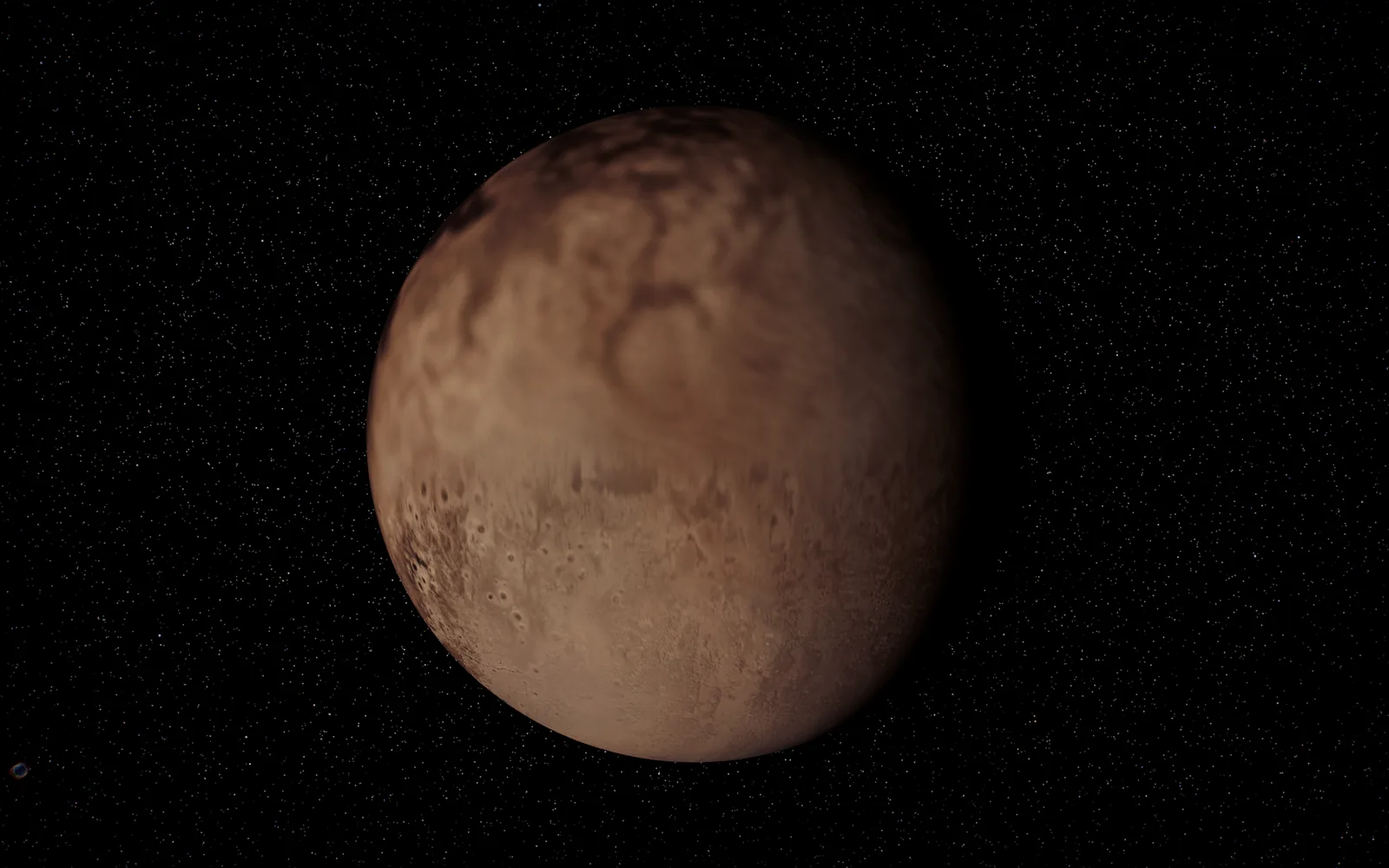
Nitrogen ice and water-ice mountains
A surprise from New Horizons (2015): vast nitrogen-ice plains (Sputnik Planitia, the heart-shaped feature), water-ice mountains up to 3.5 km tall, possible cryovolcanoes, and active geology despite the tiny scale.
Interior
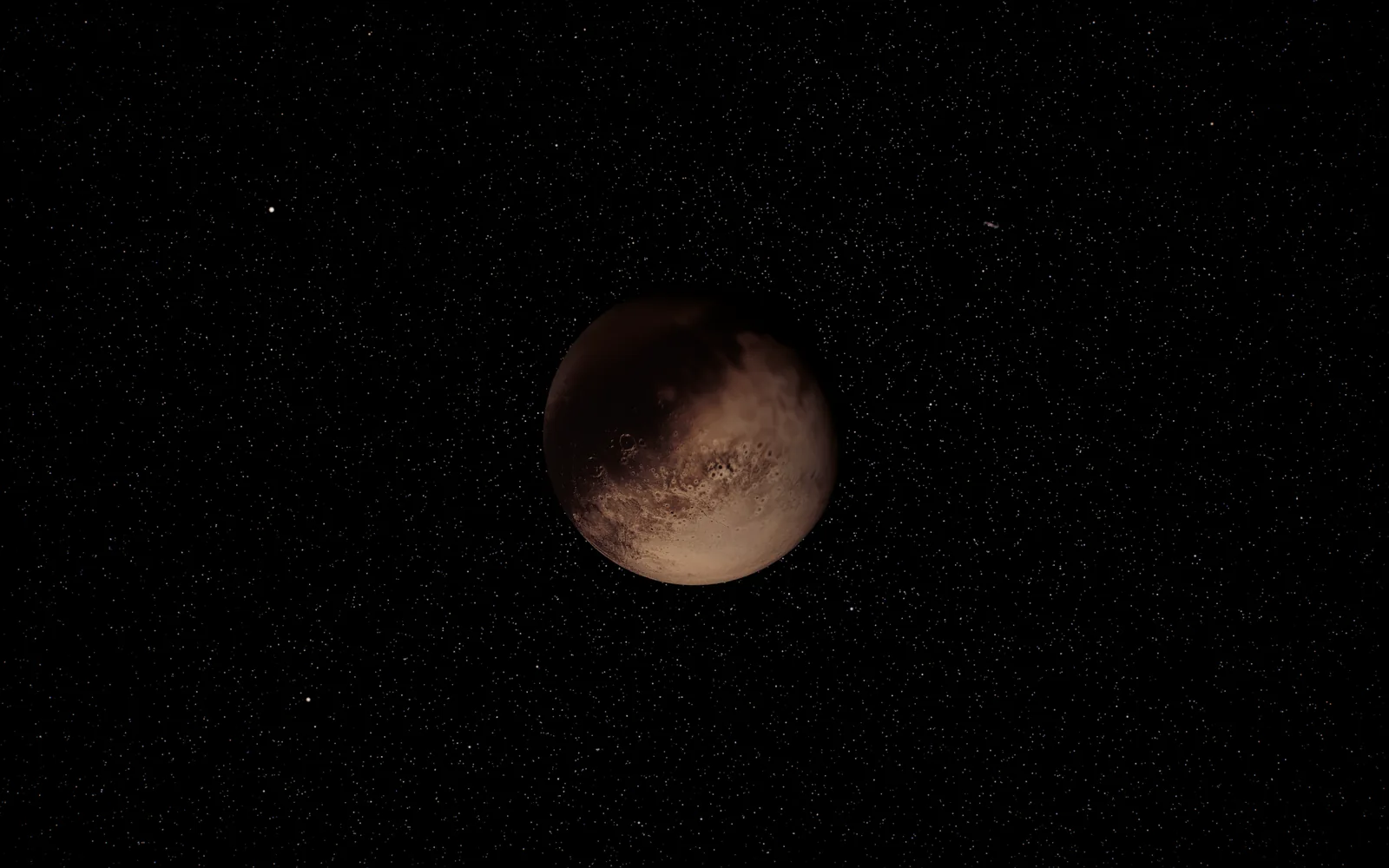
Inside Pluto
Likely a rocky core surrounded by a water-ice mantle, with hints of a subsurface ocean detected from surface tectonics.
Formation
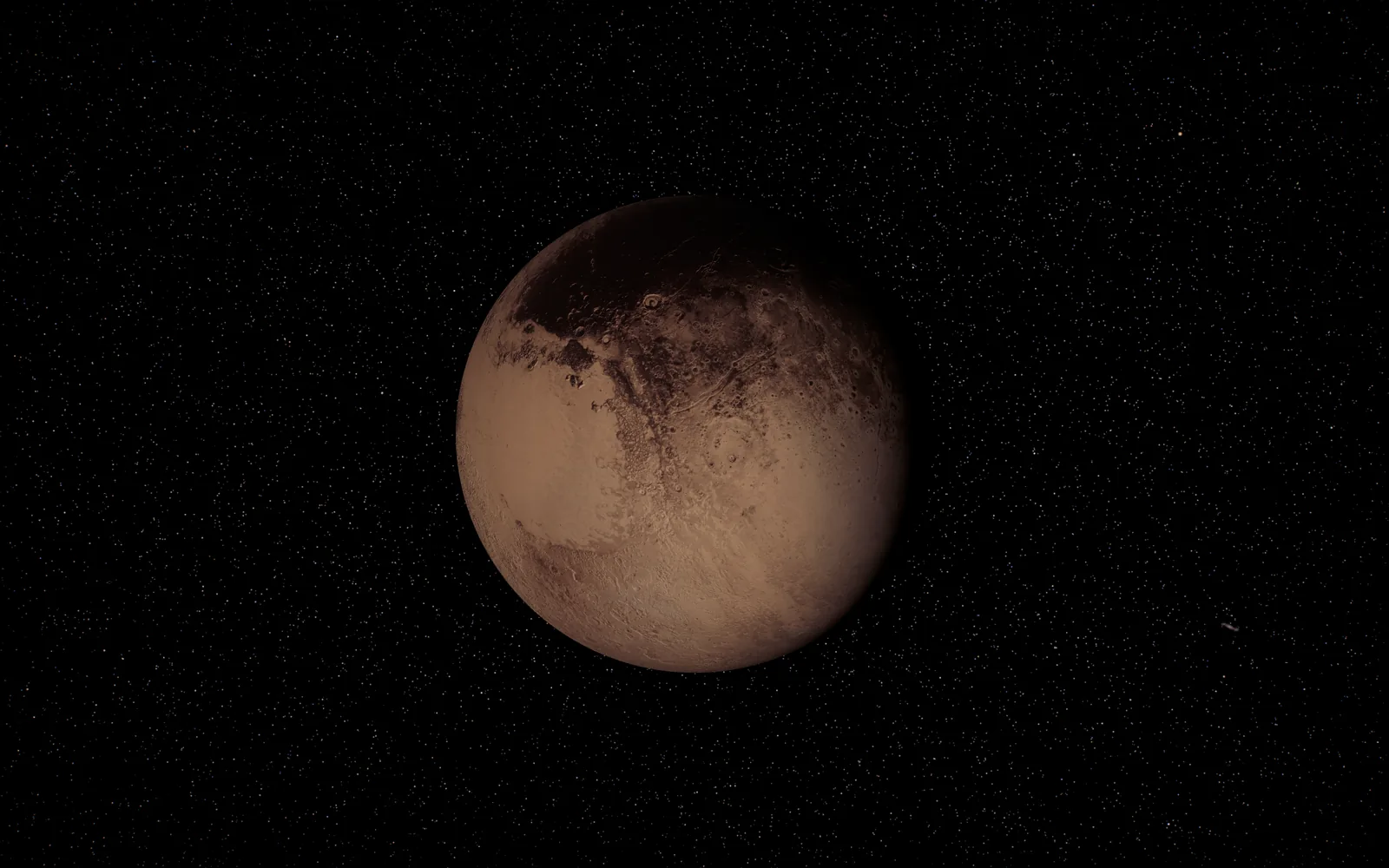
How it formed
Formed in the outer protoplanetary disc 4.5 billion years ago, in the same population as the rest of the Kuiper Belt. Charon may have formed from a giant impact, similar to Earth's Moon.
Orbit
Where Pluto is today
Average distance from the Sun: 5.91 billion km (39.5 AU). Orbital period 248 Earth years. Tilted 17° from the ecliptic and so eccentric that 20 years of each orbit are inside Neptune's — though the two never collide because of a stabilising 2:3 orbital resonance.
Sunlight takes
4 h 56 min
to reach Pluto, and its reflected light needs 4 h 53 min more to reach us.
Missions
Who has been to look
- 2015New HorizonsPast flyby
The only spacecraft ever to visit Pluto. Continued outward to fly past Arrokoth in 2019.
Go further
See it for yourself
Fly to Pluto in 3D
Pluto and Charon are tidally locked to each other — they always show the same face. From Pluto, Charon hangs motionless in the sky, and from Charon, Pluto hangs motionless. The viewer renders this correctly: in real-time mode the two stay locked as they orbit their shared centre.
Keep Pluto on your screen
Set the screensaver to one world and it stays with Pluto: the whole disc, a close pass, the day-night line, all where it really is right now.
Questions
Asked about Pluto
Why is Pluto not a planet?
The IAU's 2006 definition requires a planet to have "cleared its orbital neighbourhood." Pluto shares its orbital region with thousands of other Kuiper Belt objects.
How many moons does Pluto have?
Five: Charon, Styx, Nix, Kerberos, and Hydra.
How long is a year on Pluto?
248 Earth years.
Read more
Other bodies
- Sun Star
- Mercury Terrestrial Planet
- Venus Terrestrial Planet
- Earth Terrestrial Planet
- Mars Terrestrial Planet
- Jupiter Gas Giant
- Saturn Gas Giant
- Uranus Ice Giant
- Neptune Ice Giant
Sources & methodology
Numbers cross-referenced with the sources below; surface and atmosphere descriptions reflect findings as of October 2026. Renderings in the 3D viewer use textures based on Solar System Scope and NASA imagery.