Quick answer · Updated October 2026
How big is Jupiter?
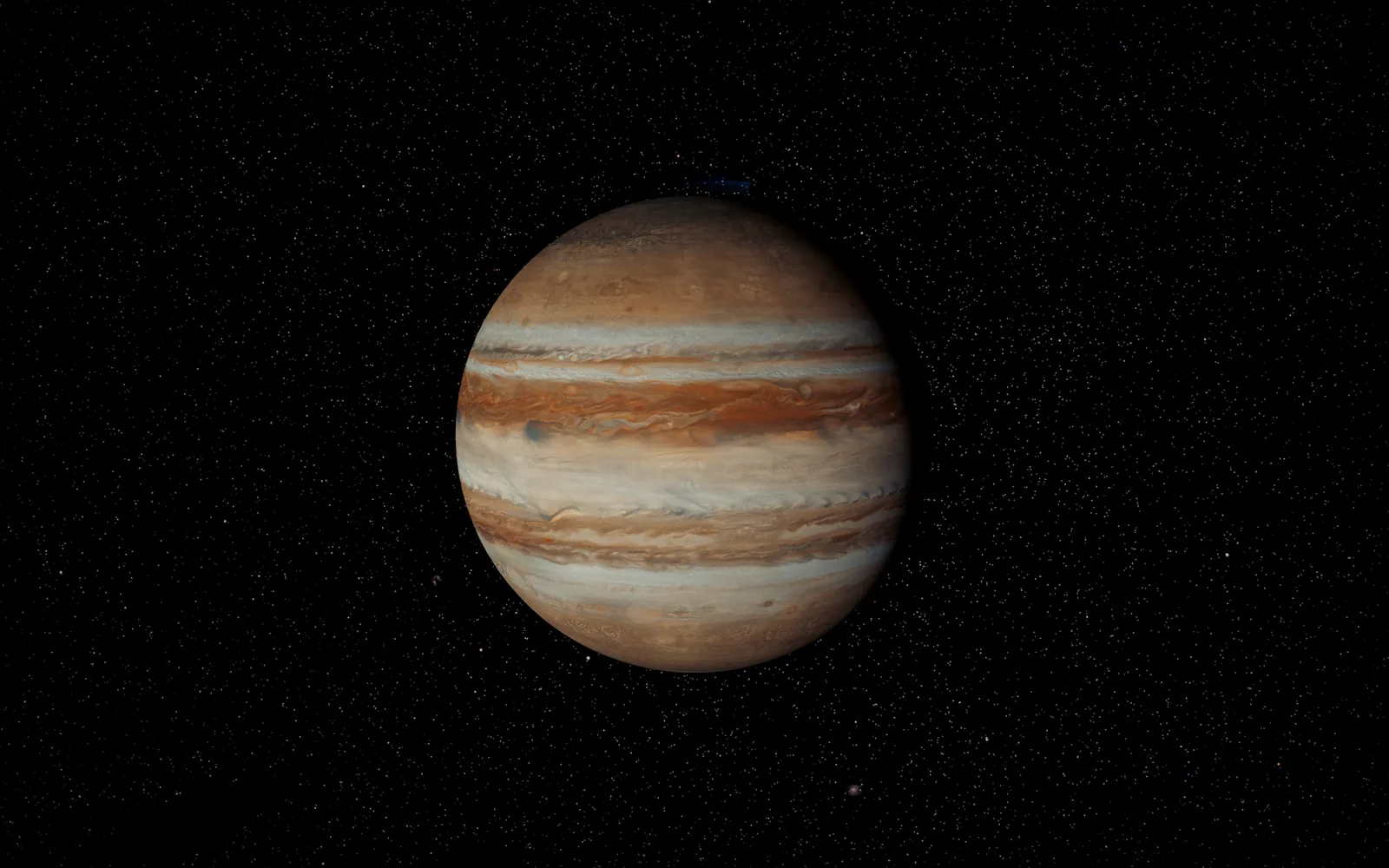
Jupiter has a diameter of 139,820 km — about 11 times the width of Earth, and roughly 2.5 times the mass of every other planet in the solar system combined. Earth would fit inside it about 1,321 times. It is the largest planet in our solar system, but only about 1/1000th the mass of the Sun.
Open the 3D viewer →More detail
- Jupiter's mean radius is 69,911 km. Earth's mean radius is 6,371 km — about 11 times smaller.
- Jupiter's mass is 1.898 × 10²⁷ kg, or 318 Earth masses, which is more than twice the mass of all the other planets combined.
- The Great Red Spot — Jupiter's persistent storm — is itself wider than Earth, around 16,000 km across.
- Despite its size, Jupiter rotates faster than any other planet: one rotation every 9 hours and 56 minutes.
Bodies in this category
Explore further
This is part of Our Solar System — an interactive 3D solar system viewer with photoreal textures, real orbital motion, and a dedicated page for every planet, moon, and major body.