
Gas Giant
Jupiter.
The giant: more than twice the mass of every other planet combined, wrapped in storms older than telescopes.
Jupiter right now
- From Earth right now
- 874,894,932 km
- Its light reaches us after
- 48 min 38.3 s
- From the Sun
- 793,845,684 km
- Speed around the Sun
- 12.80 km/s
- Around its orbit
- 31% of the way from perihelion
Worked out in your browser from JPL's orbital elements, the same maths that moves the planets in the 3D viewer. How far Jupiter is from Earth right now, with miles, AU and the next close approach.
Overview
Jupiter at a glance
Jupiter is the largest planet in the solar system — a gas giant with more than twice the mass of all the other planets combined and a diameter of 139,820 km. Its banded cloud structure rotates faster than any other planet (one rotation every 9h 56m), driving the jet streams that produce the bands and the centuries-old storm called the Great Red Spot. Jupiter has 101 confirmed moons as of March 2026, including the four Galilean satellites visible in any small telescope.
- Diameter
- 139,820 km
- From the Sun
- 778.5M km
- Year
- 11.86 years
- Axial tilt
- 3.13°
- Moons
- 101
- Type
- Gas Giant
Size, to scale
Atmosphere
Clouds without end
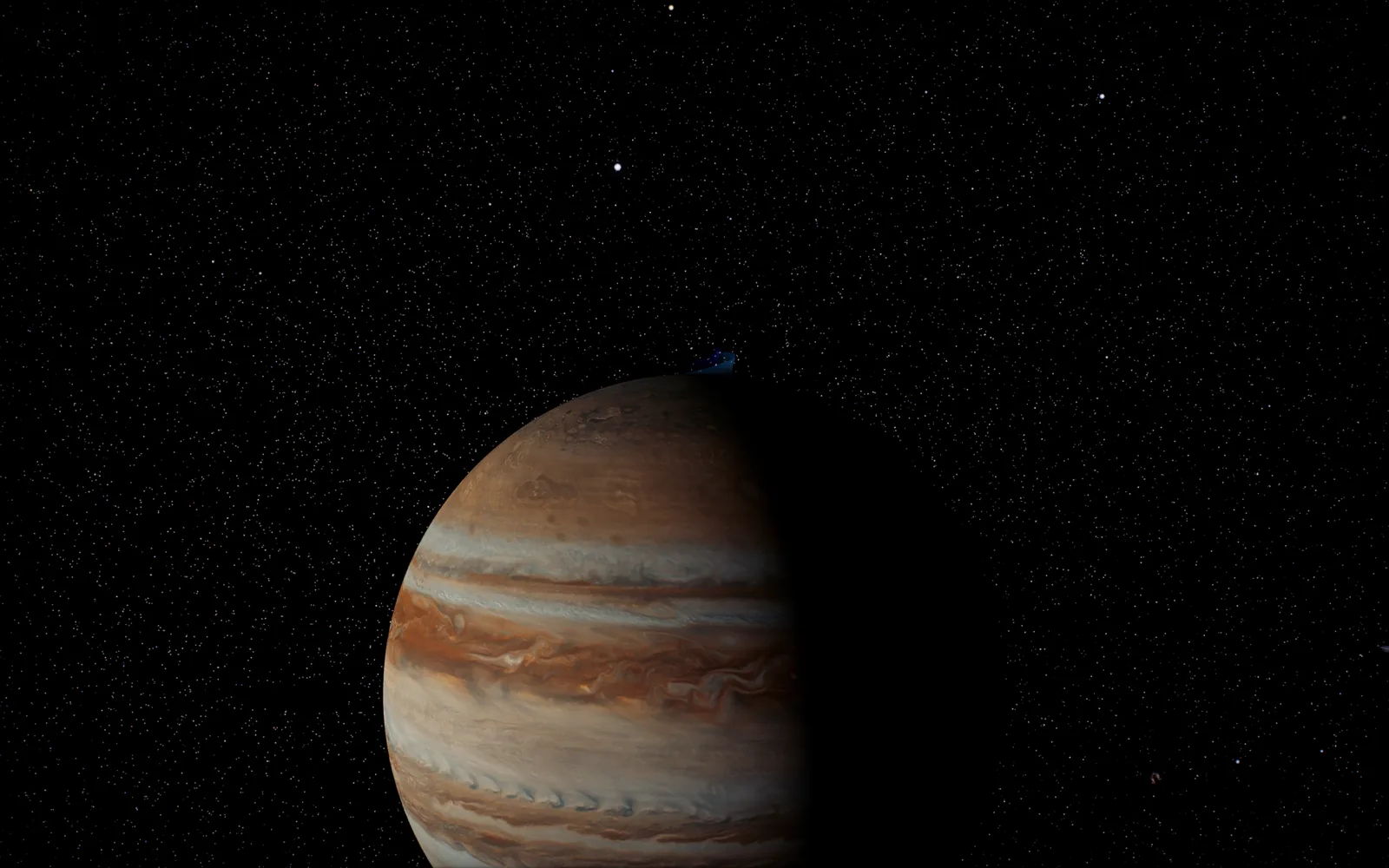
90% hydrogen, 10% helium, with traces of methane, ammonia, and water. The visible cloud bands sit in the upper troposphere — light "zones" of rising ammonia ice and dark "belts" of descending material. Wind speeds reach 400 km/h. Jupiter radiates 1.6× more energy than it receives from the Sun, leftover heat from its formation.
Surface
No surface to stand on
Jupiter has no surface in any meaningful sense. Falling inward, the gaseous atmosphere gradually compresses into a supercritical fluid, then into a layer of metallic hydrogen — hydrogen squeezed so hard that electrons free themselves and the substance conducts electricity like a metal.
Interior
Inside Jupiter
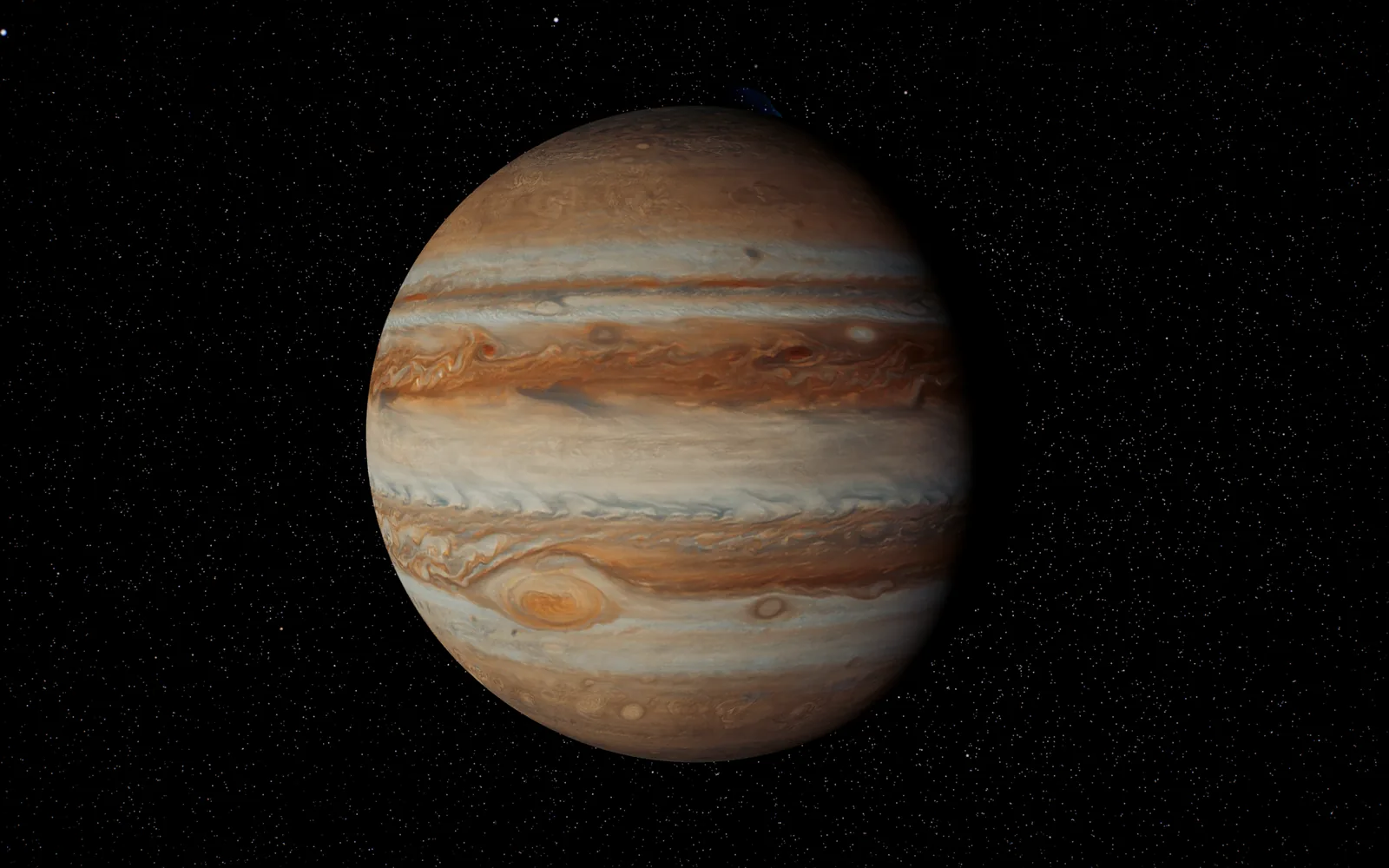
A small rocky / icy core (more dilute than once thought, per Juno data) surrounded by metallic hydrogen, then liquid hydrogen, then the gaseous envelope. The metallic hydrogen layer drives the most powerful planetary magnetic field in the solar system — 14× Earth's at the cloud tops.
Formation
How it formed
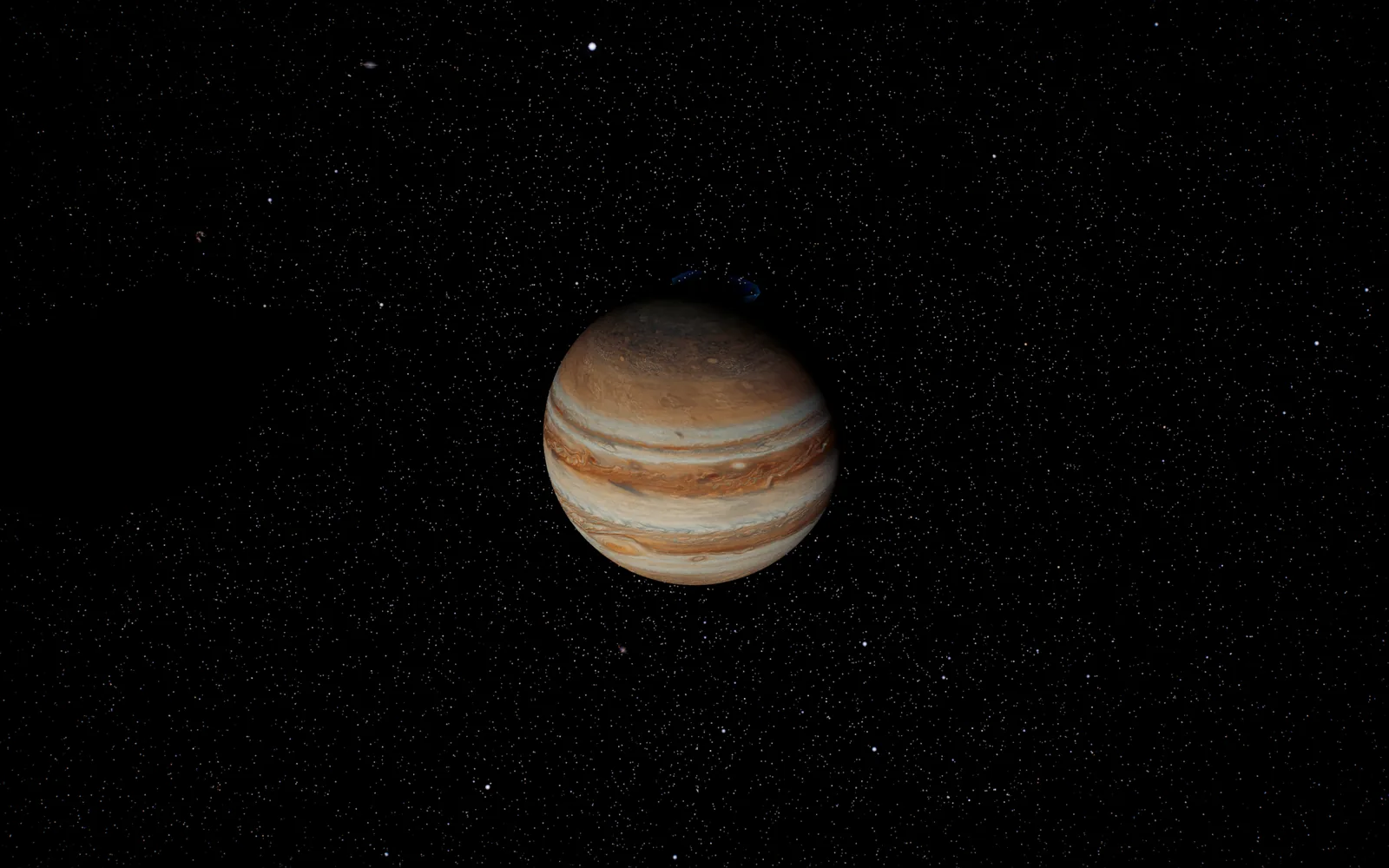
Likely formed by core accretion within the protoplanetary disc 4.5 billion years ago, growing massive enough to capture huge amounts of hydrogen and helium directly from the disc gas before that gas dispersed.
Orbit
Where Jupiter is today
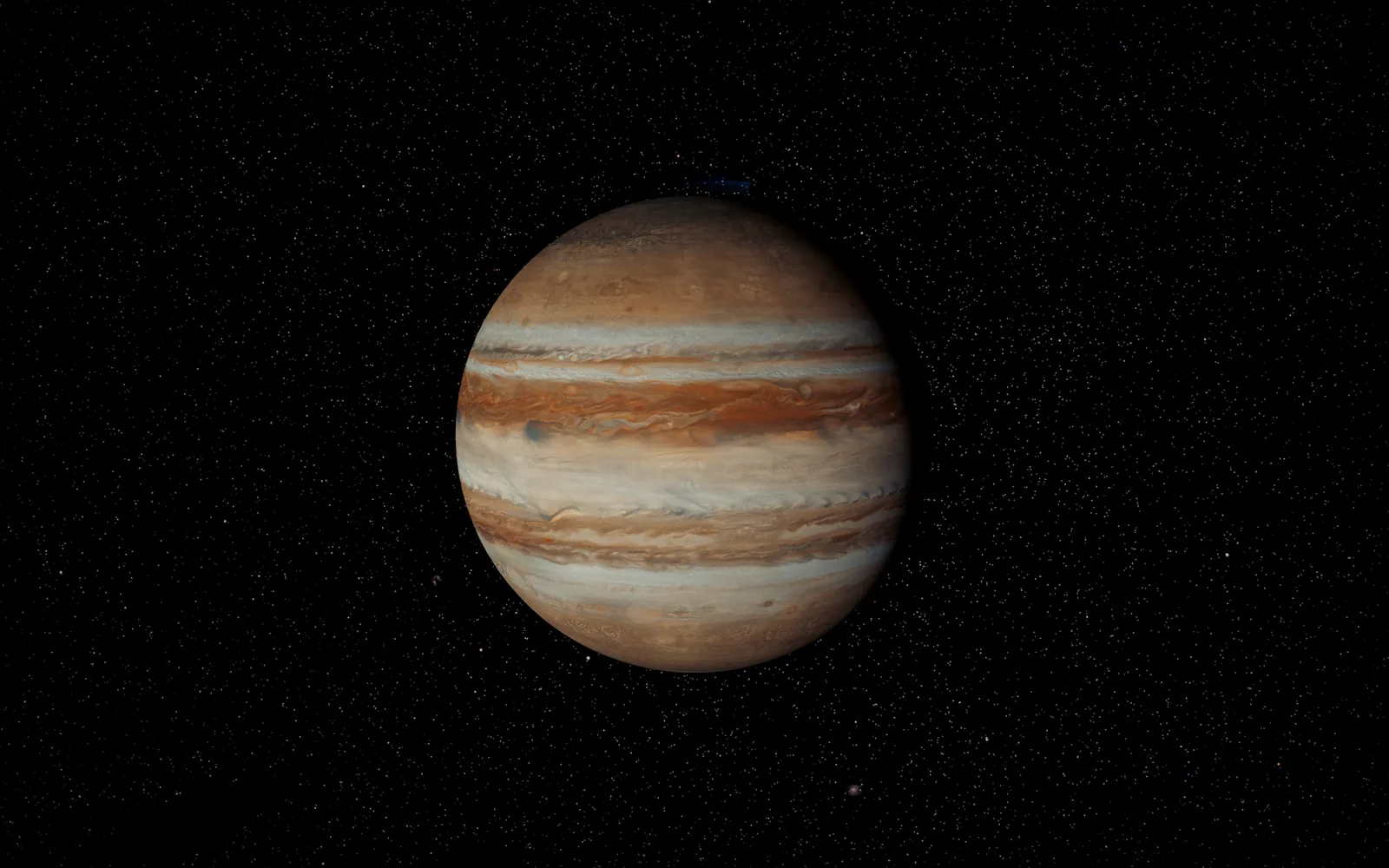
Average distance from the Sun: 778.5 million km (5.20 AU). Orbital period 11.86 years. Low orbital eccentricity (0.049) and a small 3.13° tilt.
Sunlight takes
44 min 8.0 s
to reach Jupiter, and its reflected light needs 48 min 38.3 s more to reach us.
Moons
Jupiter's major moons
- IoIo is the most volcanically active body in the Solar System. Its surface is covered with sulfur in various colorful forms.3,643 km · 421,700 km out
- EuropaEuropa has a smooth icy surface hiding a subsurface ocean. It is considered one of the most likely places to find extraterrestrial life.3,122 km · 671,034 km out
- GanymedeGanymede is the largest moon in the Solar System, even larger than Mercury. It has its own magnetic field.5,268 km · 1,070,400 km out
- CallistoCallisto is the most heavily cratered object in the Solar System. It may also harbor a subsurface ocean.4,821 km · 1,882,700 km out
Missions
Who has been to look
- 1979Voyager 1 & 2Past flyby
Discovered Jupiter's rings and the active volcanism on Io.
- 1995–2003GalileoPast
First Jupiter orbiter; deployed an atmospheric probe.
- 2016–JunoActive
Polar orbit gathering data on the deep interior, magnetic field, and auroras.
- 2023 / 2024JUICE / Europa ClipperEn route
ESA's JUICE and NASA's Europa Clipper are both en route to study the icy moons; Clipper arrives 2030.
Go further
See it for yourself
Fly to Jupiter in 3D
Earth would fit inside Jupiter roughly 1,321 times. The Great Red Spot alone — currently about 16,000 km across — is wider than Earth, and at one point in the 1800s it was three times that size. In the viewer the four Galilean moons orbit at real relative speeds: Io completes a full lap while Callisto barely moves.
Keep Jupiter on your screen
Set the screensaver to one world and it stays with Jupiter: the whole disc, a close pass, the day-night line, all where it really is right now.
Questions
Asked about Jupiter
Could Jupiter become a star?
No. It would need roughly 80× more mass to fuse hydrogen.
How many moons does Jupiter have?
101 confirmed as of March 2026, and counting. Most are small irregular bodies.
Does Jupiter have rings?
Yes, but they are faint and made of dust kicked up by micrometeoroid impacts on the inner moons.
Read more
Other bodies
- Sun Star
- Mercury Terrestrial Planet
- Venus Terrestrial Planet
- Earth Terrestrial Planet
- Mars Terrestrial Planet
- Saturn Gas Giant
- Uranus Ice Giant
- Neptune Ice Giant
- Pluto Dwarf Planet
Sources & methodology
Numbers cross-referenced with the sources below; surface and atmosphere descriptions reflect findings as of October 2026. Renderings in the 3D viewer use textures based on Solar System Scope and NASA imagery.