Quick answer · Updated November 2026
How hot is the Sun?
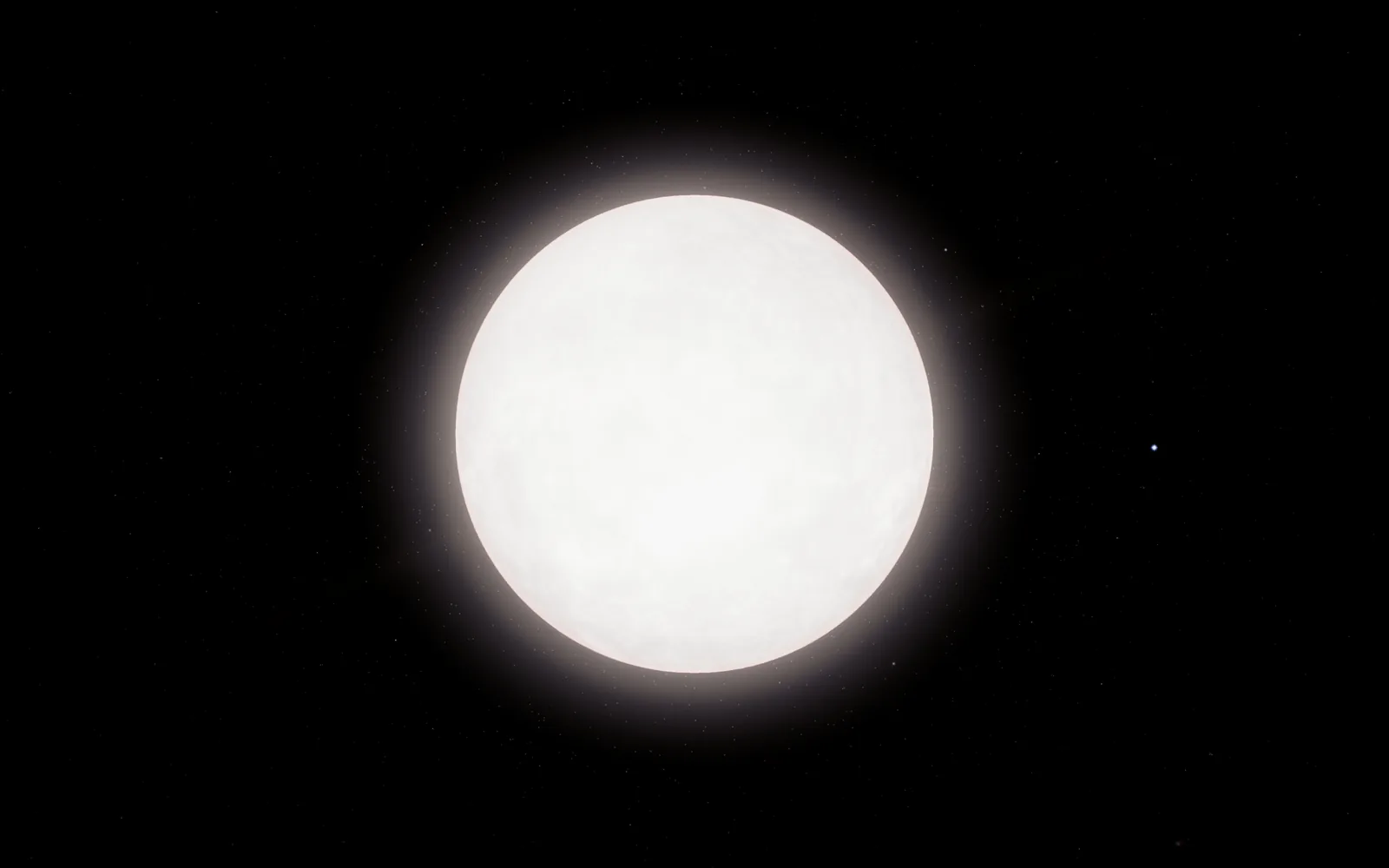
The Sun's visible surface, the photosphere, is about 5,500 °C (5,772 K, or about 9,930 °F). Its core is far hotter, about 15 million °C (27 million °F), and its outer atmosphere, the corona, reaches 1 to 2 million °C. How the corona gets so much hotter than the surface below it is still an open question.
Open the 3D viewer →The Sun's temperature, layer by layer
What we call the Sun's surface is the photosphere, the visible layer we see from Earth. Below it the temperature climbs all the way to the core. Above it the temperature falls a little through the photosphere, then rises again through the chromosphere and jumps in a thin transition region to the million-degree corona. Here is each layer in kelvin, Celsius and Fahrenheit.
| Layer | Kelvin | Celsius | Fahrenheit |
|---|---|---|---|
| Core (centre) | 15.7 million K | 15.7 million °C | 28.3 million °F |
| Radiative zone | 7 to 2 million K | 7 to 2 million °C | 12.6 to 3.6 million °F |
| Base of the convection zone | About 2 million K | About 2 million °C | About 3.6 million °F |
| Photosphere (the surface) | 5,772 K | About 5,500 °C | About 9,930 °F |
| Sunspot centres | About 3,700 K | About 3,430 °C | About 6,200 °F |
| Chromosphere | About 6,300 to 20,300 K | 6,000 to 20,000 °C | 10,800 to 36,000 °F |
| Transition region | 20,300 K to 1 million K | 20,000 °C to 1 million °C | 36,000 °F to 1.8 million °F |
| Corona | 1 to 2 million K | 1 to 2 million °C | 1.8 to 3.6 million °F |
A temperature in kelvin is the Celsius figure plus 273, so at millions of degrees the two are the same for any practical purpose. To turn Celsius into Fahrenheit, multiply by 1.8 and add 32.
The core: about 15 million °C
Nobody can measure the core directly. The figure comes from models of the Sun's interior: NASA's Sun fact sheet gives a central temperature of 15.7 million K and a density of about 162 g/cm³, around 160 times that of water. NASA rounds the core to about 15 million °C (27 million °F). There, nuclear reactions consume hydrogen to form helium, and that is what powers the Sun.
The energy leaves slowly. In the radiative zone, where the temperature falls from about 7 million °C to 2 million °C, light is absorbed and given off again so many times that a single photon takes about a million years to cross it. Through the convection zone, the outer 30% of the interior, the heat is carried up by boiling motions of the gas.
The surface: 5,772 K
The standard figure for the surface is the Sun's effective temperature, 5,772 K, fixed by the International Astronomical Union in 2015. It is worked out from the Sun's total power output and its radius: it is the temperature a perfect glowing body of the Sun's size would need to give off the same power. That is about 5,500 °C, or 9,930 °F (NASA rounds it to 10,000 °F).
The photosphere itself is about 500 km thick, with about 6,600 K at its base and 4,400 K at its top. Sunspots look dark because they are cooler than the gas around them: their dark centres are about 3,700 K, against about 5,700 K for the surrounding photosphere.
Why the corona is hotter than the surface
Above the photosphere the temperature climbs again. Through the chromosphere it rises from about 6,000 °C to 20,000 °C, hot enough for hydrogen to glow red. Then, across the thin transition region, it jumps from about 20,000 °C to around a million degrees. The corona is over 1 million °C and reaches about 2 million °C. It is the pearly white crown you can see round the Sun during a total eclipse.
A corona hundreds of times hotter than the surface below it is one of the big puzzles about the Sun. NASA's Parker Solar Probe flies through the corona to help scientists understand how it gets so hot. On 24 December 2024 it passed 6.1 million km (3.8 million miles) above the surface at about 692,000 km/h (430,000 mph), faster than any human-made object had ever moved, behind a heat shield built to reach 2,600 °F (about 1,430 °C).
Seeing the Sun for yourself
Never look at the Sun without special eye protection made for solar viewing, and never through binoculars, a camera or a telescope without a special-purpose solar filter. The only time it is safe to look with the naked eye is the brief total phase of a total solar eclipse, when the Moon completely covers the Sun's bright face and the corona comes into view.
You can see today's Sun in the 3D viewer, find out how far away it is right now, or read about the Sun as a whole.
Keep exploring
Frequently asked questions
What is the hottest part of the Sun?
The core, at about 15 million °C (27 million °F). Of the layers above the surface, the corona is the hottest, at 1 to 2 million °C.
How hot is the Sun in Fahrenheit?
The surface is about 9,930 °F (NASA rounds it to 10,000 °F), the core about 27 million °F and the corona up to about 3.6 million °F.
Why are sunspots dark?
They are cooler than the photosphere around them. Their dark centres are about 3,700 K, against about 5,700 K for the surrounding surface, so they look dark beside it.
How long will the Sun keep shining?
The Sun formed about 4.6 billion years ago. NASA puts it a little less than halfway through its life, with about another 5 billion years to go.
Sources
- NASA Science: Sun facts
- NASA NSSDC: Sun Fact Sheet, model values at the centre, effective temperature, photosphere and chromosphere
- NASA Marshall Solar Physics: The Solar Interior
- NASA Marshall Solar Physics: The Chromosphere
- NASA Marshall Solar Physics: The Transition Region
- NASA Marshall Solar Physics: The Corona
- NASA Marshall Solar Physics: Sunspots
- IAU 2015 Resolution B3 on recommended nominal conversion constants, the nominal effective temperature, 5,772 K
- NASA Science: NASA's Parker Solar Probe Makes History With Closest Pass to Sun
- NASA Science: Eclipse safety