
Star
Sun.
The star at the centre: 99.8% of the solar system's mass, and the light on every world.
Sun right now
- From Earth right now
- 149,550,932 km
- Its light reaches us after
- 8 min 18.8 s
Worked out in your browser from JPL's orbital elements, the same maths that moves the planets in the 3D viewer. How far the Sun is right now, with miles, AU and the next close approach.
Overview
Sun at a glance
The Sun is a G-type main-sequence star at the centre of the solar system, with a surface temperature of about 5,778 K and a diameter of 1,392,700 km — large enough to fit 1.3 million Earths inside it. It contains 99.86% of the system's mass, fuses about 600 million tonnes of hydrogen into helium every second, and drives every orbit you can see in this viewer.
- Diameter
- 1,392,700 km
- From Earth
- 149.6M km
- Age
- 4.6 billion years
- Spin at the equator
- about 25 days
- Axial tilt
- 7.25°
- Type
- Star
Size, to scale
Atmosphere
Above the surface
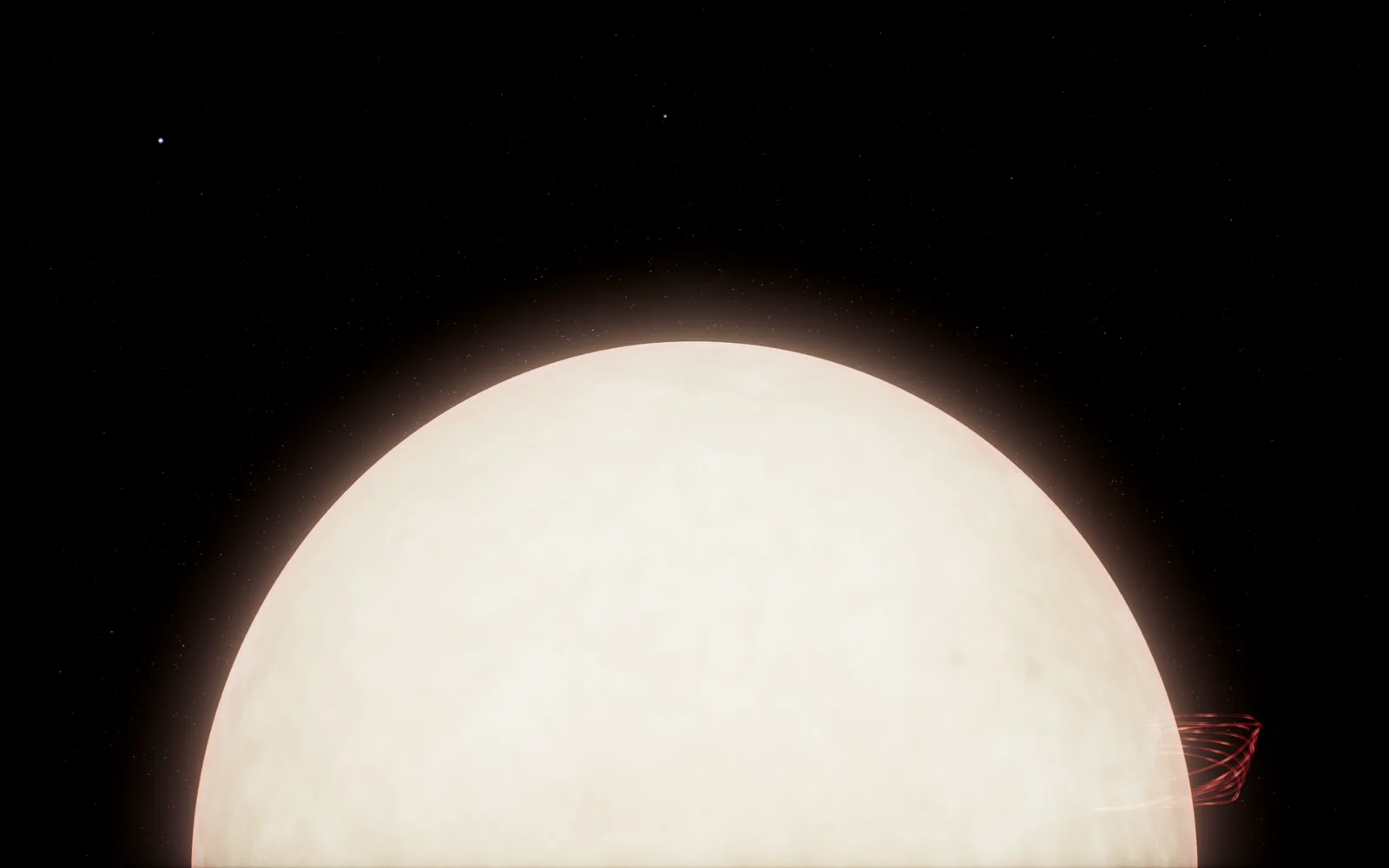
The Sun has no solid surface — what we call the photosphere is the layer where the plasma becomes opaque to visible light. Above it sits the chromosphere (a few thousand km of cooler hydrogen) and the corona, which paradoxically reaches over a million degrees and is only visible during total eclipses or with coronagraphs. The solar wind streams continuously from the corona out past Pluto, shaping the heliosphere itself.
Interior
Layers, drawn to scale
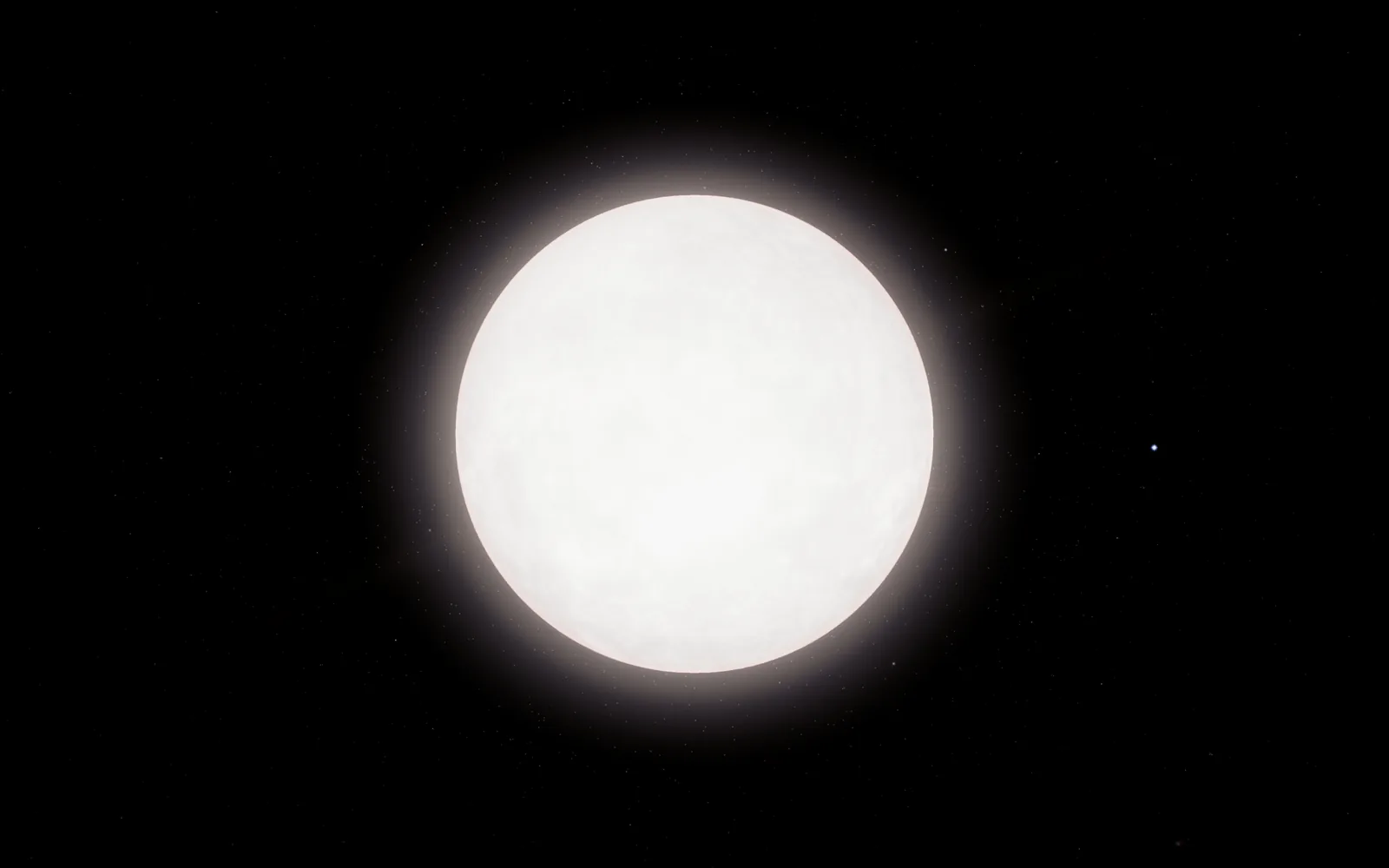
The core occupies the inner 25% of the radius and runs at roughly 15 million K under a pressure of 250 billion atmospheres. Energy from fusion takes 100,000+ years to random-walk out through the radiative zone, then convects rapidly through the outer third before escaping as the photons we see. The granulation visible in solar telescopes is the top of those convection cells.
Formation
How it formed
The Sun condensed from a giant molecular cloud roughly 4.6 billion years ago. As the protostar contracted, conservation of angular momentum spun up a flat disc — the same disc that became the planets. The Sun is currently middle-aged: it has another ~5 billion years of stable hydrogen burning before swelling into a red giant.
Orbit
Its own orbit
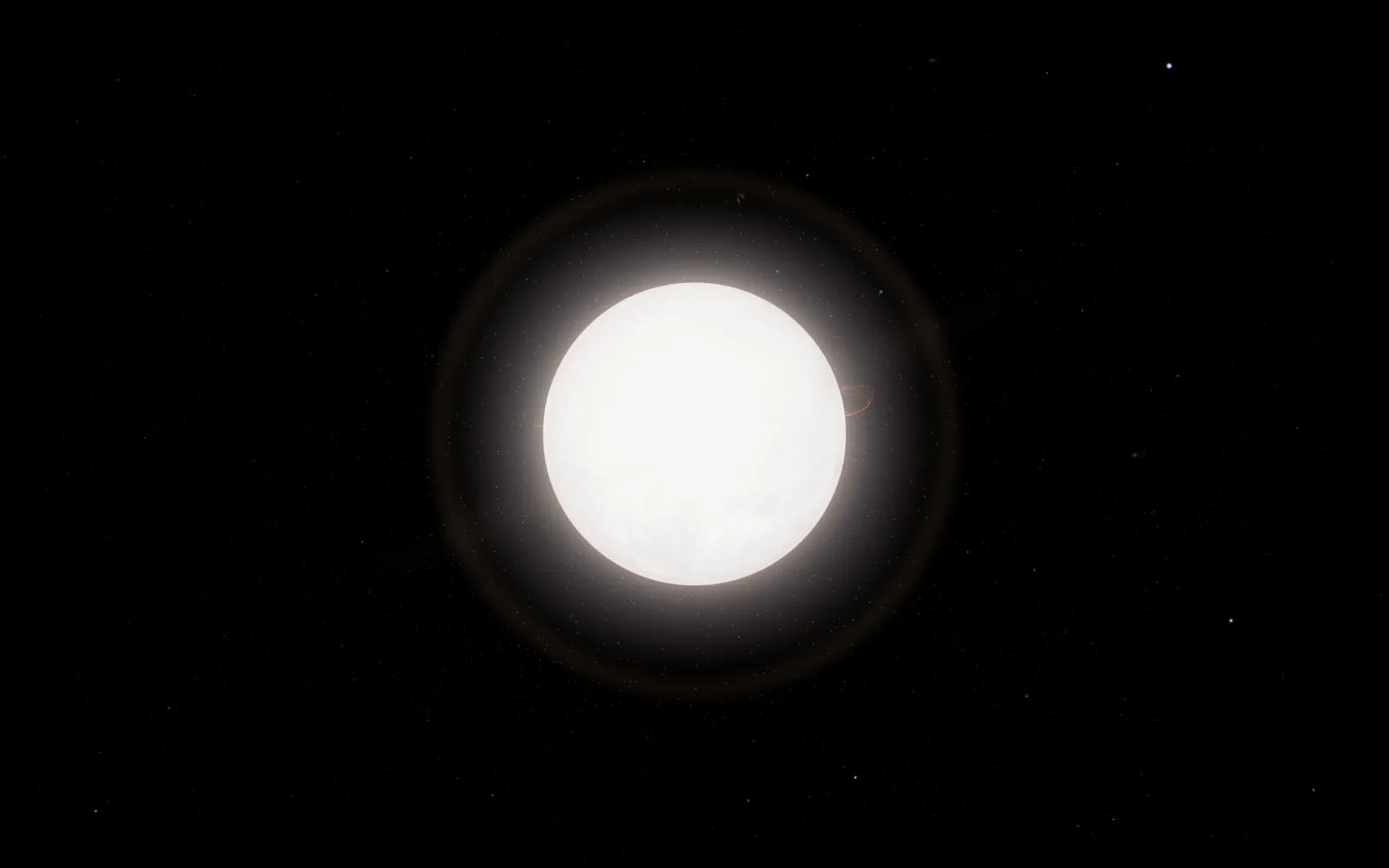
The Sun itself orbits the centre of the Milky Way at roughly 220 km/s, completing one galactic year about every 230 million Earth years.
The sunlight falling on Earth right now left the Sun
8 min 18.8 s ago
It crossed 149,550,932 km of empty space to get here.
Missions
Who has been to look
- 2018–Parker Solar ProbeActive
The first spacecraft to "touch" the Sun, repeatedly diving inside the corona at over 200 km/s.
- 2020–Solar OrbiterActive
ESA / NASA mission imaging the poles and inner heliosphere.
- 1995–SOHOActive
Decades of continuous solar observation from L1.
Go further
See it for yourself
Fly to Sun in 3D
In this viewer the Sun is rendered with a custom GLSL plasma shader: Fractal Brownian Motion noise drives the convection cells, limb darkening flattens the edges, and the colour ramp follows real black-body radiation from a 5,778 K surface to ~10,000 K spicule tips.
Keep Sun on your screen
Set the screensaver to one world and it stays with Sun: the whole disc, a close pass, the day-night line, all where it really is right now.
Questions
Asked about Sun
How big is the Sun compared to Earth?
The Sun is about 109 times Earth's diameter and 333,000 times its mass. About 1.3 million Earths would fit inside it.
How hot is the Sun?
The visible surface (photosphere) is around 5,778 K. The core reaches roughly 15 million K, and the corona — strangely — exceeds a million K.
How long until the Sun dies?
About 5 billion years before it swells into a red giant. Earth becomes uninhabitable long before that, around 1 billion years from now, as solar luminosity rises.
Other bodies
- Mercury Terrestrial Planet
- Venus Terrestrial Planet
- Earth Terrestrial Planet
- Mars Terrestrial Planet
- Jupiter Gas Giant
- Saturn Gas Giant
- Uranus Ice Giant
- Neptune Ice Giant
- Pluto Dwarf Planet
Sources & methodology
Numbers cross-referenced with the sources below; surface and atmosphere descriptions reflect findings as of October 2026. Renderings in the 3D viewer use textures based on Solar System Scope and NASA imagery.