Quick answer · Updated November 2026
How many moons does Saturn have?
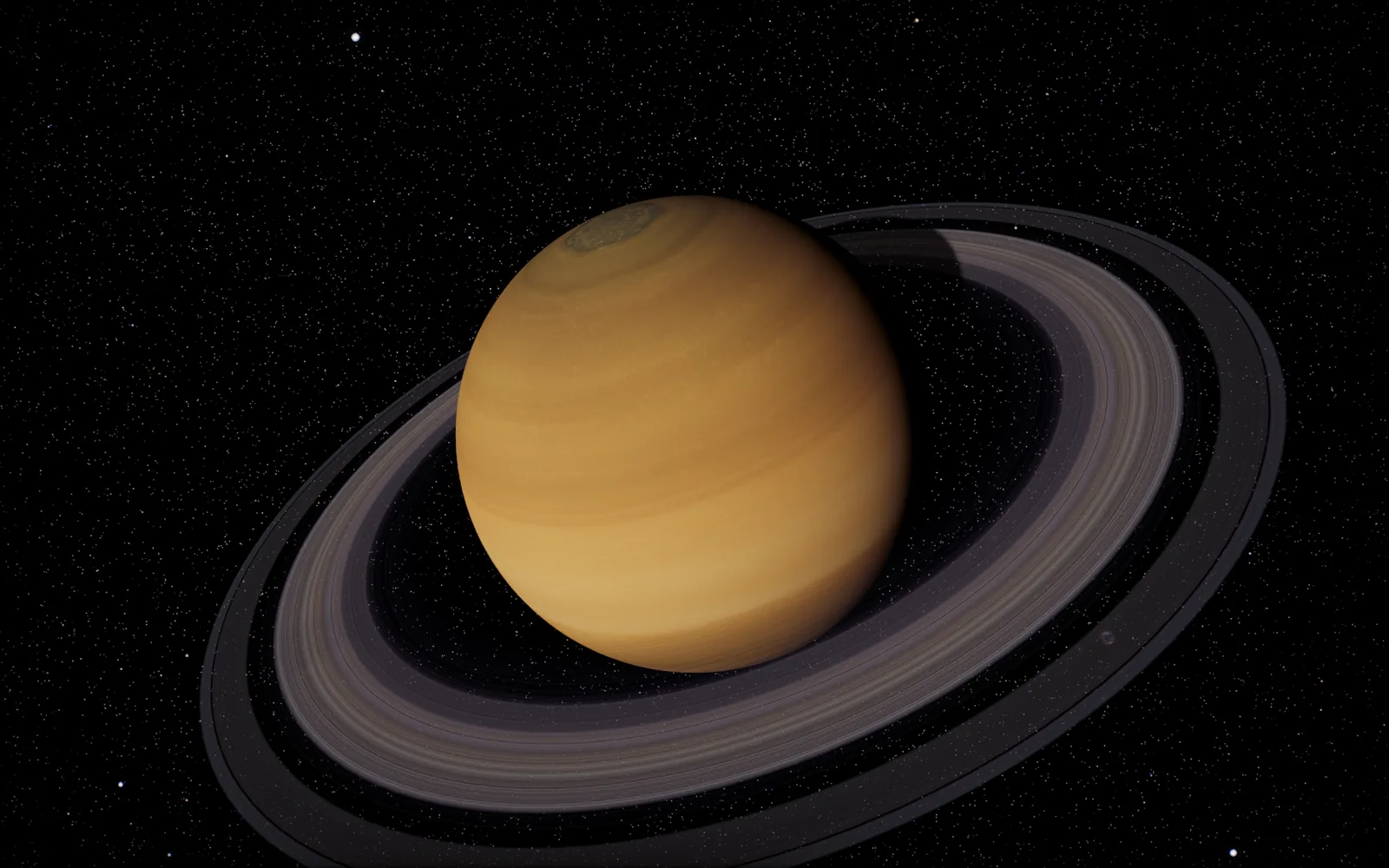
Saturn has 293 confirmed moons, the most of any planet in the solar system, on JPL's list as of October 2026. Only 63 of them have names. The other 230 still carry provisional labels such as S/2023 S 63, and most of them are small, distant moons a few kilometres across, announced since 2019.
Open the 3D viewer →How Saturn got to 293
Saturn's count has more than quadrupled since 2019. Most of the new moons come from a team led by Edward Ashton of Academia Sinica, working with Brett Gladman of the University of British Columbia and others. They watched the sky around Saturn with the Canada-France-Hawaii Telescope on Maunakea, combined many exposures to bring out moons too faint to see in any single image, and followed each one over months and years to pin down its orbit.
Some of these moons had first been caught in images taken from 2004 to 2007, and JPL credits those jointly to Scott Sheppard's team and Ashton's. Since 2019 each new moon has been announced by the IAU's Minor Planet Center in a Minor Planet Electronic Circular (earlier moons went out in IAU Circulars), and the running total below follows those circulars.
| Announced | New moons | Total | Found in |
|---|---|---|---|
| Before 2019 | 62 | 62 | Telescope searches from 1655 on, and spacecraft images |
| 7 October 2019 | 20 | 82 | Images from 2004 (Sheppard, Jewitt and Kleyna) |
| 16 November 2021 | 1 | 83 | Canada-France-Hawaii Telescope images from 2019 |
| 3 to 16 May 2023 | 62 | 145 | Images from 2004 to 2020 |
| 23 May 2023 | 1 | 146 | Images from 2006 |
| 11 March 2025 | 128 | 274 | Images from 2004 to 2023 |
| 16 March 2026 | 11 | 285 | Images from 2020 and 2023 |
| 9 April 2026 | 7 | 292 | Images from 2020 and 2023 |
| 17 June 2026 | 1 | 293 | Cassini images from 2009 |
The 11 March 2025 announcement alone added 128 moons, in three circulars of 61, 34 and 33, and took Saturn from 146 to 274. The team found them by returning to the same patches of sky for three months in a row in 2023.
The latest addition is a different kind of moon. S/2009 S 2, announced on 17 June 2026, is a regular moon orbiting inside Saturn's B ring, about 117,000 km from the planet. J. Spitale reported it from four Cassini images taken in 2009, and JPL credits the Cassini Imaging Science Team.
Named moons and provisional moons
A new moon gets a provisional designation first. In S/2023 S 63, the S/ marks a satellite, 2023 is the year of the images it was found in, the second S stands for Saturn and 63 is its number in that year's list. Of Saturn's 293 moons, 63 have names and 230 are still known only by labels like this.
Names follow rules set by the IAU. The big inner moons are named for Titans and giants of Greek and Roman myth, such as Rhea, Tethys and Iapetus. The irregular moons are named by their orbits: prograde moons tilted about 36 degrees take the names of Gallic giants, prograde moons tilted about 48 degrees take Inuit giants and spirits, and retrograde moons, which orbit backwards, are named for Norse giants. Albiorix, Kiviuq and Ymir are one of each.
The biggest moons of Saturn
| Moon | Diameter | Discovered | By |
|---|---|---|---|
| Titan | 5,150 km | 1655 | Christiaan Huygens |
| Rhea | 1,527 km | 1672 | G.D. Cassini |
| Iapetus | 1,469 km | 1671 | G.D. Cassini |
| Dione | 1,123 km | 1684 | G.D. Cassini |
| Tethys | 1,062 km | 1684 | G.D. Cassini |
| Enceladus | 504 km | 1789 | William Herschel |
| Mimas | 396 km | 1789 | William Herschel |
| Hyperion | 270 km | 1848 | W.C. Bond, G.P. Bond and W. Lassell |
| Phoebe | 213 km | 1898 | W.H. Pickering |
Titan is the giant among them. At 5,150 km across it is wider than the planet Mercury (4,879 km) and second only to Jupiter's Ganymede among all moons. Its air is about 95% nitrogen, the pressure at the surface is about 60% higher than on Earth, and rivers, lakes and seas of liquid methane and ethane lie on its surface. NASA's Dragonfly rotorcraft is due to launch no earlier than July 2028 and reach Titan in late 2034.
Enceladus is only about 500 km across, yet it is the most reflective body in the solar system. Jets of water vapour and ice escape from warm fractures in its crust, fed by a global ocean under the ice, and that material makes up Saturn's E ring. Tethys has an average density of 0.98 g/cm³, a little below that of water.
Regular and irregular moons
The big moons from Mimas out to Iapetus orbit within 3.6 million km of Saturn, on nearly circular paths and in the direction Saturn spins. The irregular moons live much farther out. Ymir, for example, orbits about 23 million km away on a stretched path tilted 172 degrees, so it goes round backwards.
Most of Saturn's small moons are retrograde like Ymir. Gladman thinks the new moons are fragments of a smaller number of captured moons broken apart by violent collisions, and Ashton's team links one cluster of tiny retrograde moons, the Mundilfari subgroup, to a collision less than 100 million years ago.
Will Saturn get more moons?
Almost certainly. The 2019 to 2021 search also turned up many objects that could not yet be designated, and every deeper search so far has added more. For now Saturn has more moons than all the other planets put together: Jupiter has 115, Uranus 29, Neptune 16, Mars 2 and Earth 1, which adds up to 163.
You can fly to Saturn and its moons in 3D, or read more on the Saturn page and in our guide to the largest moons in the solar system.
Keep exploring
Frequently asked questions
Which planet has the most moons?
Saturn, with 293 confirmed moons as of October 2026. Jupiter is second with 115, then Uranus with 29, Neptune with 16, Mars with 2 and Earth with 1.
What is Saturn's biggest moon?
Titan, at 5,150 km across. It is the second-largest moon in the solar system after Jupiter's Ganymede, and it is wider than the planet Mercury.
How many of Saturn's moons have names?
63. The other 230 have provisional designations, such as S/2023 S 63, until the IAU names them.
When were Saturn's newest moons announced?
Eighteen were announced in March and April 2026, from Canada-France-Hawaii Telescope images. The latest, S/2009 S 2, was announced on 17 June 2026: a moon inside the B ring, seen in Cassini images from 2009.
Sources
- NASA JPL Solar System Dynamics: Planetary Satellite Discovery Circumstances, moon counts, names, discovery years and the circular announcing each moon (read 15 October 2026)
- NASA JPL: Planetary Satellite Physical Parameters, diameters and densities
- NASA JPL: Planetary Satellite Mean Elements, orbits
- NASA Science: Saturn Moons, 293 confirmed moons as of August 2026
- IAU Minor Planet Center: MPEC 2025-E153, with MPECs 2025-E154 and 2025-E155, 11 March 2025
- IAU Minor Planet Center: MPEC 2023-K118, S/2006 S 20, 23 May 2023, the last moon of the 2023 batch
- IAU Minor Planet Center: MPEC 2026-F14, Eleven new Saturnian satellites, 16 March 2026
- IAU Minor Planet Center: MPEC 2026-M19, S/2009 S 2, 17 June 2026
- UBC Physics and Astronomy: 2025 discovery of more Saturnian moons
- Ashton et al. (2025): Retrograde predominance of small saturnian moons reiterates a recent retrograde collisional disruption
- IAU Working Group for Planetary System Nomenclature: Planet and Satellite Names and Discoverers
- NASA Science: Titan facts
- NASA Science: Enceladus
- NASA Science: Dragonfly
- NASA NSSDC: Planetary Fact Sheet, Mercury's diameter