
Gas Giant
Saturn.
Rings 280,000 km across and a world light enough to float, if there were an ocean big enough.
Saturn right now
- From Earth right now
- 1,261,876,837 km
- Its light reaches us after
- 1 h 10 min
- From the Sun
- 1,411,159,927 km
- Speed around the Sun
- 9.75 km/s
- Around its orbit
- 79% of the way from perihelion
Worked out in your browser from JPL's orbital elements, the same maths that moves the planets in the 3D viewer. How far Saturn is from Earth right now, with miles, AU and the next close approach.
Overview
Saturn at a glance
Saturn is the sixth planet from the Sun and the second-largest in the solar system, a gas giant best known for its bright ring system. Its 116,460 km diameter is nine times Earth's, but its average density is so low (0.69 g/cm³) that it would float in water. Saturn has 285 confirmed moons as of March 2026, the most of any planet, including Titan, the only moon with a substantial atmosphere, and Enceladus, which sprays water from a global subsurface ocean.
- Diameter
- 116,460 km
- From the Sun
- 1.43B km
- Year
- 29.46 years
- Axial tilt
- 26.73°
- Moons
- 285
- Type
- Gas Giant
Size, to scale
Atmosphere
Banded and calm
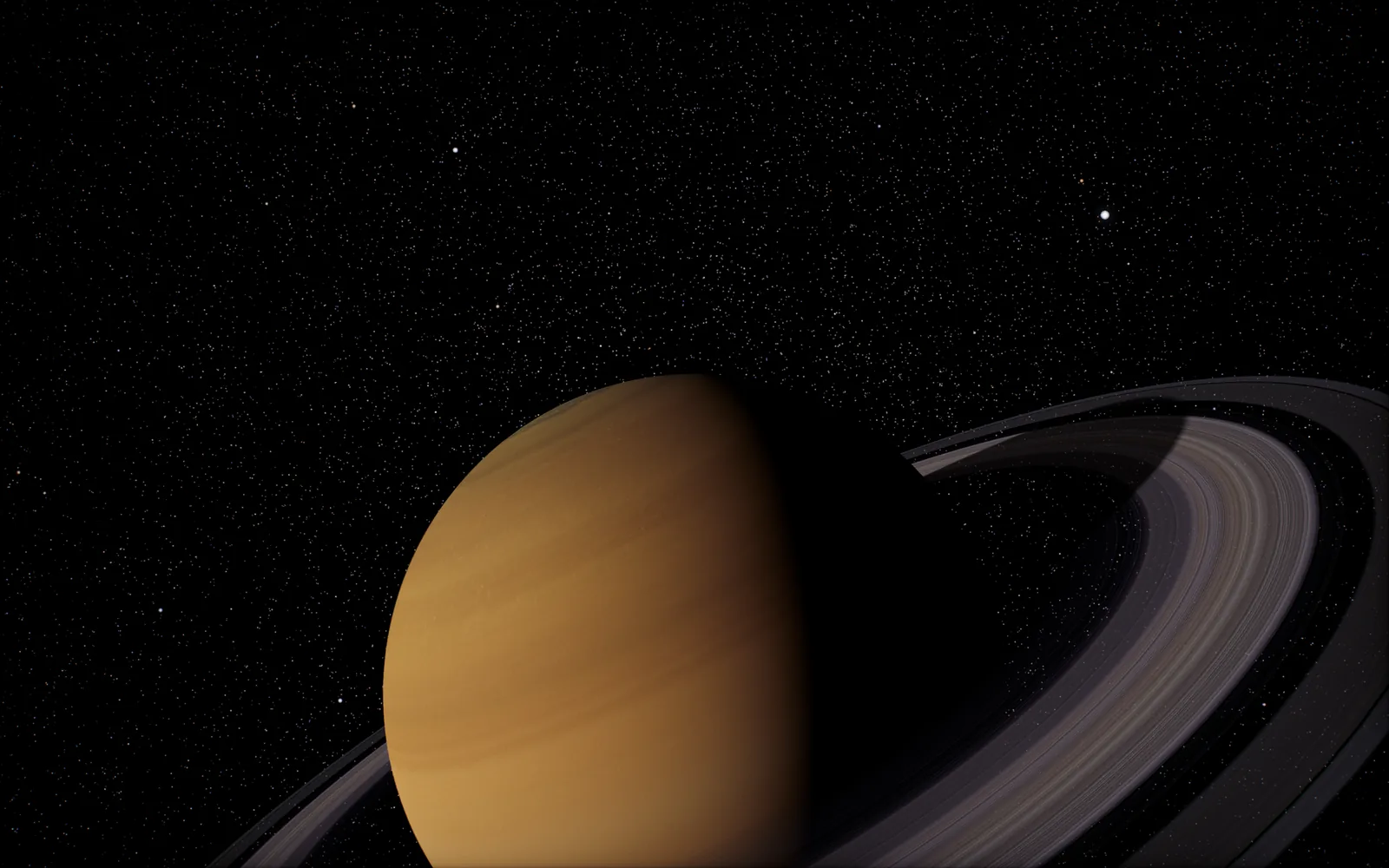
96% hydrogen, 3% helium, with traces of methane and ammonia. Wind speeds reach 1,800 km/h near the equator — five times the strongest hurricanes on Earth. The hexagonal jet stream around Saturn's north pole, first seen by Voyager and confirmed by Cassini, has held its six-sided shape for decades.
Surface
No surface to stand on
No surface; like Jupiter, the gaseous envelope compresses into liquid metallic hydrogen further down.
Interior
Inside Saturn
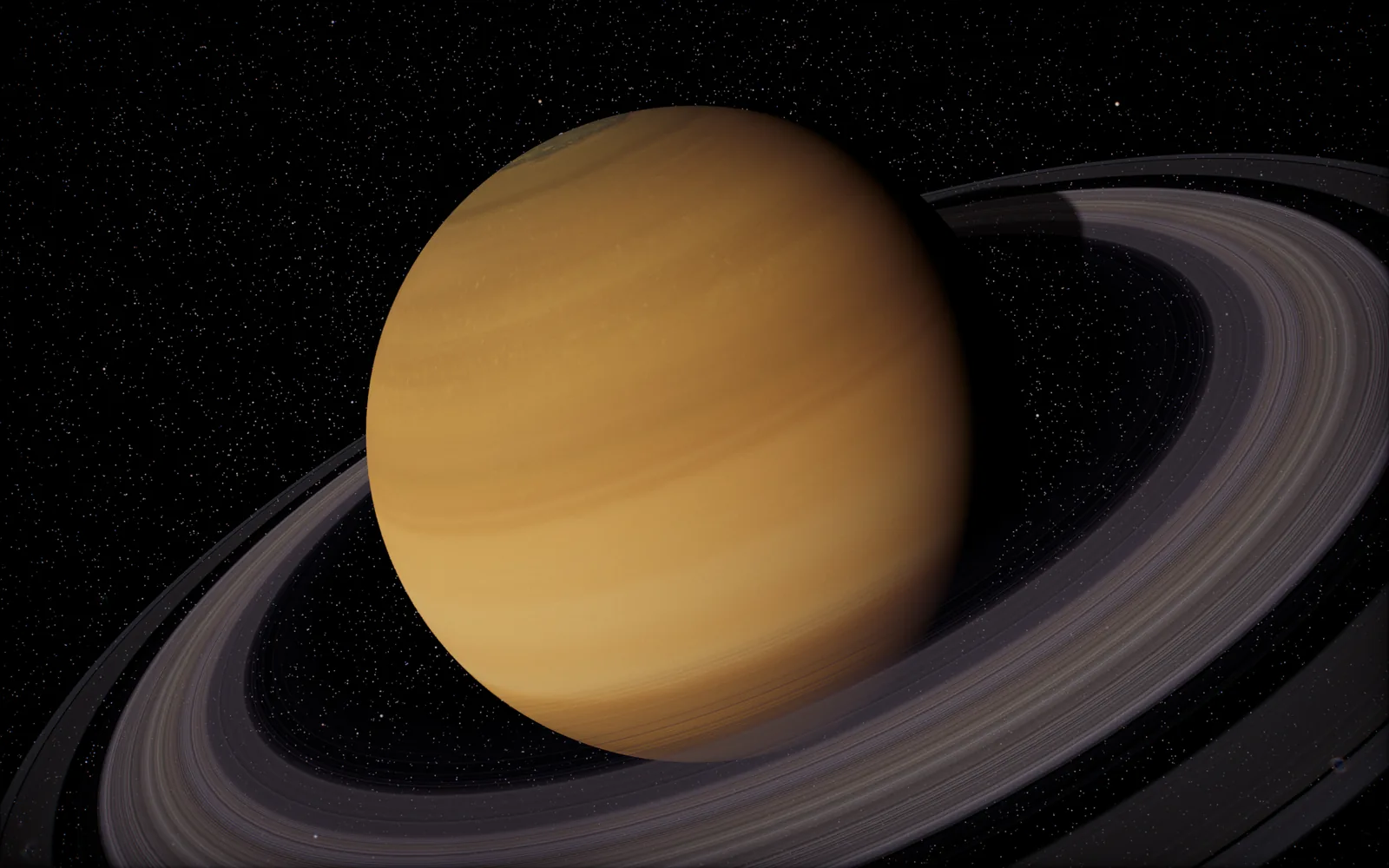
Rocky core, metallic hydrogen layer, liquid hydrogen, gaseous envelope. The internal heat output is 2.3× the energy received from the Sun — partly leftover formation heat, partly helium rain releasing gravitational energy as helium droplets sink through the lighter hydrogen.
Formation
How it formed
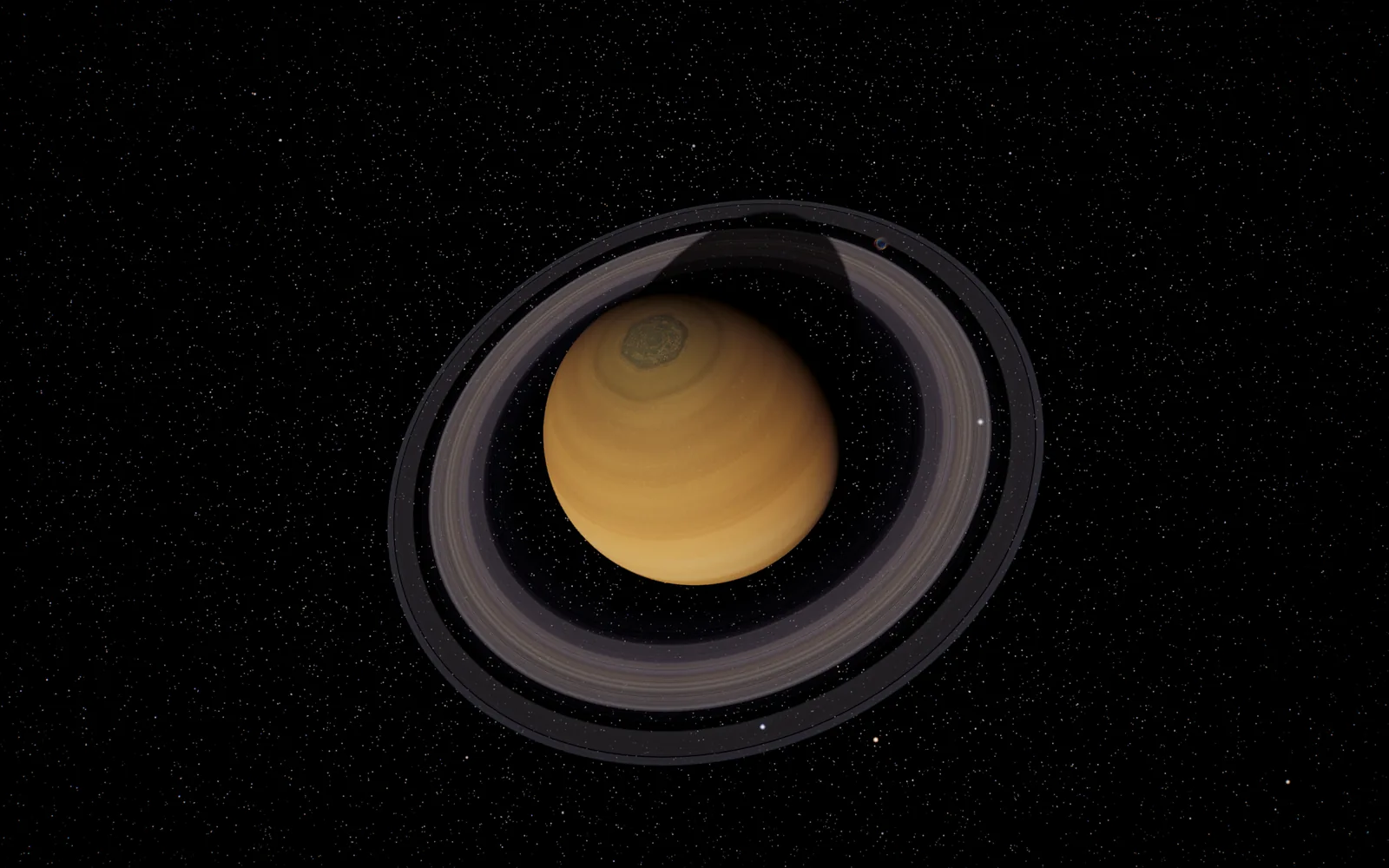
Formed beyond the snow line in the protoplanetary disc, where ice grains stuck together fast enough to build a massive core that pulled in hydrogen and helium gas. Models suggest Jupiter and Saturn migrated significantly during their first hundred million years (the "Grand Tack" hypothesis).
Orbit
Where Saturn is today
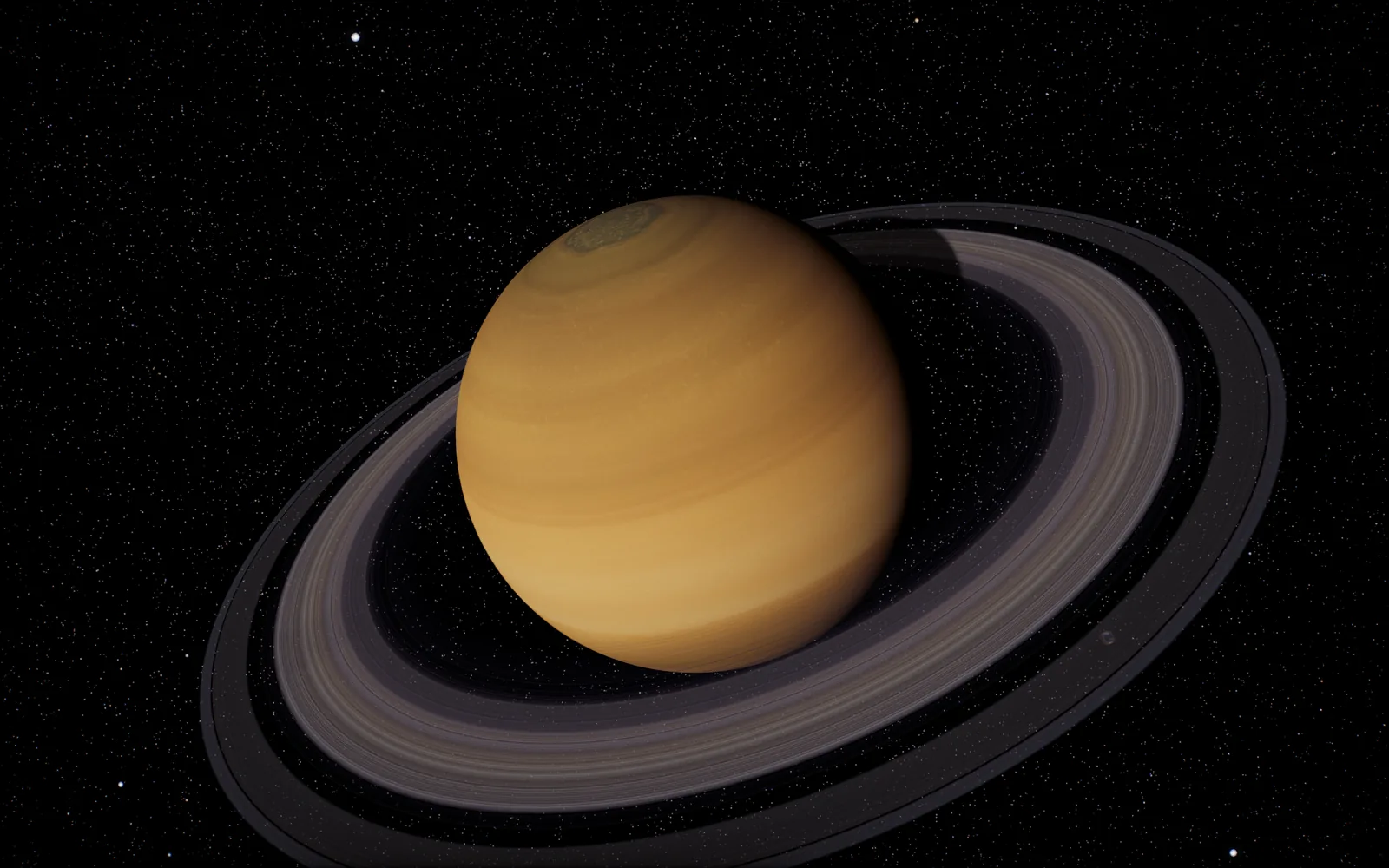
Average distance from the Sun: 1.43 billion km (9.54 AU). Orbital period 29.46 Earth years. Axial tilt 26.73° — close to Earth's — which is why we see the rings open and edge-on across a Saturnian year.
Sunlight takes
1 h 18 min
to reach Saturn, and its reflected light needs 1 h 10 min more to reach us.
Moons
Saturn's major moons
- TitanTitan is the only moon with a dense atmosphere and the only place besides Earth with stable surface liquid (methane lakes).5,150 km · 1,221,870 km out
- EnceladusEnceladus has geysers that spray water ice into space. It has a subsurface ocean and is a prime target for finding life.504 km · 238,020 km out
- RheaRhea is Saturn's second-largest moon, an icy body with a heavily cratered surface.1,527 km · 527,040 km out
- DioneDione has bright ice cliffs and is thought to have a subsurface ocean.1,123 km · 377,400 km out
Missions
Who has been to look
- 1979Pioneer 11Past flyby
First spacecraft to fly past Saturn.
- 1980, 1981Voyager 1 & 2Past flyby
Detailed close-ups of the rings and major moons.
- 2004–17Cassini–HuygensPast
NASA / ESA / ASI orbiter; Huygens probe landed on Titan in 2005, the most distant landing ever.
- Launch 2028DragonflyIn development
NASA rotorcraft to fly through Titan's thick atmosphere.
Go further
See it for yourself
Fly to Saturn in 3D
Saturn's rings span 282,000 km from the planet but are typically only 10–100 metres thick — about a million times thinner than they are wide. At the viewer's default scale that's a sub-pixel sliver; the visible ring band is the projection of 95% empty space sparsely populated with chunks of water ice from snowflake to house-sized.
Keep Saturn on your screen
Set the screensaver to one world and it stays with Saturn: the whole disc, a close pass, the day-night line, all where it really is right now.
Questions
Asked about Saturn
How old are Saturn's rings?
Cassini gravity data suggests they may be only 100–400 million years old — much younger than Saturn itself, possibly leftovers of a destroyed moon.
How many moons does Saturn have?
285 confirmed as of March 2026, more than any other planet.
Could you walk on Saturn?
No. Saturn has no solid surface to stand on.
Read more
Other bodies
- Sun Star
- Mercury Terrestrial Planet
- Venus Terrestrial Planet
- Earth Terrestrial Planet
- Mars Terrestrial Planet
- Jupiter Gas Giant
- Uranus Ice Giant
- Neptune Ice Giant
- Pluto Dwarf Planet
Sources & methodology
Numbers cross-referenced with the sources below; surface and atmosphere descriptions reflect findings as of October 2026. Renderings in the 3D viewer use textures based on Solar System Scope and NASA imagery.