Moon of Earth · Updated October 2026
Moon.
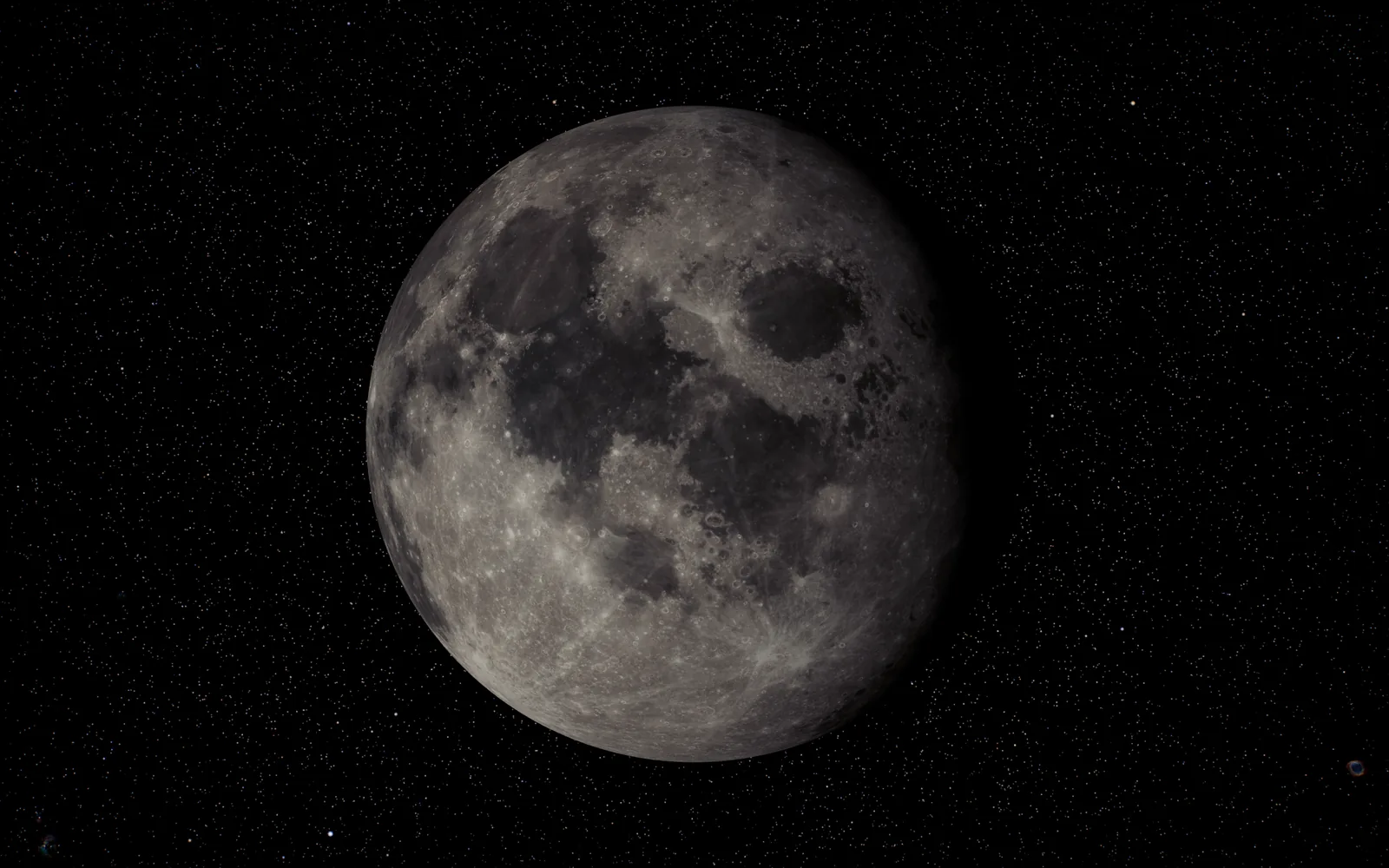
The Moon is Earth's only natural satellite — the fifth-largest moon in the solar system and the largest relative to its parent planet. Its 3,474 km diameter is roughly a quarter of Earth's, its mass 1/81. It orbits Earth every 27.3 days at an average distance of 384,400 km, but is tidally locked: the same face always points toward Earth.
View Earth system in 3D →Key facts
The Moon's distance changes by about 50,000 km over each orbit. See how far the Moon is from Earth right now, updated live, with the date of the next perigee.
The Moon is moving away from Earth at about 3.8 cm per year, measured by laser ranging from retroreflectors left by the Apollo missions. In the viewer's real-time mode you can see the Moon's phase change as the geometry between Sun, Earth, and Moon evolves.
About Moon
Formed around 4.5 billion years ago, most likely from the debris of a giant impact between proto-Earth and a Mars-sized body called Theia. The lunar surface is divided into bright cratered highlands and darker basaltic maria — the "seas" — which are old lava flows. Apollo brought back 382 kg of lunar samples between 1969 and 1972; their composition still drives lunar science. Renewed activity (Artemis programme, Chang'e, Chandrayaan-3, lunar landers from CLPS providers) is mapping water ice in permanently shadowed polar craters.
How to view Moon in 3D
Moon orbits Earth in real time inside the interactive viewer. Open the parent body to see the orbital geometry, or use the object browser to fly directly to the moon and observe its rotation, surface, and orbit.
Open the Earth system →Sources & methodology
Numbers cross-referenced with the sources below; updated October 2026.