
Terrestrial Planet
Earth.
The third planet from the Sun, and the only world known to hold life.
Earth right now
- Distance from the Sun
- 149,512,421 km
- Speed around the Sun
- 29.80 km/s
- Sunlight arriving now left the Sun
- 8 min 18.7 s ago
- Season
- Autumn in the north, spring in the south
- Next
- December solstice in 76 days
Worked out in your browser from JPL's orbital elements, the same maths that moves the planets in the 3D viewer. How far the Sun is right now, with miles, AU and the next close approach.
Overview
Earth at a glance
Earth is the third planet from the Sun, the only known world with life, and the densest planet in the solar system. Its 12,742 km diameter is the largest among the rocky inner planets. Roughly 71% of the surface is liquid water — a state stable only because Earth sits inside the Sun's habitable zone, has a thick enough atmosphere to maintain pressure, and a magnetic field strong enough to deflect the solar wind.
- Diameter
- 12,742 km
- From the Sun
- 149.6M km
- Year
- 365.25 days
- Axial tilt
- 23.44°
- Moons
- 1
- Type
- Terrestrial Planet
Size, to scale
Right now
Where it is day, and where it is night
Atmosphere
A thin blue line
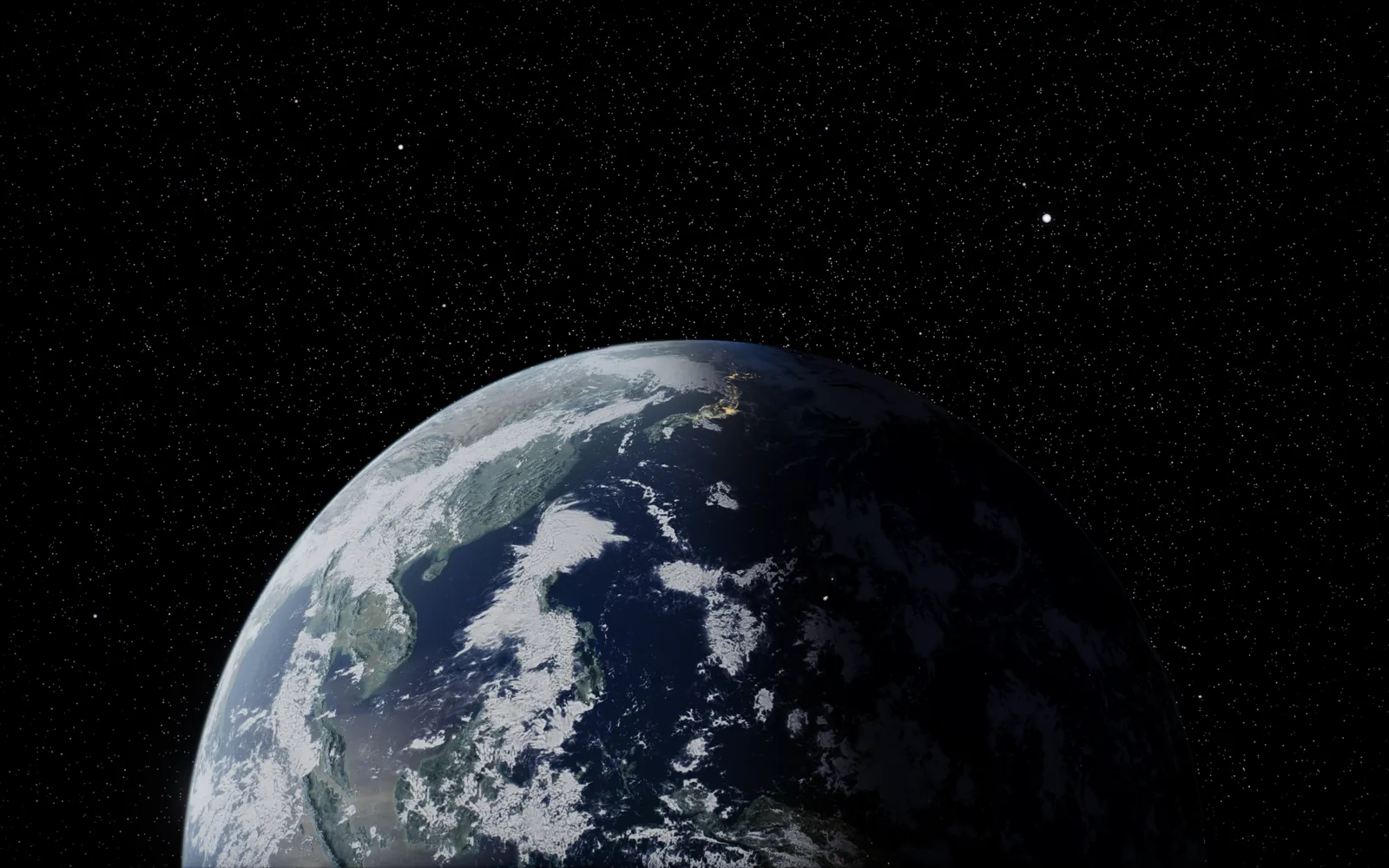
78% nitrogen, 21% oxygen, 1% argon, with trace CO₂, water vapour, and other gases. The troposphere (0–12 km) holds 99% of the water vapour and is where weather happens. Above sit the stratosphere (with the protective ozone layer), mesosphere, thermosphere, and the wispy exosphere that fades into space at 10,000 km up.
Surface
A surface that keeps moving
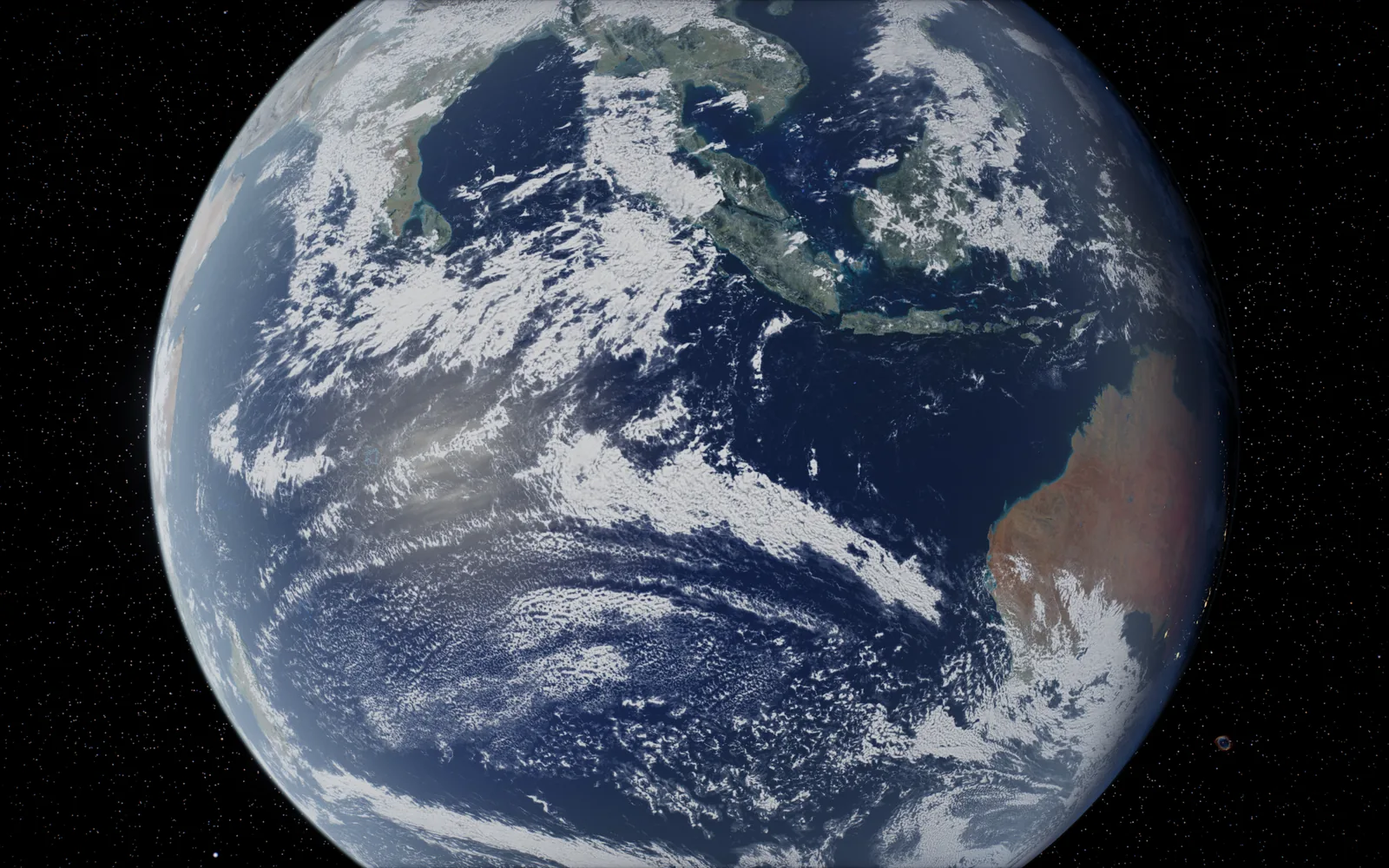
Continental crust averages 35 km thick; oceanic crust about 7 km. Plate tectonics constantly recycles surface material — the oldest oceanic crust is only ~200 million years old, while the oldest continental rocks reach 4 billion. Mount Everest rises 8.85 km; the Mariana Trench drops 11.0 km.
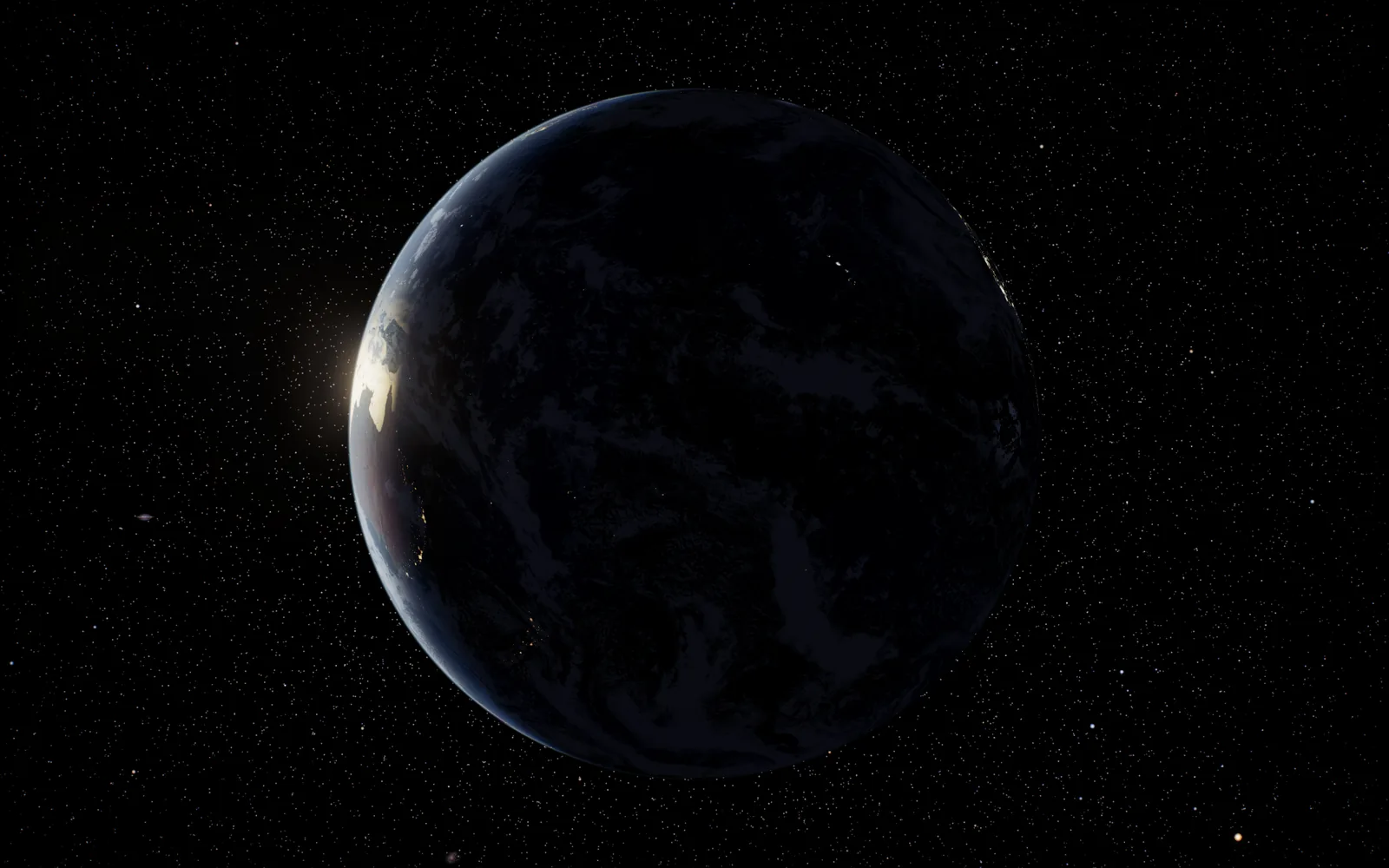
The night side, with sunrise breaking along the edge.
Rendered live in the 3D viewerInterior
Layers, drawn to scale
A solid inner iron core (~1,220 km radius) at ~5,400 °C, a liquid outer core whose convection generates the magnetic field, a silicate mantle with slow plastic flow, and a thin crust. The core temperature is comparable to the Sun's surface.
Formation
Born in a collision
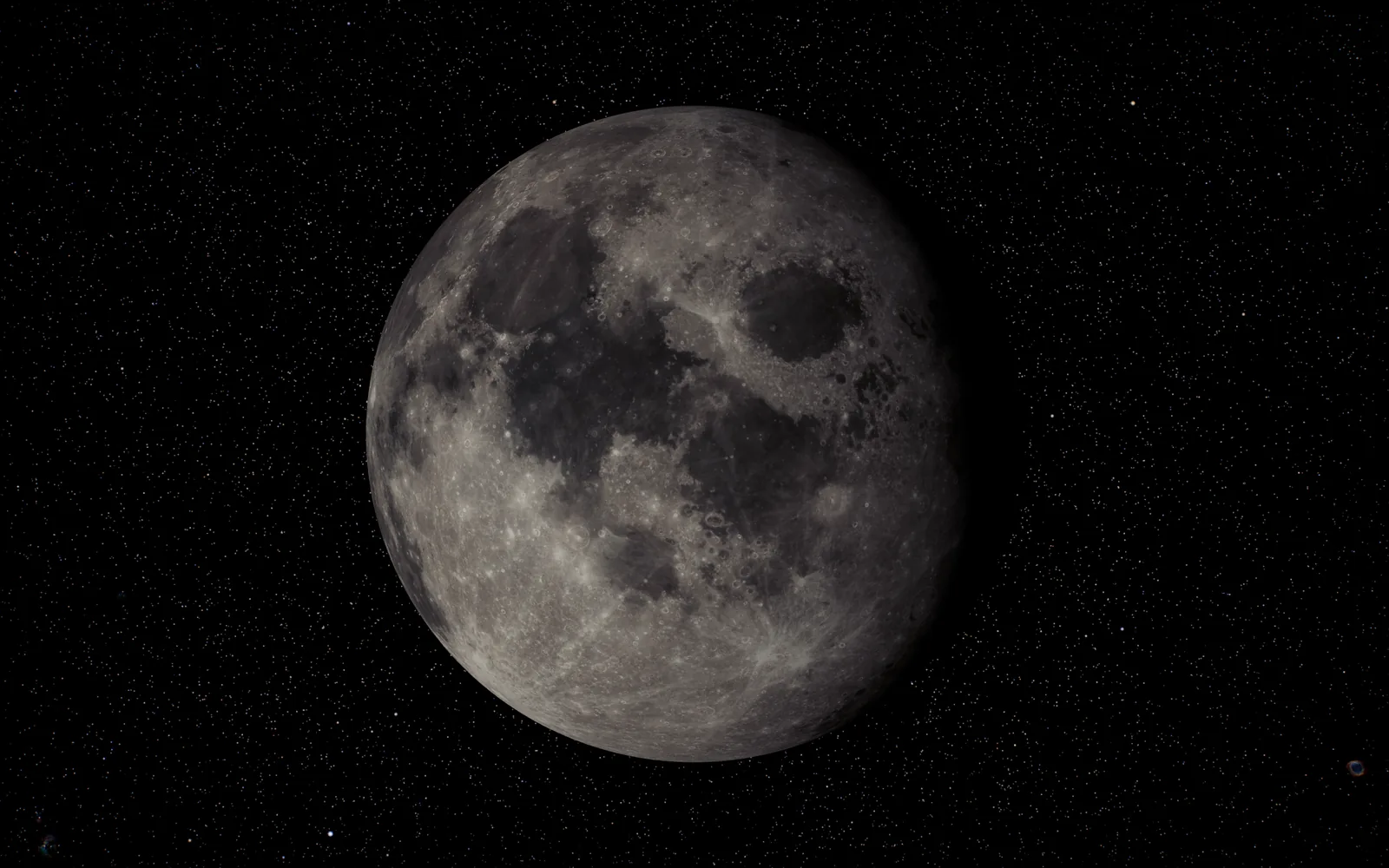
Accreted from the protoplanetary disc 4.54 billion years ago. Roughly 100 million years later, a Mars-sized body called Theia struck Earth; the debris coalesced into the Moon. Heavy bombardment delivered most of the water by ~3.9 billion years ago. Life appeared at least 3.5 billion years ago.
Orbit
Where Earth is today
Average distance from the Sun: 149.6 million km (1 AU). Orbital period 365.256 days. Axial tilt 23.44° drives the seasons. The orbit is nearly circular (e = 0.0167).
The sunlight falling on Earth right now left the Sun
8 min 18.7 s ago
It crossed 149,512,421 km of empty space to get here.
Missions
Who has been to look
- 1968–72ApolloPast
Crewed missions to the Moon; Apollo 8's "Earthrise" photo reframed how the planet sees itself.
- 1998–ISSActive
Continuously crewed since 2000; orbits Earth every 92 minutes at 408 km altitude.
- OngoingEarth-observing fleetActive
Hundreds of satellites monitor weather, climate, oceans, and land use in near real time.
Go further
See it for yourself
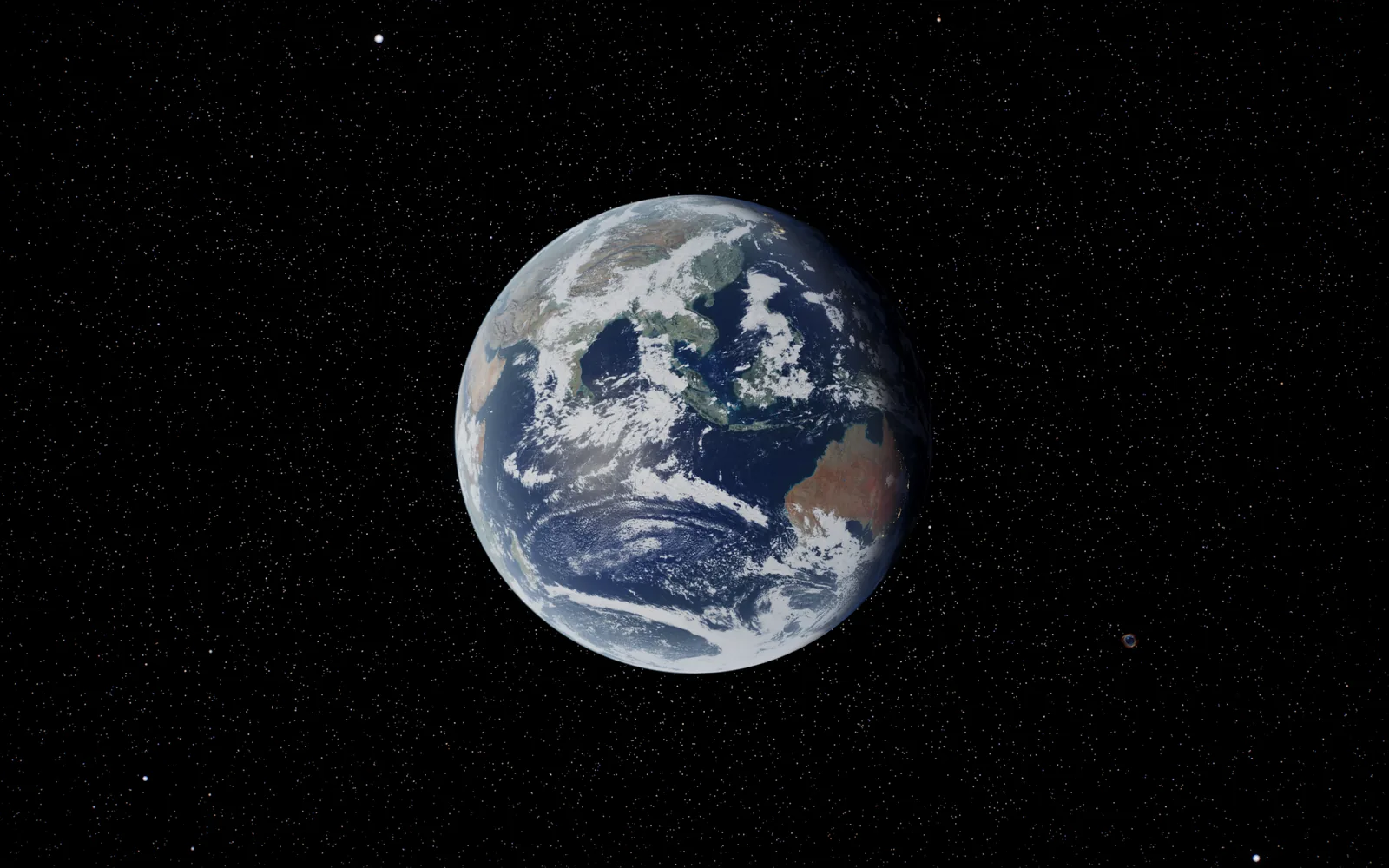
Fly to Earth in 3D
In this viewer Earth uses a custom day/night shader: sunlit oceans and continents on the dayside, glowing city lights on the nightside, drifting cloud cover, atmospheric scattering, and the Moon in real-time orbit. Pause time speed and watch the terminator line move at exactly 1,670 km/h, the speed of Earth's rotation.
Keep Earth on your screen
Set the screensaver to one world and it stays with Earth: the whole disc, a close pass, the day-night line, all where it really is right now.
Questions
Asked about Earth
How fast does Earth move?
Earth orbits the Sun at about 29.78 km/s (107,000 km/h) and rotates at 1,670 km/h at the equator.
How old is the Earth?
4.54 billion years, dated from the oldest meteorites and lunar samples.
Why does Earth have seasons?
Its 23.44° axial tilt changes which hemisphere leans toward the Sun across the year — not changing distance from the Sun.
Read more
Other bodies
- Sun Star
- Mercury Terrestrial Planet
- Venus Terrestrial Planet
- Mars Terrestrial Planet
- Jupiter Gas Giant
- Saturn Gas Giant
- Uranus Ice Giant
- Neptune Ice Giant
- Pluto Dwarf Planet
Sources & methodology
Numbers cross-referenced with the sources below; surface and atmosphere descriptions reflect findings as of October 2026. Renderings in the 3D viewer use textures based on Solar System Scope and NASA imagery.