Pillar · Region · Updated October 2026
The Kuiper belt.
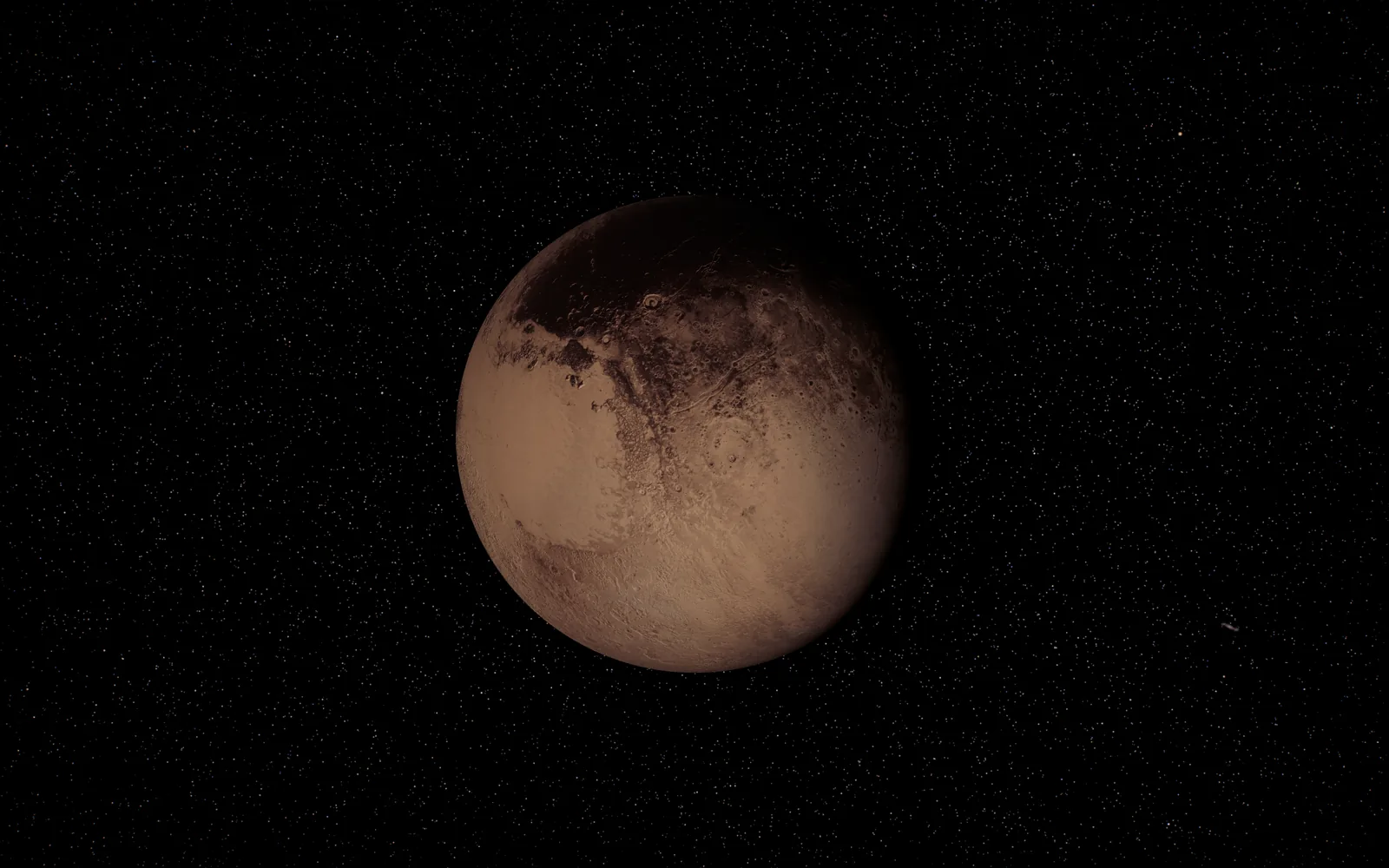
The Kuiper Belt is a doughnut-shaped region of icy bodies that begins beyond Neptune's orbit (~30 AU) and extends to roughly 50 AU from the Sun. Home to Pluto and the other Kuiper Belt dwarf planets, it contains hundreds of thousands of bodies larger than 100 km, plus an estimated trillion comets. Many short-period comets originate here.
Open the 3D viewer →A graveyard of leftover ice
The Kuiper Belt formed from the same protoplanetary disc as the planets, but at distances where ice was abundant and the density of material was too low for large planets to form. Bodies stayed small, scattered, and frozen. Average surface temperatures hover around -230 °C. Compositions are dominated by water ice, methane ice, ammonia ice, and rocky cores.
Discovered in 1992
Although Pluto had been known since 1930, the rest of the Kuiper Belt remained hypothetical until 1992, when David Jewitt and Jane Luu discovered (15760) Albion. Since then thousands more KBOs have been catalogued. The Outer Solar System Origins Survey alone identified over 800.
New Horizons has gone there
NASA's New Horizons spacecraft flew past Pluto in July 2015 and continued outward, encountering Arrokoth (formerly 2014 MU69) on 1 January 2019 — the most distant object ever visited, 6.6 billion km from Earth. Arrokoth is a contact binary, two lobes joined at a narrow neck, frozen in time since the early solar system.
Source of short-period comets
Short-period comets — those with orbits under 200 years, like Halley's — are believed to originate in the Kuiper Belt and the related scattered disc. Long-period comets come from the much more distant Oort Cloud.
Bodies in this category
Frequently asked questions
What is the Kuiper Belt?
A region of icy bodies beyond Neptune's orbit, from about 30 to 50 astronomical units from the Sun. Home to Pluto and the other outer dwarf planets.
How big is the Kuiper Belt?
It spans roughly 20 AU in radial extent (3 billion km) and contains an estimated trillion comets plus hundreds of thousands of bodies larger than 100 km.
Is Pluto in the Kuiper Belt?
Yes. It was the first Kuiper Belt object ever discovered, in 1930.