
Ice Giant
Neptune.
The outermost planet, deep blue, with the fastest winds measured anywhere in the solar system.
Neptune right now
- From Earth right now
- 4,323,184,603 km
- Its light reaches us after
- 4 h 0 min
- From the Sun
- 4,469,577,970 km
- Speed around the Sun
- 5.47 km/s
- Around its orbit
- 88% of the way from perihelion
Worked out in your browser from JPL's orbital elements, the same maths that moves the planets in the 3D viewer. How far Neptune is from Earth right now, with miles, AU and the next close approach.
Overview
Neptune at a glance
Neptune is the eighth and farthest planet from the Sun, a deep-blue ice giant with the strongest sustained winds of any planet — up to 2,100 km/h. Its 49,244 km diameter is roughly four times Earth's. At an average 4.5 billion km from the Sun, sunlight there is just 1/900 as bright as on Earth, and a single Neptunian year takes 164.8 Earth years. It has 16 known moons, including Triton, which orbits backwards and is likely a captured Kuiper Belt object.
- Diameter
- 49,244 km
- From the Sun
- 4.5B km
- Year
- 164.8 years
- Axial tilt
- 28.32°
- Moons
- 16
- Type
- Ice Giant
Size, to scale
Atmosphere
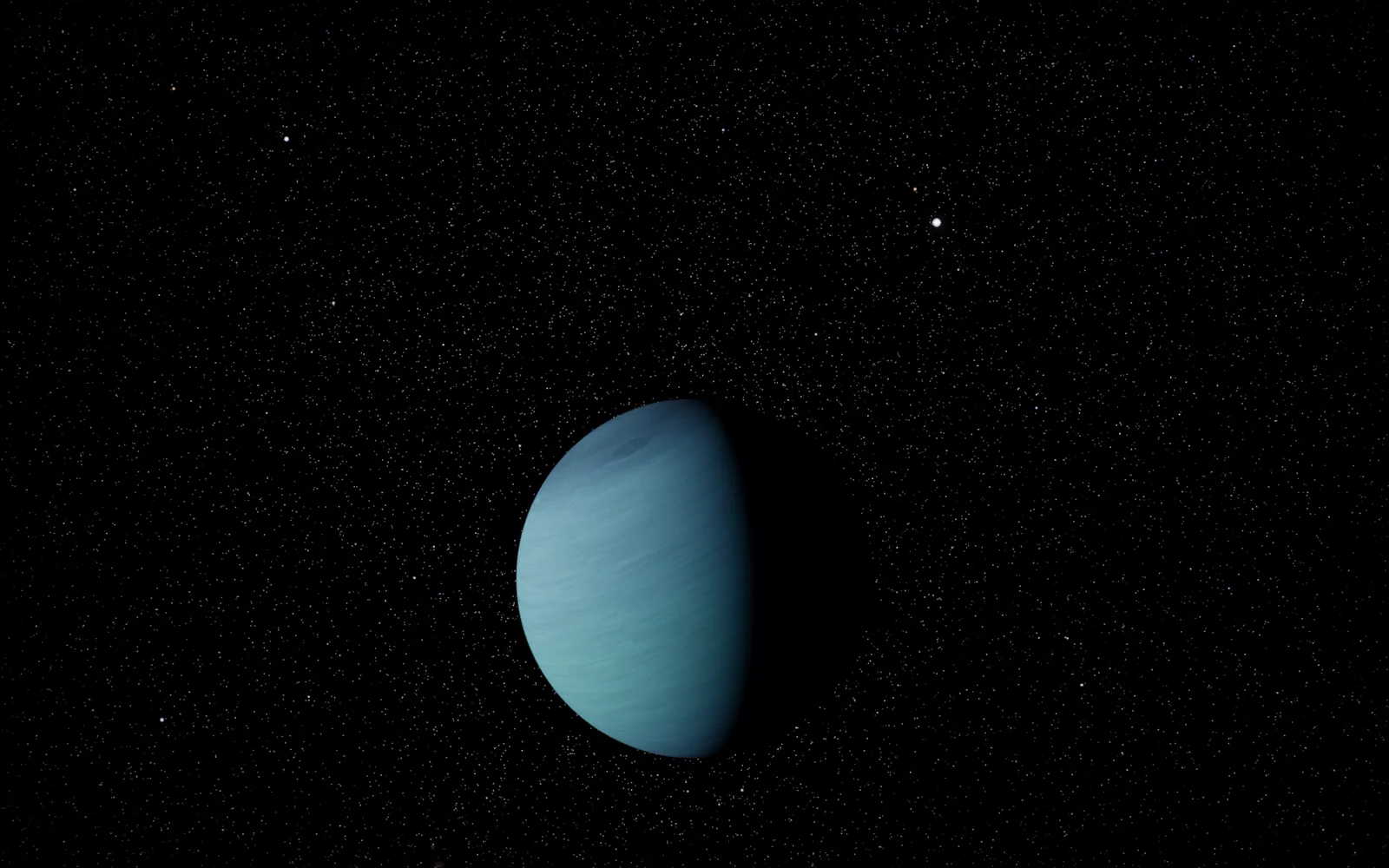
The windiest world
80% hydrogen, 19% helium, 1% methane. The deeper blue compared to Uranus comes partly from methane and partly from an unidentified additional absorber. Voyager 2 saw a Great Dark Spot in 1989 — a storm the size of Earth that had vanished by the time Hubble imaged the planet five years later.
Surface
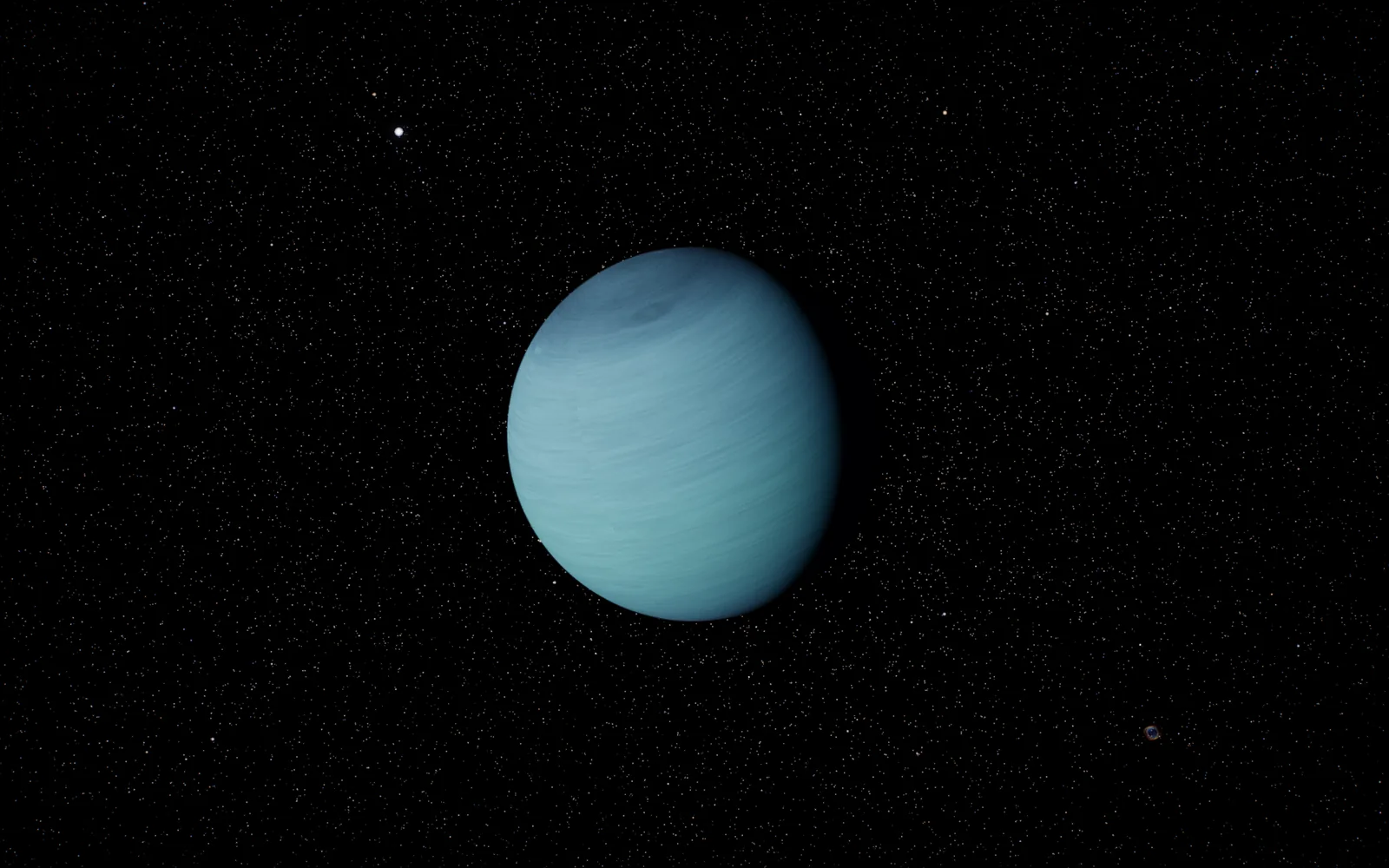
No surface to stand on
No solid surface. The atmosphere transitions smoothly into a supercritical fluid mantle of water, methane, and ammonia.
Interior
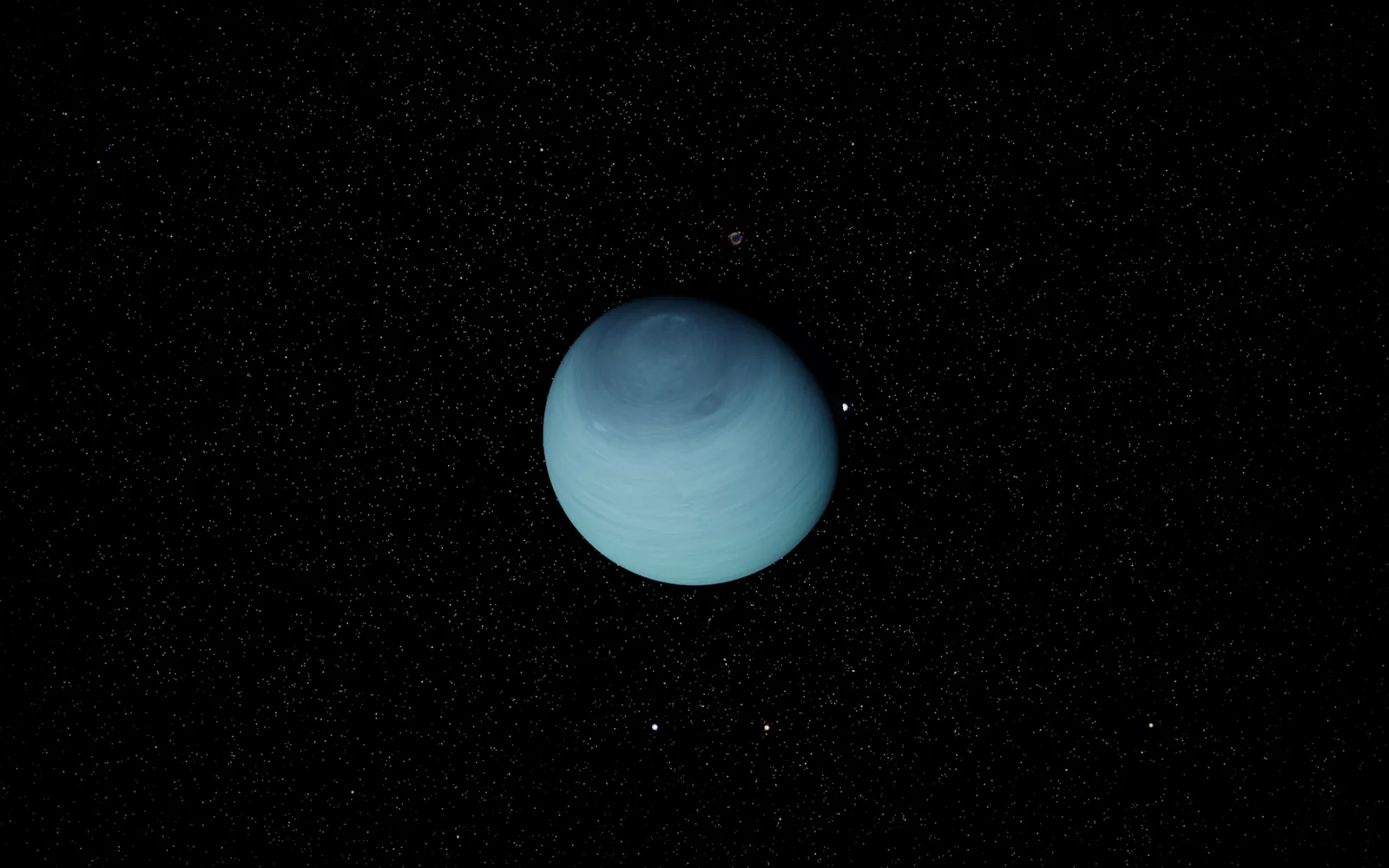
An icy interior
Rocky core, hot dense mantle of supercritical "ices," gas envelope. Unlike Uranus, Neptune radiates 2.6× the energy it receives — a residual heat output similar to Jupiter's.
Formation
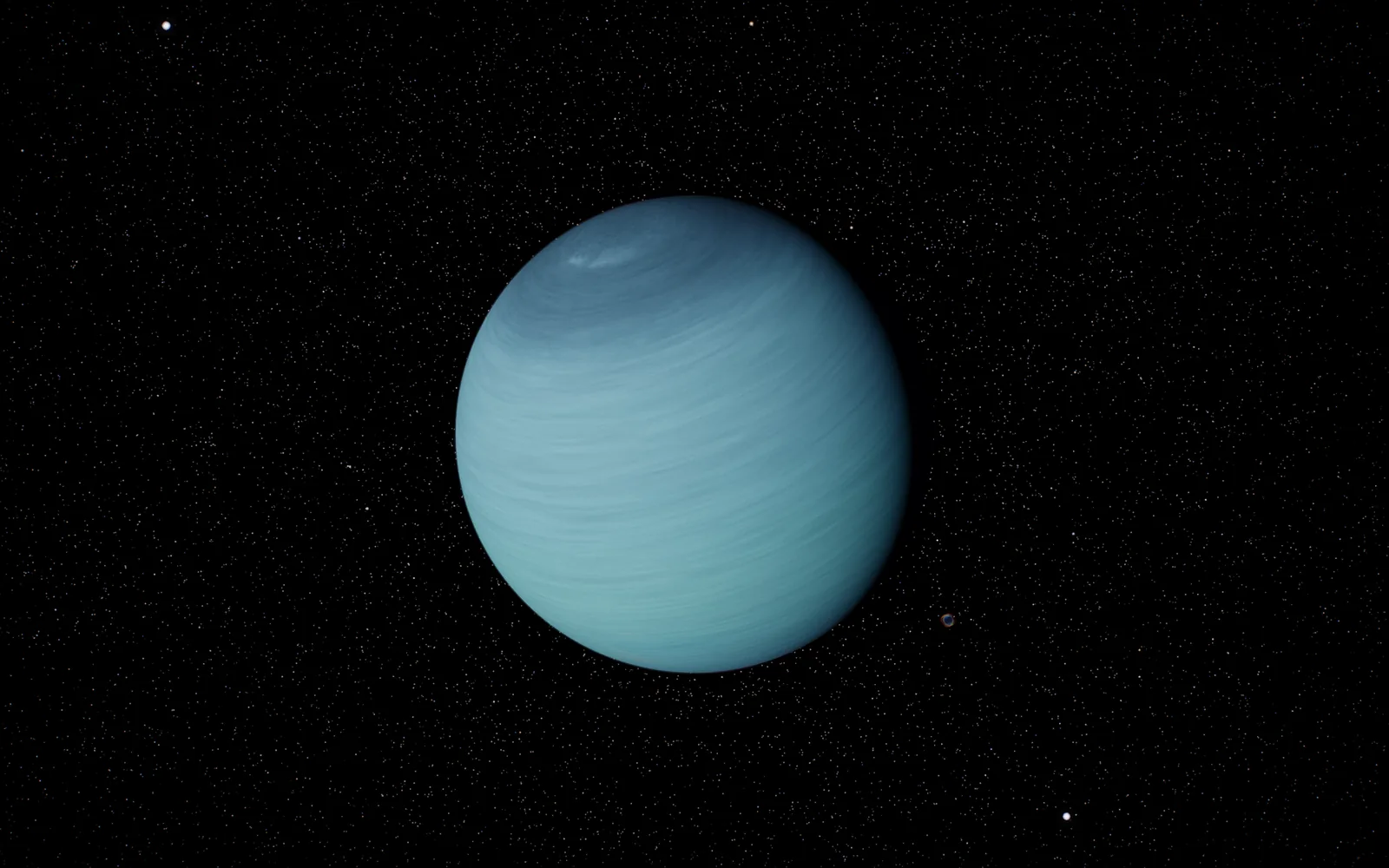
How it formed
Likely formed closer in and migrated outward during the early solar system's reorganization (the Nice Model). That migration also scattered icy bodies into the Kuiper Belt and Oort Cloud.
Orbit
Where Neptune is today
Average distance from the Sun: 4.50 billion km (30.07 AU). Orbital period 164.8 Earth years. Discovered 1846; has not yet completed a full orbit since its discovery (next return: 2011 was the first, the next will be 2175).
Sunlight takes
4 h 8 min
to reach Neptune, and its reflected light needs 4 h 0 min more to reach us.
Missions
Who has been to look
- 1989Voyager 2Past flyby
The only spacecraft ever to visit Neptune. As with Uranus, every modern view of the planet derives from that one encounter.
- Proposed 2030sNeptune OdysseyConcept
A flagship Neptune orbiter and Triton probe under study.
Go further
See it for yourself
Fly to Neptune in 3D
Neptune was the first planet discovered through mathematical prediction rather than direct observation. Urbain Le Verrier and John Couch Adams independently calculated where it should be from anomalies in Uranus's orbit; Johann Galle found it in 1846 within one degree of the predicted position. In the viewer, watch how slowly Neptune crawls — it has only completed one full orbit since its discovery.
Keep Neptune on your screen
Set the screensaver to one world and it stays with Neptune: the whole disc, a close pass, the day-night line, all where it really is right now.
Questions
Asked about Neptune
Why is Neptune blue?
Methane in the upper atmosphere absorbs red light. An additional unidentified absorber makes Neptune deeper blue than Uranus.
How fast are Neptune's winds?
Up to 2,100 km/h — the fastest in the solar system.
How long is a year on Neptune?
164.8 Earth years.
Read more
Other bodies
- Sun Star
- Mercury Terrestrial Planet
- Venus Terrestrial Planet
- Earth Terrestrial Planet
- Mars Terrestrial Planet
- Jupiter Gas Giant
- Saturn Gas Giant
- Uranus Ice Giant
- Pluto Dwarf Planet
Sources & methodology
Numbers cross-referenced with the sources below; surface and atmosphere descriptions reflect findings as of October 2026. Renderings in the 3D viewer use textures based on Solar System Scope and NASA imagery.