Pillar · Class of planet · Updated October 2026
Gas giants of the solar system.
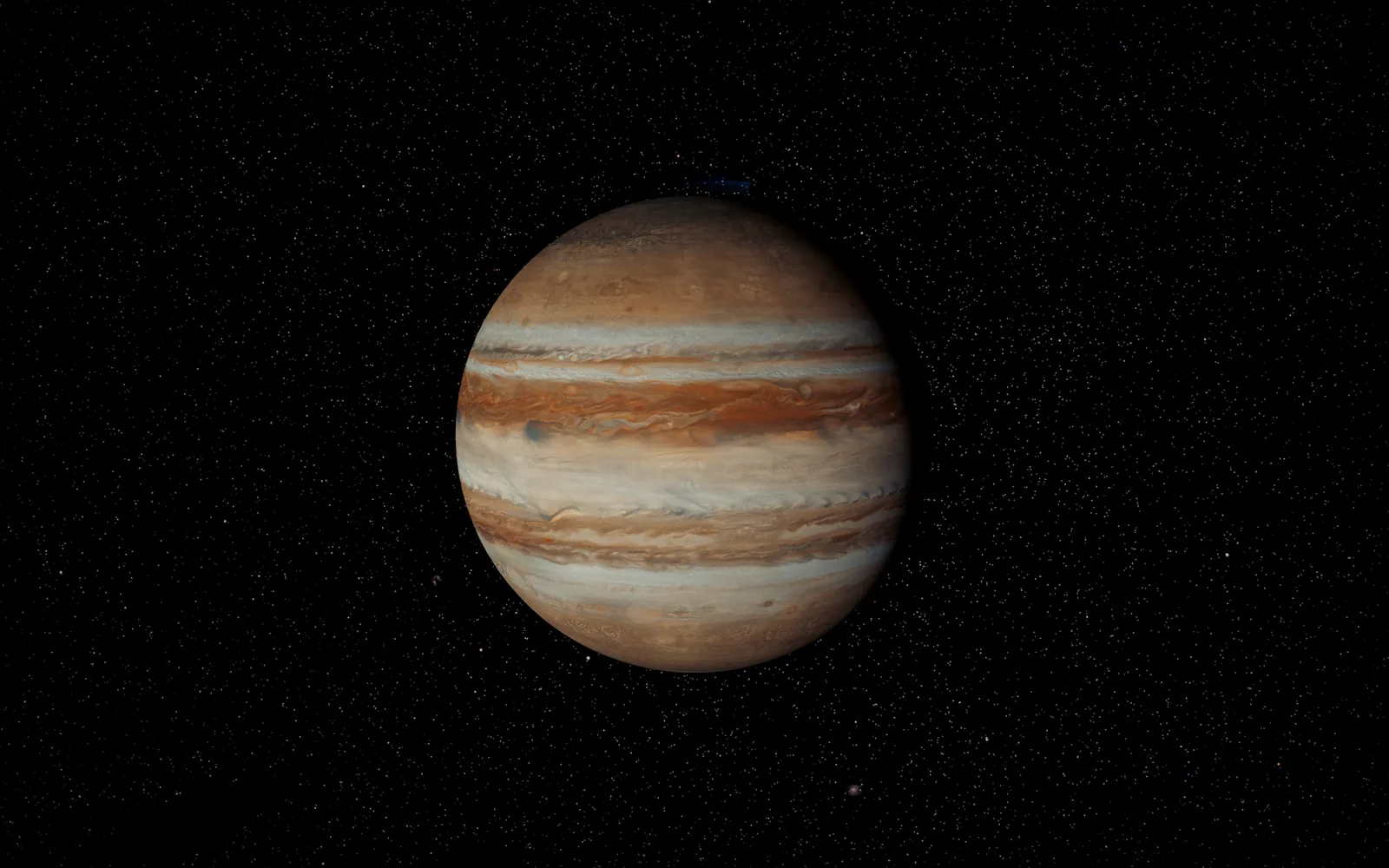
A gas giant is a planet composed mainly of hydrogen and helium, with no solid surface. Our solar system has four — Jupiter and Saturn (true gas giants) and Uranus and Neptune (often classified separately as ice giants). All four are far larger than Earth, all four rotate faster than any rocky planet, and all four have ring systems and many moons.
Open the 3D viewer →What is a gas giant?
A gas giant is a planet whose composition is dominated by gas — hydrogen and helium, with traces of methane, ammonia, and water. Pressure increases with depth until the gas becomes a supercritical fluid, then liquid, then in the case of Jupiter and Saturn, metallic hydrogen — hydrogen squeezed so hard the electrons free themselves and the substance conducts electricity like a metal. There is no clear boundary between atmosphere and interior, and no surface to stand on.
How they differ from rocky planets
Mercury, Venus, Earth, and Mars are terrestrial — small, dense, made of silicate rock and metal. Gas giants are larger by an order of magnitude, less dense, and far cooler at the cloud tops. Jupiter alone has more mass than all the other planets combined, but its average density (1.33 g/cm³) is barely greater than water. Saturn would actually float in water if you could find a tub big enough — its mean density is 0.69 g/cm³.
Why they all have rings
All four gas giants have ring systems, though only Saturn's are bright enough to see from a small telescope. Jupiter's rings, discovered by Voyager 1 in 1979, are dust kicked up by micrometeoroid impacts on the inner moons. Uranus has 13 narrow dark rings. Neptune has five rings, with arc-shaped concentrations rather than uniform bands. Ring systems form when material can't coalesce into a moon — usually because it sits inside the planet's Roche limit, where tidal forces pull anything large enough apart.
Many moons each
Jupiter has 101 confirmed moons including the four Galilean moons — Io, Europa, Ganymede, and Callisto. Saturn has 285, the most of any planet — including Titan and Enceladus. Uranus has 28 named after Shakespearean and Pope characters. Neptune has 16, dominated by the giant retrograde Triton.
Bodies in this category
Frequently asked questions
Are Uranus and Neptune gas giants?
They're often classified separately as "ice giants" because much of their mass is in supercritical fluids rich in water, methane, and ammonia. The name "gas giant" originally referred only to Jupiter and Saturn.
Could a gas giant become a star?
Only if it gained roughly 80 times Jupiter's mass. Below that threshold there's not enough gravitational pressure to fuse hydrogen.
How many gas giants does the solar system have?
Four — Jupiter, Saturn, Uranus, and Neptune. Two true gas giants (Jupiter, Saturn) and two ice giants (Uranus, Neptune).