
Ice Giant
Uranus.
An ice giant knocked onto its side, rolling around the Sun once every 84 years.
Uranus right now
- From Earth right now
- 2,812,561,374 km
- Its light reaches us after
- 2 h 36 min
- From the Sun
- 2,907,402,270 km
- Speed around the Sun
- 6.71 km/s
- Around its orbit
- 71% of the way from perihelion
Worked out in your browser from JPL's orbital elements, the same maths that moves the planets in the 3D viewer. How far Uranus is from Earth right now, with miles, AU and the next close approach.
Overview
Uranus at a glance
Uranus is the seventh planet from the Sun, an ice giant tilted nearly 98° so it rolls along its orbit on its side. With a diameter of 50,724 km and an 84-Earth-year orbit, it is the third-largest planet by radius and the coldest planetary atmosphere in the solar system, with cloud-top temperatures around −224 °C. Its pale blue-green colour comes from methane in the upper atmosphere absorbing red light.
- Diameter
- 50,724 km
- From the Sun
- 2.87B km
- Year
- 84 years
- Axial tilt
- 97.77°
- Moons
- 29
- Type
- Ice Giant
Size, to scale
Atmosphere
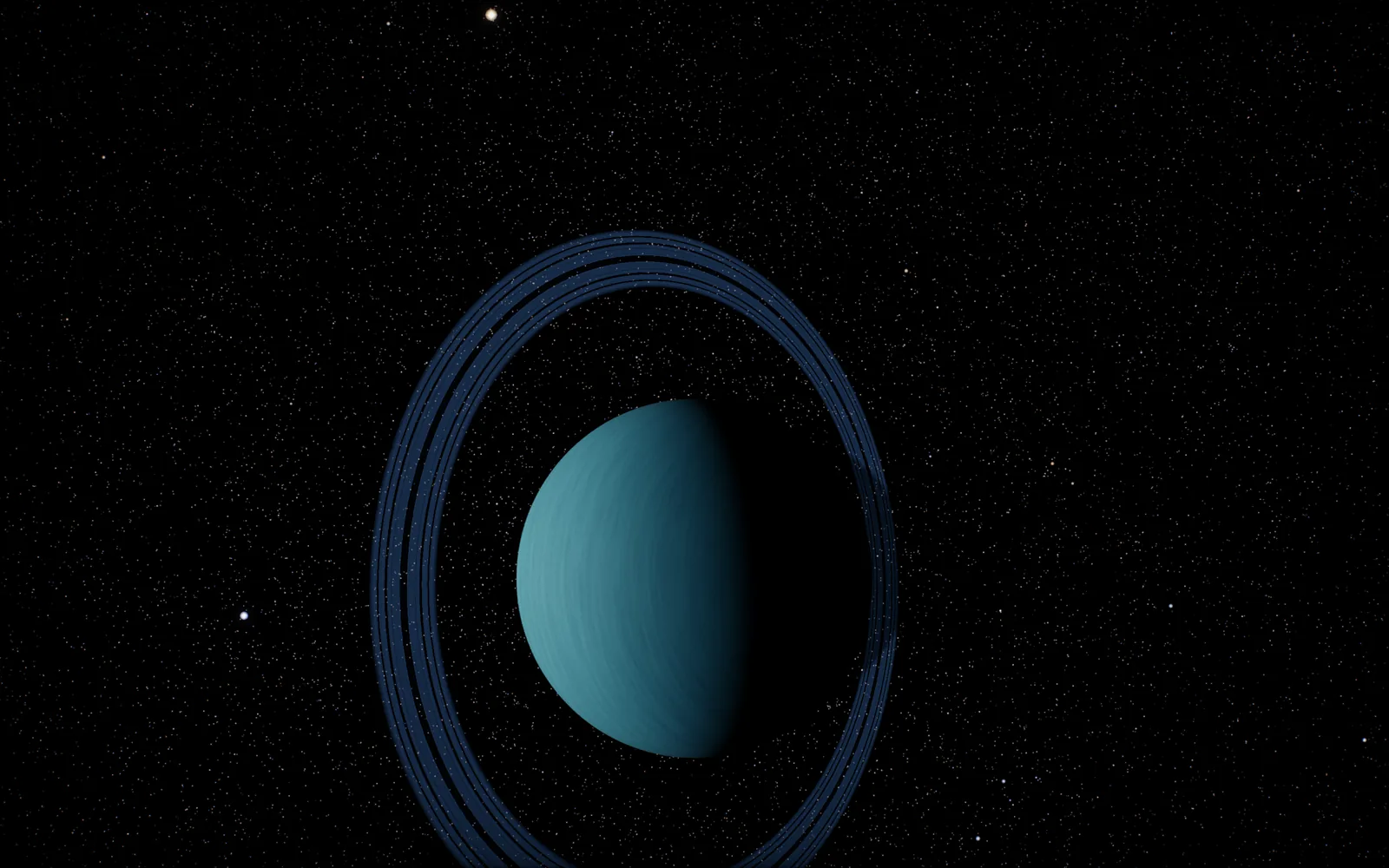
Pale and quiet
83% hydrogen, 15% helium, 2% methane. The methane is what gives Uranus its colour — it absorbs red wavelengths and reflects blue. Below the visible cloud deck of methane ice are cloud layers of hydrogen sulphide, ammonia hydrosulphide, and water.
Surface
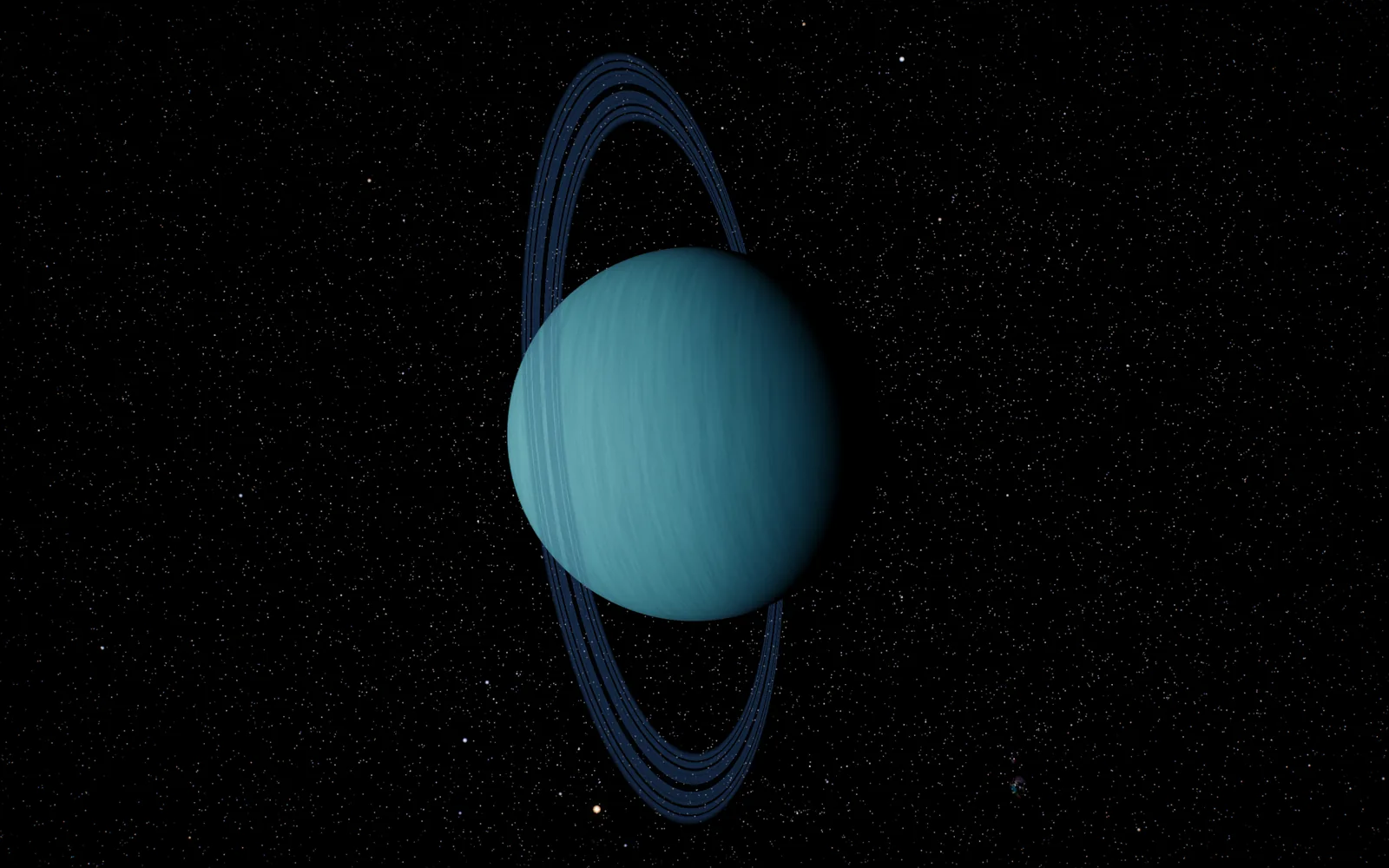
No surface to stand on
No solid surface. Moving inward, the atmosphere thickens into a hot, dense fluid of water, methane, and ammonia — sometimes called an "ice mantle" though it's actually a supercritical fluid at thousands of degrees and millions of atmospheres of pressure.
Interior
An icy interior
A small rocky core, a thick mantle of "icy" supercritical fluid (water, methane, ammonia), and a hydrogen / helium envelope. Unlike Jupiter or Saturn, Uranus radiates almost no excess heat — a long-standing puzzle.
Formation
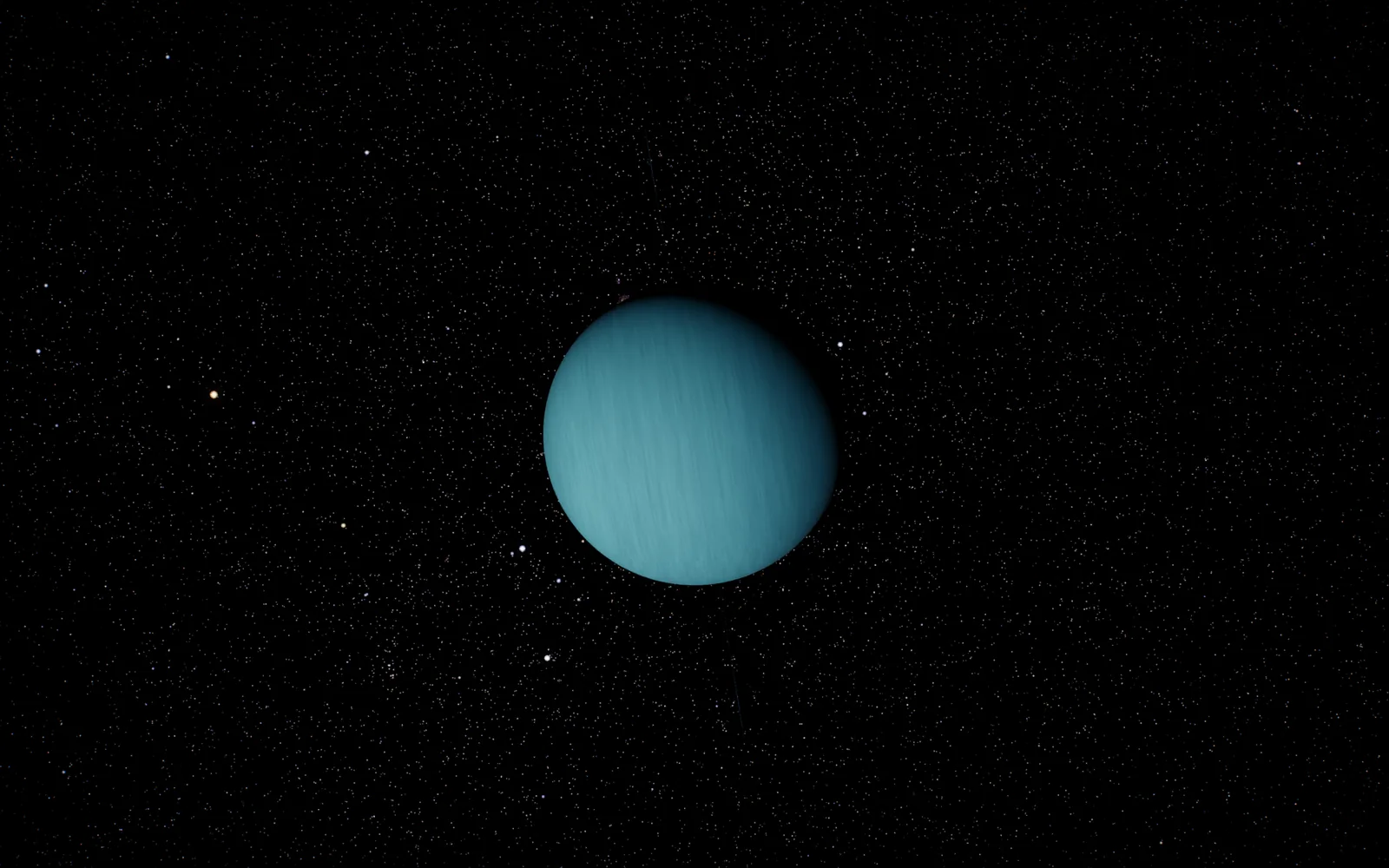
How it formed
Likely formed closer to the Sun and migrated outward during the early solar system's gravitational reshuffling. The extreme tilt is best explained by one or more giant impacts during formation.
Orbit
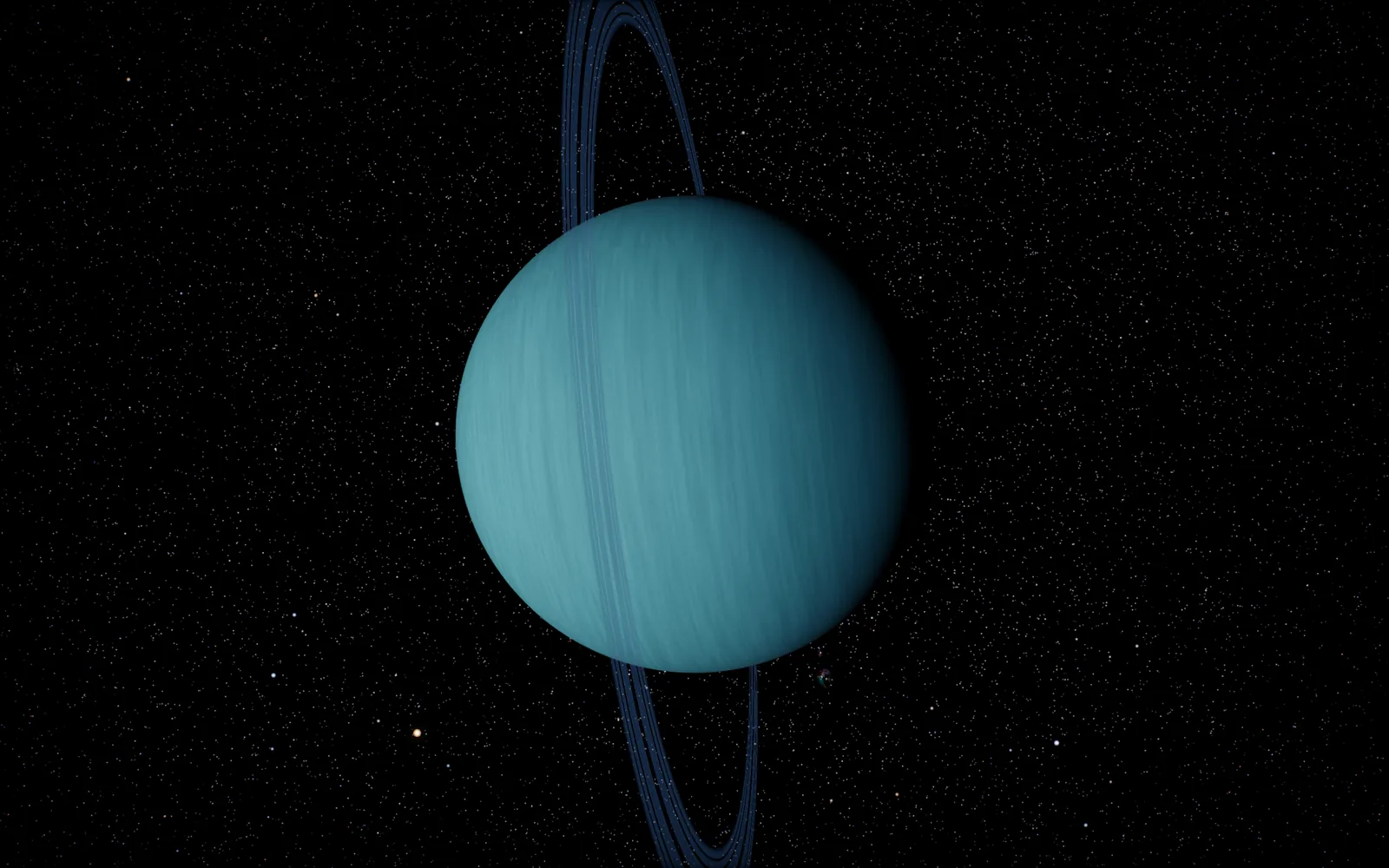
Where Uranus is today
Average distance from the Sun: 2.87 billion km (19.2 AU). Orbital period 84 Earth years. Has 13 known faint rings, narrower and darker than Saturn's, made mostly of dark particles.
Sunlight takes
2 h 42 min
to reach Uranus, and its reflected light needs 2 h 36 min more to reach us.
Moons
Uranus's major moons
- MirandaMiranda has one of the most extreme and varied landscapes in the Solar System, with giant canyons.472 km · 129,900 km out
- ArielAriel is the brightest of Uranus's moons with a relatively young surface.1,158 km · 190,900 km out
- UmbrielUmbriel is the darkest of Uranus's large moons with ancient, heavily cratered terrain.1,169 km · 266,000 km out
- TitaniaTitania is the largest moon of Uranus, with huge fault systems and canyons.1,578 km · 436,300 km out
- OberonOberon is the second largest moon of Uranus, heavily cratered with mysterious dark patches.1,523 km · 583,500 km out
Missions
Who has been to look
- 1986Voyager 2Past flyby
The only spacecraft ever to visit Uranus. Every modern image of the planet still relies on that single 1986 flyby.
- Proposed 2030sUranus Orbiter and ProbeConcept
Top priority flagship in the 2023 Planetary Science Decadal Survey.
Go further
See it for yourself
Fly to Uranus in 3D
Uranus's 97.77° axial tilt means each pole spends 42 Earth years in continuous sunlight, then 42 in continuous darkness. In the viewer this is most obvious if you watch from the side — the orbit looks normal, but the rotation axis stays pointed at a fixed star while the planet circles the Sun.
Keep Uranus on your screen
Set the screensaver to one world and it stays with Uranus: the whole disc, a close pass, the day-night line, all where it really is right now.
Questions
Asked about Uranus
Why does Uranus rotate on its side?
Most likely a series of giant impacts during the early solar system tipped it over.
How many moons does Uranus have?
29 confirmed, named after Shakespearean and Pope characters — Miranda, Ariel, Umbriel, Titania, Oberon, and 24 more.
How was Uranus discovered?
William Herschel found it in 1781 — the first planet discovered with a telescope rather than the unaided eye.
Read more
Other bodies
- Sun Star
- Mercury Terrestrial Planet
- Venus Terrestrial Planet
- Earth Terrestrial Planet
- Mars Terrestrial Planet
- Jupiter Gas Giant
- Saturn Gas Giant
- Neptune Ice Giant
- Pluto Dwarf Planet
Sources & methodology
Numbers cross-referenced with the sources below; surface and atmosphere descriptions reflect findings as of October 2026. Renderings in the 3D viewer use textures based on Solar System Scope and NASA imagery.