Pillar · Class of planet · Updated October 2026
Terrestrial planets.
A terrestrial planet is a rocky planet — dense, with a metallic core and a silicate mantle and crust. Our solar system has four: Mercury, Venus, Earth, and Mars. They orbit closer to the Sun than the gas giants, formed inside the snow line where it was too warm for ices to condense, and together hold less than 0.5% of the mass of every planet combined.
Open the 3D viewer →What makes a planet terrestrial?
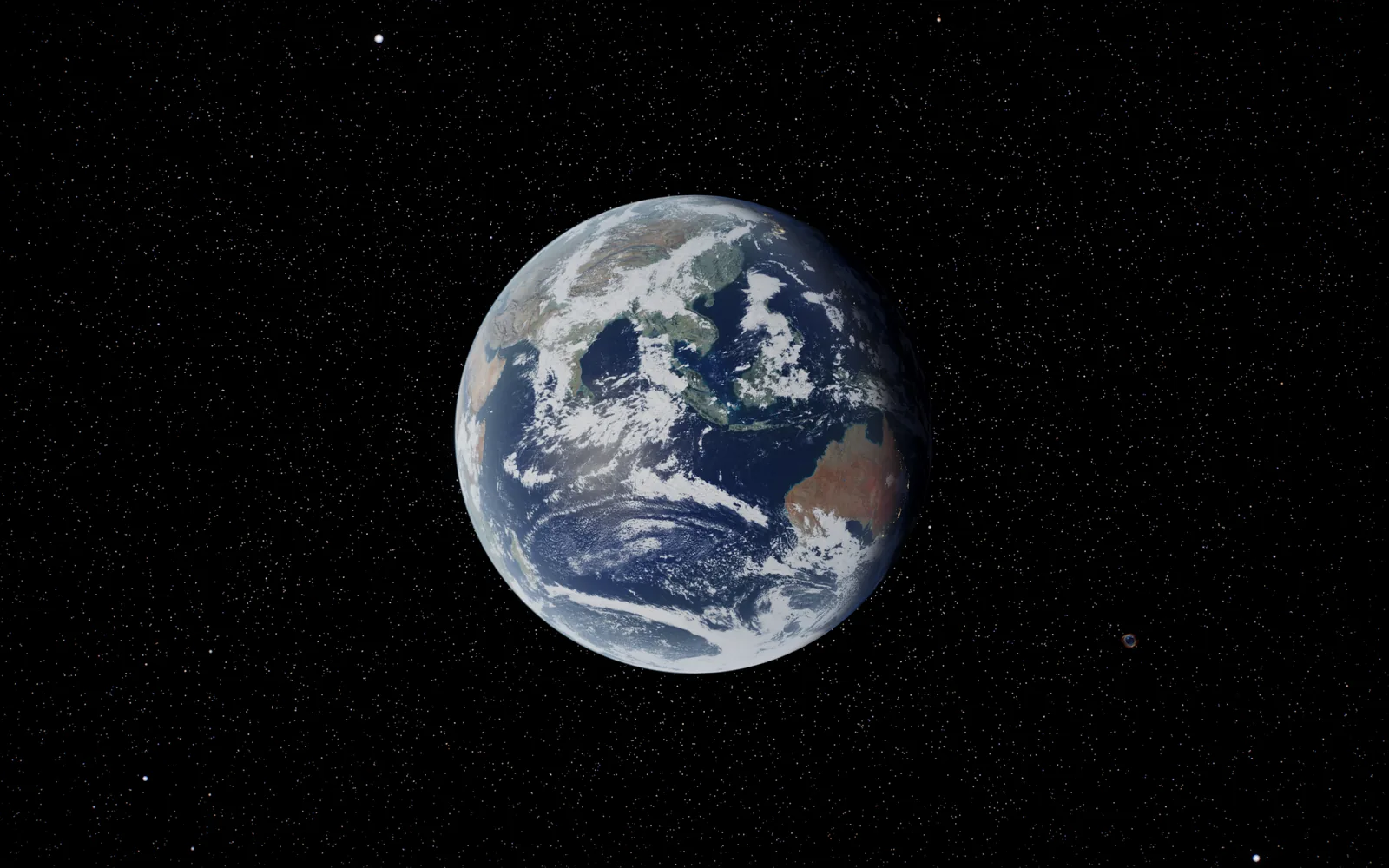
A terrestrial planet is small, dense, and made primarily of rock and metal — in contrast to the gas-giant outer planets, which are mainly hydrogen and helium. The four terrestrial planets in our solar system have differentiated interiors: an iron-nickel core, a silicate mantle, and a crust. Earth's is fully active with plate tectonics. Mars's is mostly frozen, with crustal magnetism preserving evidence of an ancient field. Venus has volcanic resurfacing. Mercury has long lobate scarps where its iron core cooled and shrank the planet.
Atmospheres are wildly different
Mercury has essentially no atmosphere — only a wisp of hydrogen, helium, oxygen, sodium, and potassium. Venus has 92 bar of mostly CO₂, the densest atmosphere of any rocky planet. Earth has 1 bar of nitrogen and oxygen. Mars has just 0.6% of Earth's pressure, mostly CO₂. The differences come down to mass, distance from the Sun, and history — Earth and Venus started similar, but Earth kept its water and Venus lost it to a runaway greenhouse.
Why no rings
None of the terrestrial planets has a ring system today. Their gravity is too low, and any ring material would either be swept up by the surface or pushed away by solar radiation. Mars likely had a ring in the distant past — the moons Phobos and Deimos may be remnants — and Phobos will likely become a ring within 30-50 million years as it spirals inward.
Habitability
Earth is the only known habitable terrestrial planet. Venus is too hot. Mars may have been habitable 3-4 billion years ago when it had liquid water and a thicker atmosphere; the surface today is frozen, dry, and bombarded by radiation. Mercury swings between extremes too violently. The "habitable zone" — the orbital range where liquid water can exist — is bounded roughly by Venus on the inside and Mars on the outside.
Bodies in this category
Frequently asked questions
How many terrestrial planets are in the solar system?
Four — Mercury, Venus, Earth, and Mars.
Why are they all close to the Sun?
Inside the protoplanetary disc's "snow line," it was too warm for water and methane ice to condense. Only rock and metal could solidify, so only rocky planets formed there.
Is the Moon a terrestrial planet?
No — it's a moon, not a planet. But it has terrestrial composition (rock and metal) and is sometimes informally grouped with the inner solar system as a "terrestrial body."