
Terrestrial Planet
Venus.
Earth's near twin in size, hidden under clouds of sulphuric acid and a surface hot enough to melt lead.
Venus right now
- From Earth right now
- 47,548,142 km
- Its light reaches us after
- 2 min 38.6 s
- From the Sun
- 108,665,722 km
- Speed around the Sun
- 34.87 km/s
- Around its orbit
- 64% of the way from perihelion
Worked out in your browser from JPL's orbital elements, the same maths that moves the planets in the 3D viewer. How far Venus is from Earth right now, with miles, AU and the next close approach.
Overview
Venus at a glance
Venus is the second planet from the Sun and the hottest world in the solar system, with a surface temperature of about 465 °C — hot enough to melt lead. A dense CO₂ atmosphere 92 times the surface pressure of Earth's drives a runaway greenhouse effect, while sulfuric-acid clouds blanket the planet. It also rotates backwards: a Venusian day is longer than its 225-day year.
- Diameter
- 12,104 km
- From the Sun
- 108.2M km
- Year
- 225 days
- Axial tilt
- 177.4°
- Moons
- 0
- Type
- Terrestrial Planet
Size, to scale
Atmosphere
Crushing, acid cloud
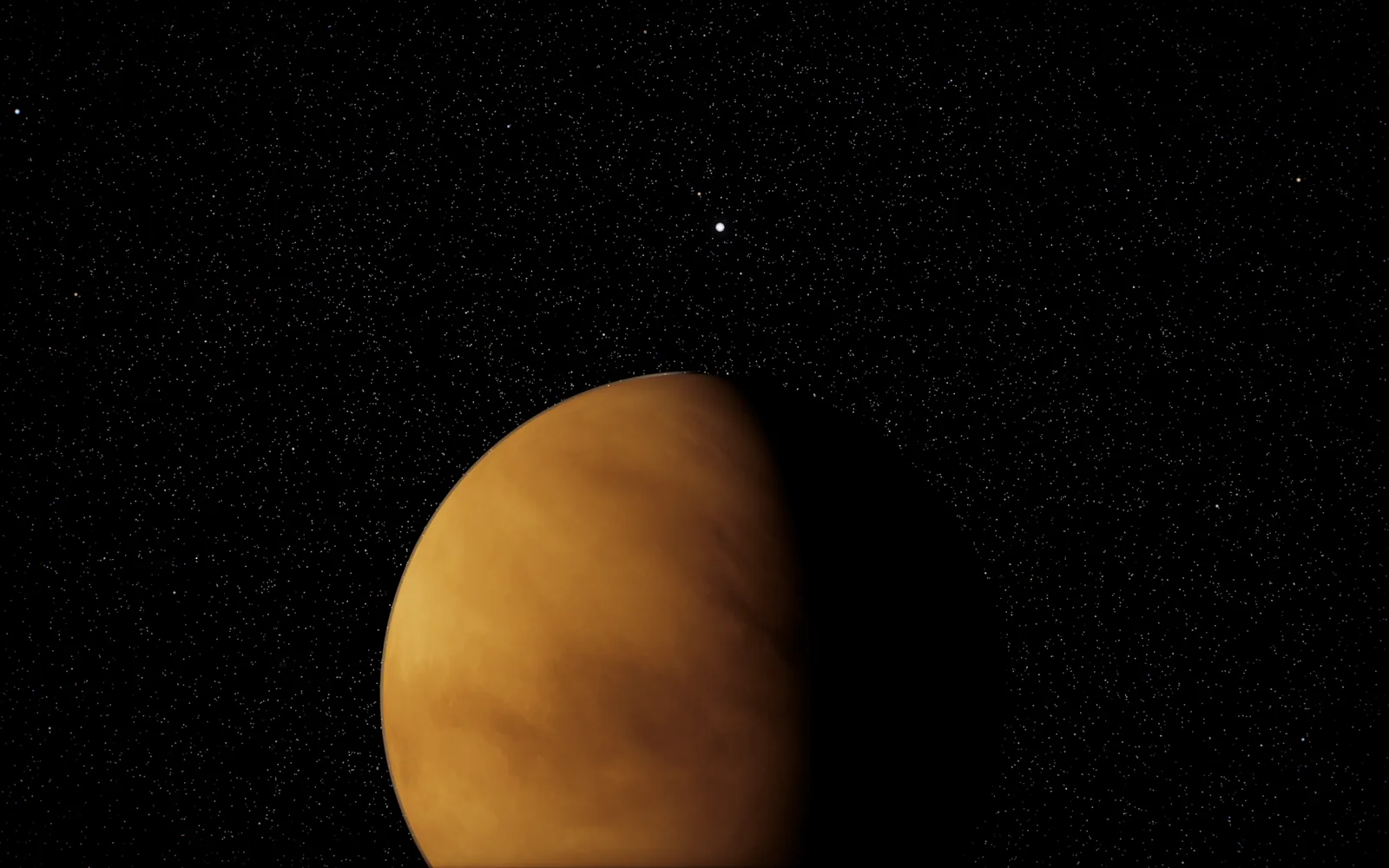
96.5% carbon dioxide, 3.5% nitrogen. The cloud deck sits 50–70 km up, made of sulfuric acid droplets. Super-rotating winds in the upper clouds circle the planet every four Earth days — sixty times faster than the surface rotates. Probes that have landed survived only minutes before being crushed and melted.
Surface
Beneath the clouds
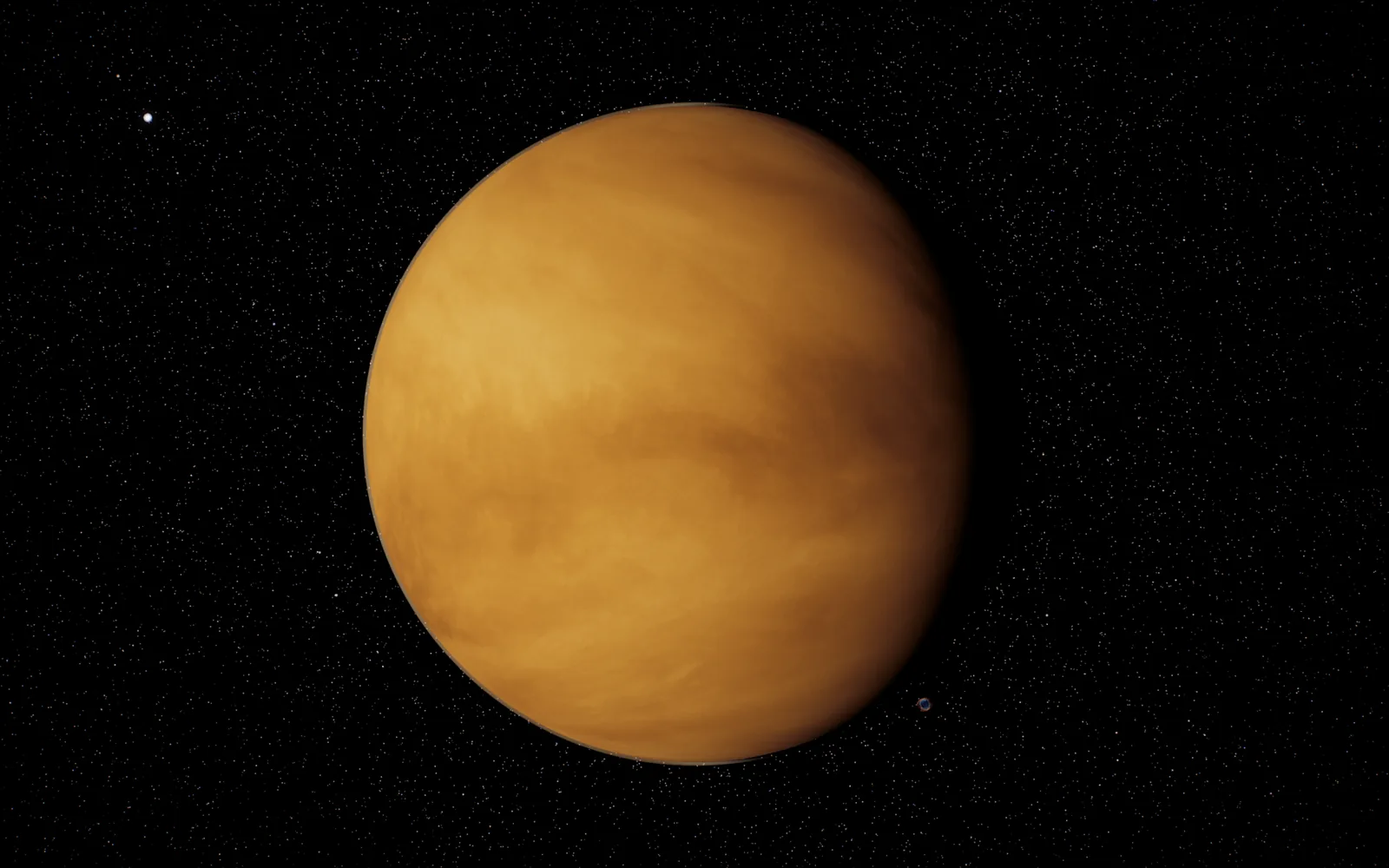
Volcanic plains cover roughly 80% of the surface, dotted with thousands of volcanoes. Maxwell Montes, the highest peak, rises 11 km. Active volcanism was confirmed in 2023 from re-analysed Magellan radar data, making Venus the second confirmed volcanically active world after Io.
Interior
Inside Venus
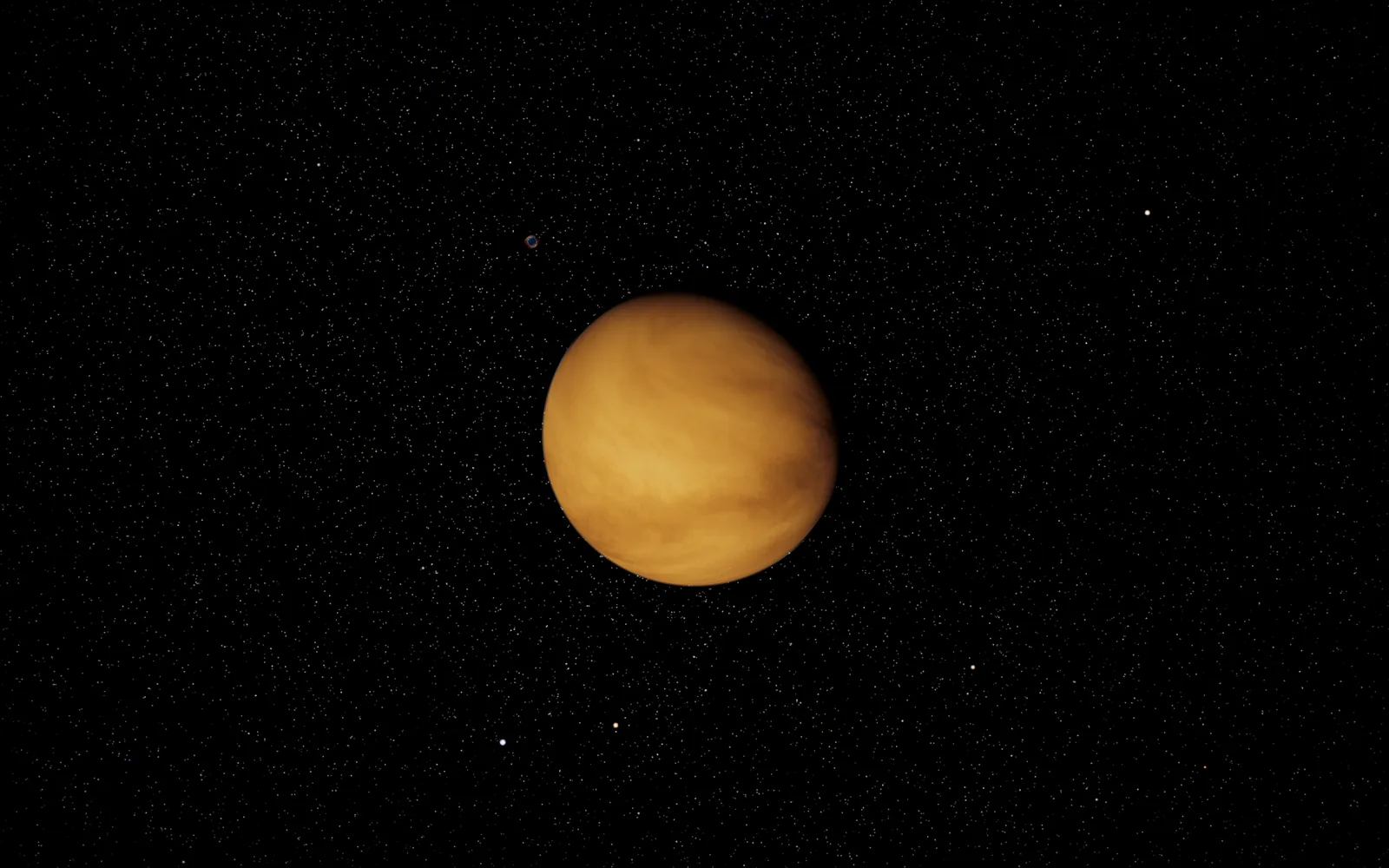
Likely similar in bulk composition to Earth — iron core, silicate mantle, basaltic crust — but the lack of plate tectonics means heat escapes through periodic global resurfacing events rather than continuous tectonic spreading.
Formation
How it formed
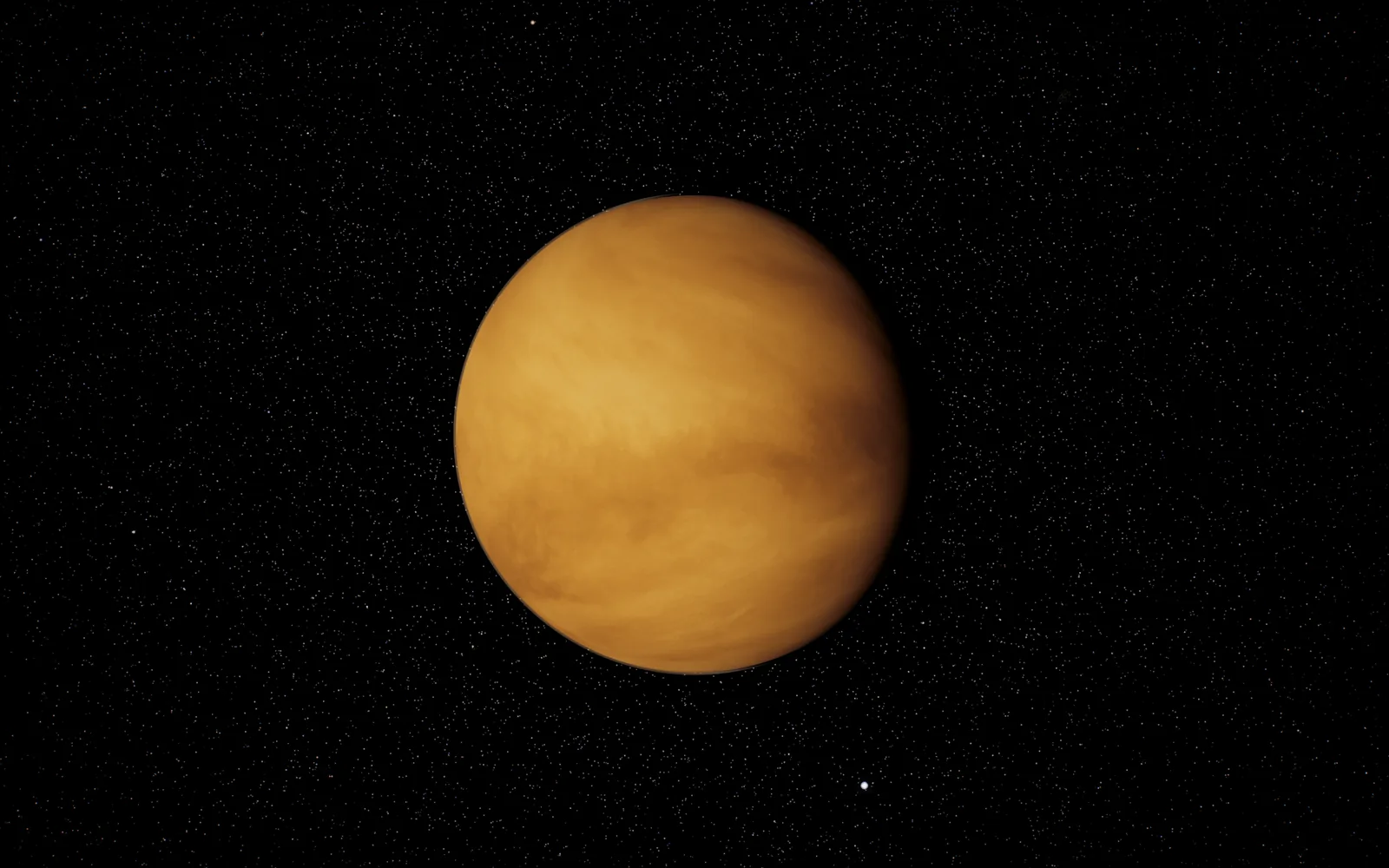
Formed at a similar time and from similar material to Earth. The leading hypothesis for the runaway greenhouse: as the Sun brightened, Venus's oceans evaporated, water vapour amplified the warming, and ultraviolet radiation eventually split the H₂O so the hydrogen escaped to space.
Orbit
Where Venus is today
Average distance from the Sun: 108.2 million km. Orbital period 224.7 Earth days. Axial tilt of 177.4° means Venus is essentially upside-down — the source of its retrograde rotation.
Sunlight takes
6 min 2.5 s
to reach Venus, and its reflected light needs 2 min 38.6 s more to reach us.
Missions
Who has been to look
- 1961–84Venera programmePast
Soviet missions; Venera 7 (1970) was the first probe to land on another planet, and Venera 13 sent back colour surface photos in 1982.
- 1990–94MagellanPast
NASA orbiter that radar-mapped 98% of the surface through the cloud deck.
- 2030sDAVINCI / VERITAS / EnVisionPlanned
NASA and ESA missions selected to return to Venus, focused on atmosphere chemistry and surface mapping.
Go further
See it for yourself
Fly to Venus in 3D
Venus rotates so slowly (243 Earth days per rotation) and in retrograde that the viewer's real-time scene shows the surface pattern moving the opposite way to every other inner planet. Set the time speed to 1000× and you can see it.
Keep Venus on your screen
Set the screensaver to one world and it stays with Venus: the whole disc, a close pass, the day-night line, all where it really is right now.
Questions
Asked about Venus
Why is Venus hotter than Mercury?
A 92-bar CO₂ atmosphere traps heat through the greenhouse effect. Mercury has no atmosphere, so its dayside heat radiates straight back into space.
Could humans ever live on Venus?
Not on the surface. Some proposals look at floating habitats around 50 km altitude, where the temperature and pressure are roughly Earth-like.
Does Venus have moons?
No.
Read more
Other bodies
- Sun Star
- Mercury Terrestrial Planet
- Earth Terrestrial Planet
- Mars Terrestrial Planet
- Jupiter Gas Giant
- Saturn Gas Giant
- Uranus Ice Giant
- Neptune Ice Giant
- Pluto Dwarf Planet
Sources & methodology
Numbers cross-referenced with the sources below; surface and atmosphere descriptions reflect findings as of October 2026. Renderings in the 3D viewer use textures based on Solar System Scope and NASA imagery.