
Terrestrial Planet
Mars.
A cold desert world with the tallest volcano in the solar system and the ghosts of ancient rivers.
Mars right now
- From Earth right now
- 242,053,055 km
- Its light reaches us after
- 13 min 27.4 s
- From the Sun
- 234,334,103 km
- Speed around the Sun
- 23.46 km/s
- Around its orbit
- 28% of the way from perihelion
Worked out in your browser from JPL's orbital elements, the same maths that moves the planets in the 3D viewer. How far Mars is from Earth right now, with miles, AU and the next close approach.
Overview
Mars at a glance
Mars is the fourth planet from the Sun, the Red Planet, with a thin CO₂ atmosphere and an iron-oxide-rich surface that gives it its colour. Its diameter of 6,779 km is roughly half Earth's. A Martian day (24h 37m) is almost the same as Earth's, but a year takes 687 Earth days. Mars hosts Olympus Mons, the tallest volcano in the solar system at 22 km, and Valles Marineris, a canyon system 4,000 km long.
- Diameter
- 6,779 km
- From the Sun
- 227.9M km
- Year
- 687 days
- Axial tilt
- 25.19°
- Moons
- 2
- Type
- Terrestrial Planet
Size, to scale
Atmosphere
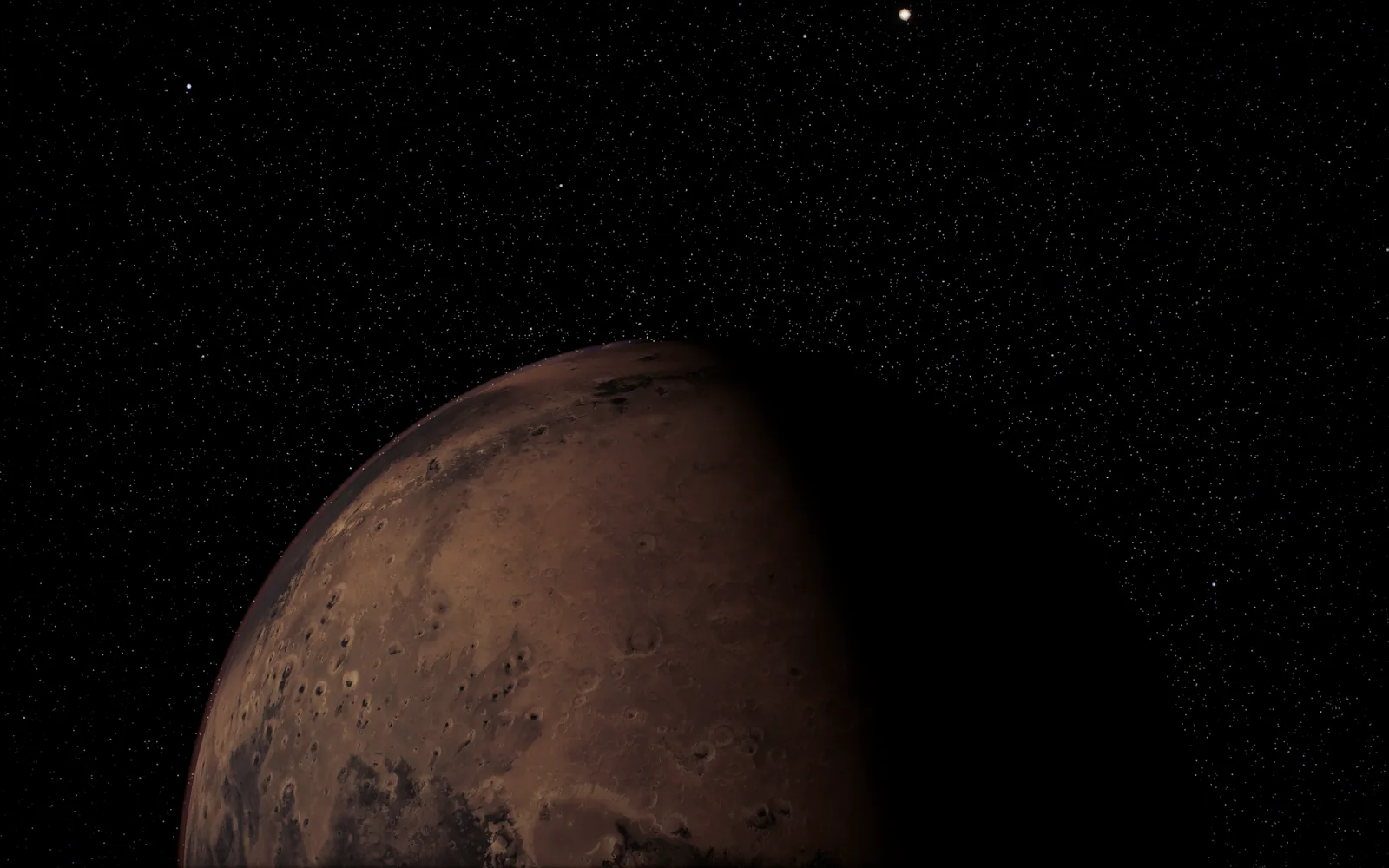
A thin cold sky
95% carbon dioxide, 2.8% nitrogen, 2% argon, with traces of oxygen and water vapour. Surface pressure is just 0.6% of Earth's — too thin for liquid water to be stable except in transient brines. Dust storms can grow to engulf the entire planet for weeks at a time.
Surface
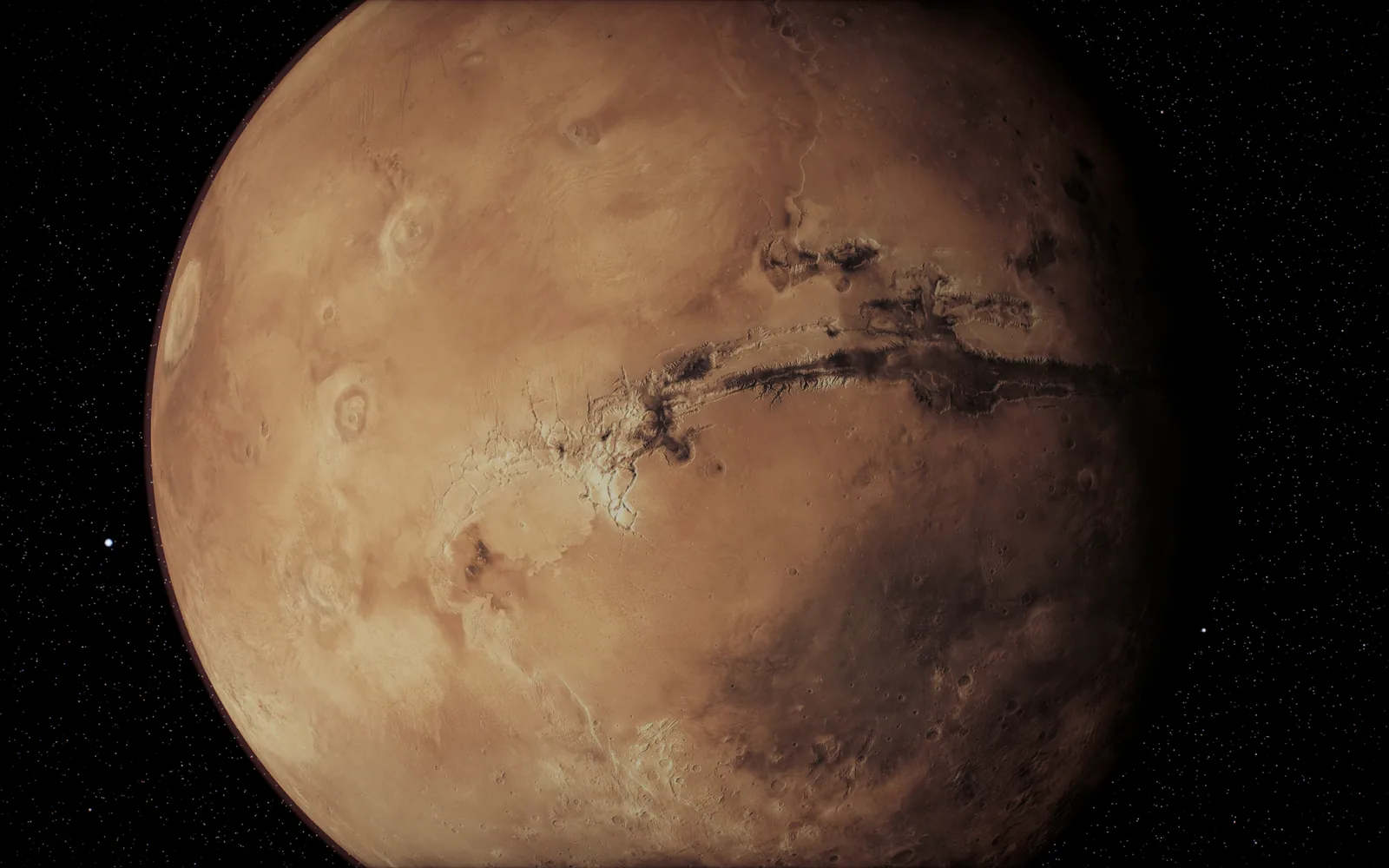
Red dust and giant volcanoes
Vast volcanic plains, ancient riverbeds, polar ice caps of frozen water and CO₂, and impact craters. Recurring slope lineae — dark streaks that appear seasonally — were once thought to be flowing water but are now interpreted mostly as dry granular flows.
Interior
Layers, drawn to scale
A partly molten silicate mantle and a liquid iron-sulfur core ~1,830 km in radius (confirmed by NASA's InSight lander seismic data, 2018–22). Mars lacks a global magnetic field today, though crustal magnetism preserves evidence of an ancient one.
Formation
How it formed
Formed roughly 4.5 billion years ago from the same protoplanetary disc as Earth. Its smaller size meant faster cooling — Mars lost most of its internal heat and atmospheric retention within its first billion years.
Orbit
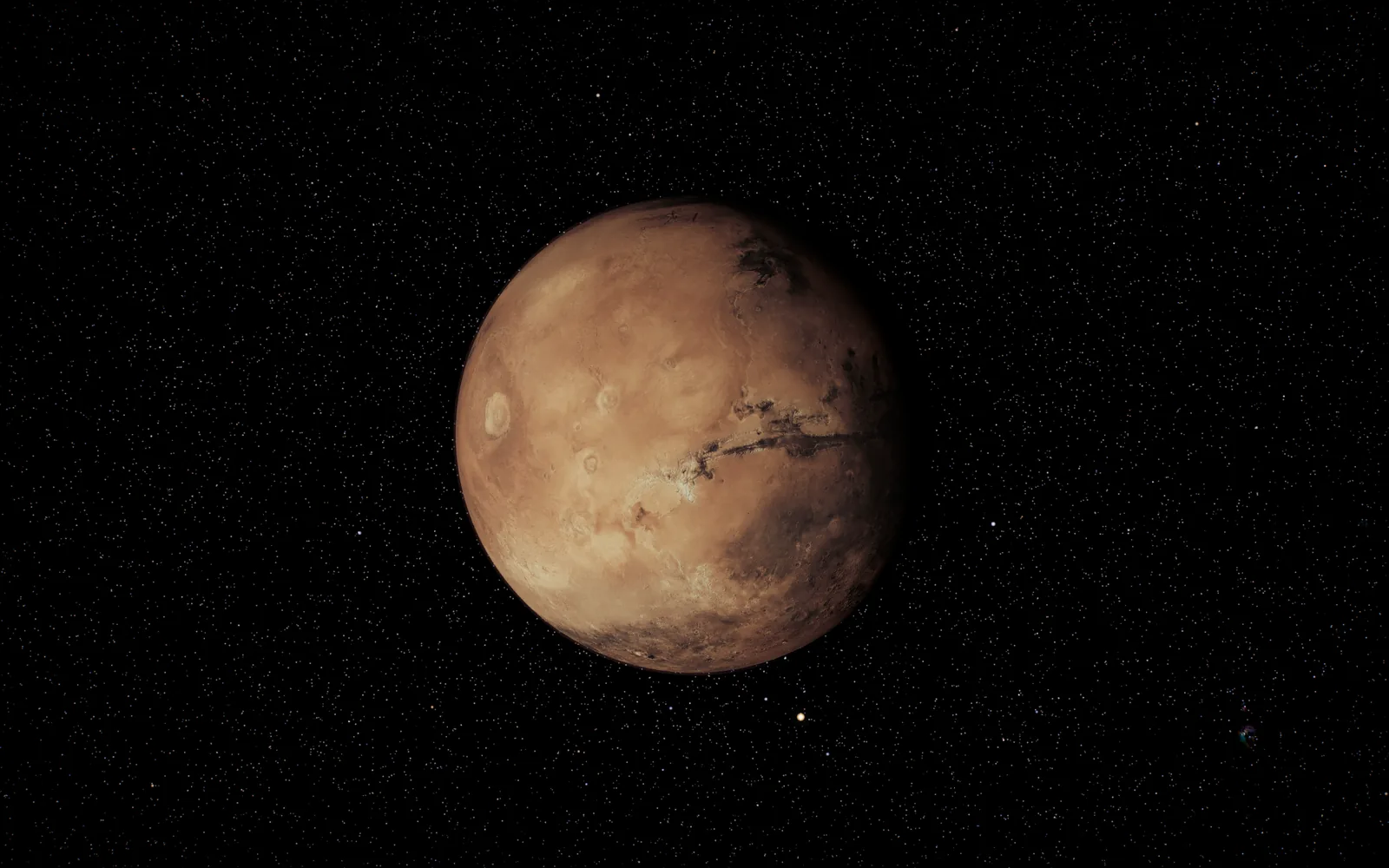
Where Mars is today
Average distance from the Sun: 227.9 million km (1.52 AU). Eccentricity 0.0934 — its distance from the Sun varies considerably across the year. Axial tilt 25.19°, similar to Earth's, so Mars has seasons too.
Sunlight takes
13 min 1.7 s
to reach Mars, and its reflected light needs 13 min 27.4 s more to reach us.
Missions
Who has been to look
- 1965Mariner 4Past
First successful Mars flyby; killed off the canals-of-Mars hypothesis with cratered photographs.
- 2012–CuriosityActive
Climbing Mount Sharp in Gale crater, sampling sediments laid down when the crater held a lake.
- 2021–Perseverance / IngenuityActive
Caching samples for a future return mission; Ingenuity flew the first powered flight on another planet (now retired Jan 2024).
Go further
See it for yourself
Fly to Mars in 3D
Olympus Mons is roughly two and a half times the height of Mount Everest measured from sea level — but its base is so wide (600 km) that if you stood on it, the slope would feel almost flat. In the viewer the volcano renders to scale on Mars's surface texture.
Keep Mars on your screen
Set the screensaver to one world and it stays with Mars: the whole disc, a close pass, the day-night line, all where it really is right now.
Questions
Asked about Mars
How long would it take to get to Mars?
Roughly 6–9 months on a Hohmann transfer; the launch window opens about every 26 months.
Is there water on Mars?
Yes — abundant water ice in the polar caps and subsurface, plus seasonal frost. Liquid water is unstable on the surface today but flowed there billions of years ago.
How many moons does Mars have?
Two: Phobos and Deimos. Both are small, irregularly shaped, and likely captured asteroids.
Read more
Other bodies
- Sun Star
- Mercury Terrestrial Planet
- Venus Terrestrial Planet
- Earth Terrestrial Planet
- Jupiter Gas Giant
- Saturn Gas Giant
- Uranus Ice Giant
- Neptune Ice Giant
- Pluto Dwarf Planet
Sources & methodology
Numbers cross-referenced with the sources below; surface and atmosphere descriptions reflect findings as of October 2026. Renderings in the 3D viewer use textures based on Solar System Scope and NASA imagery.