
Terrestrial Planet
Mercury.
The smallest planet and the closest to the Sun, with an iron core that fills most of it.
Mercury right now
- From Earth right now
- 163,532,060 km
- Its light reaches us after
- 9 min 5.5 s
- From the Sun
- 67,954,516 km
- Speed around the Sun
- 40.18 km/s
- Around its orbit
- 61% of the way from perihelion
Worked out in your browser from JPL's orbital elements, the same maths that moves the planets in the 3D viewer. How far Mercury is from Earth right now, with miles, AU and the next close approach.
Overview
Mercury at a glance
Mercury is the smallest planet in the solar system and the closest to the Sun, completing an orbit every 88 Earth days at an average distance of 57.9 million km. Its diameter of 4,879 km is barely larger than Earth's Moon. With essentially no atmosphere to retain heat, the dayside reaches 430 °C while the nightside falls below −180 °C — the steepest temperature swing of any planet.
- Diameter
- 4,879 km
- From the Sun
- 57.9M km
- Year
- 88 days
- Axial tilt
- 0.034°
- Moons
- 0
- Type
- Terrestrial Planet
Size, to scale
Atmosphere
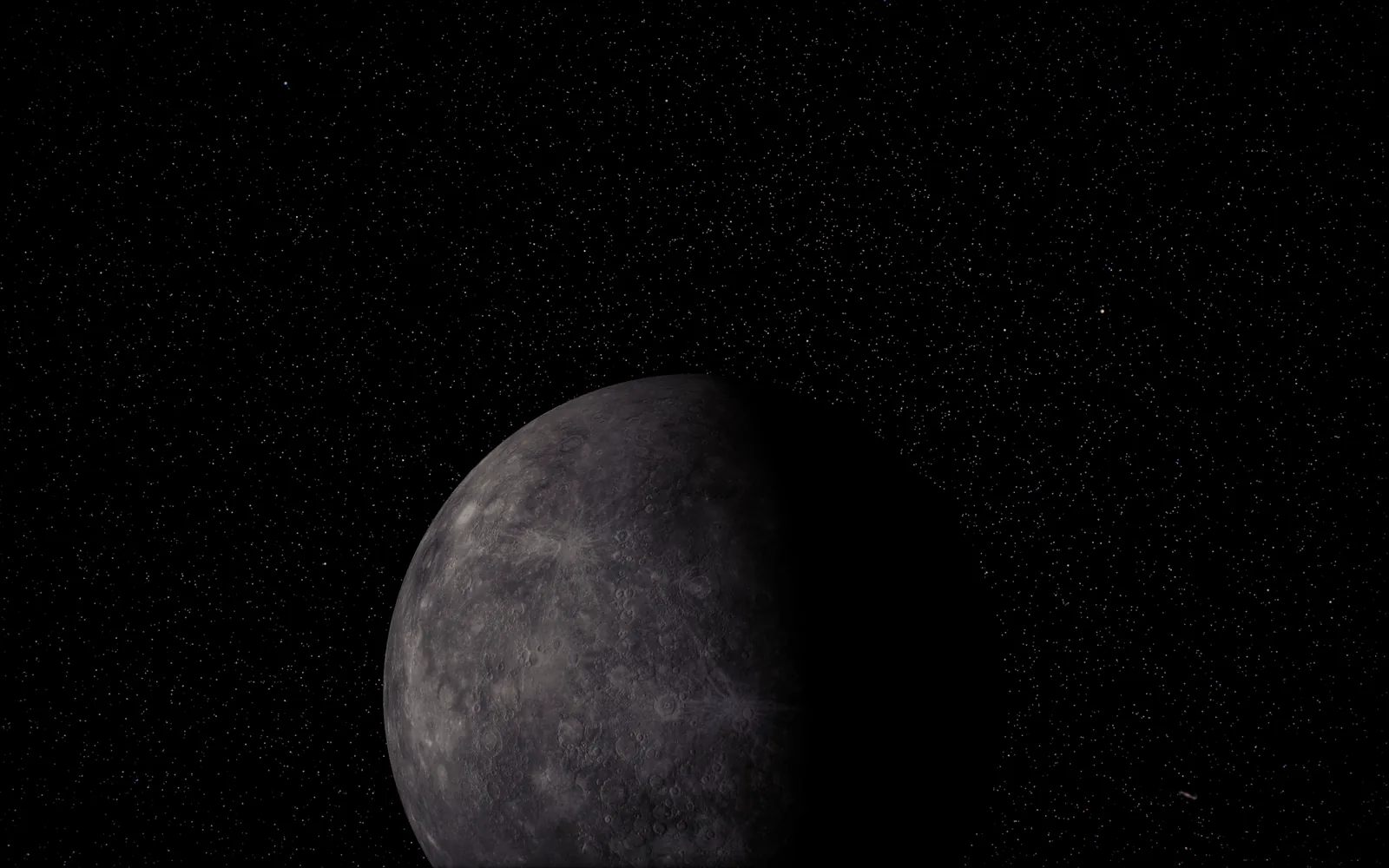
Almost no air
Mercury has only an exosphere — a wisp of hydrogen, helium, oxygen, sodium and potassium atoms knocked loose by the solar wind and micrometeoroid impacts. There is no weather, no sound, and no greenhouse effect to even out the temperature.
Surface
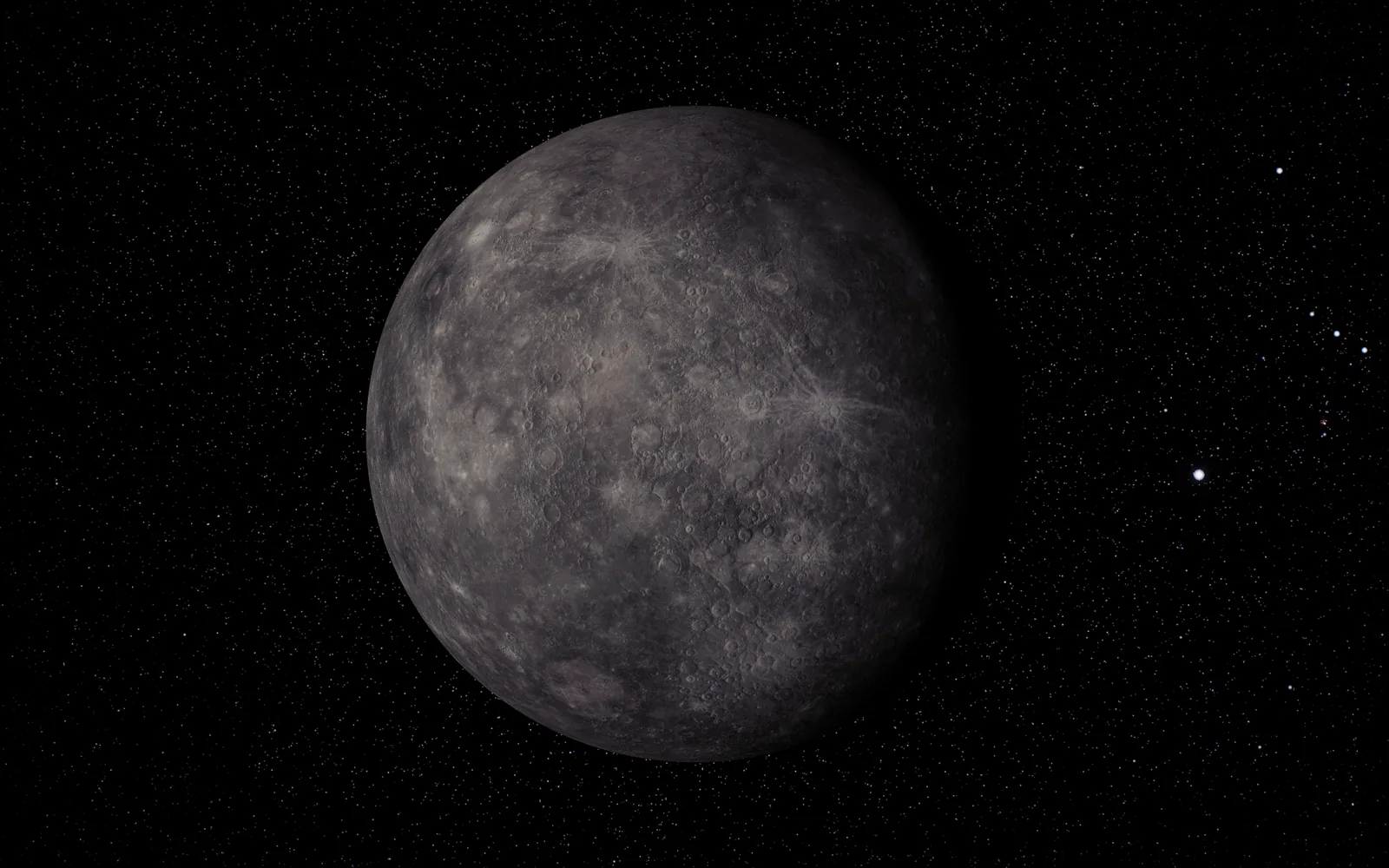
A cratered world
Heavily cratered and visually similar to Earth's Moon. The Caloris Basin, a 1,550-km impact crater, is one of the largest in the solar system. Long lobate scarps cut across the planet — wrinkles formed as the iron core cooled and the whole planet shrank by an estimated 7 km in radius.
Interior
An iron heart, to scale
Mercury has the largest iron core relative to size of any planet — roughly 85% of its radius. That oversized core is why Mercury, alone among the inner planets besides Earth, sustains a global magnetic field, though only about 1% as strong as Earth's.
Formation
How it formed
Mercury likely formed in roughly its current location 4.5 billion years ago. One leading theory says a giant impact stripped away most of its rocky mantle, leaving the disproportionately huge iron core behind.
Orbit
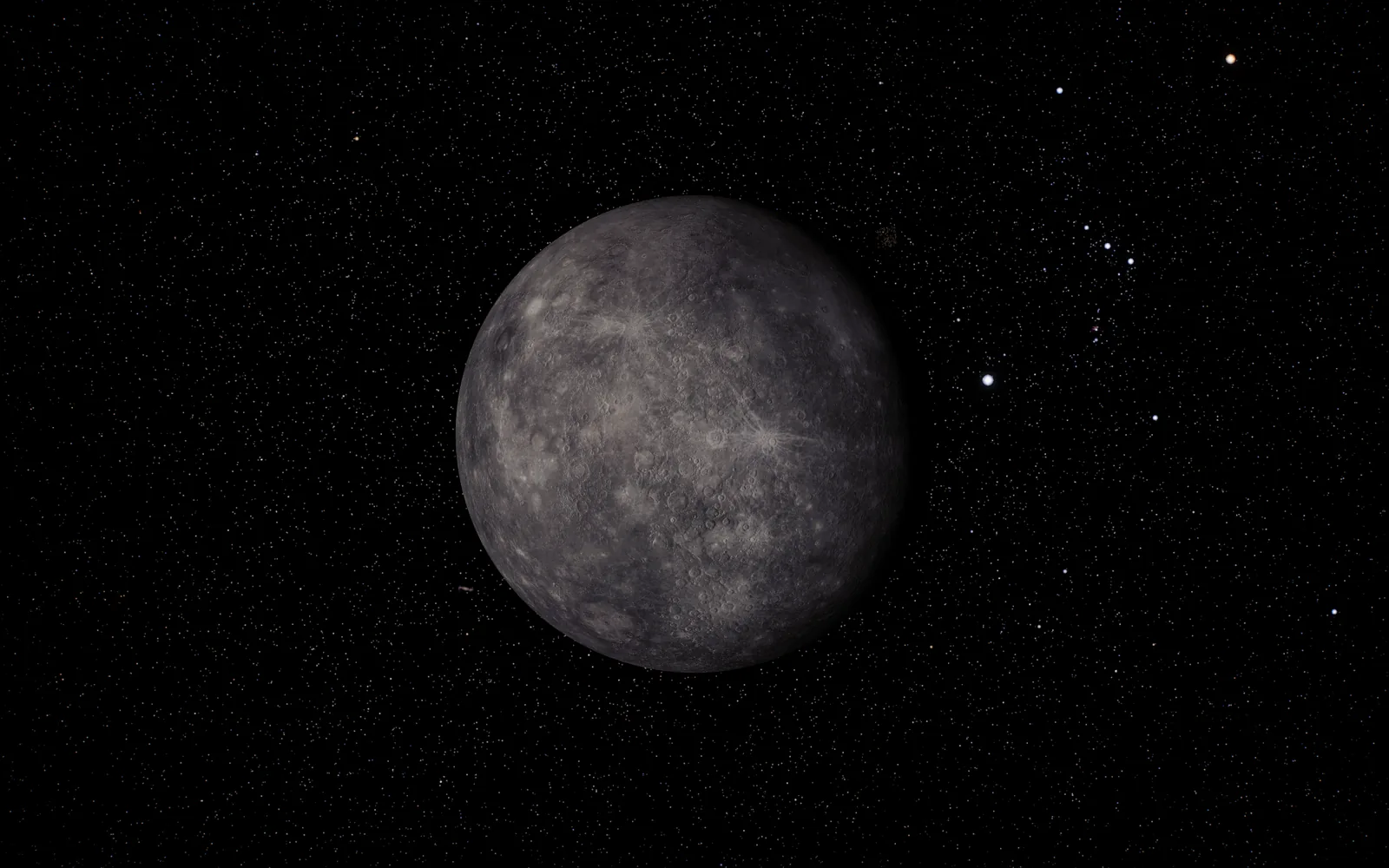
Where Mercury is today
Mercury's orbit is the most eccentric of any planet (e = 0.205) and tilted 7° from the ecliptic. Its 3:2 spin–orbit resonance — three rotations every two orbits — was only discovered in 1965; before that, astronomers wrongly assumed it was tidally locked.
Sunlight takes
3 min 46.7 s
to reach Mercury, and its reflected light needs 9 min 5.5 s more to reach us.
Missions
Who has been to look
- 1974–75Mariner 10Past
First close-up photographs; mapped 45% of the surface during three flybys.
- 2011–15MESSENGERPast
First orbiter; confirmed water ice in permanently shadowed polar craters.
- 2018–2026BepiColomboEn route
ESA / JAXA dual-orbiter mission, scheduled to enter Mercury orbit in late 2026.
Go further
See it for yourself
Fly to Mercury in 3D
A solar day on Mercury (sunrise to sunrise) lasts 176 Earth days — twice its 88-day year. In this viewer's real-time simulation Mercury laps the Sun more than four times every Earth year you watch.
Keep Mercury on your screen
Set the screensaver to one world and it stays with Mercury: the whole disc, a close pass, the day-night line, all where it really is right now.
Questions
Asked about Mercury
Is Mercury the hottest planet?
No — Venus is hotter despite being further from the Sun, because its thick CO₂ atmosphere traps heat. Mercury has no atmosphere to do that.
How long is a year on Mercury?
88 Earth days.
Does Mercury have moons?
No.
Read more
Other bodies
- Sun Star
- Venus Terrestrial Planet
- Earth Terrestrial Planet
- Mars Terrestrial Planet
- Jupiter Gas Giant
- Saturn Gas Giant
- Uranus Ice Giant
- Neptune Ice Giant
- Pluto Dwarf Planet
Sources & methodology
Numbers cross-referenced with the sources below; surface and atmosphere descriptions reflect findings as of October 2026. Renderings in the 3D viewer use textures based on Solar System Scope and NASA imagery.