Ranked · Updated November 2026
The largest moons in the solar system.
Ganymede, a moon of Jupiter, is the largest moon in the solar system at 5,262 km across, wider than the planet Mercury. The second largest is Saturn's Titan, at 5,150 km. The eight planets have 456 confirmed moons between them (JPL, October 2026), and Pluto has five more. Here are the 20 largest moons of the planets and Pluto, ranked by diameter.
Open the 3D viewer →The 20 largest moons, ranked
| Rank | Moon | Planet | Diameter |
|---|---|---|---|
| 1 | Ganymede | Jupiter | 5,262 km |
| 2 | Titan | Saturn | 5,150 km |
| 3 | Callisto | Jupiter | 4,821 km |
| 4 | Io | Jupiter | 3,643 km |
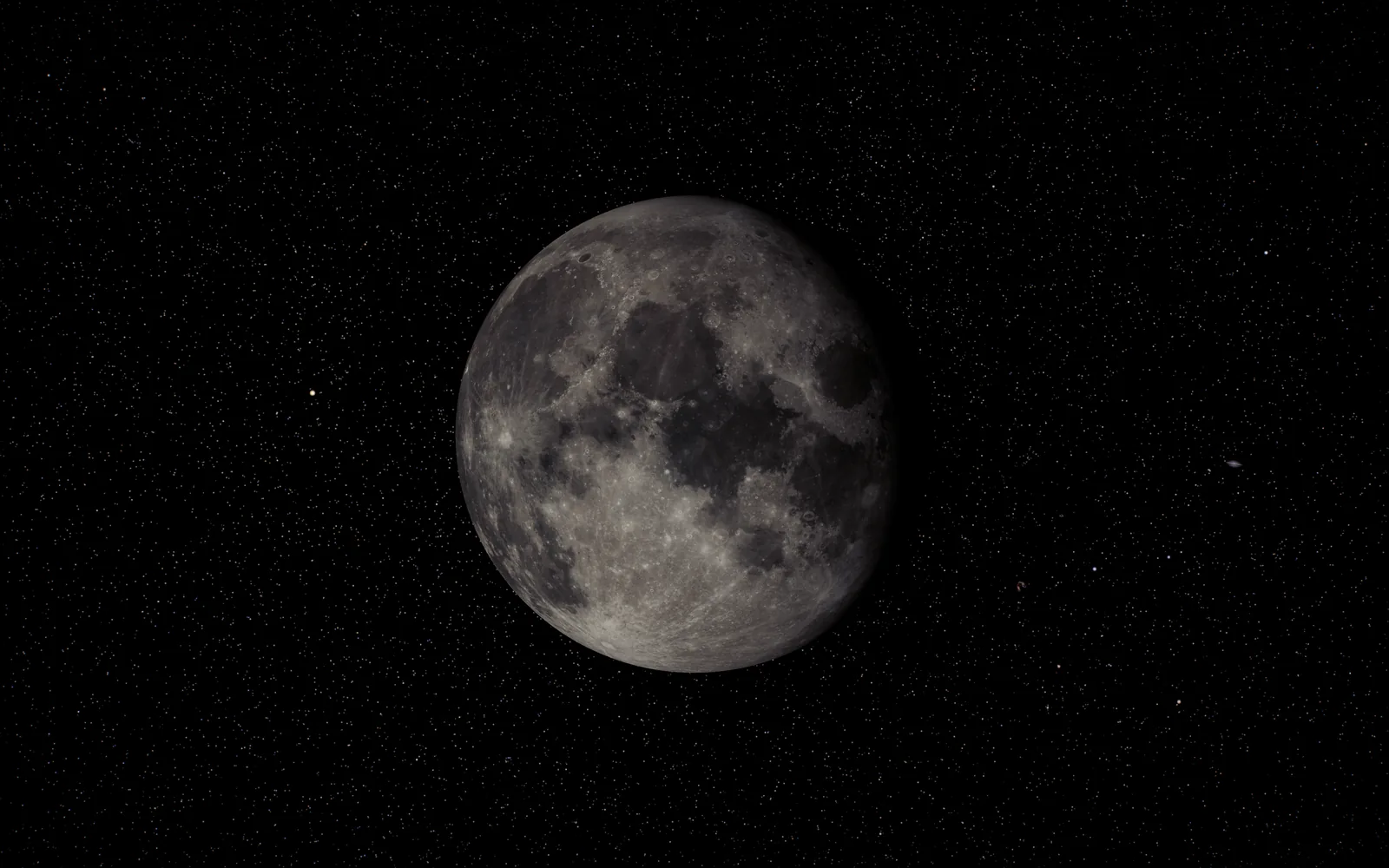
| 5 | The Moon | Earth | 3,475 km |
| 6 | Europa | Jupiter | 3,122 km |
| 7 | Triton | Neptune | 2,705 km |
| 8 | Titania | Uranus | 1,578 km |
| 9 | Rhea | Saturn | 1,527 km |
| 10 | Oberon | Uranus | 1,523 km |
| 11 | Iapetus | Saturn | 1,469 km |
| 12 | Charon | Pluto | 1,212 km |
| 13 | Umbriel | Uranus | 1,169 km |
| 14 | Ariel | Uranus | 1,158 km |
| 15 | Dione | Saturn | 1,123 km |
| 16 | Tethys | Saturn | 1,062 km |
| 17 | Enceladus | Saturn | 504 km |
| 18 | Miranda | Uranus | 472 km |
| 19 | Proteus | Neptune | 416 km |
| 20 | Mimas | Saturn | 396 km |
Diameters are twice the mean radius in JPL's table of planetary satellites, which covers the moons of the planets and Pluto. There is a big drop after Tethys: the next moon down in that table, Enceladus, is less than half as wide.
Moons of the more distant dwarf planets are measured far less precisely, but two would make this list. Eris's moon Dysnomia is about 700 km across (give or take 115 km, from ALMA's thermal images), which would put it between Tethys and Enceladus. Orcus's moon Vanth is about 443 km across, from the way it blocked a star in 2017, which would put it between Miranda and Proteus.
The top ten up close
- 5,262 km Ganymede Larger than Mercury. Has its own magnetic field.
- 5,150 km Titan Only moon with a substantial atmosphere; methane lakes on the surface.
- 4,821 km Callisto Most heavily cratered object in the solar system.
- 3,643 km Io Most volcanically active body known.
- 3,475 km Moon Largest moon relative to its planet (Pluto-Charon excepted).
- 3,122 km Europa Subsurface ocean. Prime astrobiology target.
- 2,705 km Triton Only large moon with a retrograde orbit.
- 1,578 km Titania Largest moon of Uranus, crossed by fault canyons up to about 1,500 km long.
- 1,527 km Rhea Saturn's second-largest moon.
- 1,523 km Oberon Outermost major moon of Uranus.
Bigger than a planet
Two moons are wider than the planet Mercury (4,879 km): Ganymede and Titan. Neither comes close to it in mass. From the gravity figures in JPL's and NASA's tables, Ganymede has about 45% of Mercury's mass and Titan about 41%, because both are far less dense: about 1.9 g/cm³, against Mercury's 5.4 g/cm³.
Seven moons are wider than the dwarf planet Pluto (2,377 km): Ganymede, Titan, Callisto, Io, our Moon, Europa and Triton. Jupiter alone holds four of the six largest, the moons Galileo found in 1610.
Largest compared with their planet
Our Moon is the fifth-largest moon, and it is big for the size of its planet: at 3,475 km it is 27% of Earth's width. Charon goes further. At half the size of Pluto, it is the largest known satellite relative to its parent body. Ganymede, by comparison, is less than 4% of Jupiter's width.
Worlds in their own right
Titan has a nitrogen atmosphere with a surface pressure about 60% higher than Earth's, and rivers, lakes and seas of liquid methane and ethane. Io is the most volcanically active world in the solar system, with hundreds of volcanoes. Scientists believe Europa has a salty ocean under its ice holding twice as much water as Earth's oceans; NASA's Europa Clipper launched on 14 October 2024 to study it.
Callisto has the oldest and most heavily cratered surface in the solar system. Ganymede is the only moon known to have its own magnetic field. Triton is the only large moon that orbits in the opposite direction to its planet's spin; scientists believe it is a Kuiper Belt object captured by Neptune's gravity, and Voyager 2 found active geysers on it in 1989. Titania, the largest moon of Uranus, is crossed by fault valleys up to about 1,500 km long: Messina Chasmata runs 1,492 km.
See every moon in our guide to the moons, or fly out to them in the 3D viewer.
Frequently asked questions
What is the largest moon in the solar system?
Ganymede, a moon of Jupiter, at 5,262 km across. It is bigger than the planet Mercury and the dwarf planet Pluto.
Is Titan bigger than Ganymede?
No. Titan is 5,150 km across, about 112 km less than Ganymede, which makes it the second-largest moon.
Where does our Moon rank?
Fifth, at 3,475 km across, after Ganymede, Titan, Callisto and Io.
Which planet has the largest moons?
Jupiter. Four of the six largest moons are its own: Ganymede, Callisto, Io and Europa.
How many moons are there in the solar system?
The eight planets have 456 confirmed moons (JPL, October 2026): 293 at Saturn, 115 at Jupiter, 29 at Uranus, 16 at Neptune, 2 at Mars and 1 at Earth. Pluto has 5 more.
Sources
- NASA JPL: Planetary Satellite Physical Parameters, mean radii, gravity (GM) and densities
- NASA JPL: Planetary Satellite Discovery Circumstances, moon counts and discovery years (read 15 October 2026)
- NASA NSSDC: Planetary Fact Sheet, planet diameters and densities
- NASA NSSDC: Mercury Fact Sheet, Mercury's GM
- NASA Science: Ganymede facts
- NASA Science: Titan facts
- NASA Science: Io facts
- NASA Science: Callisto facts
- NASA Science: Europa
- NASA Science: Triton
- NASA Science: Charon
- NASA Science: Titania, fault valleys "some nearly 1,000 miles" long
- IAU / USGS Gazetteer of Planetary Nomenclature: Messina Chasmata, 1,492 km (listed as its diameter)
- Brown and Butler (2018): Medium-sized satellites of large Kuiper belt objects, The Astronomical Journal 156, 164, Dysnomia's diameter, 700 ± 115 km
- Sickafoose et al. (2019): A stellar occultation by Vanth, a satellite of (90482) Orcus, Icarus 319, 657, Vanth's diameter, 443 ± 10 km
- NASA Science: Pluto facts