
Screensaver · The black hole
A black hole screensaver, traced ray by ray.
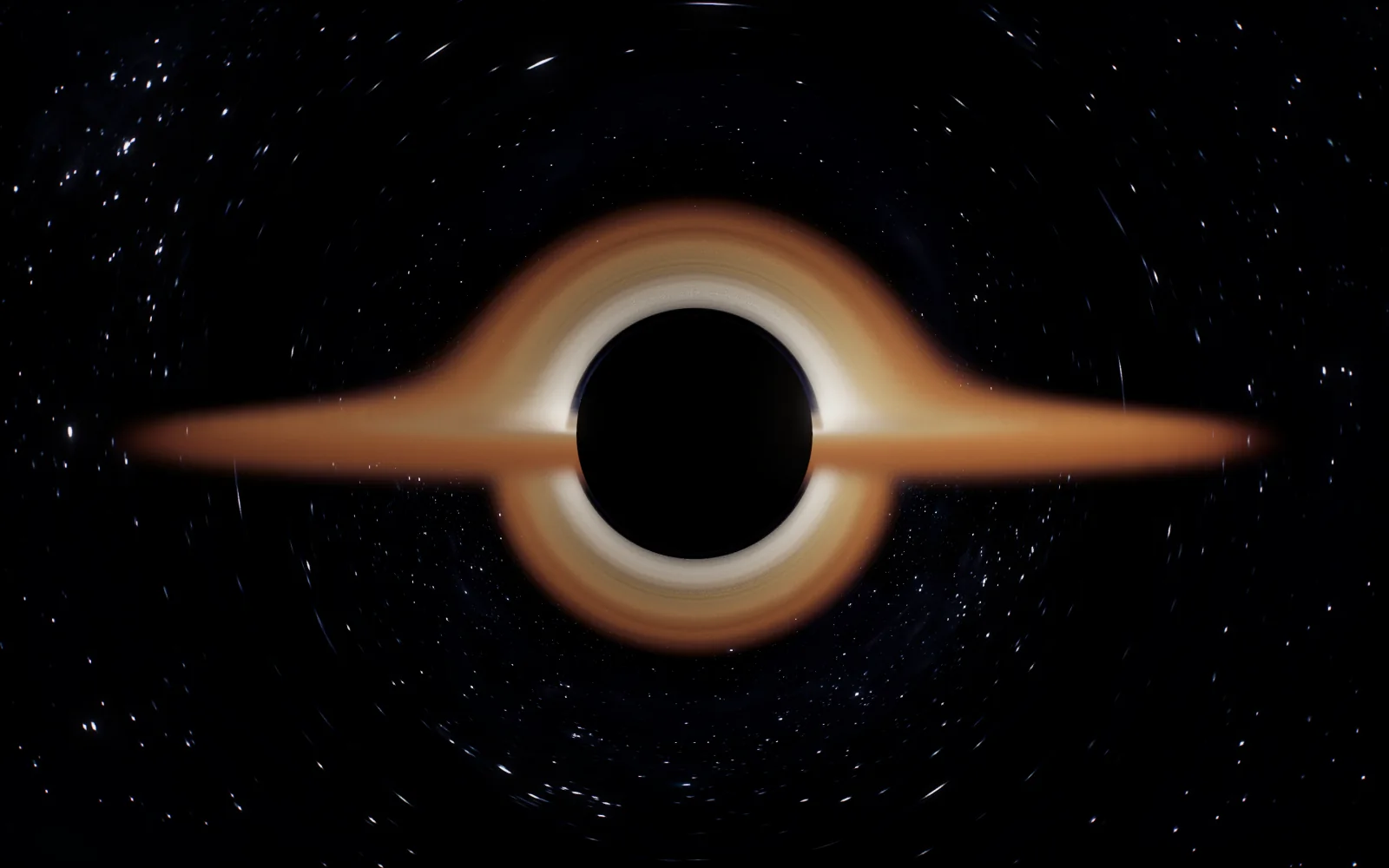
When your computer goes idle, a black hole fills the screen, a disc of glowing gas bent over and under its shadow by gravity. Every pixel is traced through the curved space round it, every frame, from Einstein’s equations for a black hole that doesn’t spin.
One purchase, the whole screensaver and all seven shows · Mac, Windows and Linux · Runs offline
What you’re looking at
Every bit of it is light that gravity has bent.
A black hole gives off no light of its own, so everything you see comes from around it: the disc of gas circling it, and the stars and the Milky Way behind it, every ray pulled off its straight line on its way to you.1
The screensaver runs that in reverse. For each pixel it sends a ray out from your screen and steps it through the hole’s gravity up to 180 times, picking up the glow of the disc wherever the ray crosses it and the light of the sky wherever it ends up pointing, or leaving the pixel black when the hole keeps it. It’s the approach Kip Thorne and the effects team behind the film Interstellar described in 2015, light followed through curved space, theirs round a spinning black hole and ours round one that doesn’t.2
01 · The shadow
The dark disc is wider than the black hole.
The event horizon is the point of no return, and for a black hole that doesn’t spin it’s a sphere whose radius is called the Schwarzschild radius. The shadow you see is bigger than that. Light passing close gets bent in as well, so any ray aimed within about 2.6 Schwarzschild radii of the centre ends up falling in, and from far away that whole region reads as black.3 The screensaver draws its shadow from that same line, so it’s the true size for the hole.
It’s the dark centre the Event Horizon Telescope found inside a ring of glowing gas round M87* in 2019, and round Sagittarius A*, the black hole at the middle of the Milky Way, in 2022.3,4
02 · The photon ring
A hairline where light goes round and comes back out.
- Rays wound round the photon sphere
- Photon sphere, 1.5 rs, and the shadow’s edge, 2.6 rs
At one and a half Schwarzschild radii, gravity bends light into a circle, which is called the photon sphere. Nothing stays on it for long: a ray a touch inside spirals in and a ray a touch outside comes back out, but the rays that skim it go round once, twice or more before they leave.5,1
Each half lap carries another picture of the whole sky, squeezed into a ring narrower and fainter than the one outside it, and stacked at the edge of the shadow they make a bright hairline.6 The screensaver draws that stack as a brightening of the rays that skim the edge, so the hairline is there in every frame.
- 4%
- The light in each ring next to the one outside it (e−π)6
03 · Lensing
The stars behind it, bent round its edge.
Gravity bends every ray of light that passes a mass, and the closer it passes the more it bends. Even the Sun does it: Einstein’s theory said starlight grazing its edge would bend by 1.75 arcseconds, and the expeditions to the eclipse of May 1919 measured 1.98 and 1.61, close enough to back him.7
Near a black hole the bending is strong enough that a star behind it shows up twice, once on each side of the shadow, and a star lined up exactly behind it spreads into a full circle, an Einstein ring.2,5,8 In the show the stars and the Milky Way behind the hole are bent the same way, and as the camera drifts slowly round, they slide along arcs round the shadow.
04 · The disc
Gas lit gold, lifted over the shadow.
Gas drawn towards a black hole settles into a flat disc churning round it, the accretion disc. Seen nearly edge-on you’d expect a thin line across the hole, but light from the top of the disc’s far side is bent up into an arch over the shadow, and light from its underside into another arch below.1,9 Jean-Pierre Luminet worked out what that looks like in 1979, down to a simulated photograph.10
The screensaver’s disc is a volume of glowing gas, a thin bright layer with a soft haze above and below it, running from 2.6 to 12 Schwarzschild radii out. Its inner gas goes round faster than its outer gas, as it does round a real hole, and it runs white-hot at the inner edge, through gold and orange, to a deep red at the rim.9
In a real disc the gas coming towards you looks brighter and bluer and the gas going away dimmer and redder, which is why the Event Horizon Telescope’s picture of M87* is brighter on one side.1,3 The film Interstellar left those shifts out, because a fully realistic disc came out so lopsided that the shadow was hard to make out.2 The screensaver keeps a gentle version, so the side coming towards you is brighter without washing out the other, and the light from nearest the hole is dimmed for its climb out of the gravity.
- 2.6 to 12
- Schwarzschild radii: where the screensaver’s disc runs
- 1979
- Luminet’s simulated photograph of a black hole and its thin disc10
Straight from the screensaver
Every picture here is the screensaver itself.


One purchase, every show
The black hole comes with the whole solar system.
It’s one of seven shows in the Solar System screensaver, and the one purchase gets you all of them. Pick one under Options in System Settings and it stays on that until you change it.
-

Grand tour
From the Sun out past Neptune, over the Earth’s night side and its city lights, then out to the Milky Way and a black hole, each move one continuous flight.
-

One planet
One world from the Sun to Pluto, in the view you choose: the whole disc, the top half filling the screen, a crescent, low over the limb, or a slow orbit through day and night.
-
The ISS from outside
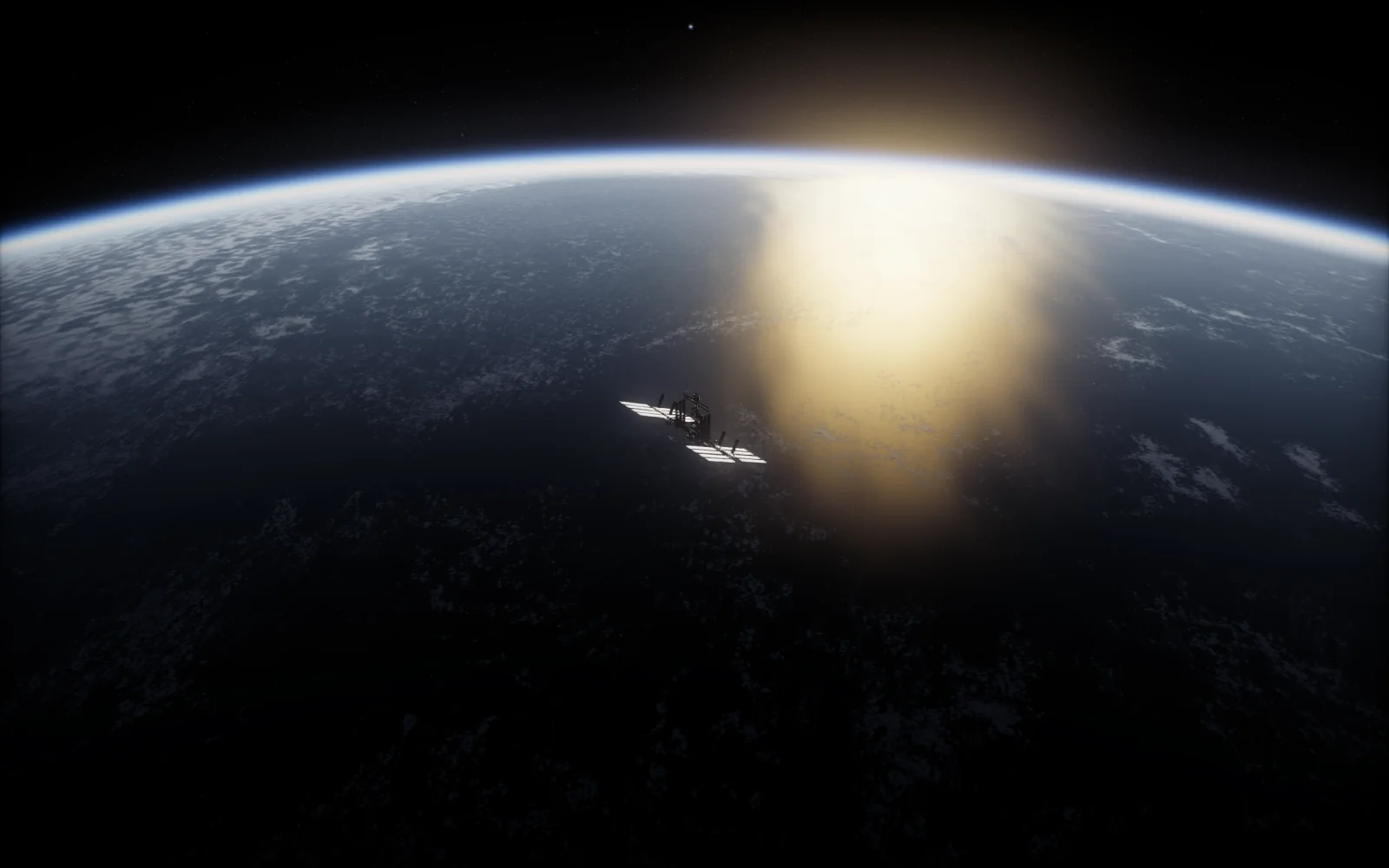
The space station on its real orbit, framed from behind and above with the horizon level, the camera drifting slowly round it.
-

Inside the ISS Cupola
Inside the station’s seven-window Cupola, looking out towards the horizon, your head resting on one side window and then the next.
-

The Milky Way
Our galaxy from outside: from high above, tilted, close and low over its disc, and face-on, held long and turning slowly.
-

Famous space photos, live
Famous pictures from space as live views, the camera where the spacecraft was and the clock running on from the moment it took the photo.
The price
Once, for the lot.
$1.99one time
- The black hole and the six other shows
- Free updates: your download always gives you the latest version
- Runs offline, everything is inside the download
- Mac, Windows and Linux, all included
Pay through Stripe’s checkout by card, Apple Pay or Google Pay, and your download is on the next page. On a Mac, double-click Solar System.saver, choose it in System Settings under Screen Saver, then press Options and pick The black hole. On Windows, run the installer; on Linux, install the .deb or run the AppImage.
Questions
Good to know.
Is it a real black hole?
Its light bending is real: it’s the simplest kind of black hole general relativity allows, one that doesn’t spin, described by the solution Karl Schwarzschild found in 1916, and the shadow and the way the disc and the stars bend round it are what that solution says you’d see.3 The disc itself is drawn for the picture. Its swirls are patterns that turn with the orbits, its colour runs from white-hot to deep red by choice, and its Doppler brightening is turned down.
Where does the look come from?
From the physics. Light is followed through the curved space round the hole, the approach James, von Tunzelmann, Franklin and Thorne described for the film Interstellar, whose black hole spins, here for one that doesn’t.2 Every frame comes out of our own engine, nothing is taken from the film, and the screensaver has no connection with it.
Can I show only the black hole?
Yes. On a Mac, choose Solar System in System Settings under Screen Saver, press Options and pick The black hole. On Windows, press Settings in the Screen Saver dialog; on Linux, open Solar System Screensaver from your app menu. The grand tour ends at a black hole too, a smaller one without a disc, after the Milky Way.
Can I see it before I buy?
Yes, the same show runs in your browser. Watch it live in a new tab, and close the tab when you’re done.
I already bought the screensaver. Do I have the black hole?
Yes, it’s the same screensaver. Download it again from your thanks page or your account and you get the latest version, every show included.
Will my computer keep up?
The disc is the heaviest thing the screensaver draws: every pixel steps its light through the hole’s gravity up to 180 times, every frame. So on an older computer it may run less smoothly than the planet shows, which are much lighter.
What does it run on?
Mac: macOS 12 Monterey or later, Apple silicon or Intel. Windows: Windows 10 or 11, on Intel, AMD or Arm. Linux: 64-bit Intel, AMD or Arm, as an AppImage or a .deb for Ubuntu and Debian. One purchase covers all three.
Does it need an internet connection?
No. Everything it needs is inside the download, so it runs offline. When you’re online, the two ISS shows also fetch the station’s latest orbit.
Solar System Screensaver for Mac, Windows and Linux
Put a black hole on your screen.
Sources
- NASA Science, Black Hole Anatomy
- James, von Tunzelmann, Franklin and Thorne (2015), Gravitational lensing by spinning black holes in astrophysics, and in the movie Interstellar, Classical and Quantum Gravity 32, 065001
- Event Horizon Telescope Collaboration (2019), First M87 Event Horizon Telescope Results. I. The Shadow of the Supermassive Black Hole, The Astrophysical Journal Letters 875, L1
- Event Horizon Telescope Collaboration (2022), First Sagittarius A* Event Horizon Telescope Results. I. The Shadow of the Supermassive Black Hole in the Center of the Milky Way, The Astrophysical Journal Letters 930, L12
- Virbhadra and Ellis (2000), Schwarzschild black hole lensing, Physical Review D 62, 084003
- Johnson et al. (2020), Universal interferometric signatures of a black hole's photon ring, Science Advances 6, eaaz1310
- Dyson, Eddington and Davidson (1920), A Determination of the Deflection of Light by the Sun’s Gravitational Field, Philosophical Transactions of the Royal Society A 220, 291
- NASA Science, Hubble's Gravitational Lenses
- Reddy, NASA Goddard Space Flight Center (2019), NASA Visualization Shows a Black Hole's Warped World
- Luminet (1979), Image of a Spherical Black Hole with Thin Accretion Disk, Astronomy and Astrophysics 75, 228
The black hole in the screensaver is our own render, made by tracing light through the Schwarzschild solution in a shader. It is not taken from any film and has no connection with one.