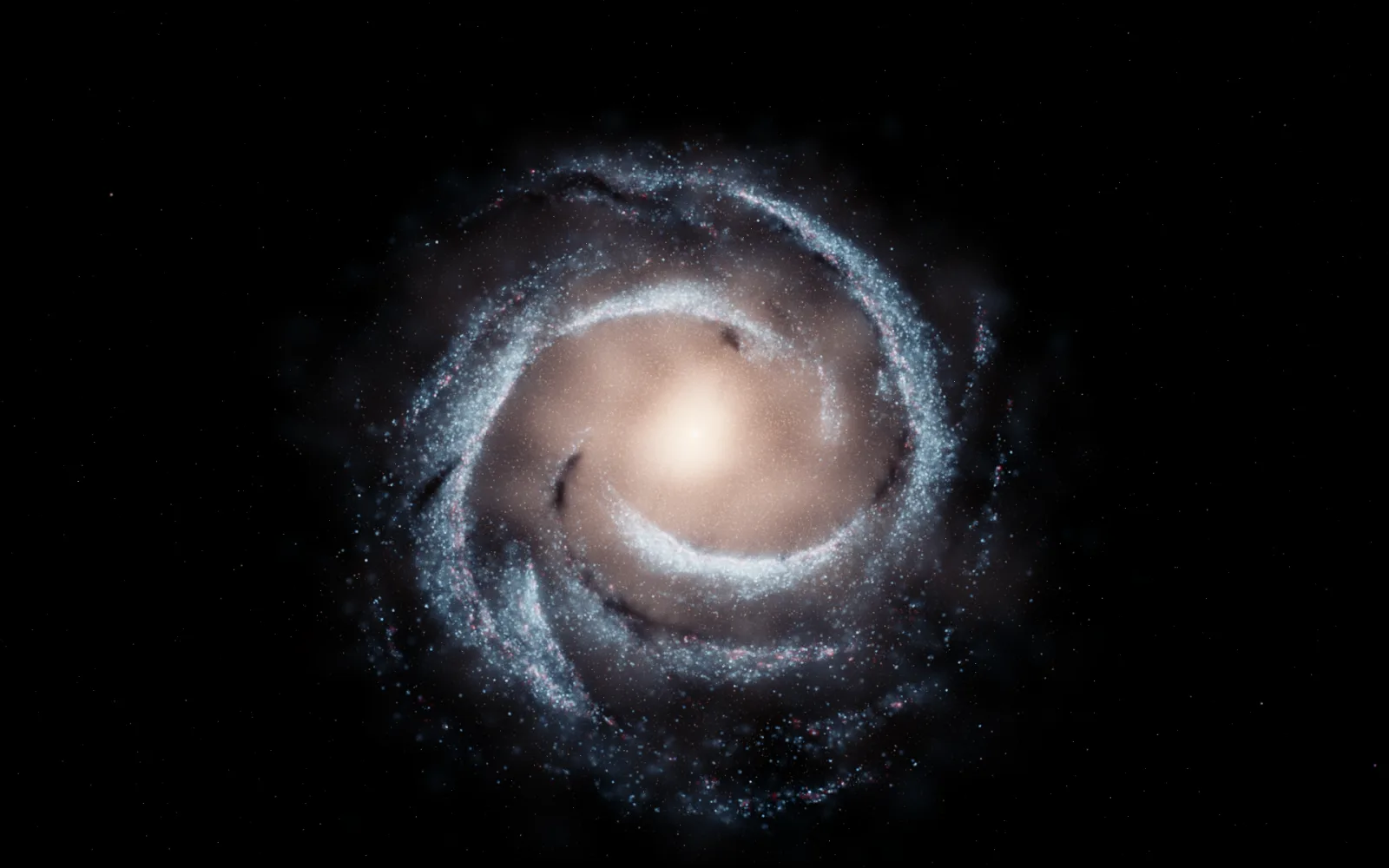
Pull back far enough in the viewer, past the planets and past the nearby stars, and the Milky Way comes into view from outside. It's in the screensaver's grand tour, it has a show of its own, and as of this week it's a completely new galaxy, built as real 3D structure out of stars, gas and dust. Getting there took three attempts.
A painting from one side and stripes from every other
We live inside our own galaxy, so its shape has to come from measurements and its look from photographs of other spirals. The first rebuild was a baked map, a carefully colored picture of the galaxy seen face-on, and every view was drawn from that one flat picture. From above it read as a painting, and from the side it smeared out into stripes, so the original star sprites went back in. The second attempt was a raymarched 3D volume, which sounded like the proper answer and read as flat anyway, so I went and looked at how people who do this seriously solve it.
Particles, the way Gaia Sky does it
Gaia Sky, the 3D explorer built around the Gaia star catalogue, draws its procedural galaxies as particles in channels: stars, HII regions, gas, dust and the bulge, each with a cap on its size (Sagristà et al. 2019, "Gaia Sky: Navigating the Gaia Catalog"). Microsoft's Galaxy Explorer does something similar, placing particles once on density-wave spirals and moving them on the GPU. That's the approach now, and the galaxy is generated from a seed, so it's the same galaxy every time you load it.
About 230,000 of the particles are stars, with a luminosity function that gives a few bright ones and a great many faint ones, colored by population: blue young stars in the arms, yellow-orange old ones in the disc, warmer still in the bulge. They only carry about a tenth of the light, though. The rest lives in clouds, which is why the galaxy reads as a smooth glow with stars resolving inside it. There are about 5,200 star-forming complexes along the arms, clumps of young-star clouds at their own heights above the disc, three in ten with pink-red HII knots by the dust lane, and another 10,000 overlapping clouds give the arms continuous light.
Dust you can see through
The dust is what makes a spiral galaxy look like one, and it was the hardest part to get right.
It's built as chains of small clouds along the inside edges of the arms, feathers crossing the gaps, broken lanes along the bar, and a smooth dust disc after Drimmel and Spergel's model. Every one of those clouds is faint, with an optical depth of a few tenths at most, so a lane only goes dark where lots of them overlap, and up close no single cloud reads as a hole. Radiative transfer simulations of Milky Way-like galaxies show dust has to be clumpy like that for lanes to read dark and ragged (Kapoor et al. 2021).
Each cloud is a soft 3D blob, a Gaussian flattened along the disc's axis, and every frame it's projected to the ellipse it makes on your screen. That's EWA splatting, from Zwicker et al. 2001, the same idea Gaussian splatting uses. Seen face-on a cloud is round, seen edge-on it's as thin as the layer it sits in, and that's the whole reason this version holds up from every side: the band, its dust lane and the bulge all come out of the same particles wherever you look from. Anything smaller than 0.7 of a pixel is widened with its light kept, so nothing shimmers.
Draw order mattered more than I expected. Light and dust share one blend, drawn back to front, so dust only dims what's behind it. The disc is cut into columns about 2.5 kiloparsecs across that get sorted by depth, and inside each column the light is drawn by height and then the dust. My first go drew everything purely by height, and edge-on the near columns' own glowing midplane covered up their dust, so the dark lane through the middle simply wasn't there.
Built from the measurements
The structure comes from the literature, mostly Bland-Hawthorn and Gerhard 2016. The thin disc has a scale height of 300 parsecs and a scale length of 2.6 kiloparsecs, the thick disc is 900 parsecs high and carries 12% of the light, and the bar sits at 27 degrees. The Sun is 8.2 kiloparsecs from the center and 25 parsecs above the plane, and the bulge is boxy and peanut-shaped, with a faint X in it.
The arms follow R. Hurt's reconstruction for NASA/JPL-Caltech: two major arms from the ends of the bar, two minor arms, the Orion spur and two outer branches. On top of those go nine seeded branches, the way M101's arms fork. Each arm leaves the bar at about 40 degrees and settles to its own pitch of 12 to 15 within a kiloparsec, so the arms wind out of the bar ends.
One fix was about where the galaxy sits. Inside the solar system the sky is a real panorama photograph with its own Milky Way band, and as you fly out the 3D galaxy fades in to take over. The old galaxy was tilted 64 degrees away from that band, so for a while you saw two bands crossing. The new disc lies in the panorama band's own plane, so the 3D band comes in exactly where the photographed one was.
Colors measured against real galaxies
Colors were matched region by region in OKLCh, a color space that tracks how we actually see lightness and hue, against photographs of M51, M101 and M31 face-on, and NGC 891 and NGC 4565 edge-on, from the bulge core out through the arms, the gaps, the dust lanes and the HII regions. The bulge core's hue in the photographs runs from 55 to 76, ours is 78, and the outer arms run 250 to 256 against our 250. The palette's chroma sits a little above the photographs' on purpose, because the tone mapping takes some of it back out.
There are known gaps. The edge-on dust lane is weaker than NGC 891's, which is why the galaxy show has no edge-on framing yet. The arm crests come out violet-white where M101's are blue, and the HII regions are sparser and pinker than M51's. From inside the disc, the real panorama photograph still looks better than ours, which is why the hand-over stays where it is.
It costs about 3 milliseconds a frame at the tour's framing on an M-series Mac, and about 5 looking along the disc. It's drawn into its own target with its own far plane, which also fixed an old bug where zooming out far enough clipped the galaxy away entirely.
Indeed, the biggest lesson was the first one. A galaxy that only looks right from one place is a picture, and the moment you can fly round it, it has to be built like the real thing.