Our Solar System
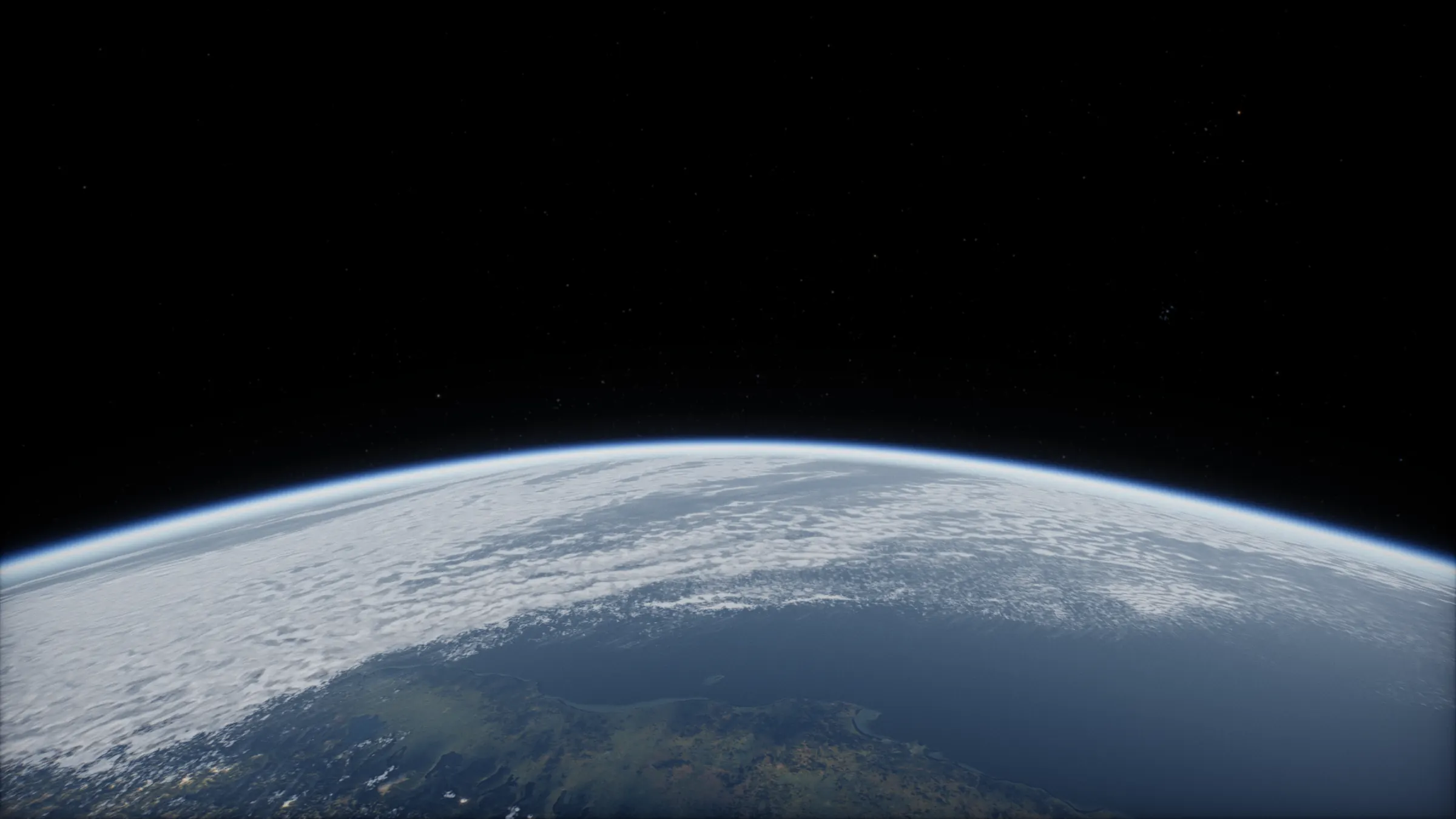
The Earth's limb from low orbit in the viewer: cloud over sea and land, and the thin blue line of the atmosphere against black space

The best 3D solar system online

The best 3D solar system matches the real one.

Our Solar System is a realistic solar system simulator that runs free in your browser, with no sign-up and nothing to install. Every planet and the Moon sit where they are this second. In our checks its planetarium put every planet within 2.2 arcseconds of where NASA JPL's Horizons system has it. The Earth zooms to 15 metre satellite imagery, with a sea calibrated against NASA's DSCOVR camera. The aurora, the Sun's spots and over 16,600 satellites follow live data from NOAA and CelesTrak.

Free in your browser. No sign-up. Phones, tablets and computers.

The physics and the data

What makes it a realistic solar system.

Two things: the planets and the Moon are where they really are, and they look the way cameras record them. Here is what is under each one, with a source for every number.

Positions

Where the planets are

The 3D viewer works out every planet from JPL's orbital elements for the exact moment on its clock.1 From 1800 to 2050 JPL gives their nominal error in each planet's longitude round the Sun as under an arcminute, except for Jupiter and Saturn at about 7 and 10 arcminutes. The Moon comes from Meeus' lunar theory,2 so its phase, its distance and every eclipse follow the date. The clock runs from 1800 to 2200, though JPL fitted the elements only to 2050.

Astronomy mode, the planetarium built into the viewer, needs more, since arcminutes show against the stars. It uses the VSOP87 planetary theory, cut down to within 1.7 arcseconds of the full series,3 with precession, nutation, aberration, light time, parallax for your place and refraction. Then we measured it.4
Astronomy mode, measured4,5,6

  • 2.2″The Sun and the planets, worst case, against JPL Horizons
  • 10.2″The Moon, worst case, against JPL Horizons
  • 0.6″The navigational stars, worst case, against the USNO
  • 0.5 minSun and Moon rise, transit and set, against the USNO

The Earth

The Earth, down to 15 metres

The Earth turns by its real rotation angle for the time on the clock, so the day side and the seasons match the date, checked against NOAA's solar position to within 0.3 degrees.13

Zoom in and NASA's 1999 Landsat composite streams in to about 31 metres a pixel, then Sentinel-2 cloudless imagery by EOX to about 15 metres.7,8 The sea is a model of light in water, built from ETOPO 2022 depths and MODIS-Aqua water clarity and calibrated against NASA's DSCOVR EPIC camera.9,10 The clouds are NASA's 1 km Blue Marble set, the city lights NASA's Black Marble at 500 metres.11,12

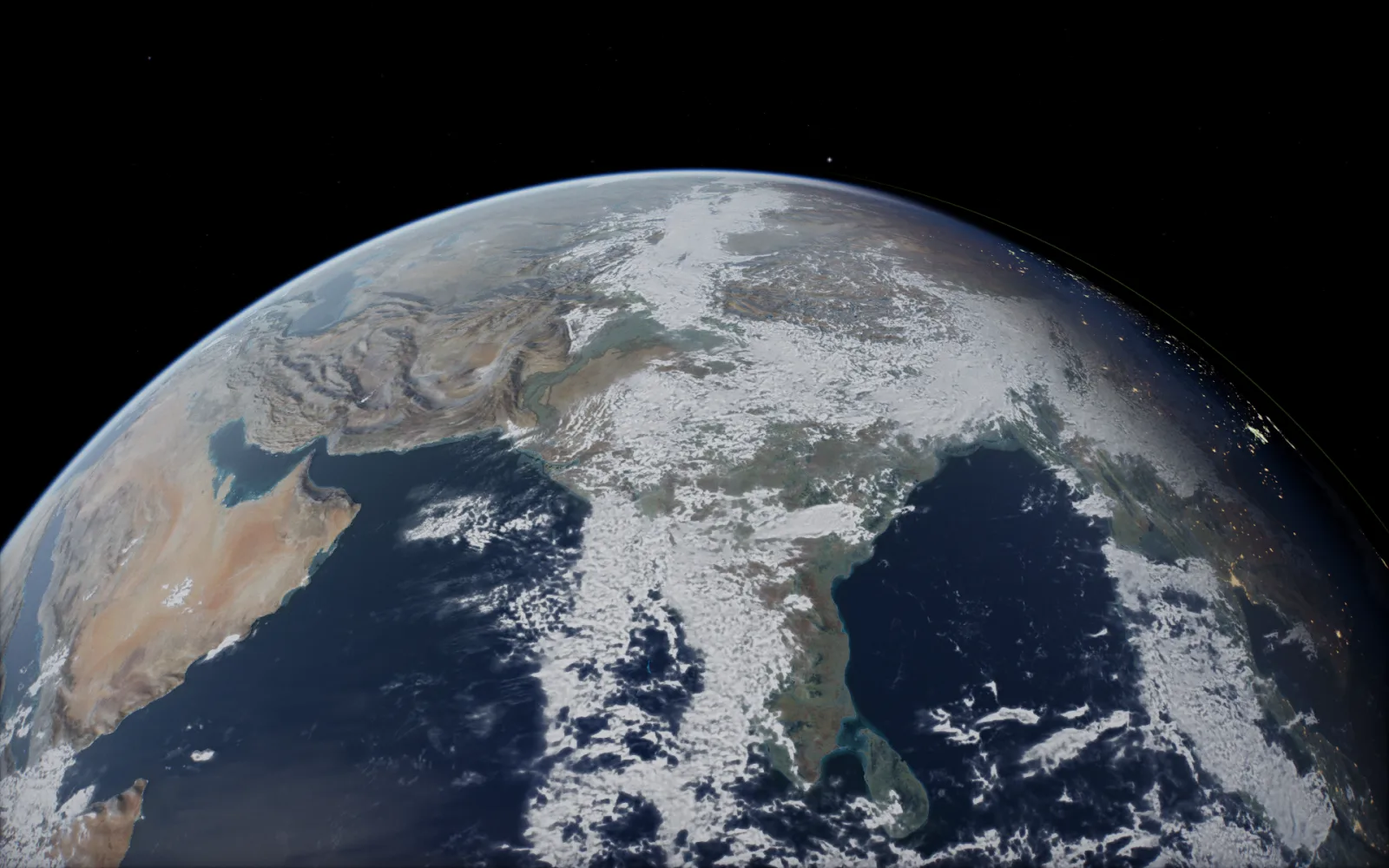
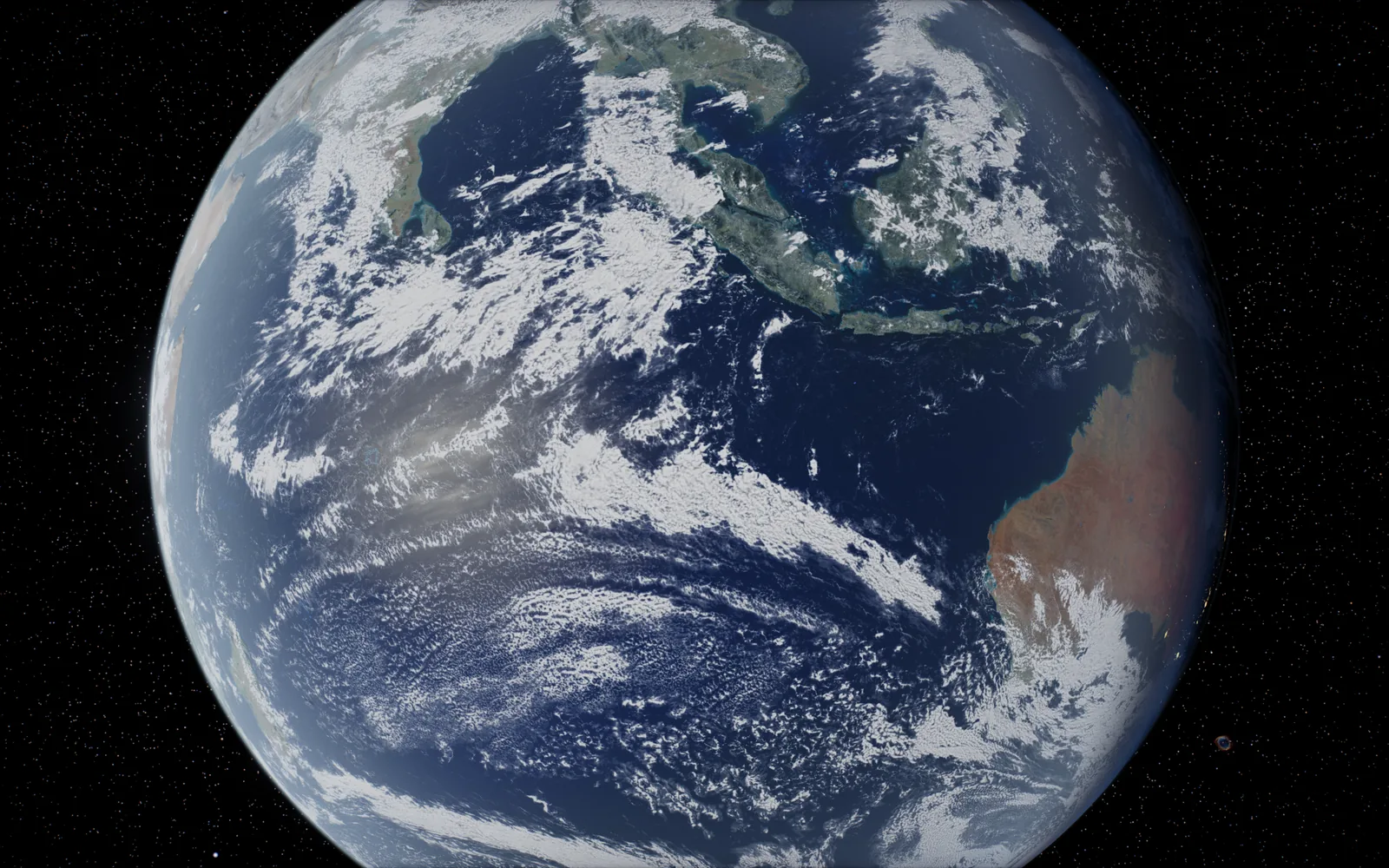
The Earth from space in the viewer, Indonesia and Western Australia under drifting cloud beside the deep blue Indian Ocean
Indonesia and Western Australia under NASA's cloud imagery, in the viewer.

The Sun

The Sun, with today's sunspots

The disc darkens towards its edge by Neckel and Labs' measured limb darkening.14 Close in, the surface breaks into granulation: cells about 1,200 km across that are born, swell and fade, matched against a National Solar Observatory frame and the DKIST telescope's first light.

The sunspots follow the solar cycle for the date on the clock. Within 2.5 days of NOAA's report, the real numbered regions replace them, and an M or X class flare from the GOES satellites lights its region as two ribbons.15

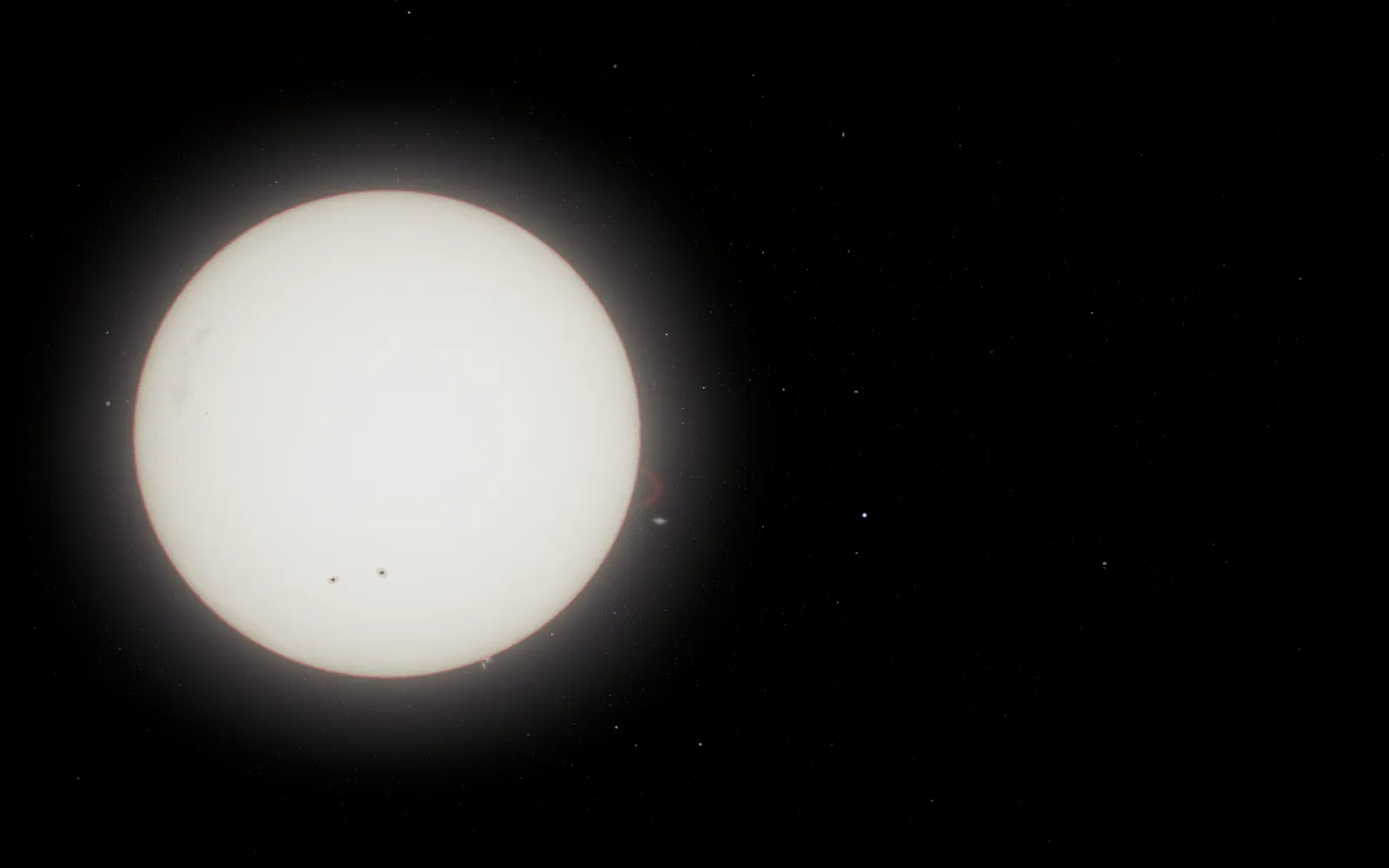
The Sun in the viewer, a white disc darkening towards its edge with two small sunspots, against black space
The Sun in the viewer: a white disc darkening towards its edge, with two small sunspots.

The sky

The stars are real ones: the HYG catalogue to magnitude 8 and 312,809 Tycho-2 stars from 8 to 10.18,19 Behind them is NASA's Deep Star Maps 2020 Milky Way, built from Gaia.17 One exposure covers them all and stops down when the Sun is in view, so the faint stars go first, as in a camera. At true scale a planet too small to resolve is a point at its apparent magnitude.20

True scale

The Realistic switch puts the Sun, the planets and the moons at their true sizes and distances, where the planets shrink to specks. To Scale lines up the worlds from Pluto to the Sun side by side at their real relative sizes.

The asteroid belt

164,776 numbered asteroids from JPL's element tables, each on its own orbit for the time on the clock.21 The Kirkwood gaps, the Hildas' triangle and the Trojan swarms either side of Jupiter come out of the data, and a test checks the gaps and the Trojans.

Satellites and the ISS

Every active satellite, and a seat in the Cupola

Switch on Satellites and over 16,600 active satellites appear, from Starlink to the geostationary belt, on CelesTrak's elements through the SGP4 orbit model.22

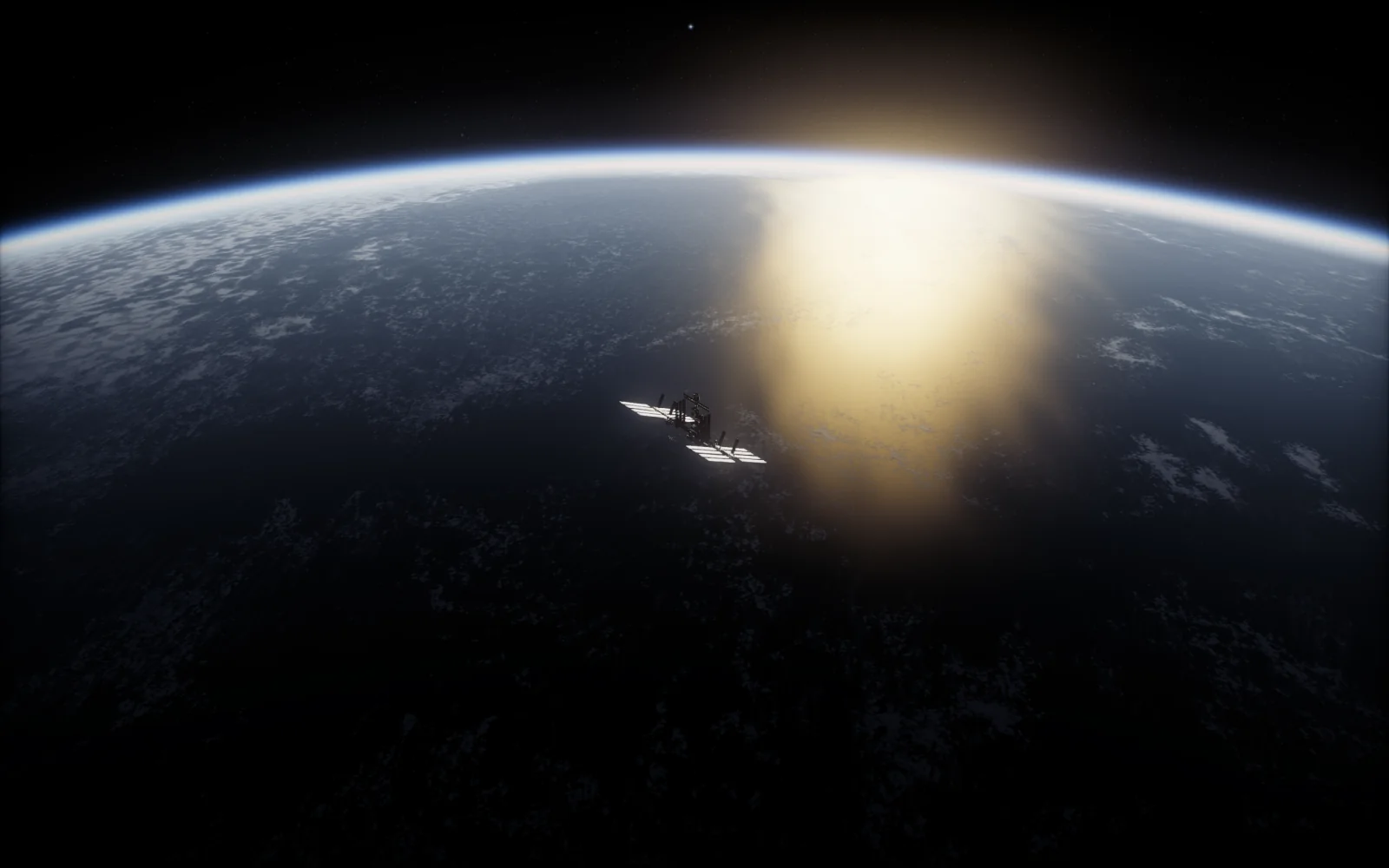
The ISS is NASA's model flown on the station's latest elements. Track the ISS follows it and says where it is, how high and how fast. The Cupola view puts you inside its seven windows, modelled from ESA and NASA dimensions.23

The International Space Station over the Earth's night side, the Sun coming up over the limb and lighting a path on the sea
The ISS over the night side as the Sun comes up over the limb.

Eclipses

Eclipses from the real geometry

Eclipses come out of the positions of the Sun, the Moon and the Earth. The viewer works out how much of the Sun's disc is hidden from each point, so the umbra, the penumbra and an annular ring come out at their true size, and the Moon turns red inside the Earth's shadow.

Against NASA's eclipse tables, the Moon's shadow axis passes within 0.006 Earth radii of NASA's figure for five solar eclipses, and six lunar eclipses agree within 0.015 in umbral magnitude.24

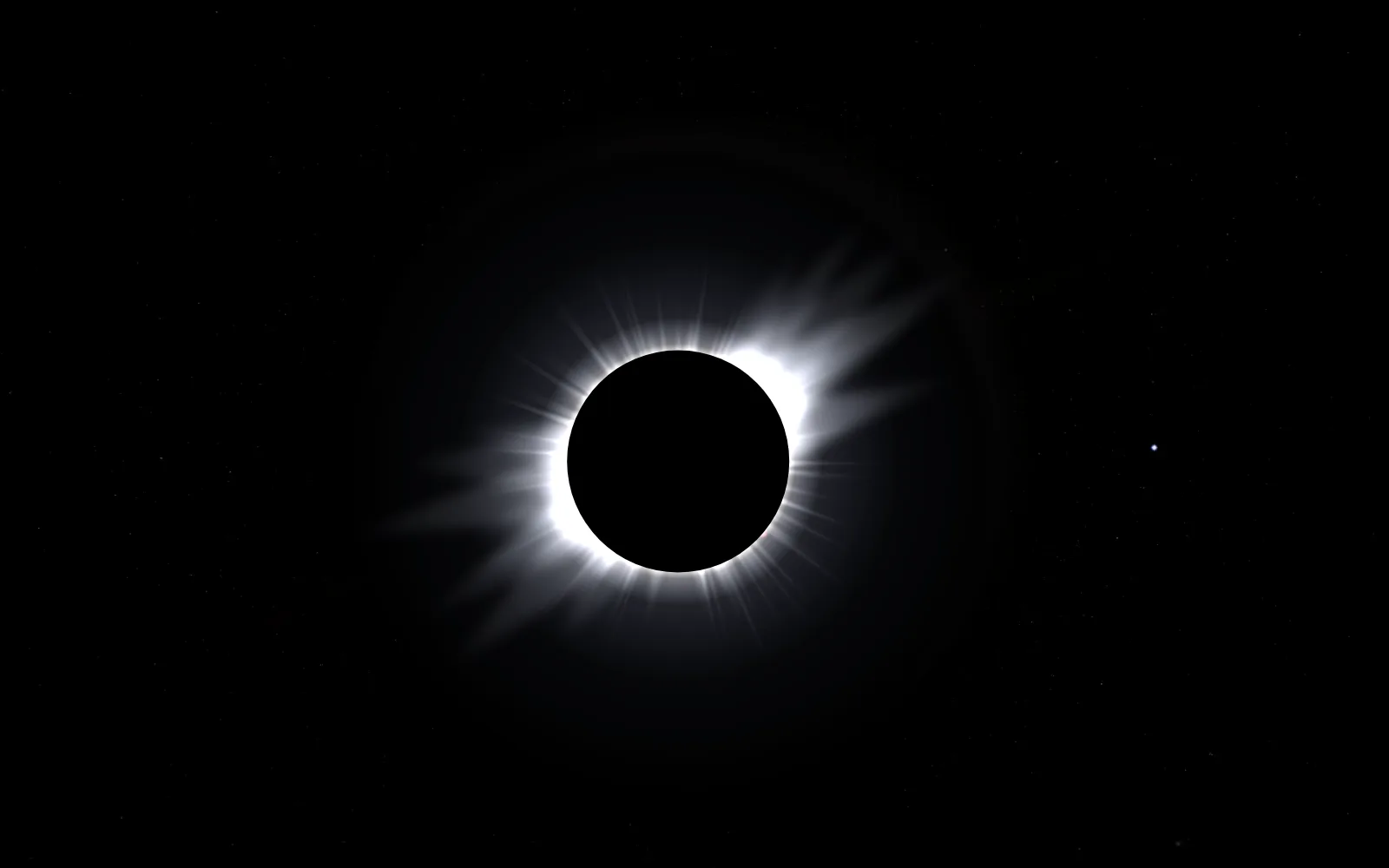
A total solar eclipse: the Moon's black disc ringed by the white streamers of the corona
Totality as drawn for our eclipse pages: the corona is painted round the Moon over the viewer's render of the Sun.

The aurora

Light from a shell 85 to 330 km up: green from a sharp lower edge near 100 km, red above 150 km, in colours measured on NASA crew photographs from the ISS. On the live clock, NOAA's Kp index moves and brightens the oval and NOAA's OVATION nowcast sets its shape.15,16

The Moon

NASA's CGI Moon Kit: colour from the Lunar Reconnaissance Orbiter's camera, relief from its laser altimeter.26 The site's Moon phase pages use the same lunar theory as the viewer and land within a minute of the USNO for 140 of the 149 main phases from 2026 to 2028.6

The black hole and the wormhole

The wormhole beside Saturn is a gravitational lens with no surface, from the wormhole metric James, von Tunzelmann, Franklin and Thorne published in 2015, so the stars behind it wrap into Einstein rings.28 The black hole steps each ray of light through the curved space round it, the approach the same team described that year, theirs round a spinning black hole and ours round one that does not spin.29

Famous photos

Famous space photos, taken again live

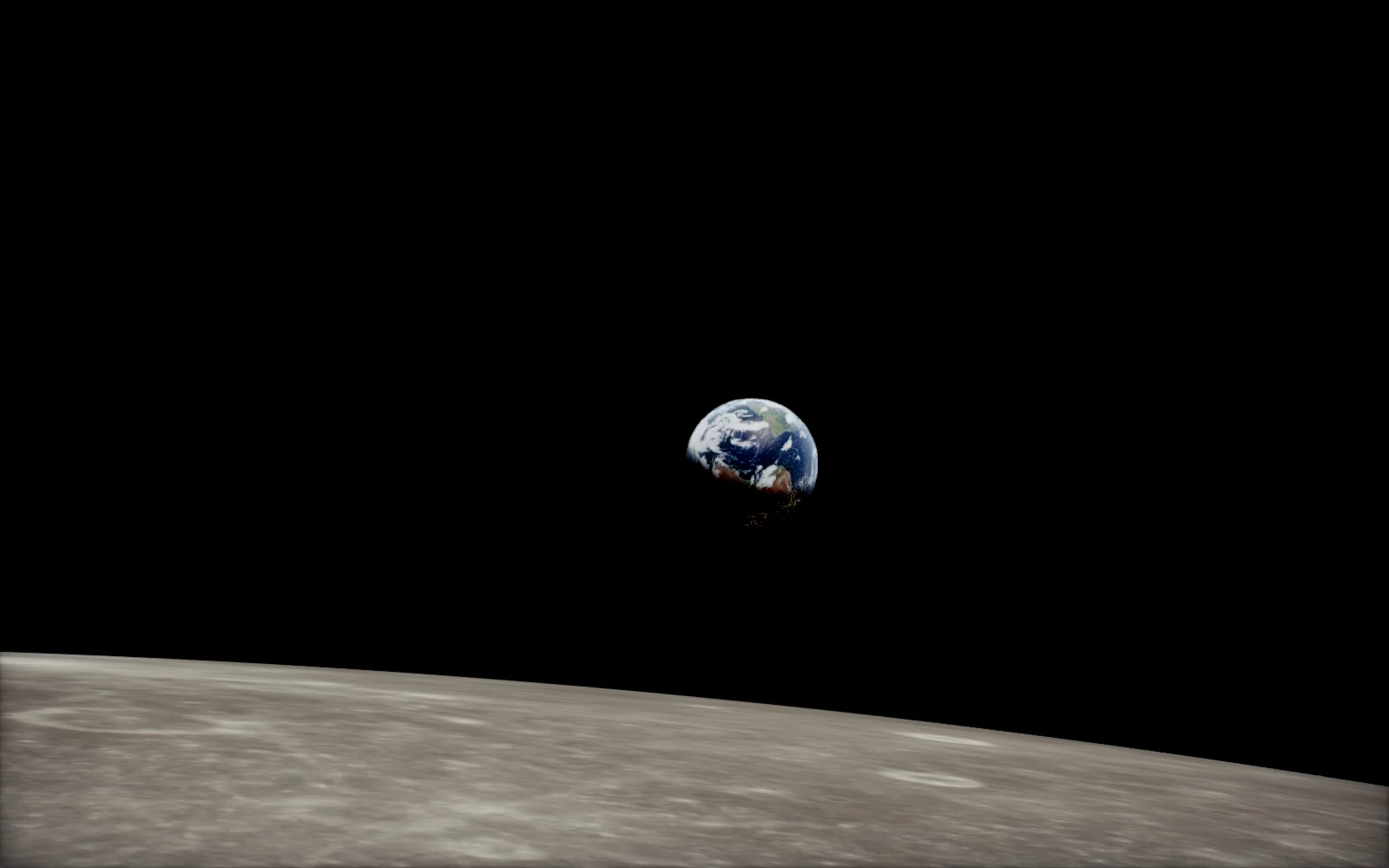
Eight famous space photos, from Earthrise to the Pale Blue Dot, open as live views. The viewer sets the clock to the moment each was taken and holds the camera where the spacecraft was, from JPL Horizons or from NASA's own records where Horizons has none, with the lens and pointing solved from the picture.5,27 Lay the original over it to compare.

Earthrise recreated live: the blue and white Earth above the grey curve of the Moon's horizon
Earthrise, live at 16:39:39.7 UT on 24 December 1968, the moment NASA's reconstruction gives for Apollo 8's colour frame.

Verification

How we check it.

We compare the engine with the references astronomers use, write the results down, and keep most of the comparisons as automated tests, so a change that breaks one fails.

WhatChecked againstResult
The Sun and the planets in the planetariumJPL Horizons, four moments in three citiesWorst 2.2″4,5
The Moon in the planetariumJPL HorizonsWorst 10.2″4,5
The navigational starsUS Naval ObservatoryWorst 0.6″4,6
Sun and Moon rise, transit and set, 24 eventsUS Naval ObservatoryWithin 0.5 minutes4,6
Jupiter's four large moonsJPL HorizonsWithin 0.123 Jupiter radii4,5
Sunrise, sunset, twilight and Moon times, ten towns from 69.6° N to 33.9° SUS Naval Observatory57 of 58 exact to the minute, the other one minute out6
Planet rise and set on the tonight pagesJPL Horizons8 of 10 exact to the minute, the worst one minute out5
Moon phases, 2026 to 2028US Naval Observatory140 of 149 within a minute6
Five solar eclipses, 2026 to 2030NASA eclipse tablesShadow axis within 0.006 Earth radii24
Six lunar eclipses, 2026 to 2032NASA eclipse tablesUmbral magnitude within 0.01524
The 2027 eclipse on 63 city pagesXavier Jubier's eclipse map249 contact times, median 0.1 s, largest 0.3 s25
The Earth's spin and seasonsNOAA's solar positionSub-solar point within 0.3°13
Clear ocean near the centre of the disc, the Sahara and the AmazonNASA DSCOVR EPIC, six framesWithin 6% of EPIC's brightness10
The sky's frameCatalogue positionsSpica and Regulus at their ecliptic positions, Orion the right way round

The planetarium's figures are from 14 October 2026 and the town figures from 15 October 2026. The planetarium's full tables are on its page; the tonight pages are checked against the USNO and JPL Horizons on every run of their test.

In the viewer and on the site

Everything you can do.

  1. Time machine

    Set any moment from 1800 to 2200, run time backwards, or jump to the next full Moon, equinox or eclipse.

    Sky events calendar
  2. Eclipse mode

    Watch a coming solar or lunar eclipse at true scale, the Moon's shadow crossing the Earth.

    Eclipses
  3. Track the ISS

    Follow the station live, then look down from the Cupola.

    ISS passes over you
  4. To Scale

    The worlds from Pluto to the Sun side by side at their true relative sizes.

    Compare the planets
  5. Fly mode

    Take a ship from planet to planet, with a dead-stop brake, flight assist and target lock.

    Open the viewer
  6. The planetarium

    The real sky over your town, live, checked against JPL Horizons.

    The online planetarium
  7. Tonight's sky by town

    Sunset, full dark, each planet and the ISS's passes for 282 towns.

    Tonight's sky
  8. Famous photos, live

    Eight space photos as live views, with the original laid over them.

    Famous photos
  9. Lessons for teachers

    25 lessons from age 5 to university, with a Present mode for the projector and pupil lessons with graded questions.

    For teachers
  10. Moon phase

    Tonight's Moon and every phase this month, drawn as the real Moon.

    Moon phase today
  11. Distances right now

    How far the Sun, the Moon and each planet are from the Earth this second.

    Distances right now
  12. Phones and tablets

    Touch controls and lighter graphics, in any current browser with WebGL 2.

    Open the viewer
  13. VR and AR mode Paid

    The viewer in WebXR on a headset, a one-time unlock.

    VR and AR
  14. Screensaver and live wallpapers Paid

    The engine's camera shows on your desktop: the screensaver for Mac, Windows and Linux, live wallpapers for Mac and Windows.

    The screensaver Live wallpapers
  15. Star map prints Paid

    The sky over any place at any moment from 1800 to 2200 as a print file, drawn from the planetarium's positions.

    Star map prints

Alternatives

How it compares.

Each of these is good at something, and the right one depends on what you want to see. Every fact about the others comes from the page cited beside it, read on 15 October 2026.

ComparedOur Solar SystemNASA's Eyes on the Solar SystemSolar System ScopeStellarium Web
Runs in a browserYes, phones includedYes, on any device with a browser30Yes, and apps for computers and phones32Yes34
PriceFree, with paid extrasFree31Free version; desktop app USD 9.8032Not stated on its pages; its engine is open source (AGPL-3.0)35
Best forThe Earth up close, live data, checked positionsOver 150 NASA missions30The planets and the night sky in one model32Stars, from the Gaia database35
Dates1800 to 22001950 to 205030Not stated on its home pageNot stated on its pages
Accuracy, in its own wordsPlanets within 2.2″ of JPL Horizons, in the planetarium4“The most accurate data and imagery possible”30“Accurate positions of objects”32Not stated on its pages

NASA's Eyes on the Solar System is the one for spacecraft. It follows over 150 NASA missions from start to finish, Voyager, Cassini and New Horizons among them, from 1950 to 2050, in a browser simulation NASA says uses the most accurate data and imagery possible.30

Solar System Scope has had a free version since 2011, with apps for computers and phones.32 Its planet maps are on our planets too: we use them under their CC BY 4.0 licence.33

Stellarium Web is the deeper star atlas. It is an online planetarium built on the open source Stellarium Web project,34 whose engine reads the Gaia star database of more than a billion stars.35 Our planetarium draws the catalogue stars to magnitude 10 and the rest of the Milky Way as NASA's Gaia-based map.17

Our Solar System puts the planets, the Earth up close, live data from NOAA and CelesTrak and the night sky from the ground into one free viewer, and publishes its checks against the references. For the solar system as it is right now, drawn the way a camera would record it, start here.

Questions

Questions people ask.

Is this 3D solar system free?

Yes. The 3D viewer, the planetarium, the lessons and the site's guides are free in your browser, with no account and nothing to install. The paid extras are VR and AR mode on headsets, the screensaver for Mac, Windows and Linux, live wallpapers for Mac and Windows, and star map prints.

Does it work on phones?

Yes, in any current browser with WebGL 2: Chrome, Safari, Edge or Firefox, on phones, tablets, Chromebooks and computers. Phones and tablets get touch controls and lighter graphics. Fly mode is easiest with a keyboard.

How accurate are the planet positions?

In the 3D viewer the planets come from JPL's orbital elements, whose nominal error in longitude JPL gives as under an arcminute for every planet except Jupiter and Saturn, at about 7 and 10 arcminutes, from 1800 to 2050, and the Moon from Meeus' lunar theory.1,2 The planetarium uses VSOP87. In our checks it landed within 2.2 arcseconds of JPL Horizons for the Sun and the planets and 10.2 for the Moon, and within 0.6 of the US Naval Observatory for the stars.4 The moons of the other planets keep their real orbital periods, though where each one sits along its orbit is illustrative.

Is it to scale?

You choose. By default sizes and distances are spread out so every planet is visible at once, and a slider sets how much. The Realistic switch puts everything at its true size and distance. To Scale lines up the Sun and the planets side by side at their real relative sizes.

What data does it use?

Positions from JPL's orbital elements, VSOP87 and Meeus; the Earth from NASA's Landsat composite, Sentinel-2 cloudless by EOX and NASA's Blue Marble and Black Marble; the stars from HYG, Tycho-2 and NASA's Gaia-based Deep Star Maps; satellites from CelesTrak; space weather from NOAA; planet maps from Solar System Scope. The credits page lists every source.

Can teachers use it?

Yes. Teachers mode has 25 lessons at seven levels, from age 5 to university. Each plays two ways: Present, for a projector, and a pupil version with graded questions and live tasks. Every fact in a lesson cites its source. See For teachers.

Is it live?

Yes, by default. With time on Real the clock is the wall clock, so the planets, the Earth's day side and the Moon's phase are as they are now. Satellites run on CelesTrak's latest elements, the aurora follows NOAA's Kp index, and the Sun's active regions come from NOAA's report. Set any other moment and everything moves to it.

Sources

  1. JPL Solar System Dynamics, Approximate positions of the planets (Standish), the orbital elements the 3D viewer uses. ssd.jpl.nasa.gov/planets/approx_pos.html
  2. Meeus, J. (1998), Astronomical Algorithms, 2nd edition, Willmann-Bell: the Moon, chapter 47.
  3. Bretagnon, P. and Francou, G. (1988), Planetary theories in rectangular and spherical variables: VSOP87 solutions, Astronomy and Astrophysics 202, 309. CDS VI/81
  4. Our comparison of Astronomy mode with JPL Horizons and the US Naval Observatory at four moments in three cities (London, Sydney and Denver), 14 October 2026, kept as an automated test in our code. The tables are on the planetarium page.
  5. JPL Horizons System, NASA Jet Propulsion Laboratory. ssd.jpl.nasa.gov/horizons
  6. Astronomical Applications Department, US Naval Observatory. aa.usno.navy.mil/data
  7. NASA Global Imagery Browse Services (GIBS), Landsat WELD corrected reflectance, 1999 annual composite. nasa-gibs.github.io/gibs-api-docs
  8. Sentinel-2 cloudless 2016 by EOX IT Services GmbH (contains modified Copernicus Sentinel data 2016), CC BY 4.0. s2maps.eu
  9. NOAA National Centers for Environmental Information, ETOPO 2022 Global Relief Model. ncei.noaa.gov
  10. NASA DSCOVR EPIC, the Earth Polychromatic Imaging Camera. epic.gsfc.nasa.gov
  11. NASA Earth Observatory, The Blue Marble: true colour global imagery at 1 km resolution (clouds from MODIS Terra, 2001). science.nasa.gov
  12. NASA Earth Observatory, Earth at Night: Black Marble 2016 flat maps, to 500 m (Suomi NPP VIIRS), via NASA GIBS. science.nasa.gov
  13. NOAA Global Monitoring Laboratory, Solar Calculator and its equations. gml.noaa.gov/grad/solcalc
  14. Neckel, H. and Labs, D. (1994), Solar limb darkening 1986-1990, Solar Physics 153, 91.
  15. NOAA Space Weather Prediction Center: the planetary K-index, numbered solar regions and GOES flare reports. swpc.noaa.gov
  16. NOAA Space Weather Prediction Center, Aurora 30-minute forecast (the OVATION model). spaceweather.gov
  17. NASA Goddard Space Flight Center Scientific Visualization Studio, Deep Star Maps 2020; Gaia DR2: ESA/Gaia/DPAC. svs.gsfc.nasa.gov/4851
  18. HYG Database v4.2, Astronexus, CC BY-SA 4.0. astronexus.com/hyg
  19. Høg, E. et al. (2000), The Tycho-2 Catalogue of the 2.5 million brightest stars; ESA Hipparcos and Tycho-2 catalogues. cosmos.esa.int
  20. Mallama, A. and Hilton, J. L. (2018), Computing apparent planetary magnitudes for The Astronomical Almanac, Astronomy and Computing 25, 10. doi.org/10.1016/j.ascom.2018.08.002
  21. JPL Solar System Dynamics, orbital elements of the numbered asteroids. ssd.jpl.nasa.gov/sb/elem_tables.html
  22. CelesTrak, orbital elements of the active satellites. celestrak.org
  23. ESA, Cupola, and NASA, Cupola: the windows and their dimensions. esa.int, nasa.gov
  24. NASA Eclipse Web Site, F. Espenak, NASA Goddard Space Flight Center: solar and lunar eclipse tables. eclipse.gsfc.nasa.gov
  25. Xavier Jubier, interactive map of the total solar eclipse of 2 August 2027. xjubier.free.fr
  26. NASA Goddard Space Flight Center Scientific Visualization Studio, CGI Moon Kit (Lunar Reconnaissance Orbiter camera colour and laser altimeter elevation). svs.gsfc.nasa.gov/4720
  27. NASA Scientific Visualization Studio, Earthrise reconstruction (2013). svs.gsfc.nasa.gov/4129
  28. James, O., von Tunzelmann, E., Franklin, P. and Thorne, K. S. (2015), Visualizing Interstellar's Wormhole, American Journal of Physics 83, 486. doi.org/10.1119/1.4916949
  29. James, O., von Tunzelmann, E., Franklin, P. and Thorne, K. S. (2015), Gravitational lensing by spinning black holes in astrophysics, and in the movie Interstellar, Classical and Quantum Gravity 32, 065001. doi.org/10.1088/0264-9381/32/6/065001
  30. NASA, NASA's Eyes: Eyes on the Solar System, read 15 October 2026. science.nasa.gov/eyes
  31. NASA's Eyes, Wikipedia, read 15 October 2026 ("a freely available suite of computer visualization applications"). en.wikipedia.org/wiki/NASA's_Eyes
  32. Solar System Scope, home page, read 15 October 2026. solarsystemscope.com
  33. Solar System Scope, planet textures, CC BY 4.0. solarsystemscope.com/textures
  34. Stellarium Labs, Stellarium Web, read 15 October 2026. stellarium-labs.com/stellarium-web
  35. Stellarium Web Engine, README and licence (AGPL-3.0), read 15 October 2026. github.com/Stellarium/stellarium-web-engine

Every picture on this page is the viewer's own render, apart from the eclipse, whose corona is painted over the viewer's Sun. Data modified by Polyxmedia; no endorsement by NASA, ESA, NOAA or any data provider is implied. Every source the viewer uses is on our credits page.

The top of the Earth rising from below, its day side lit under a black sky

See the solar system as it is right now.