Free · In your browser
Explore the universe in 3D.
Start at the Earth and keep zooming out: past the Moon, the planets and Pluto, through the stars around the Sun, to the Milky Way seen from outside.
This is a 3D space viewer that runs in your browser, with nothing to install. The planets and our Moon are where they really are right now, and the sky behind them is the real sky: the stars from the HYG and Tycho-2 catalogues and the Milky Way from NASA's Deep Star Maps.
The zoom-out, step by step
-
The Earth
12,742 km across
Begin over your own planet: satellite imagery down to 15 metres, NASA's cloud maps, aurora round the poles and city lights on the night side.
Go to the Earth -
The Moon
384,400 km away · light takes 1.3 s
The Moon sits where it really is tonight, placed by the Meeus lunar theory, with tonight's phase and a surface map from NASA mission data.
Go to the Moon -
The Sun and the planets
The Earth is 149.6 million km from the Sun · light takes 8 min 19 s
The planets circle the Sun on orbits worked out from JPL's elements. Switch on Realistic and every world shrinks to its true size, lost in the dark between them.
Go to the Sun -
Neptune
4,515 million km from the Sun · light takes 4 h 11 min
The last of the eight planets. From out here the Sun is a dazzling star rather than a disc.
Go to Neptune -
Pluto and the Kuiper belt
5,906 million km from the Sun · light takes 5 h 28 min
Pluto, a dwarf planet, among the icy worlds of the belt beyond Neptune.
Go to Pluto -
The Oort cloud
2,000 to 100,000 AU from the Sun
A shell of icy bodies thought to reach up to about 1.6 light years from the Sun. Nobody has ever seen it directly, so the viewer does not draw it.
About the Oort cloud -
The nearest stars
Proxima Centauri is 4.24 light years away
Open the galaxy map in fly mode (press M) for 11,976 catalogued stars within 200 light years, then plot a route and jump from star to star.
Open the viewer -
The Milky Way, from outside
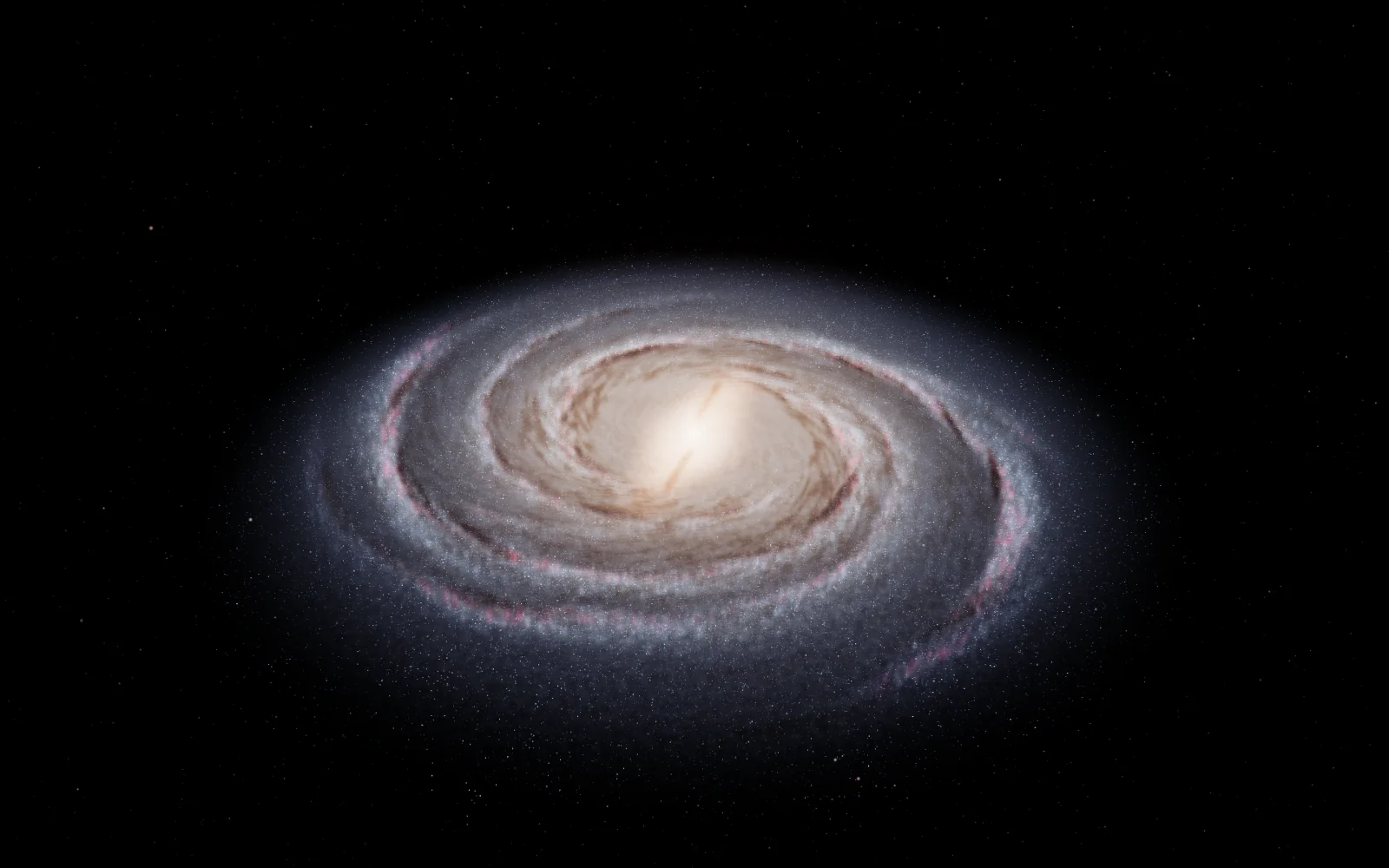
About 100,000 light years across · the Sun is 26,000 light years from its centre
Leave the galaxy and look back at it: a 3D model of the Milky Way built from its published structure, with the central bar, the spiral arms, star-forming clouds and dust lanes, about 230,000 stars in all.
Fly out to the Milky Way -
Nebulae and other galaxies
The Andromeda Galaxy is 2.5 million light years away
Switch on Deep space under Explore to put 33 named nebulae and galaxies on the sky at their real places, from the Orion Nebula and the Pleiades to Andromeda and the Hubble Deep Field.
Open the viewer
How far it all is
| Object | Distance | Light takes |
|---|---|---|
| The Moon | 384,400 km | 1.3 s |
| The Sun | 149.6 million km (1 AU) | 8 min 19 s |
| Neptune | 4,515 million km (30.2 AU) | 4 h 11 min |
| Pluto | 5,906 million km (39.5 AU) | 5 h 28 min |
| The Oort cloud, outer edge | up to 100,000 AU | up to 1.6 years |
| Proxima Centauri | 4.24 light years | 4.24 years |
| The centre of the Milky Way | about 26,000 light years | about 26,000 years |
| The Andromeda Galaxy | about 2.5 million light years | about 2.5 million years |
Distances from the Sun for the planets and the Oort cloud, from the Earth for the rest. The planets' figures are their average distances.
What is to scale, and what is not
Inside the solar system the planets and our Moon are at their real places, and the Realistic switch puts every planet and moon at its true size and distance too. The galaxy map's stars sit at their catalogued distances. The Milky Way you fly out to is a model at its own scale: drawn at the same scale as the planets it would be far too big to see whole.
Questions
Can I explore the universe in 3D for free?
Yes. The viewer runs in the browser on a phone, a tablet or a computer, with nothing to download and no account to make.
How far out can you zoom?
Out of the Milky Way: the camera leaves the galaxy and looks back at it from outside. On the way you pass the planets, Pluto and the stars around the Sun, and other galaxies and nebulae sit on the sky where they really are.
Is this the real sky?
Yes. The stars come from the HYG and Tycho-2 catalogues at their real positions and brightness, the Milky Way's glow from NASA's Deep Star Maps, and the planets and the Moon are worked out for the time on the clock. The Milky Way seen from outside is a model, since nobody has photographed our galaxy from outside.
Sources
- Planetary Fact Sheet (metric), NASA NSSDCA
- Moon Fact Sheet, NASA NSSDCA
- Measuring the Universe: the IAU and astronomical units, International Astronomical Union
- Speed of light in vacuum, CODATA value, NIST
- Oort Cloud: Facts, NASA Science
- Sun: Facts, NASA Science (Proxima Centauri)
- The Milky Way Galaxy, Imagine the Universe, NASA Goddard
- Messier 31 (the Andromeda Galaxy), NASA Hubble
- The HYG star database (nearby stars)
- Deep Star Maps 2020, NASA Scientific Visualization Studio