Moon phase today
Live, worked out in your browser
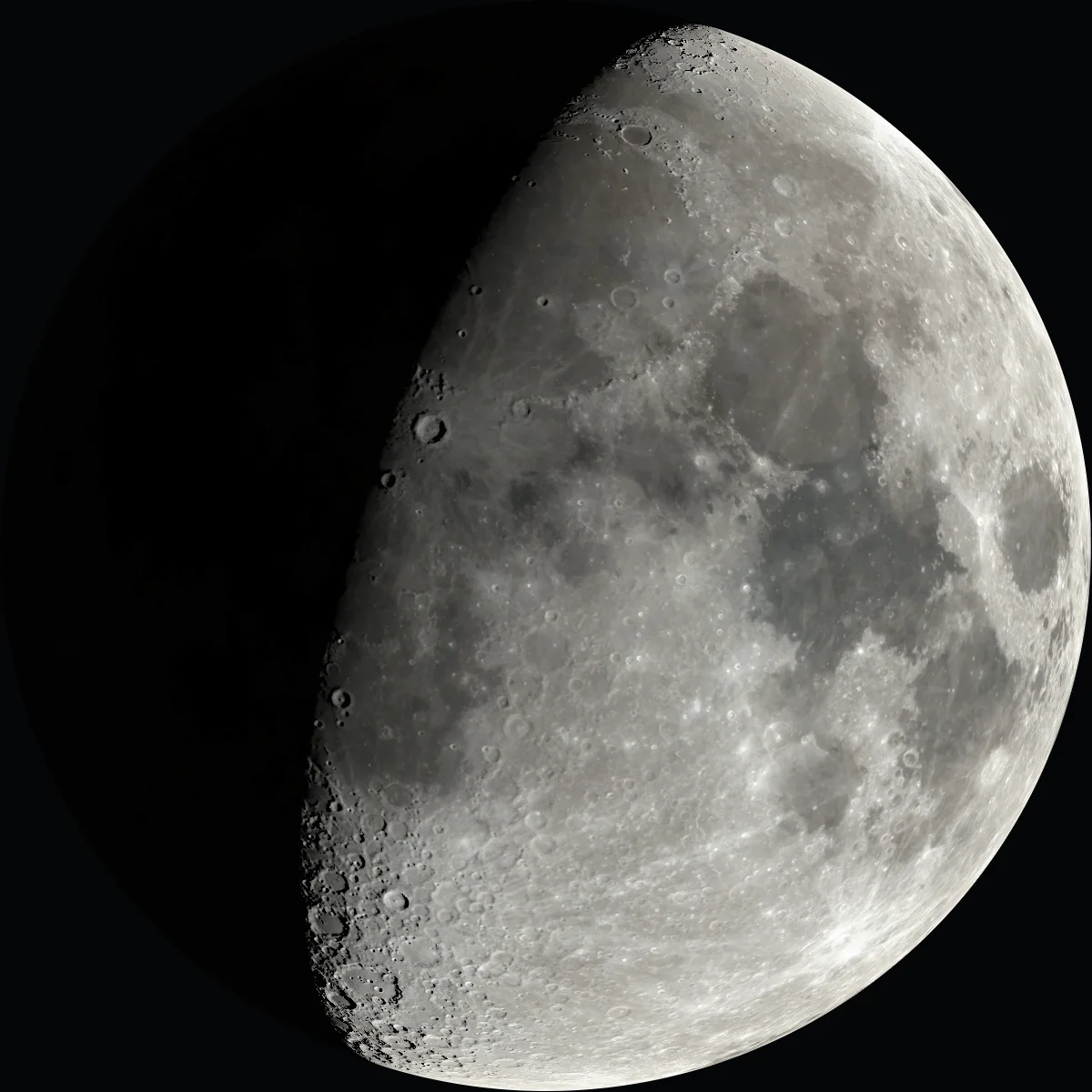
Waxing gibbous
67% lit9.8 days old396,921 km away (246,635 miles)
Tuesday 20 October 2026, 11:09 UTC
From one new Moon to the next. Arrow keys move a day, Page Up and Page Down jump to the next main phase.
The next full Moon, the Hunter's Moon, is on Monday 26 October 2026, 04:11 UTC.
Drawn north up, as the Moon looks from the Northern Hemisphere. From the Southern Hemisphere it is the other way up.
The next four phases
- Full Moon: Hunter's Moon Mon 26 Oct 2026 04:11 UTC Your time: 04:11 UTC
- Last quarter Sun 1 Nov 2026 20:28 UTC Your time: 20:28 UTC
- New Moon Mon 9 Nov 2026 07:02 UTC Your time: 07:02 UTC
- First quarter Tue 17 Nov 2026 11:48 UTC Your time: 11:48 UTC
To the nearest minute. We checked our times against the US Naval Observatory's for every phase from 2026 to 2028, and they agree to within a minute and a half. Next new Moon: 9 November. The Moon's distance today.
Is the next full Moon a supermoon?
No. The full Moon of 26 October 2026 is close to being a supermoon: it is 368,872 km from Earth, 88.9% of the way from apogee (404,642 km on 16 October) to perigee (364,409 km on 28 October), and Fred Espenak's test needs 90% or more.
How a supermoon is decided
"Supermoon" is not an official astronomical term. NASA says it is typically used for a full Moon that comes within at least 90 percent of perigee, the nearest point of the Moon's orbit, and that at its closest the full Moon can look up to 14 percent bigger and 30 percent brighter than the faintest Moon of the year, when it is farthest from Earth. The 90% comes from Richard Nolle, the astrologer who coined the word. Fred Espenak's tables measure each full Moon against the apogee and perigee either side of it, and so do we. Our list agrees with his for every full Moon from 2026 to 2028.
Supermoons coming up:
- Tuesday 24 November 2026, 14:54 UTC: the Beaver Moon, 360,767 km away (96.9%)
- Thursday 24 December 2026, 01:28 UTC: the Cold Moon, 356,740 km away (99.8%)
- Friday 22 January 2027, 12:17 UTC: the Wolf Moon, 357,644 km away (99.3%)
- Saturday 20 February 2027, 23:24 UTC: the Snow Moon, 363,306 km away (94.8%)
- Wednesday 12 January 2028, 04:03 UTC: the Wolf Moon, 360,266 km away (97.4%), with a partial lunar eclipse
- Thursday 10 February 2028, 15:04 UTC: the Snow Moon, 356,720 km away (99.9%)
- Saturday 11 March 2028, 01:06 UTC: the Worm Moon, 358,074 km away (99.0%)
- Sunday 9 April 2028, 10:27 UTC: the Pink Moon, 363,867 km away (94.3%)
The Moon in October 2026
| Mon | Tue | Wed | Thu | Fri | Sat | Sun |
|---|---|---|---|---|---|---|
| 1 October: Waning gibbous, 73% lit | 2 October: Waning gibbous, 62% lit | 3 October: Last quarter at 13:25, 51% lit | 4 October: Waning crescent, 39% lit | |||
| 5 October: Waning crescent, 29% lit | 6 October: Waning crescent, 19% lit | 7 October: Waning crescent, 11% lit | 8 October: Waning crescent, 5% lit | 9 October: Waning crescent, 2% lit | 10 October: New Moon at 15:50, 0% lit | 11 October: Waxing crescent, 1% lit |
| 12 October: Waxing crescent, 4% lit | 13 October: Waxing crescent, 8% lit | 14 October: Waxing crescent, 14% lit | 15 October: Waxing crescent, 22% lit | 16 October: Waxing crescent, 30% lit | 17 October: Waxing crescent, 39% lit | 18 October: First quarter at 16:12, 48% lit |
| 19 October: Waxing gibbous, 58% lit | 20 October: Waxing gibbous, 67% lit | 21 October: Waxing gibbous, 76% lit | 22 October: Waxing gibbous, 84% lit | 23 October: Waxing gibbous, 91% lit | 24 October: Waxing gibbous, 96% lit | 25 October: Waxing gibbous, 99% lit |
| 26 October: Full Moon at 04:11, 100% lit | 27 October: Waning gibbous, 97% lit | 28 October: Waning gibbous, 92% lit | 29 October: Waning gibbous, 85% lit | 30 October: Waning gibbous, 76% lit | 31 October: Waning gibbous, 65% lit |
Tonight's Moon in 3D
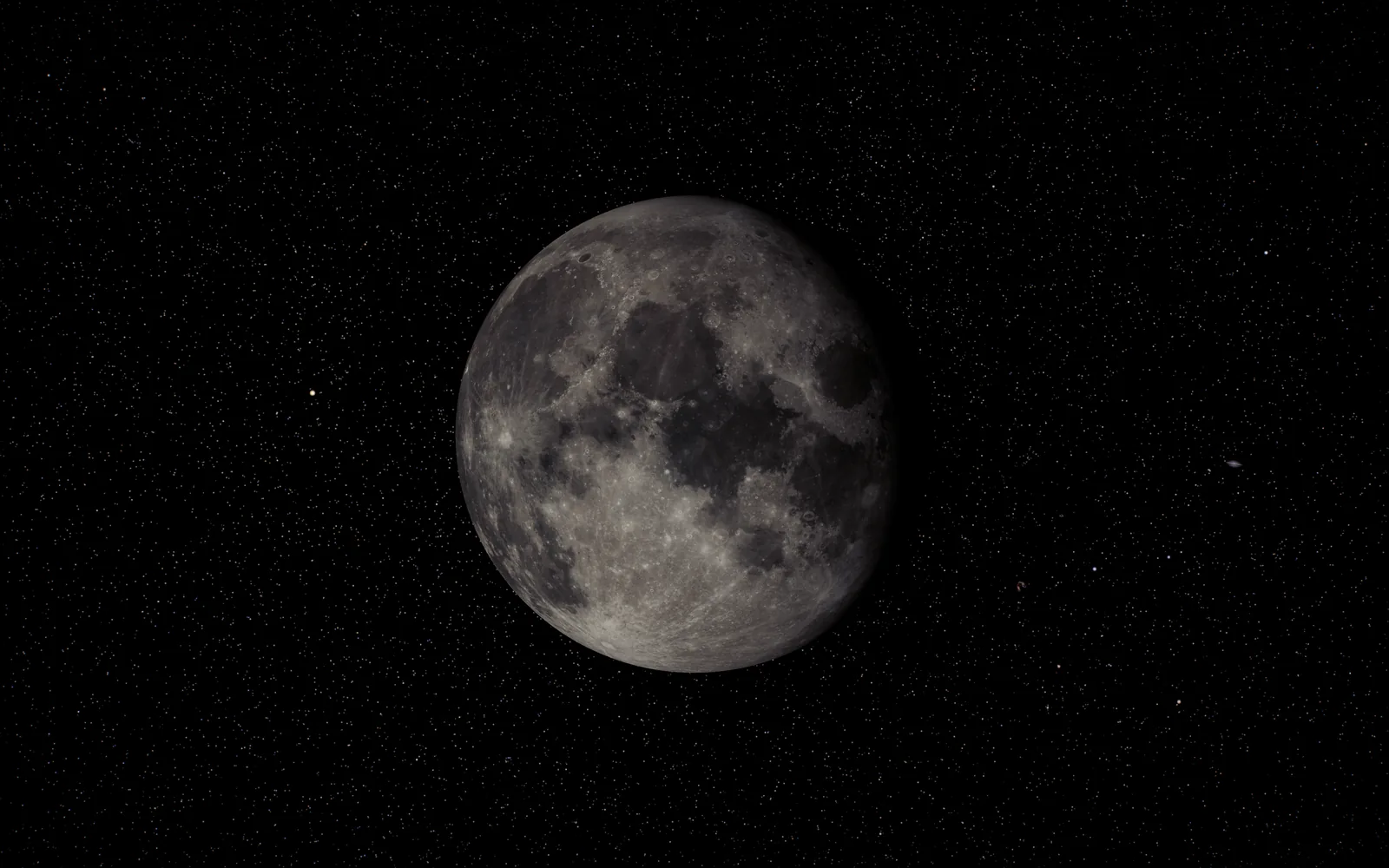
The Moon drawn by our 3D viewer, seen from the Earth's side and lit by the Sun as it is right now, so the globe, with its seas and craters, shows tonight's phase. Press play to load it here, or open the full viewer to fly round it.
- Open the Moon in the 3D viewerFly round it
- Get tonight's sky as a printThe stars, the planets and the Moon over your own town, on a star map
- Get the Moon from your date as a printThe Moon as it looked on a day that matters to you
See tonight's Moon from your own town in the online planetarium: where it stands in your sky, and when it rises and sets.
Why the Moon has phases
The Moon is always half lit by the Sun. As it goes round the Earth we see more or less of that lit half, and the cycle from one new Moon to the next takes 29.5 days on average.
The four main phases are moments. The US Naval Observatory puts new Moon, first quarter, full Moon and last quarter at the instants the Moon is 0, 90, 180 and 270 degrees east of the Sun along the sky. Between them the Moon is a crescent, less than half lit, or gibbous, more than half lit: waxing while the lit part grows and waning while it shrinks. This page names each main phase for the day around its moment.
The phase is the same for everyone on Earth at the same moment. Your clock changes only the time you read it at, and sometimes the date, so every time here is given in UTC and in your own time zone.
From the Southern Hemisphere the Moon appears the other way up, so the lit side is on the left while it waxes. The switch under the Moon turns it round.
The free lesson Phases of the Moon shows it in 3D, with the Sun, the Earth and the Moon to move round.
Moon phase calendars
A calendar for every month from January 2026 to October 2028, each day with its Moon and the main phases to the minute.
- October 2026Moon phases
- November 2026Moon phases
- December 2026Moon phases
- January 2027Moon phases
- February 2027Moon phases
- March 2027Moon phases
- April 2027Moon phases
- May 2027Moon phases
- June 2027Moon phases
- July 2027Moon phases
- August 2027Moon phases
- September 2027Moon phases
- 2026Every phase of the year
- 2027Every phase of the year
- 2028Every phase of the year
- Full Moons 2026Names and supermoons
- Full Moons 2027Names and supermoons
- Full Moons 2028Names and supermoons
The next blue moon is on 20 May 2027, the third full Moon in a season of four.
Questions
What phase is the Moon today?
On 20 October 2026 the Moon is waxing gibbous, 67% lit and 9.8 days old. The phase at the top of this page is worked out live in your browser, so it is right whenever you read it.
When is the next full Moon?
Monday 26 October 2026 at 04:11 UTC, the Hunter's Moon. It is not a supermoon. The full Moon calendar lists every full Moon of the year with its name.
When is the next new Moon?
Monday 9 November 2026 at 07:02 UTC. At new Moon the lit half of the Moon faces away from the Earth, so there is nothing of it to see.
Is the Moon waxing or waning?
On 20 October 2026 it is waxing: the lit part grows each night until the full Moon. The US Naval Observatory calls the Moon waxing while the lit fraction increases and waning while it decreases.
What is the Moon's age?
The number of days since the last new Moon, as the US Naval Observatory defines it. It runs from 0 at new Moon to about 29.5 just before the next, so a full Moon is about 15 days old.
Is the Moon's phase the same everywhere on Earth?
Yes. The phase and the percent lit are the same from anywhere at the same moment, and each main phase happens at one instant for everyone. Only the clock time and sometimes the date differ, which is why this page gives every time in UTC and in your own zone. From the Southern Hemisphere the Moon looks the other way up, so the lit side is on the left while it waxes.
What is a supermoon?
A full Moon close to perigee, the nearest point of the Moon's orbit. NASA says the term is not an official astronomical one and is typically used for a full Moon within at least 90 percent of perigee. We use Fred Espenak's test: the full Moon's distance must be 90% or more of the way from the apogee to the perigee either side of it.
Why does the Moon's face tilt and rock?
The Moon always keeps the same face to us, but not exactly the same face. Because of the tilt and shape of its orbit we see it from slightly different angles through the month, so it seems to wobble: that is libration. It also seems to roll back and forth, as its north pole turns against celestial north. The Moon on this page is turned the way it is at that moment, to within a hundredth of a degree of JPL's Horizons system on the dates we test.
Sources
- US Naval Observatory: Phases of the Moon. Our times are checked against USNO's for every phase from 2026 to 2028 and agree to within a minute and a half
- US Naval Observatory: Phases of the Moon and percent of the Moon illuminated (how the phases, the percent lit and the Moon's age are defined)
- NASA Science: Moon phases
- NASA Science: Supermoons
- Fred Espenak, AstroPixels: Full Moon at Perigee (full supermoons), 2001 to 2100, and the test for one
- EarthSky (Bruce McClure, 2018): why experts disagree on what makes a supermoon, with Richard Nolle's original definition
- The Old Farmer's Almanac: Full Moon names
- NASA Watch the Skies: the monthly and seasonal blue moon
- NASA JPL: approximate positions of the planets, the Earth's orbit behind the Sun's place
- Jean Meeus, Astronomical Algorithms (2nd edition, 1998): chapter 47, the lunar theory behind the Moon's place, phase and distance; chapter 48, the lit fraction and the bright limb; chapter 25, the Sun's aberration
- IAU Office of Astronomy for Education: the lunar phases seen from the Southern Hemisphere
- NASA's Scientific Visualization Studio, CGI Moon Kit (Ernie Wright, Noah Petro, 2019): the Moon's colour from the LROC Wide Angle Camera's Hapke-normalised mosaic, the face every Moon on these pages is drawn from
- LRO Lunar Orbiter Laser Altimeter, LDEM_64 heights (NASA PDS Geosciences Node): the slopes that shade the ground near the terminator
- Archinal et al. (2011), Report of the IAU Working Group on Cartographic Coordinates and Rotational Elements: 2009, Celestial Mechanics and Dynamical Astronomy 109, 101: the Moon's pole and turning, so the drawn face shows the libration of the moment
- NASA's Scientific Visualization Studio, Moon Phase and Libration, 2026: what libration and the position angle of the axis are, and the frames we compared our drawing with
- NASA JPL Horizons: the Moon's sub-Earth point and pole angle, which our drawing matches to within 0.01 degrees on the dates we test
- Krisciunas and Schaefer (1991), A model of the brightness of moonlight, Publications of the Astronomical Society of the Pacific 103, 1033: the Moon's brightness through its phases, which sets the earthshine against the sunlit side
- NASA Earth fact sheet: the Earth's radius and geometric albedo, for the earthshine
- The phases, distances and dates on this page are worked out by our own code from the sources above, the same lunar theory that places the Moon in the 3D viewer. The Moons are drawn by our own renderer from NASA's maps.