Planet prints
The planets as they were on your day.
Posters of Saturn, the Moon, the Earth, Mars, Jupiter and Neptune, drawn by our 3D engine and lit by the Sun as it shone on the date you choose: Saturn backlit, its globe hiding the Sun; the Moon in its phase; the Earth at night over your town.
Coming soon
Six planet posters.
Every poster is the world on its date, turned on its real axis and lit by the Sun from where it really was.6 Only the vantage changes: Saturn backlit from beyond the planet, Mars and Jupiter as crescents only spacecraft see, the Earth at night over a town, the Moon and Neptune as the Earth saw them. Each carries three facts from NASA's fact sheets.1 These are drawn for 14 October 2026.
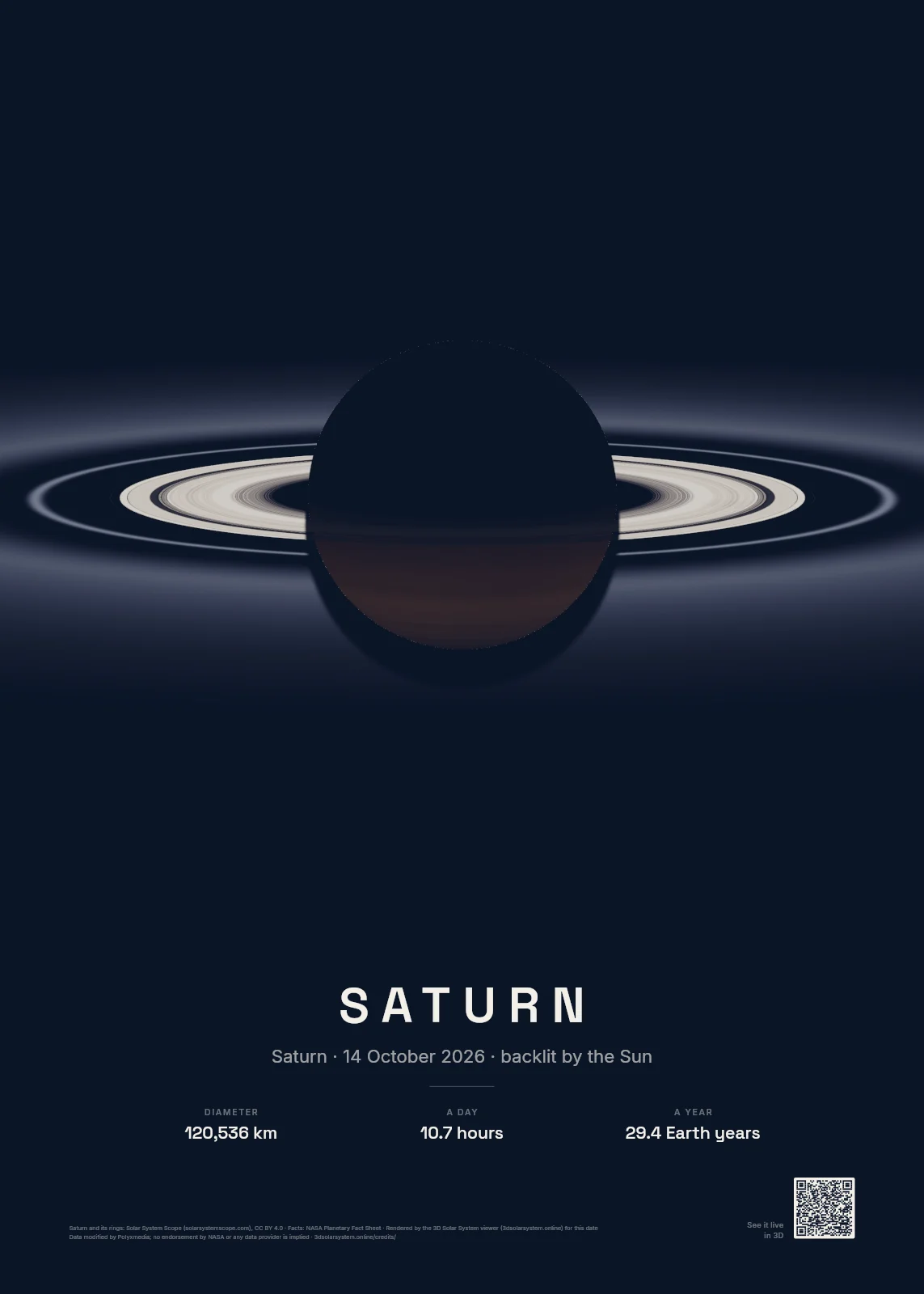
Saturn, backlit
Saturn from beyond the planet with the Sun behind it: the dark globe hides the Sun and the rings glow, lit from behind as they were on your date.
- Diameter: 120,536 km
- A day: 10.7 hours
- A year: 29.4 Earth years
The Moon on your night
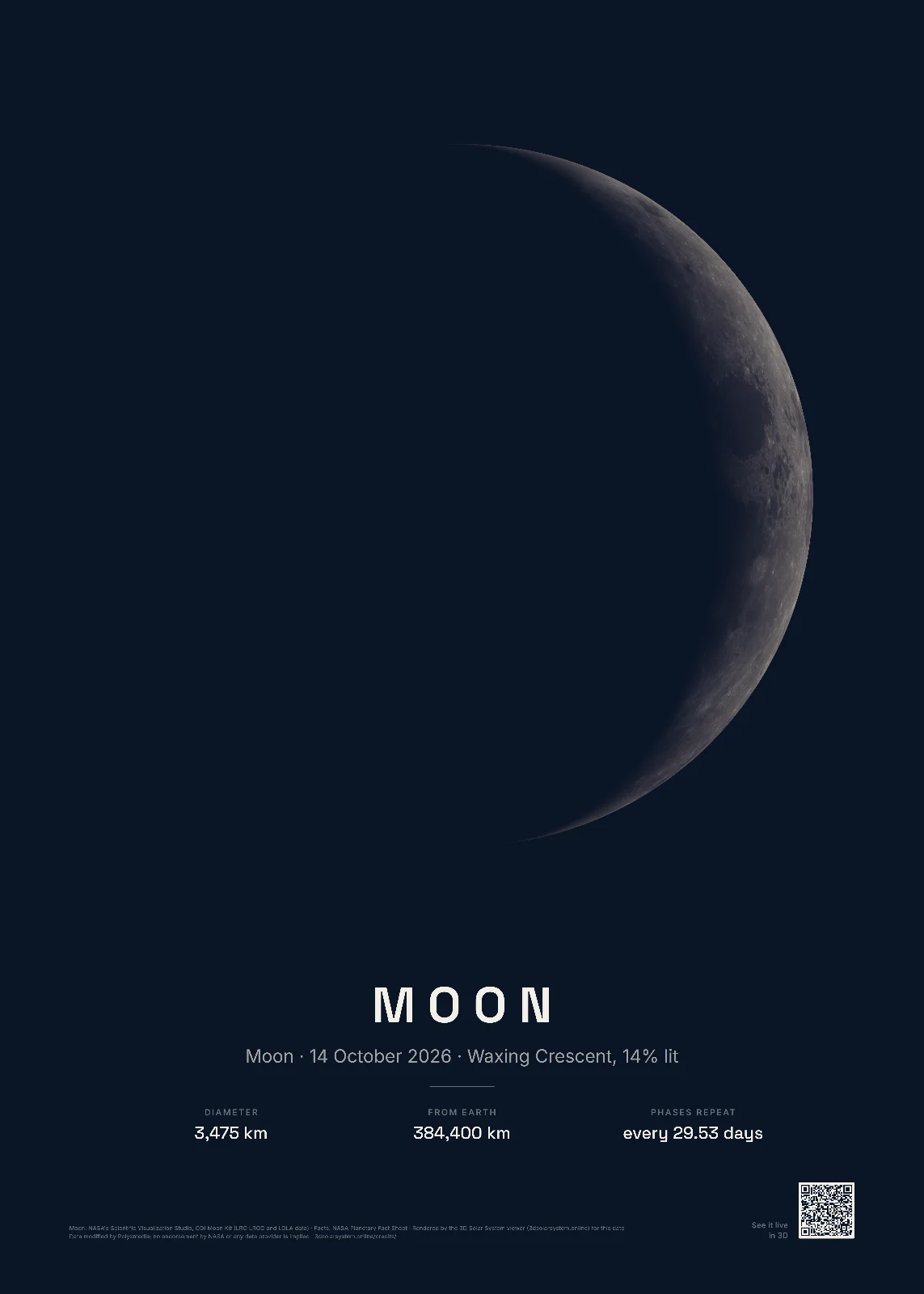
The Moon as it was from the Earth on your date: its phase, the face it turned to us and its tilt, from NASA's lunar maps.
- Diameter: 3,475 km
- From Earth: 384,400 km
- Phases repeat: every 29.53 days
The Earth at night over your town
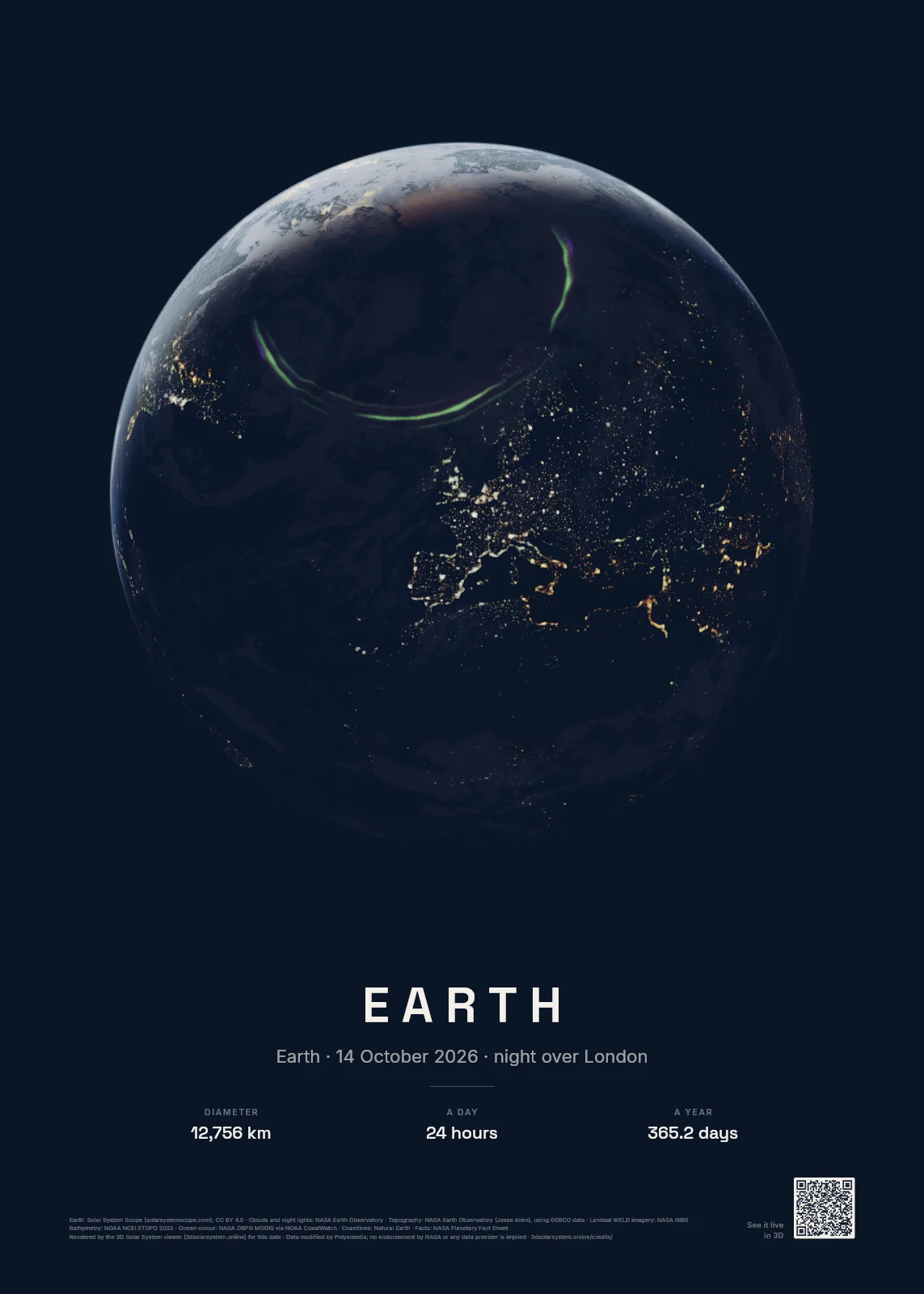
The Earth over the town you choose on the evening of your date, once the Sun is well below its horizon: city lights on the night side, the day a crescent on the edge.
- Diameter: 12,756 km
- A day: 24 hours
- A year: 365.2 days
Mars as a crescent
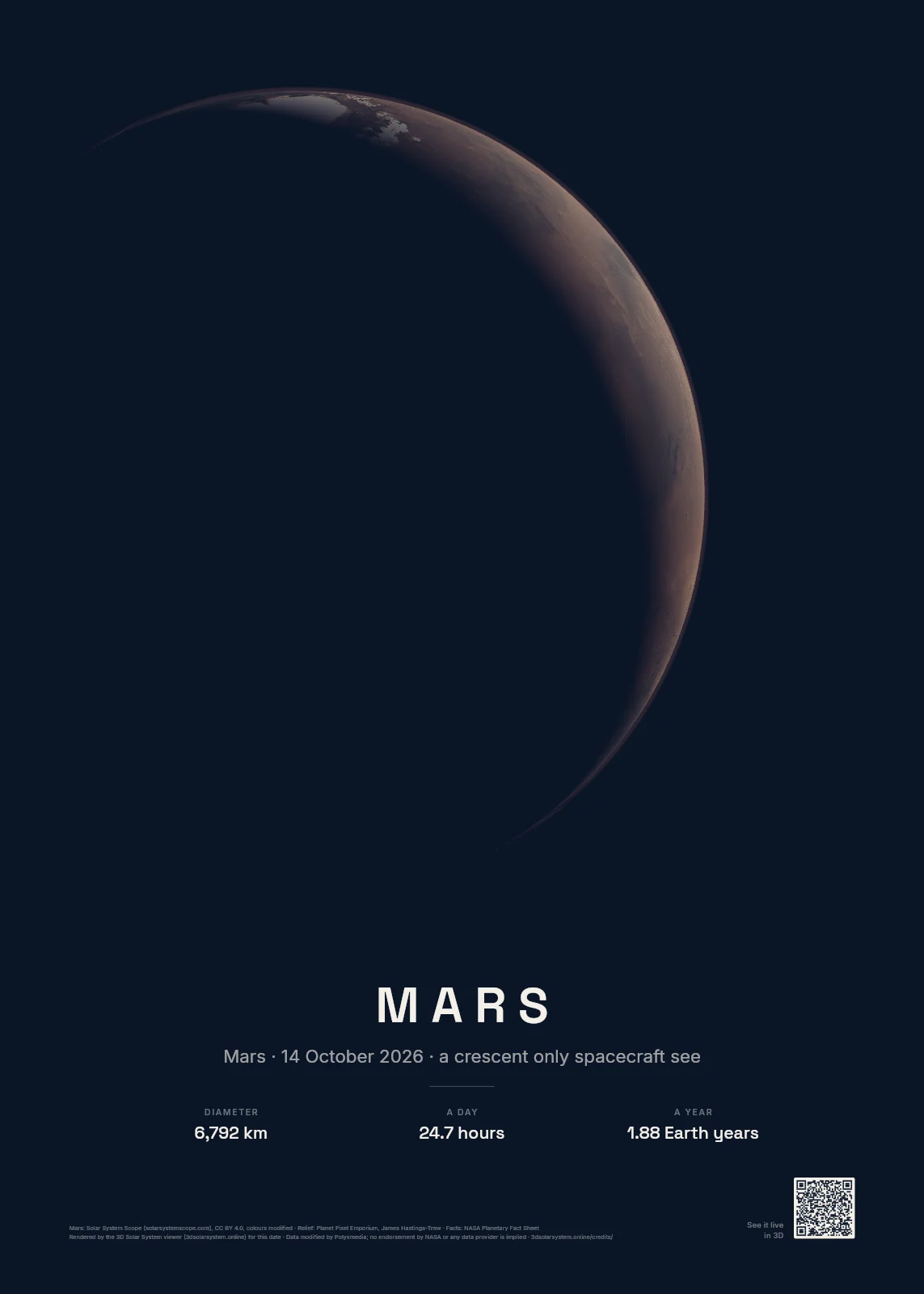
Mars as a thin crescent, a view only spacecraft see, lit by the Sun as it shone on your date and turned on its real axis.
- Diameter: 6,792 km
- A day: 24.7 hours
- A year: 1.88 Earth years
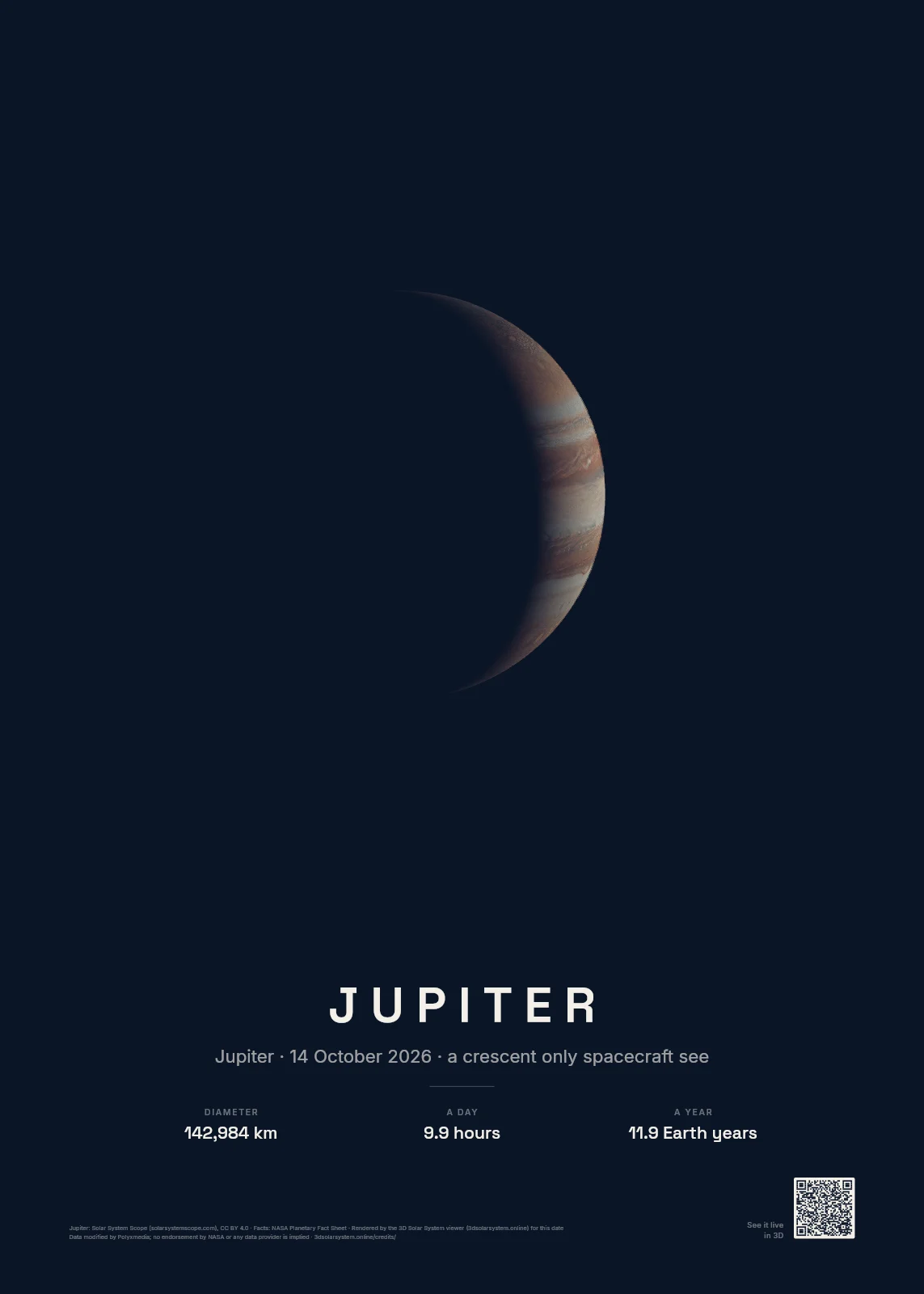
Jupiter as a crescent
Jupiter's belts and zones on a crescent only spacecraft see, lit by the Sun as it shone on your date.
- Diameter: 142,984 km
- A day: 9.9 hours
- A year: 11.9 Earth years
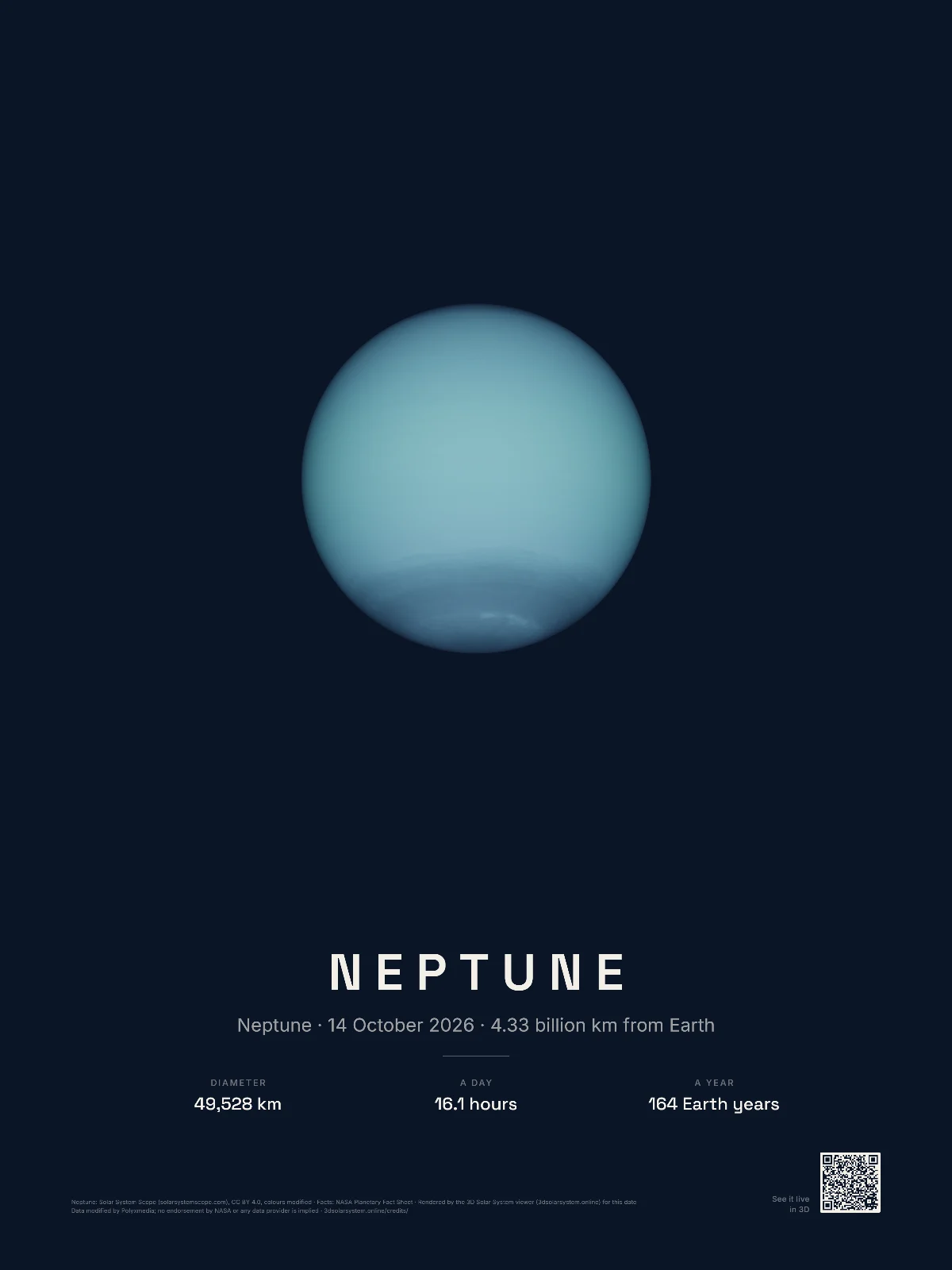
Neptune from the Earth
Neptune as the Earth saw it on your date, the far blue world tilted as it was, with its distance from us that day.
- Diameter: 49,528 km
- A day: 16.1 hours
- A year: 164 Earth years
More views of the same date.
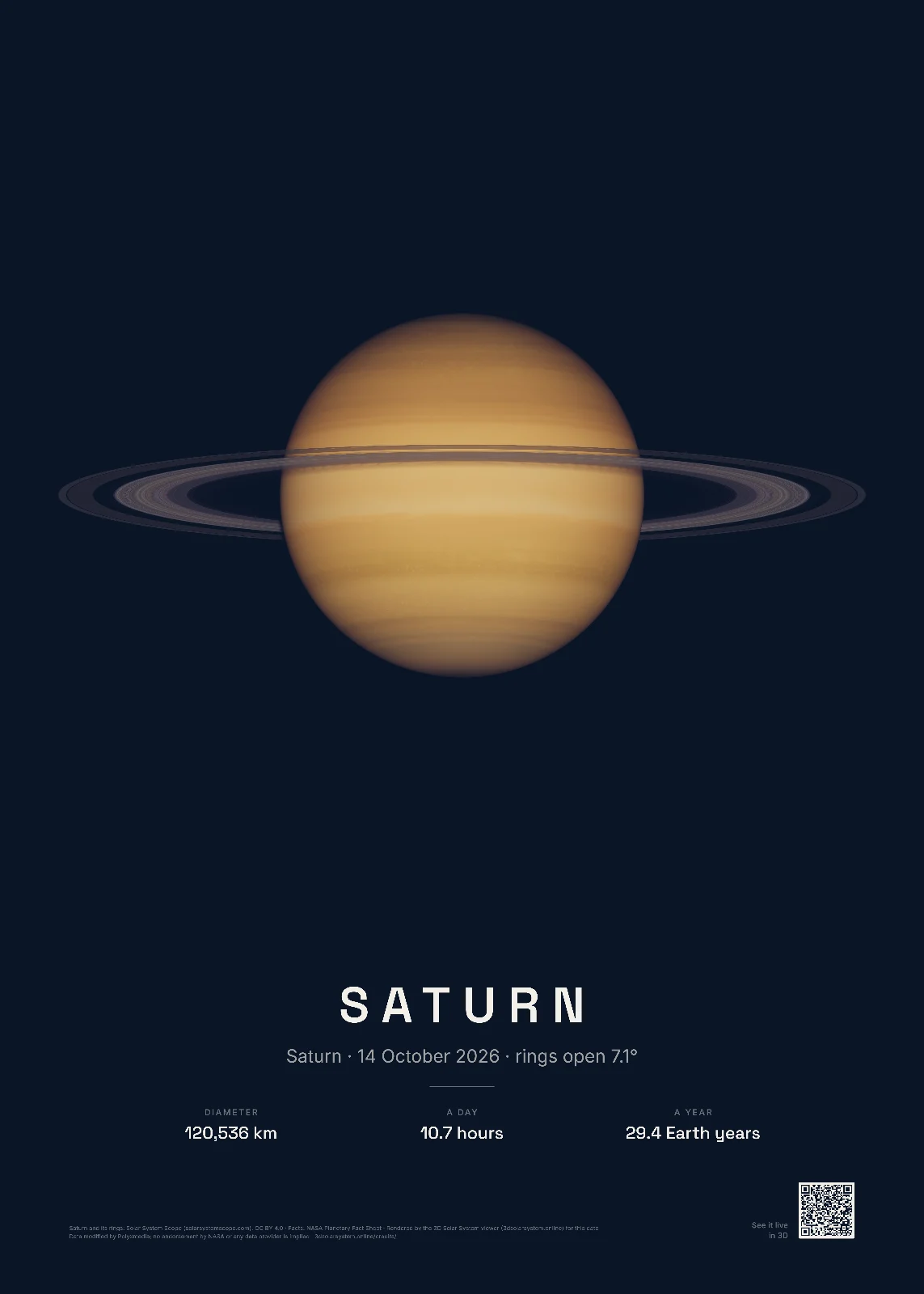
Saturn from the Earth
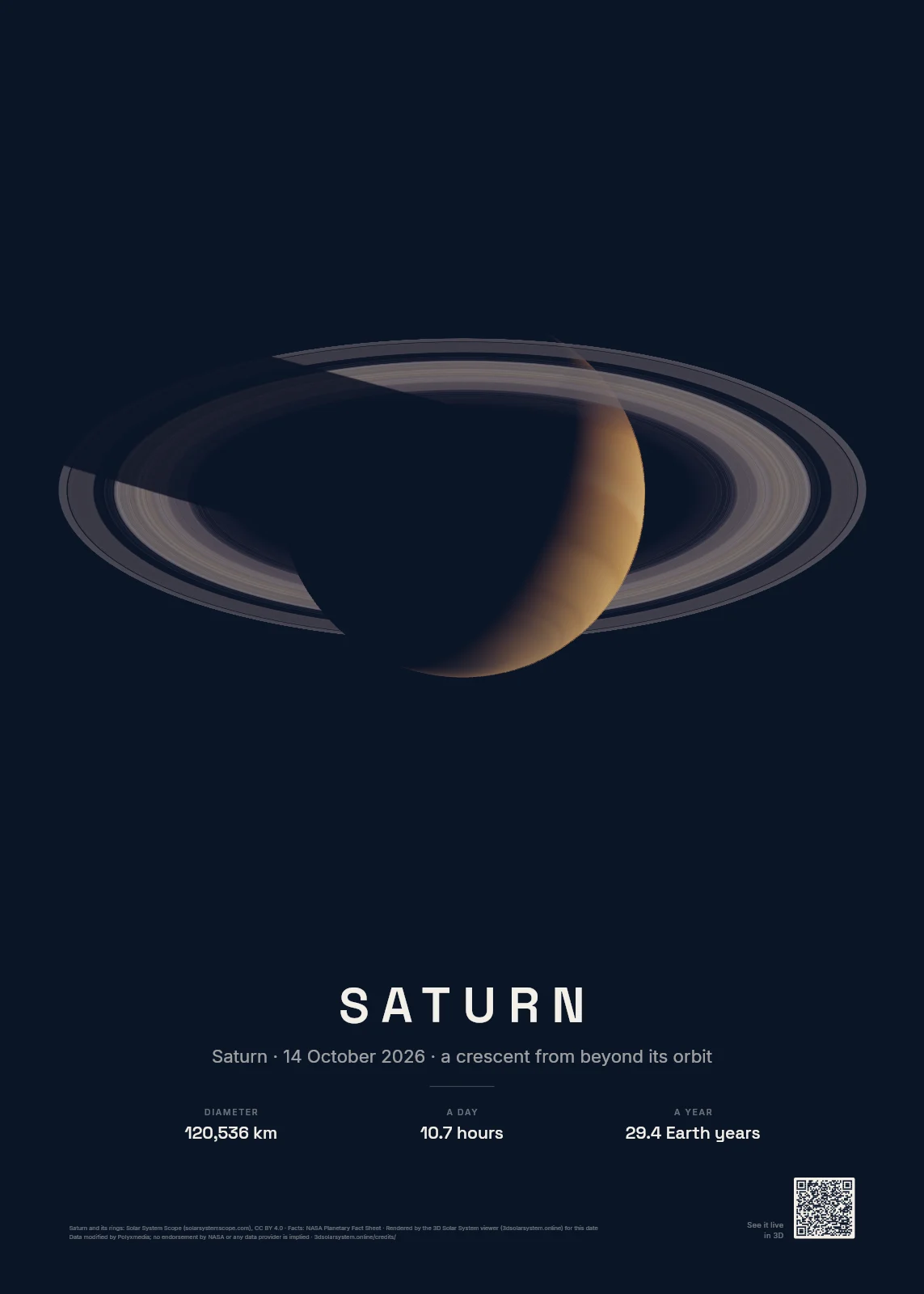
Saturn as a crescent
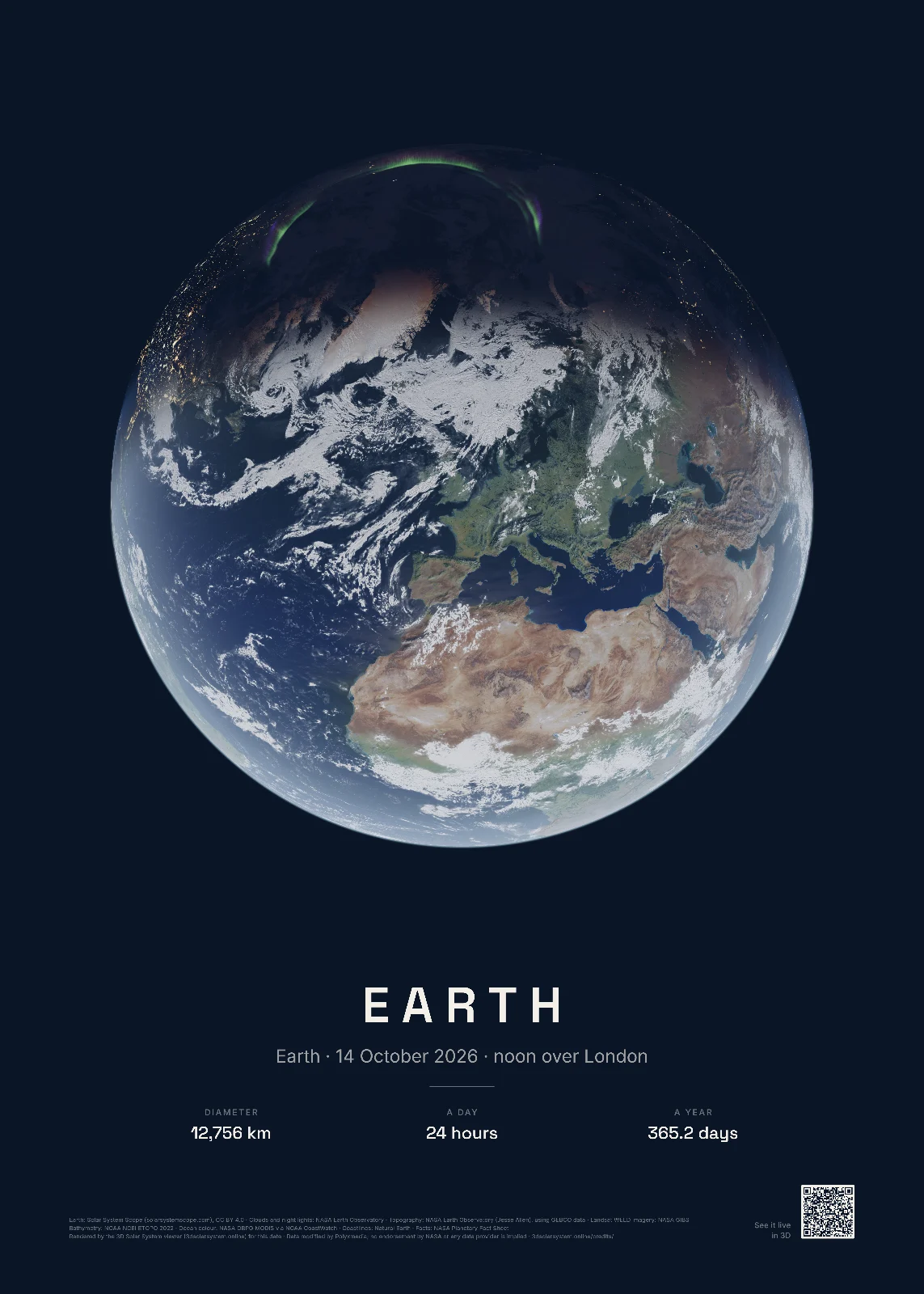
The Earth at noon over your town
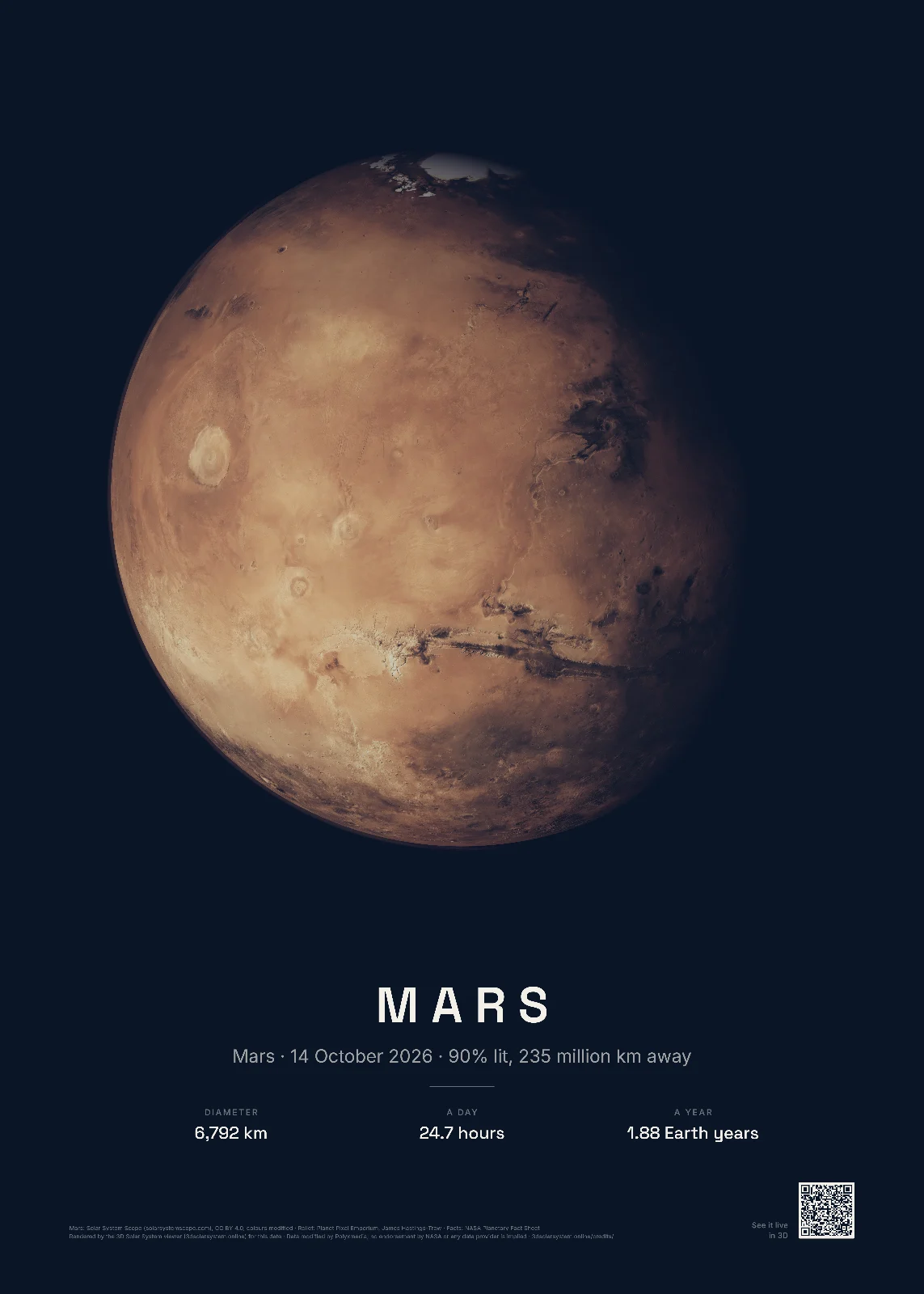
Mars from the Earth
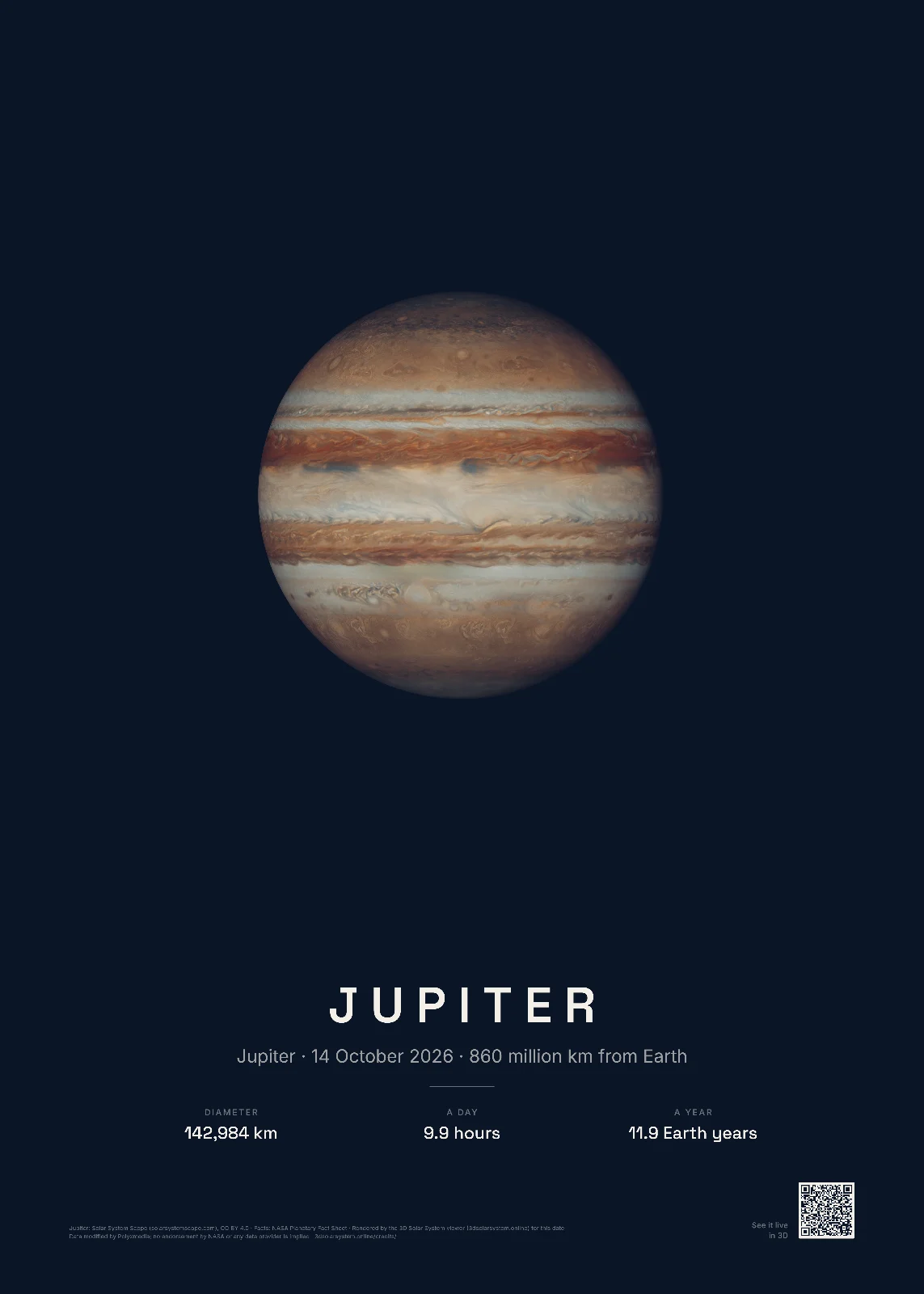
Jupiter from the Earth
What your date changes.
Saturn poster: backlit, from the Earth, or a crescent
Backlit, the view is from beyond Saturn on the line from the Sun: the dark globe hides the Sun and the rings glow with the light behind them, the view Cassini made famous in In Saturn's Shadow.
From the Earth, the rings open as far as they were on your date. They lie over Saturn's equator, tilted 26.73° to its orbit,2 so as Saturn goes round the Sun we see them from above, then edge-on, then from below. They last turned edge-on to the Earth on 23 March 2025, and the crossings come every 13 to 16 years.5 On 14 October 2026 they were open 7.1° towards us; by June 2032 they open 26.9°, worked out by the same geometry we test against JPL's Horizons system.6,7
Moon poster: a moon phase print of the night you choose
The Moon's phases repeat every 29.53 days,3 so the same date a year later shows a different Moon. The Moon poster draws it from the Earth on your date: the phase it showed, how much of it was lit, and the face it turned to us, which rocks a little from night to night.6
For a birth, a wedding or the night you met, it is the Moon of that night, drawn from NASA's own lunar maps.9 To see the Moon on any night now, try the Moon phase calendar.
Earth poster: your town at night or at noon
At night, the Earth over the town you choose late on the evening of your date, once the Sun is 45 degrees below its horizon (or at local midnight, where it never sinks so far): the city lights on the night side and the day a crescent on the edge. At noon, the whole sunlit Earth over your town from about 25,000 km up.
The Earth's axis is tilted 23.44° to its orbit,4 so the edge between day and night swings with the seasons, and a June poster lights the poles differently from a December one.
Mars, Jupiter and Neptune
Mars and Jupiter come as crescents, a view only spacecraft see, or as the Earth saw them on your date, turned to the face they showed us after allowing for the time their light took to reach us.6 Neptune is drawn as the Earth saw it, with its distance from us that day. Their surfaces and cloud bands come from the same maps as our 3D viewer.8
How open were Saturn's rings?
The rings' opening seen from the Earth on each date, worked out by the posters' geometry.6
- 24.7°1 January 1990, the north face
- 7.0°1 January 1995, the north face
- 19.1°1 January 2000, the south face
- 22.5°1 January 2005, the south face
- 4.9°1 January 2010, the north face
- 24.5°1 January 2015, the north face
- 23.6°1 January 2020, the north face
- Edge-on23 March 2025
- 7.1°14 October 2026, the south face
- 21.4°1 January 2030, the south face
- 26.9°1 June 2032, the south face
- 20.2°1 January 2035, the south face
Questions about planet prints.
When can I order a planet print?
We are getting them ready now. Press Notify me and we email you once, the day they go on sale. Star map prints of the night sky are on sale today.
Which date does a planet print show?
The one you choose. Every view is lit by the Sun from where it really was that day and turned on the planet's real axis, and the poster prints the date with three facts from NASA's fact sheets.1,6 The posters on this page are drawn for 14 October 2026.
Is it a photograph?
No. Each poster is drawn by our 3D engine from maps of that world, turned on its real axis and lit by the Sun from the direction it shone that day. The maps' makers are credited on every poster.8,9
What does backlit mean on the Saturn poster?
The view is from beyond Saturn, on the line from the Sun, so the planet's dark globe hides the Sun and the rings shine with the light behind them. Saturn also comes as the Earth saw it on your date, and as a crescent from beyond its orbit.
How far do Saturn's rings open?
Seen from the Earth, up to about 27 degrees, because Saturn's equator, where the rings lie, is tilted 26.73° to its orbit.2 Twice in each 29.4-year orbit the rings turn edge-on to us; the last time was 23 March 2025.5
Can the Earth poster show my town?
Yes, at night or at noon. At night, the Earth over your town late on the evening of your date, once the Sun is 45 degrees below its horizon (or at local midnight, where it never sinks so far), with the city lights on the night side. At noon, the whole sunlit Earth over your town.
Will there be a moon phase print of the night I was born?
The Moon poster shows the Moon from the Earth on any date: the phase it showed, how much of it was lit and the face it turned to us. The phases repeat every 29.53 days.3
Sources
- Williams, D. R., Planetary Fact Sheet (Metric), NASA Goddard Space Flight Center, read 14 October 2026. nssdc.gsfc.nasa.gov/planetary/factsheet
- Williams, D. R., Saturn Fact Sheet, NASA Goddard Space Flight Center: obliquity to orbit 26.73°, sidereal orbit period 10,755.699 days. saturnfact.html
- Williams, D. R., Moon Fact Sheet, NASA Goddard Space Flight Center: synodic period 29.53 days. moonfact.html
- Williams, D. R., Earth Fact Sheet, NASA Goddard Space Flight Center: obliquity to orbit 23.44°. earthfact.html
- NASA Science, "Hubble Views Saturn Ring-Plane Crossing": "Saturn ring plane crossings generally occur on 13 to 16 year intervals" and the next "on 23 March 2025". science.nasa.gov
- Our own test of the posters' geometry against [7] for 25 December 2026 (tests/prints-planets.test.js in our code, October 2026): the sub-Earth and sub-solar points of Mars, Jupiter, Saturn and Neptune and the Moon's libration within 0.01°, and Saturn's ring opening.
- JPL Horizons System, NASA Jet Propulsion Laboratory. ssd.jpl.nasa.gov/horizons
- Solar System Scope textures, CC BY 4.0 (Earth, Mars, Jupiter, Saturn and its rings, Neptune). solarsystemscope.com/textures
- NASA's Scientific Visualization Studio, CGI Moon Kit (LRO LROC and LOLA data), public domain. svs.gsfc.nasa.gov/4720
Each poster credits its maps in its own small print; every source is on our credits page. No endorsement by NASA or any data provider is implied. Privacy.