Moon phases in April 2026
The Moon is full on 2 April (the Pink Moon), at last quarter on 10 April, new on 17 April and at first quarter on 24 April.
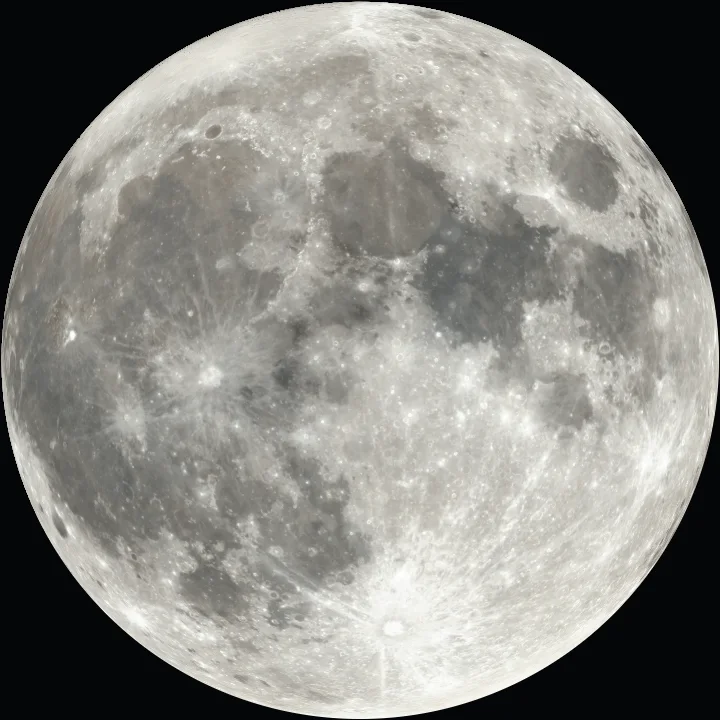
| Mon | Tue | Wed | Thu | Fri | Sat | Sun |
|---|---|---|---|---|---|---|
| 1 April: Waxing gibbous, 100% lit | 2 April: Full Moon at 02:13, 100% lit | 3 April: Waning gibbous, 98% lit | 4 April: Waning gibbous, 94% lit | 5 April: Waning gibbous, 89% lit | ||
| 6 April: Waning gibbous, 82% lit | 7 April: Waning gibbous, 75% lit | 8 April: Waning gibbous, 66% lit | 9 April: Waning gibbous, 57% lit | 10 April: Last quarter at 04:52, 47% lit | 11 April: Waning crescent, 38% lit | 12 April: Waning crescent, 28% lit |
| 13 April: Waning crescent, 19% lit | 14 April: Waning crescent, 11% lit | 15 April: Waning crescent, 5% lit | 16 April: Waning crescent, 1% lit | 17 April: New Moon at 11:53, 0% lit | 18 April: Waxing crescent, 2% lit | 19 April: Waxing crescent, 6% lit |
| 20 April: Waxing crescent, 13% lit | 21 April: Waxing crescent, 22% lit | 22 April: Waxing crescent, 32% lit | 23 April: Waxing crescent, 43% lit | 24 April: First quarter at 02:32, 54% lit | 25 April: Waxing gibbous, 65% lit | 26 April: Waxing gibbous, 75% lit |
| 27 April: Waxing gibbous, 83% lit | 28 April: Waxing gibbous, 90% lit | 29 April: Waxing gibbous, 95% lit | 30 April: Waxing gibbous, 98% lit |
The main phases in April 2026
- Full Moon: Pink Moon Thu 2 Apr 2026 02:13 UTC Your time: 02:13 UTC
- Last quarter Fri 10 Apr 2026 04:52 UTC Your time: 04:52 UTC
- New Moon Fri 17 Apr 2026 11:53 UTC Your time: 11:53 UTC
- First quarter Fri 24 Apr 2026 02:32 UTC Your time: 02:32 UTC
To the nearest minute. Our times agree with the US Naval Observatory's to within a minute and a half for every phase from 2026 to 2028. The Moon right now, live.
The Pink Moon
The full Moon of Thursday 2 April 2026 at 02:13 UTC is the Pink Moon in the Old Farmer's Almanac's list. It is 393,597 km from Earth, 30% of the way from apogee to perigee, so it is not a supermoon.
Every full Moon of 2026, with its name, is on full Moons in 2026.
Get the night of the Pink Moon as a print: the sky over your own town that night, on a star map.
Get the Moon from your date as a print: the Moon as it looked on a day that matters to you.
See the night sky on any date, free: the stars, the planets and the Moon over any town.
Questions
When is the full Moon in April 2026?
Thursday 2 April 2026 at 02:13 UTC. It is the Pink Moon.
When is the new Moon in April 2026?
Friday 17 April 2026 at 11:53 UTC.
Is there a supermoon in April 2026?
The full Moon of 2 April 2026 is 393,597 km from Earth, 30% of the way from apogee to perigee, so it is not a supermoon.
Why are the times in UTC?
Each phase happens at one moment for the whole world, and UTC is the clock everyone can convert from. With JavaScript on, this page also shows every time and the whole calendar in your own time zone, so a phase near midnight lands on your own date.
Sources
- US Naval Observatory: Phases of the Moon. Our times are checked against USNO's for every phase from 2026 to 2028 and agree to within a minute and a half
- US Naval Observatory: Phases of the Moon and percent of the Moon illuminated (how the phases, the percent lit and the Moon's age are defined)
- Fred Espenak, AstroPixels: Full Moon at Perigee (full supermoons), 2001 to 2100, and the test for one
- NASA Science: Supermoons
- The Old Farmer's Almanac: Full Moon names
- The Old Farmer's Almanac: the Hunter's Moon, the full Moon after the Harvest Moon
- NASA Watch the Skies: the monthly and seasonal blue moon
- NASA Eclipse Web Site (Espenak): eclipse dates
- Jean Meeus, Astronomical Algorithms (2nd edition, 1998): chapter 47, the lunar theory behind the Moon's place, phase and distance; chapter 48, the lit fraction and the bright limb; chapter 25, the Sun's aberration
- IAU Office of Astronomy for Education: the lunar phases seen from the Southern Hemisphere
- NASA's Scientific Visualization Studio, CGI Moon Kit (Ernie Wright, Noah Petro, 2019): the Moon's colour from the LROC Wide Angle Camera's Hapke-normalised mosaic, the face every Moon on these pages is drawn from
- LRO Lunar Orbiter Laser Altimeter, LDEM_64 heights (NASA PDS Geosciences Node): the slopes that shade the ground near the terminator
- Archinal et al. (2011), Report of the IAU Working Group on Cartographic Coordinates and Rotational Elements: 2009, Celestial Mechanics and Dynamical Astronomy 109, 101: the Moon's pole and turning, so the drawn face shows the libration of the moment
- NASA's Scientific Visualization Studio, Moon Phase and Libration, 2026: what libration and the position angle of the axis are, and the frames we compared our drawing with
- NASA JPL Horizons: the Moon's sub-Earth point and pole angle, which our drawing matches to within 0.01 degrees on the dates we test
- Krisciunas and Schaefer (1991), A model of the brightness of moonlight, Publications of the Astronomical Society of the Pacific 103, 1033: the Moon's brightness through its phases, which sets the earthshine against the sunlit side
- NASA Earth fact sheet: the Earth's radius and geometric albedo, for the earthshine
- The phases, distances and dates on this page are worked out by our own code from the sources above, the same lunar theory that places the Moon in the 3D viewer. The Moons are drawn by our own renderer from NASA's maps.