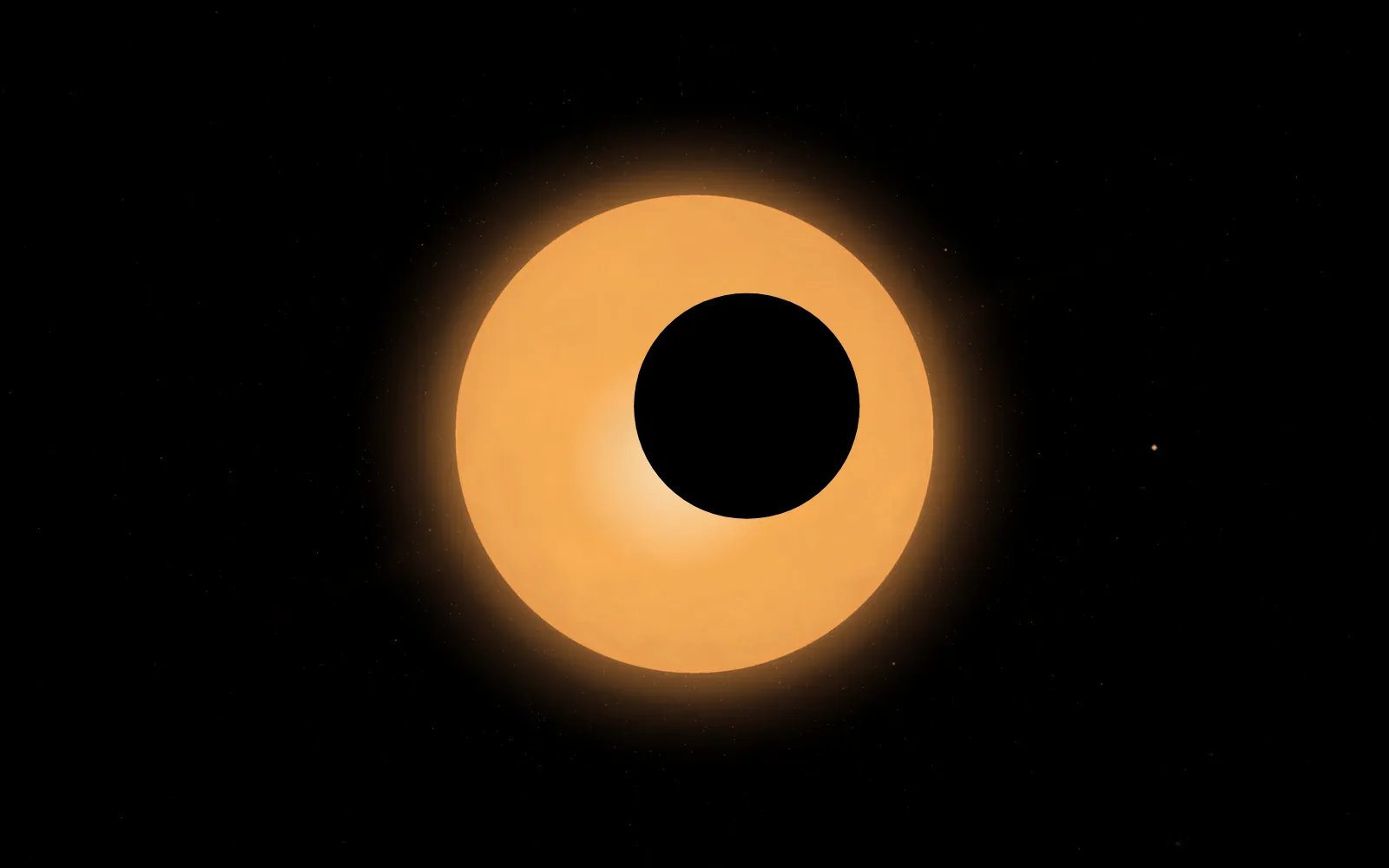
Rabat, Morocco · Partial solar eclipse · 2 August 2027
Eclipse 2027 in Rabat
In Rabat the Moon covers 98.5% of the Sun at 08:45 local time (WET, UTC) on Monday 2 August 2027. The path of totality passes 65 km to the north.
Begins07:39:07 WET
Greatest08:45:23 WET
Your time08:45:23 UTC
When it happens in Rabat
| Stage | WET | UTC | Sun |
|---|---|---|---|
| Partial eclipse beginsC1, the Moon first touches the Sun | 07:39:07 | 07:39:07 | 23° |
| Greatest eclipsethe most of the Sun covered | 08:45:23 | 08:45:23 | 37° |
| Partial eclipse endsC4, the Moon leaves the Sun | 09:58:43 | 09:58:43 | 52° |
Monday 2 August 2027, local time in Rabat (Morocco time, UTC). The Sun column is its height above the horizon. Times are for the centre of Rabat, 34.013° N, 6.833° W; a few kilometres away they shift by a few seconds.
Rabat and the path of totality
The shaded band is the path of totality, the dashed line its centre, where totality lasts longest. Coastlines, rivers and borders: Natural Earth.
Rabat is outside the path of totality, 65 km beyond its southern edge. Travel 65 km north and the Sun is covered completely, at first only for moments; on the centre line, 180 km to the north, totality lasts 4 min 48 s.
The nearest place in the path with its own page here is Chefchaouen, 195 km to the north-east, with 4 min 13 s of totality.
What you will see
Through eclipse glasses, the Moon's edge first touches the Sun at 07:39:07. By 08:45 it has turned the Sun into a thin crescent, with 98.5% of its face covered, and at 09:58:43 it moves clear. The whole eclipse lasts 2 h 20 min.
Outside the path some of the Sun always shows, and even a thin crescent is far too bright to look at, so glasses stay on from start to finish. The Sun is 37° up in the east: any open spot with a clear view that way works.
How to watch safely
- Wear eclipse glasses that meet the ISO 12312-2 standard whenever any part of the Sun is showing. Sunglasses, however dark, are not safe.
- Never look through binoculars, a telescope or a camera without a proper solar filter on the front.
- A pinhole projector works anywhere: a small hole in card throws an image of the Sun onto paper behind it.
- There is no safe moment without glasses in Rabat: even at 98.5% a crescent of the Sun is still showing.
See it in 3D
The Moon’s shadow crossing the Earth on the day, drawn by our 3D viewer from the real positions of the Sun, the Moon and the Earth, with the umbra and penumbra at their true size. Press play to load it here, then play, pause and scrub through the eclipse, or open it in the full viewer.
Open this eclipse in the 3D viewer →
Get a reminder
Remind me sends one notification to this phone or computer shortly before, with no account needed, where your browser allows it. Otherwise we email you a day or two before. Add to calendar puts it in Google, Apple or Outlook. Nothing else arrives unless you ask for it.
Get this moment as a print: the sky over Rabat at greatest eclipse, on a star map.
Questions
What time is the eclipse in Rabat?
On Monday 2 August 2027 it begins at 07:39:07 WET, is greatest at 08:45:23 and ends at 09:58:43. In UTC that is 07:39:07 to 09:58:43.
Is Rabat in the path of totality?
No. Rabat is 65 km outside the southern edge of the path, so it sees a partial eclipse, with 98.5% of the Sun covered at its deepest.
How much of the Sun is covered in Rabat?
98.5% of its disc at 08:45:23 WET, an eclipse magnitude of 0.981 (the share of the Sun's width the Moon covers).
Where is the nearest total eclipse to Rabat?
The edge of the path of totality is 65 km to the north, and its centre line 180 km to the north, where totality lasts 4 min 48 s. The nearest place with its own page here is Chefchaouen, with 4 min 13 s.
Where is the Sun during the eclipse?
At greatest eclipse it is 37° up in the east (bearing 93°). At the start it is 23° up and at the end 52°.
Is it safe to look at?
Never without protection: use ISO 12312-2 eclipse glasses or a pinhole projector for the whole eclipse, and never look through binoculars, a telescope or a camera without a solar filter on the front.
Nearby
- CasablancaPartial, 97.1% of the Sun · 85 km south-west
- FezPartial, 98.4% of the Sun · 170 km east
- ChefchaouenTotal for 4 min 13 s · 195 km north-east
- TangierTotal for 4 min 50 s · 220 km north-east
- TetouanTotal for 4 min 51 s · 220 km north-east
- TarifaTotal for 4 min 39 s · 250 km north-east
The whole eclipse, its path and how it works are on the total solar eclipse of 2 August 2027 page, with every city on one list.
Sources
- Fred Espenak, EclipseWise: Besselian elements of the total solar eclipse of 2027 August 2, the numbers every time and duration on this page is worked from
- NASA Eclipse Web Site: Besselian elements and lunar radii for this eclipse
- NASA: path of totality, with centre-line durations
- IERS Bulletin A (8 October 2026): the Earth's predicted rotation on 2 August 2027, which sets Delta T to 69.4 s
- GeoNames: Rabat, its coordinates, height and time zone (CC BY 4.0)
- Xavier Jubier: interactive map of the 2027 eclipse, which these times were checked against
- Natural Earth: coastlines, rivers and borders on the map (public domain)
- NASA: eclipse safety and American Astronomical Society: eye safety
- The method is the classical one for local circumstances (Explanatory Supplement to the Astronomical Almanac, chapter 8), run for this page at build time.