Lesson plan · Ages 9 to 14 · 20 minutes
Phases of the Moon
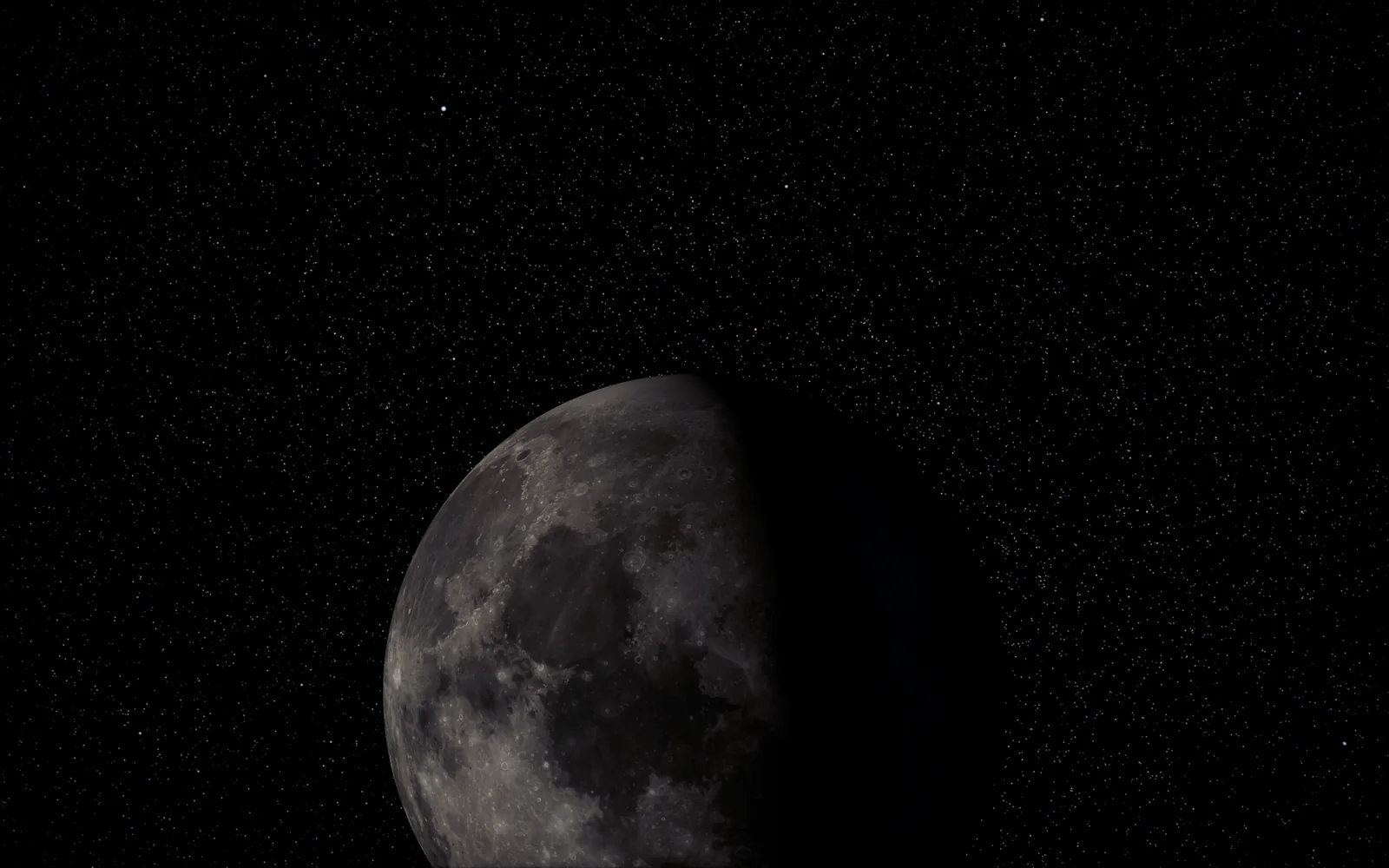
Half of the Moon is always lit by the Sun, and the phase is how much of that half we can see from Earth.
The lesson
The class watches the Moon go round Earth from above, then looks at the Moon from Earth at new Moon, first quarter, full Moon and last quarter in January 2027. Pupils then run the clock to a full Moon.
What they take away
The Sun always lights half of the Moon. As the Moon travels round Earth we see different amounts of that lit half, from none at new Moon to all of it at full Moon, and the cycle repeats about every 29.5 days.
Curriculum links
Quoted word for word from the official documents.
England national curriculum
-
Key stage 2, year 5: Earth and space
Read it on gov.ukdescribe the movement of the moon relative to the Earth
Next Generation Science Standards (NGSS)
-
MS-ESS1-1
Read it on nextgenscience.orgDevelop and use a model of the Earth-sun-moon system to describe the cyclic patterns of lunar phases, eclipses of the sun and moon, and seasons.
Step by step
The caption is what the class reads on screen; the talking points are in your notes drawer (N) when you present. Steps marked Pupils only appear only in the pupil lesson.
-
01
Round and round
Presented and for pupilsCaption
The Moon travels round Earth. One trip from new Moon to the next new Moon takes about 29.5 days.
Talking points
- The clock runs at a day a second, so a month of phases takes about half a minute.
- NASA: the Moon goes round Earth once every 27.3 days measured against the stars, but it takes 29.5 days to go from new Moon to new Moon. The USNO gives the average as about 29.531 days.
- This view is not to scale. NASA says the gap between Earth and the Moon, 384,399 km on average, could hold about 30 Earths.
Sources 1 2 3 5Present from this step
-
02
Always half lit
Presented and for pupilsCaption
The Sun always lights up half of the Moon. The phase is how much of that lit half we can see from Earth.
Talking points
- NASA: the Sun always illuminates half of the Moon while the other half remains dark, but how much of that illuminated half we see changes as the Moon travels through its orbit.
- The Moon makes no light of its own. NASA: the only object in our Solar System that shines with its own light is the Sun.
- A common mistake is to think the dark part of the Moon is Earth's shadow. Earth's shadow falls on the Moon only in a lunar eclipse, which NASA Space Place describes as a full Moon fading as Earth's shadow covers it.
Ask the class
How much of the Moon is lit by the Sun at new Moon?
- None of it
- Half of itRight answer
- All of it
WhyHalf of the Moon is always lit. At new Moon the lit half faces away from Earth, so we cannot see it.
Sources 1 4Present from this step
-
03
New Moon
Presented and for pupilsCaption
New Moon. The lit half faces away from us, so we cannot see the Moon. It is in the same part of the sky as the Sun.
Talking points
- USNO: new Moon on 7 January 2027 at 20:24 UTC.
- NASA: at new Moon the Moon rises and sets with the Sun. Because its orbit is tilted, it usually passes near the Sun in our sky without crossing in front of it.
Sources 1 6Present from this step
-
04
First quarter
Presented and for pupilsCaption
First quarter. The Moon is a quarter of the way round, and from Earth we see half of its face lit.
Talking points
- USNO: first quarter on 15 January 2027 at 20:34 UTC.
- NASA: people often call this a half Moon. What we see is half of the lit half. A first quarter Moon rises around midday and sets around the middle of the night.
Ask the class
Why is it called a first quarter Moon when it looks like half a Moon?
- The Moon has gone a quarter of the way round EarthRight answer
- A quarter of the Moon has fallen into shadow
- It happens in the first quarter of the year
WhyNASA: the Moon is a quarter of the way through its monthly journey, and we see half of its lit side.
Sources 1 6Present from this step
-
05
Full Moon
Presented and for pupilsCaption
Full Moon. The Moon is opposite the Sun in our sky, and its whole lit half faces us.
Talking points
- USNO: full Moon on 22 January 2027 at 12:17 UTC.
- NASA: a full Moon rises around sunset and sets around sunrise.
Sources 1 6Present from this step
-
06
Last quarter
Presented and for pupilsCaption
Last quarter. The Moon is three quarters of the way round, and now the other side of its face is lit.
Talking points
- USNO: last quarter on 29 January 2027 at 10:55 UTC.
- NASA: a last quarter Moon is also called a third quarter Moon. It rises around the middle of the night and sets around midday.
- USNO defines last quarter as the moment the Moon is 270 degrees east of the Sun along the ecliptic. 270 of 360 degrees is three quarters of the way round from new Moon.
Sources 1 5 6Present from this step
-
07
The order of the phases
Presented and for pupilsCaption
The phases come round in the same order every month.
Talking points
- NASA lists the eight phases in order: new Moon, waxing crescent, first quarter, waxing gibbous, full Moon, waning gibbous, third quarter and waning crescent.
- USNO defines the four main phases by how far the Moon is east of the Sun along the ecliptic: 0 degrees (new), 90 (first quarter), 180 (full) and 270 (last quarter).
Ask the class
Put these phases in order, starting from new Moon.
They start in this order: Full Moon, First quarter, Last quarter, New Moon.
Answer
- New Moon
- First quarter
- Full Moon
- Last quarter
WhyNew Moon, first quarter, full Moon, last quarter, and back to new Moon about 29.5 days after the last one.
Sources 1 5Present from this step
-
08
Find the full Moon
Pupils onlyCaption
Your turn. Run the clock until the Moon is full, then pause it.
Talking points
- The check passes within 12 degrees of full Moon. The Moon gains 360 degrees on the Sun every 29.53 days, about 12 degrees a day, so that is about a day either side.
Pupil task
Play the clock. Pause it when the Moon is full.
HintFull Moon comes about a week after first quarter. Slow down when the Moon looks nearly round.
The viewer checks the task as the pupil works and says when it is done.
Sources 2 5 6Open this step as a pupil
Sources
Every fact in this lesson comes from these sources, and each step lists the ones it uses.