Lesson plan · GCSE · Ages 14 to 16 · 30 minutes
Earth's magnetic shield
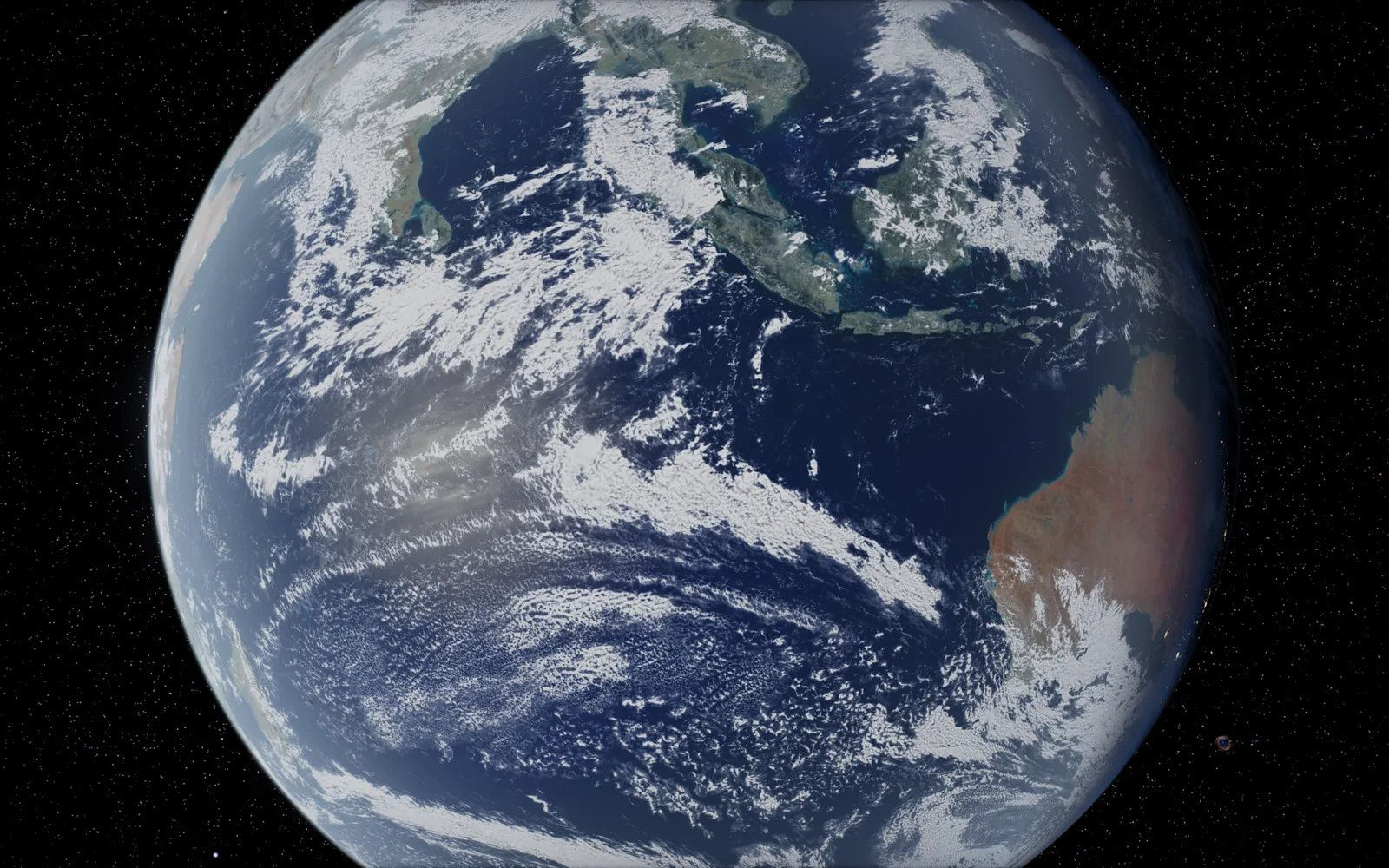
The Earth's field from the compass needle to the magnetopause: the solar wind, a storm pushing the boundary in, the tail past the Moon, the Van Allen belts and the aurora.
The lesson
The class sees the Earth's magnetic field drawn round the planet for the solar wind arriving now: why a compass points the way it does, where the wind meets the field about 10 Earth radii out, and what a storm does to that boundary. They follow the field out into a tail past the Moon, down to the Van Allen belts, and into the upper air over the poles, where electrons it guides make the aurora.
What they take away
The Earth is a magnet because of currents in its molten outer core, which is why a compass points north. The solar wind squeezes that field on the day side to about 10 Earth radii, pushes it closer in a storm and stretches it into a tail past the Moon, and particles held and steered by the field make the Van Allen belts and the aurora.
Curriculum links
Quoted word for word from the official documents.
England national curriculum
-
Key stage 4 physics: magnetism and electromagnetism
Read it on gov.ukexploring the magnetic fields of permanent and induced magnets, and the Earth’s magnetic field, using a compass
AQA GCSE Physics (8463)
-
4.7.1.2 Magnetic fields
Read it on aqa.org.ukA magnetic compass contains a small bar magnet. The Earth has a magnetic field. The compass needle points in the direction of the Earth’s magnetic field.
-
4.7.1.2 Magnetic fields: students should be able to
Read it on aqa.org.ukexplain how the behaviour of a magnetic compass is related to evidence that the core of the Earth must be magnetic.
Pearson Edexcel GCSE Astronomy (1AS0)
-
Topic 10, Solar astronomy: 10.11
Read it on qualifications.pearson.comUnderstand the principal effects of the solar wind, including: a aurorae, b cometary tails, c geomagnetic storms, d the effects on satellites, aircraft travel and manned missions
-
Topic 10, Solar astronomy: 10.12
Read it on qualifications.pearson.comKnow the shape and position of the Earth’s magnetosphere including the Van Allen Belts
Step by step
The caption is what the class reads on screen; the talking points are in your notes drawer (N) when you present. Steps marked Pupils only appear only in the pupil lesson.
-
01
A magnet the size of a planet
Presented and for pupilsCaption
The Earth behaves like a giant bar magnet. Its field comes from electric currents in the molten iron of its outer core.
Talking points
- NOAA: in 1600 William Gilbert published De Magnete and showed that the Earth behaves like a giant magnet. To a great extent the field can be viewed as a dipole, with north and south poles like a simple bar magnet.
- BGS: the field is generated in the fluid outer core by a self-exciting dynamo process; electrical currents flowing in the slowly moving molten iron generate it.
- AQA 4.7.1.2 asks pupils to explain how the behaviour of a magnetic compass is related to evidence that the core of the Earth must be magnetic.
- The lines are the field traced through a published model of it for today's conditions, and the dots run the way the field points.
Ask the class
What makes the Earth's magnetic field?
- Electric currents in the molten iron of the outer coreRight answer
- A solid bar magnet buried at the centre
- Sunlight heating the poles
WhyBGS: electrical currents flowing in the slowly moving molten iron of the outer core generate the field, by a dynamo process.
Sources 1 7 18Present from this step
-
02
Which way a compass points
Presented and for pupilsCaption
A compass needle lines up with the Earth's field. The field's axis is tilted about 10 degrees from the axis the Earth spins on, so its pole is not at the North Pole.
Talking points
- AQA 4.7.1.2: a magnetic compass contains a small bar magnet, and the needle points in the direction of the Earth's magnetic field.
- BGS: the axis of the Earth's equivalent dipole is inclined at about 10° to the rotation axis. The 14th generation IGRF puts its north geomagnetic pole at 80.85° N, 72.76° W in 2025; it was at 78.68° N in 1900, so it moves.
- NOAA's page gives the tilt as about 11 degrees. Both are rounded, and the pole moves.
- BGS: the north dip pole, where the field is vertical, was at 85.73° N, 138.65° E in 2025, about 1,440 km from the geomagnetic pole labelled here. The geomagnetic pole is the end of the axis of the dipole that best fits the whole field, and cannot be found by measuring at one place.
- The pole in the Arctic is called the north geomagnetic pole because of where it is. As a magnet it attracts the north-seeking end of a compass, so in the physics naming it is a south pole (the question below).
- The yellow rod is the axis the Earth spins on, with a point at its north end.
Ask the class
A compass needle's north-seeking pole is pulled towards the Arctic, and unlike poles attract. So what kind of magnetic pole does the Earth have in the Arctic?
- A south poleRight answer
- A north pole
- No pole at all
WhyAQA 4.7.1.1: two unlike poles attract each other. The needle's north-seeking pole is pulled towards the Arctic, so the Earth's magnetic pole there acts as a south pole, and the field lines point into the ground near it.
Sources 1 8 18Present from this step
-
03
A wind from the Sun
Presented and for pupilsCaption
The Sun blows out a continuous wind, mainly protons and electrons. Near the planets it usually travels at about 400 km per second.
Talking points
- NOAA: the solar wind flows continuously out from the Sun and is mainly protons and electrons, a plasma, carrying the Sun's magnetic field with it. In the plane the planets orbit in, the most common wind is the slow wind at about 400 km/s; coronal holes send out fast wind at 500 to 800 km/s.
- NOAA: Ludwig Biermann discovered the solar wind in 1951 while studying why comet tails always point away from the Sun.
- ESA: the L1 point, about a hundredth of the way to the Sun, is a good place to watch the Sun, because the solar wind reaches it about an hour before it reaches Earth.
- The picture uses NOAA's latest measurements of the wind, timed to when that wind reaches the Earth. The Sun is to the left.
Ask the class
A spacecraft at L1, about 1.5 million km towards the Sun, measures the wind. At 400 km/s, how many minutes does that wind take to reach the Earth?
Answer62.5 minutes. Answers from 59.5 to 65.5 are marked right.
WhyTime = distance ÷ speed = 1,500,000 km ÷ 400 km/s = 3,750 s, which is 62.5 minutes. ESA: the wind reaches L1 about an hour before it reaches Earth. (L1 is about a hundredth of the Sun's distance of 149.6 million km, so about 1.5 million km.)
Sources 1 2 10 12Present from this step
-
04
Where the wind meets the field
Presented and for pupilsCaption
The wind squeezes the field on the side facing the Sun. The boundary where they meet, the magnetopause, is about 10 Earth radii from the Earth's centre.
Talking points
- NOAA: the solar wind's pressure compresses the field on the day side and stretches it into a long tail on the night side, like water flowing around a rock in a stream. On the day side the field is confined to within about 10 Earth radii of the Earth's centre.
- NOAA: the magnetopause is always moving as the wind changes. It shields us to some extent, but energy, mass and momentum still get through.
- ESA: further out is the bow shock, where the wind first meets the Earth's magnetic bubble; its particles, travelling at more than 1 million km/h, are suddenly slowed to subsonic speeds.
- The inner shell is the magnetopause and the outer one the bow shock.
Ask the class
The magnetopause is about 10 Earth radii from the Earth's centre, and the Earth's radius is 6,371 km. About how far is that in kilometres?
Answer63,710 km. Answers from 62,210 to 65,210 are marked right.
Why10 × 6,371 km = 63,710 km, about 64,000 km. NOAA puts the Moon at 60 Earth radii, so that is a sixth of the way to the Moon.
Sources 1 9 12Present from this step
-
05
A storm squeezes the shield
Presented and for pupilsCaption
A coronal mass ejection can hit us with a much faster, denser wind. Its pressure pushes the magnetopause in, here to about 6.6 Earth radii.
Talking points
- NOAA: coronal mass ejections leave the Sun at anything from under 250 km/s to nearly 3,000 km/s, and the fastest can reach the Earth in 15 to 18 hours. The DSCOVR spacecraft at L1 can often give 15 to 60 minutes' warning of their arrival.
- NOAA: storms come from hours of fast wind and, most of all, a wind whose magnetic field points south, opposite to the Earth's.
- This step holds a storm wind chosen for the lesson: 800 km/s, 6.6 protons per cm³ and a southward field of 15 nT. The viewer works out the magnetopause from Shue et al. 1998: about 10.6 Earth radii for a quiet wind of 400 km/s and 5 protons per cm³ with no southward field, about 6.6 for this one.
- ESA: geostationary satellites orbit 35,786 km above the equator. Add the Earth's equatorial radius of 6,378 km and divide by 6,371 km: about 6.6 Earth radii from the centre, so this storm pushes the magnetopause in to about where they fly.
- Shue et al. 1998 describe 11 January 1997, when a storm pushed the magnetopause inside geosynchronous orbit.
- ESA: the bow shock moves in and out too, as the wind's pressure changes.
Ask the class
Why did the magnetopause move closer to the Earth?
- The faster, denser wind pushes harder on the fieldRight answer
- The Earth's field got stronger
- The Sun moved closer to the Earth
WhyNOAA: the pressure of the solar wind compresses the Earth's field on the day side. A faster, denser wind presses harder, so the boundary moves in until the squeezed field pushes back as hard, which is the balance Shue et al. 1998 fit.
-
06
A tail past the Moon
Presented and for pupilsCaption
On the night side the wind stretches the field into a tail hundreds of Earth radii long, well past the Moon's orbit. At full Moon, as here, the Moon passes through it, out past where the drawing fades.
Talking points
- NOAA: on the night side the field is stretched out to hundreds of Earth radii, well beyond the orbit of the Moon at 60 Earth radii.
- NASA: for a small part of each orbit the Moon passes through the magnetotail on the night side of the Earth, where it is sheltered from the solar wind. NASA: at full Moon the Moon is opposite the Sun, as seen from the Earth.
- The drawing fades out over the 30 Earth radii before 60, so the tail is faint just short of the Moon; the real tail goes on much further.
- NOAA: the wind carries a magnetic field of its own. When it points south, opposite to the Earth's field, energy from the wind is passed in most easily, which is what feeds a storm.
Ask the class
Why does the tail point away from the Sun?
- The solar wind blows the field out behind the EarthRight answer
- The Moon pulls it out
- The Earth's spin flings it out
WhyNOAA: the pressure of the solar wind stretches the field into a long tail on the night side, the way water flowing round a rock trails behind it.
Sources 1 4 14 16Present from this step
-
07
Send the Moon into the tail
Pupils onlyCaption
Your turn. The Moon is at first quarter, off to one side of the tail. Run the clock and pause it when the Moon is full, on the night side where the tail is.
Talking points
- The check passes within 12 degrees of full Moon. NASA: the synodic month, from one full Moon to the next, is 29.53 days, so the Moon gains about 12 degrees a day on the Sun and the window is about a day either side.
- NASA: the Moon spends a small part of each orbit inside the magnetotail, on the night side of the Earth.
Pupil task
Play the clock. Pause it when the Moon is full, inside the tail.
HintFull Moon comes about a week after first quarter, when the Moon is straight behind the Earth from the Sun.
The viewer checks the task as the pupil works and says when it is done.
Sources 1 14 15Open this step as a pupil
-
08
The Van Allen belts
Presented and for pupilsCaption
The field holds fast particles in belts round the Earth. An inner belt, about 1.1 to 3 Earth radii from the centre, holds protons and electrons. An outer belt, from about 3 to 10, holds electrons.
Talking points
- NOAA: the radiation belts were found shortly after the first US satellite was launched in 1958, one of the earliest discoveries of the space age. NASA: Explorer 1 launched on 31 January 1958, carrying a radiation experiment designed by James Van Allen.
- NOAA: electrons above 0.1 MeV are found in an inner belt from about 1.5 to 3 Earth radii from the centre in the equatorial plane and an outer belt from about 3 to 10; protons above 10 MeV form one belt from about 1.1 to 3. A slot region lies between the two electron belts.
- NOAA: the belts are a very harsh place for satellites and can be hazardous for astronauts. Their protons can cause computer errors or failures, and their electrons can damage cables and chips through deep dielectric charging.
- NOAA: the particles' motion is controlled to a great extent by the magnetic and electric fields round the Earth.
- The glow follows the field lines: the belts sit round the magnetic axis, so they tilt with it.
Ask the class
What can the radiation belts' particles do to a satellite? Choose every answer that applies.
More than one answer is right.
- Cause computer errors or failuresRight answer
- Damage cables and computer chips by charging themRight answer
- Freeze its fuel
- Stop it in its orbit
WhyNOAA: high-energy protons can alter the electronic state of sensitive devices, causing computer errors or failures, and high-energy electrons can damage cables and chips through deep dielectric charging.
Sources 5 13Present from this step
-
09
Lights over the poles
Presented and for pupilsCaption
Electrons from the tail run down the field lines towards the poles and hit oxygen and nitrogen, typically 80 to 500 km up. The gas gives off light: the aurora.
Talking points
- NOAA: the aurora is electrons colliding with the upper atmosphere. They are sped up in the tail on the night side and lower down along the field lines, follow the field down to the polar regions and hit oxygen and nitrogen, which give the energy back as light, much as a neon light works. It typically forms 80 to 500 km up.
- NOAA: the field guides the electrons so the aurora forms two ovals centred roughly on the magnetic poles, best seen between about 60 and 75 degrees north or south. In major storms the ovals grow away from the poles, and in large events the aurora can be seen as far south as the US, Europe and Asia.
- BGS: the auroral ovals are centred on the geomagnetic poles and sit slightly towards the night side.
- Edexcel 10.11: aurorae and geomagnetic storms are two of the solar wind's principal effects.
Ask the class
Put the aurora's story in order, starting at the Sun.
They start in this order: Electrons follow the field lines down towards the poles, The solar wind leaves the Sun, Oxygen and nitrogen in the upper air give off light, The wind stretches the Earth's field into a tail, Electrons are sped up in the tail.
Answer
- The solar wind leaves the Sun
- The wind stretches the Earth's field into a tail
- Electrons are sped up in the tail
- Electrons follow the field lines down towards the poles
- Oxygen and nitrogen in the upper air give off light
WhyNOAA: the wind stretches the field into a tail on the night side; electrons are sped up there and follow the field down to the polar regions, where they hit oxygen and nitrogen and make them glow.
Sources
Every fact in this lesson comes from these sources, and each step lists the ones it uses.
- Earth's Magnetosphere, NOAA Space Weather Prediction Center
- Solar Wind, NOAA Space Weather Prediction Center
- Coronal Mass Ejections, NOAA Space Weather Prediction Center
- Geomagnetic Storms, NOAA Space Weather Prediction Center
- Radiation Belts, NOAA Space Weather Prediction Center
- Aurora, NOAA Space Weather Prediction Center
- The Earth's magnetic field: an overview, British Geological Survey
- Magnetic poles (positions from the 14th generation IGRF), British Geological Survey
- A shocking time for Cluster, ESA
- What are Lagrange points?, ESA
- Types of orbits, ESA
- Earth Fact Sheet, NASA NSSDCA
- Explorer 1, NASA Science
- The Moon Passes Through Earth's Magnetotail, NASA Scientific Visualization Studio
- Moon Fact Sheet, NASA NSSDCA
- Moon Phases, NASA Science
- Shue et al. 1998, Magnetopause location under extreme solar wind conditions, Journal of Geophysical Research 103, 17691
- AQA GCSE Physics (8463) specification, version 1.1
- Pearson Edexcel GCSE (9-1) Astronomy (1AS0) specification, issue 3