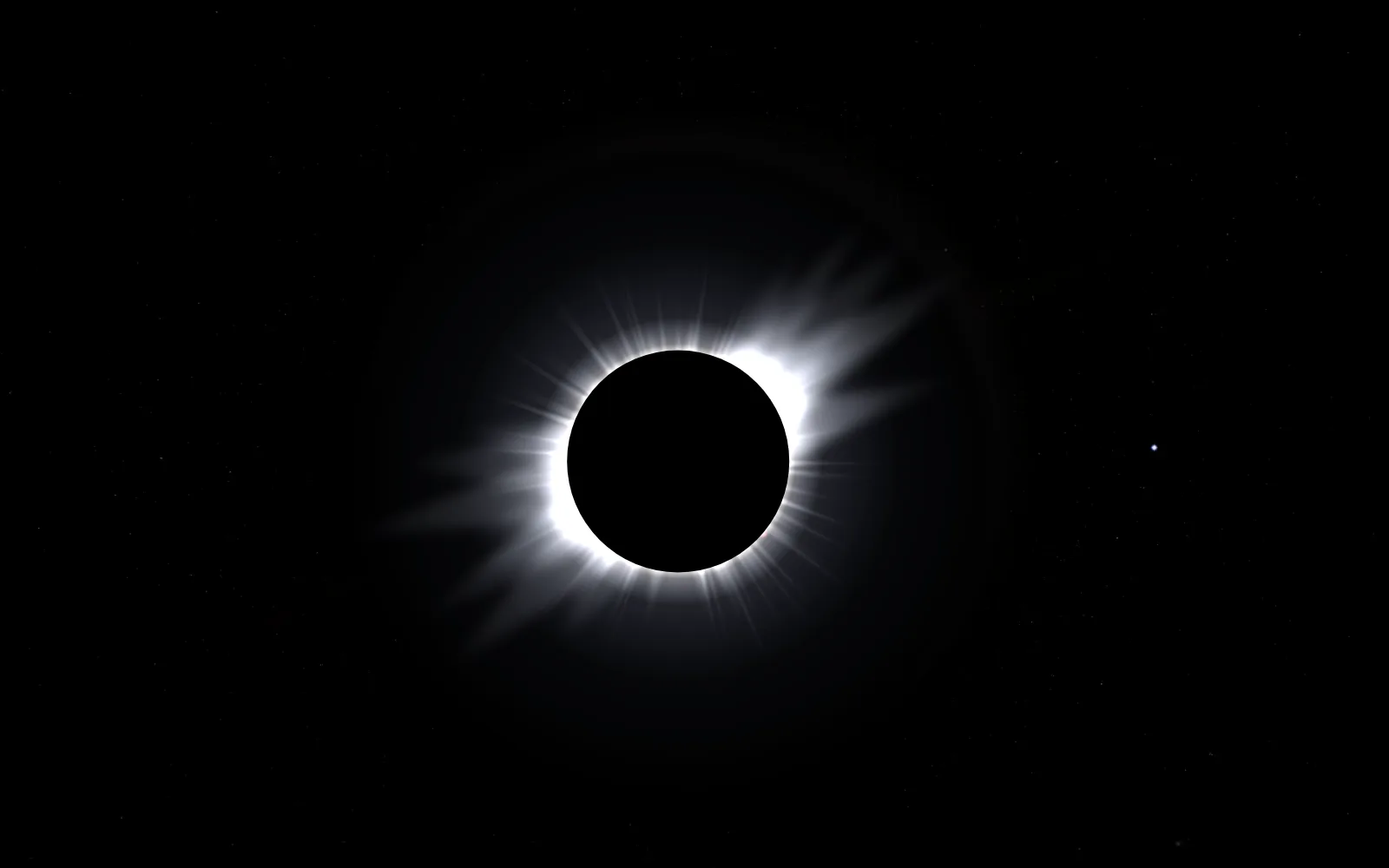
Spain · Total solar eclipse · 2 August 2027
The total solar eclipse of 2 August 2027 in Spain
On Monday 2 August 2027 the Moon's shadow crosses the far south of Spain in the middle of the morning. Totality reaches the Cádiz coast at 10:45 CEST and has left the Almería coast by 10:52. Ceuta has the longest totality on Spanish soil, 4 min 48 s, and Tarifa the longest on the mainland, 4 min 39 s.
Where the path crosses Spain
The shaded band is the path of totality, the dashed line its centre, where totality lasts longest. Coastlines, rivers and borders: Natural Earth.
The path is 240 km wide at Tarifa. It comes in from the Atlantic over the Cádiz coast, crosses the Strait of Gibraltar and runs east along the Costa del Sol and the Granada coast to the west of Almería province, with Ceuta and Melilla inside it on the African shore. In Spain it covers parts of the provinces of Cádiz, Málaga, Granada and Almería, and the cities of Ceuta and Melilla. The centre line, where totality is longest, runs through the Strait itself, which is why Tarifa and Ceuta lead the list.
Every town in the path
Every town in southern Spain with 15,000 people or more where the Sun is completely covered, longest totality first, with Gibraltar. Times are CEST (UTC+2), the local time in Spain, Ceuta and Melilla in August. A town with its own page has every contact time to the second there.
| Town | Totality lasts | Totality begins | Sun's height |
|---|---|---|---|
| CeutaCeuta | 4 min 48 s | 10:45:22 | 38° |
| TarifaCádiz | 4 min 39 s | 10:45:09 | 38° |
| MelillaMelilla | 4 min 34 s | 10:48:15 | 41° |
| AlgecirasCádiz | 4 min 27 s | 10:45:28 | 38° |
| GibraltarGibraltar | 4 min 26 s | 10:45:36 | 38° |
| La Línea de la ConcepciónCádiz | 4 min 24 s | 10:45:38 | 38° |
| Los BarriosCádiz | 4 min 20 s | 10:45:30 | 38° |
| San RoqueCádiz | 4 min 17 s | 10:45:39 | 38° |
| BarbateCádiz | 4 min 16 s | 10:45:02 | 38° |
| Conil de la FronteraCádiz | 4 min 1 s | 10:45:01 | 38° |
| EsteponaMálaga | 3 min 37 s | 10:46:20 | 39° |
| Chiclana de la FronteraCádiz | 3 min 29 s | 10:45:16 | 38° |
| San Pedro AlcántaraMálaga | 3 min 23 s | 10:46:40 | 39° |
| MarbellaMálaga | 3 min 16 s | 10:46:51 | 39° |
| San FernandoCádiz | 3 min 12 s | 10:45:22 | 38° |
| FuengirolaMálaga | 3 min 10 s | 10:47:13 | 39° |
| Puerto RealCádiz | 2 min 55 s | 10:45:32 | 38° |
| CádizCádiz | 2 min 54 s | 10:45:26 | 37° |
| BenalmádenaMálaga | 2 min 51 s | 10:47:27 | 39° |
| MijasMálaga | 2 min 50 s | 10:47:23 | 39° |
| Arroyo de la MielMálaga | 2 min 50 s | 10:47:30 | 39° |
| TorremolinosMálaga | 2 min 42 s | 10:47:37 | 39° |
| Alhaurín el GrandeMálaga | 2 min 30 s | 10:47:30 | 39° |
| El Puerto de Santa MaríaCádiz | 2 min 28 s | 10:45:44 | 37° |
| Alhaurín de la TorreMálaga | 2 min 22 s | 10:47:44 | 39° |
| CoínMálaga | 2 min 21 s | 10:47:30 | 39° |
| RotaCádiz | 2 min 11 s | 10:45:45 | 37° |
| UbriqueCádiz | 2 min 0 s | 10:46:53 | 38° |
| Rincón de la VictoriaMálaga | 1 min 55 s | 10:48:19 | 40° |
| CártamaMálaga | 1 min 54 s | 10:47:54 | 39° |
| AlmuñécarGranada | 1 min 52 s | 10:49:03 | 40° |
| MálagaMálaga | 1 min 51 s | 10:48:10 | 39° |
| AdraAlmería | 1 min 45 s | 10:49:56 | 41° |
| Torre del MarMálaga | 1 min 40 s | 10:48:40 | 40° |
| MotrilGranada | 1 min 40 s | 10:49:22 | 40° |
| Jerez de la FronteraCádiz | 1 min 37 s | 10:46:18 | 38° |
| NerjaMálaga | 1 min 35 s | 10:48:58 | 40° |
| Roquetas de MarAlmería | 1 min 34 s | 10:50:32 | 41° |
| TorroxMálaga | 1 min 29 s | 10:48:56 | 40° |
| El EjidoAlmería | 1 min 23 s | 10:50:23 | 41° |
| RondaMálaga | 1 min 17 s | 10:47:35 | 39° |
| Vélez-MálagaMálaga | 1 min 3 s | 10:48:58 | 40° |
| Arcos de la FronteraCádiz | 40 s | 10:47:10 | 38° |
| ChipionaCádiz | 2 s | 10:46:47 | 37° |
Durations are for a smooth Moon. The Moon's mountains and valleys change them by a few seconds and decide exactly where the edges of the path fall, so close to an edge aim a few kilometres inside it.
Close, but partial
Some of the best known places in the south are outside the path. They see a deep partial eclipse, but some of the Sun always shows, so the sky never goes dark and the corona never appears. Even 99.9% of the Sun is far too bright to look at without glasses.
- Seville98.4% of the Sun covered at 10:47
- Granada99.18% of the Sun covered at 10:50
- Almería99.98% of the Sun covered at 10:51
- Córdoba96.6% of the Sun covered at 10:49
- Huelva98.6% of the Sun covered at 10:46
- Sanlúcar de Barrameda99.97% of the Sun covered at 10:46
- Antequera99.60% of the Sun covered at 10:49
- Murcia96.3% of the Sun covered at 10:53
- Jaén97.2% of the Sun covered at 10:50
- Madrid86.3% of the Sun covered at 10:51
- Barcelona81.6% of the Sun covered at 10:58
- Valencia90.2% of the Sun covered at 10:54
Seville is 70 km from the edge of the path, a short drive south, and from Granada or Almería the coast inside the path is closer still.
The weather on the morning
Southern Spain in early August is one of the sunniest places in Europe. AEMET's averages for August (1981 to 2010) give Jerez airport 19.9 clear days and 334 hours of sunshine, Málaga airport 17.1 days and 316 hours, and Almería airport 15.0 days and 315 hours. Melilla has fewer, 10.3 days and 268 hours.
Those count whole days. For the eclipse itself, the meteorologist Jay Anderson checked satellite pictures taken close to the time of totality on every day from 12 July to 18 August in 2024 and 2025. Cádiz could see the Sun on 88% of them, and Barbate, Atlanterra and Tarifa on 74% on average, held back by marine cloud from the Atlantic. That cloud rarely gets past Tarifa into the Strait, so Marbella and the rest of the Costa del Sol do particularly well, and inland Spain averages under 15% cloud.
Two things can spoil a coastal morning. Sea fog on the Alboran Sea is most frequent from June to August, thickest just after sunrise and usually gone during the day. And the Levante, the east wind through the Strait, can hang cloud on the Rock of Gibraltar and the mountains behind Algeciras and the Costa del Sol. If the coast is grey at dawn, a short drive inland often finds clear sky, as long as you stay inside the path. Haze from Saharan dust is the other risk: in 2023 African air reached western Andalusia on 10 days in August and eastern Andalusia on 16.
For a near guarantee, Anderson points further along the track: parts of it in Libya and western Egypt have had no August cloud on eclipse day in 23 years.
Planning the day
- A Monday at the height of summer. 2 August 2027 falls in the busiest weeks on the Costa de la Luz, the Campo de Gibraltar and the Costa del Sol. On the day of the 2026 eclipse Spain counted 26 million more journeys than on a normal August day.
- The government's advice. Spain's commission for the three eclipses, Trío de Eclipses, began preparing for 2027 on 8 October 2026. It asks people to plan ahead, prefer public transport, avoid travelling on the day and especially just after the eclipse, and pick a spot near a main road, adding that around a minute of totality is already a full experience.
- Crossing to Ceuta. Ferries from Algeciras take about an hour. Early August is inside the Operación Paso del Estrecho, which runs every year from 15 June to 15 September and fills the Strait's ferries, so book ahead and cross the day before.
- Gibraltar. Since 15 July 2026 there are no routine checks at the land border with Spain; Gibraltar's own and Schengen checks now happen at its airport and port.
- Glasses. Spain's health and consumer ministries ask for eclipse glasses marked EN ISO 12312-2:2015 with the CE mark.
How to watch safely
- Wear eclipse glasses that meet the ISO 12312-2 standard whenever any part of the Sun is showing. Sunglasses, however dark, are not safe.
- Never look through binoculars, a telescope or a camera without a proper solar filter on the front.
- A pinhole projector works anywhere: a small hole in card throws an image of the Sun onto paper behind it.
- Only during totality is it safe to take the glasses off and look at the corona, and only inside the path. Put them back on at the first bright point of sunlight.
Spain's three eclipses
Spain is in the middle of a rare run: three central eclipses of the Sun in eighteen months.
- 12 August 2026, total. The path crossed northern Spain and the Balearic Islands in the evening, with the Sun low in the west: Oviedo 1 min 49 s, Burgos 1 min 44 s, Palma, Mallorca 1 min 36 s, Valladolid 1 min 27 s, Zaragoza 1 min 25 s and Valencia 1 min of totality. Madrid and Barcelona lie just outside the path, where the Moon covers almost all of the Sun. The 2026 eclipse
- 2 August 2027, total. The south, in the middle of the morning with the Sun high, and the longest totality of the three. This page.
- 26 January 2028, annular. A ring of fire, the Moon too far away to cover the Sun completely. In Portugal and Spain the ring of fire comes just before sunset, with the Sun a few degrees above the western horizon. Seville and Valencia are on the path. The ring lasts about 7 minutes in Seville, Córdoba, Albacete and Valencia, with the Sun 4° to 7° above the western horizon. The 2028 annular eclipse
After 2027 the next total eclipse of the Sun seen from Spain is in 2053.
See it in 3D
The Moon’s shadow crossing the Earth on the day, drawn by our 3D viewer from the real positions of the Sun, the Moon and the Earth, with the umbra and penumbra at their true size. Press play to load it here, then play, pause and scrub through the eclipse, or open it in the full viewer.
Open this eclipse in the 3D viewer →
Get a reminder
We email you a day or two before, with the time. Leave your email once and we send a code to confirm it; nothing else arrives unless you ask for it.
Questions
What time is the solar eclipse in Spain on 2 August 2027?
The partial eclipse begins in southern Spain at about 09:40 CEST. Totality reaches the Cádiz coast at 10:45 and has passed Almería province by 10:52, and the partial eclipse ends by about 12:09. Each town's own times are in the table above.
Which parts of Spain will see the total eclipse?
The far south: parts of the provinces of Cádiz, Málaga, Granada and Almería, and the cities of Ceuta and Melilla. 43 towns of 15,000 people or more are in the path, from Cádiz, Tarifa and Algeciras to Marbella, Málaga, Motril and El Ejido.
Where is the longest totality in Spain?
In Ceuta, 4 min 48 s. On the mainland it is Tarifa, with 4 min 39 s, followed by Algeciras and the towns round the Bay of Gibraltar.
Will Seville, Granada or Madrid see the total eclipse?
No. They are outside the path and see a partial eclipse: 98.4% of the Sun covered in Seville, 99.18% in Granada and 86.3% in Madrid. Almería city, at 99.98%, misses by a few kilometres.
How long is totality in Málaga?
1 min 51 s in the city, from 10:48:10 CEST. West along the Costa del Sol it grows: Marbella has 3 min 16 s and Estepona 3 min 37 s.
What will the weather be like for the eclipse in Spain?
Early August mornings are usually clear in southern Spain. In satellite pictures taken near the time of totality in July and August 2024 and 2025, Cádiz could see the Sun on 88% of days and Tarifa and the Atlantic coast near it on about 74%, while the Costa del Sol and inland sites did better. Morning sea fog and the east wind, the Levante, are the main risks on the coast.
Is it safe to look at the eclipse?
Only during totality itself, inside the path. Before and after, and anywhere outside the path, use ISO 12312-2 eclipse glasses or a pinhole projector, and never look through binoculars, a telescope or a camera without a solar filter on the front.
When is the next eclipse in Spain after 2027?
On 26 January 2028 an annular eclipse, a ring of fire, crosses Portugal and Spain just before sunset, with Seville and Valencia on its path.
The whole eclipse, from the Atlantic to Somalia, is on the total solar eclipse of 2 August 2027 page, with every city on one list.
Sources
- Fred Espenak, EclipseWise: Besselian elements of the total solar eclipse of 2027 August 2, the numbers every time and duration on this page is worked from
- NASA: path of totality, with centre-line durations
- Xavier Jubier: interactive map of the 2027 eclipse, which the city pages' times were checked against
- GeoNames: the towns, their coordinates, heights and populations (CC BY 4.0)
- Natural Earth: coastlines, rivers and borders on the map (public domain)
- NASA: eclipse safety and American Astronomical Society: eye safety
- AEMET, climate normals 1981 to 2010: Jerez airport, Málaga airport, Almería airport, Melilla
- Jay Anderson, Eclipsophile: Total Solar Eclipse 2027 August 2, the satellite survey of 2024 and 2025 and the cloud along the track
- F. Polvorinos Pascual (AEMET Málaga), Nieblas en el mar de Alborán, and L. García de Pedraza, Características de los vientos en la zona del Estrecho de Gibraltar
- MITECO and CSIC: Episodios naturales de partículas 2023, the days with African air
- Trío de Eclipses, the Spanish government's commission: preparing for 2027 and the 2026 figures, travel advice
- Ministerio de Sanidad: Operación Paso del Estrecho; DFDS: Algeciras to Ceuta
- HM Government of Gibraltar: the treaty and the border
- Ministerio de Consumo: certified eclipse glasses
- IGN: the 2027 eclipse in Spain, the next total eclipse in 2053, and the 2028 annular eclipse
- The method is the classical one for local circumstances (Explanatory Supplement to the Astronomical Almanac, chapter 8), run for this page at build time.