Ranked · Updated October 2026
Planets with rings.
Four planets have rings: Jupiter, Saturn, Uranus and Neptune. They are the four giant planets, and none of the rocky planets has rings. Saturn's are by far the brightest and broadest. The other three ring systems are faint, and all were found from 1977 onwards.
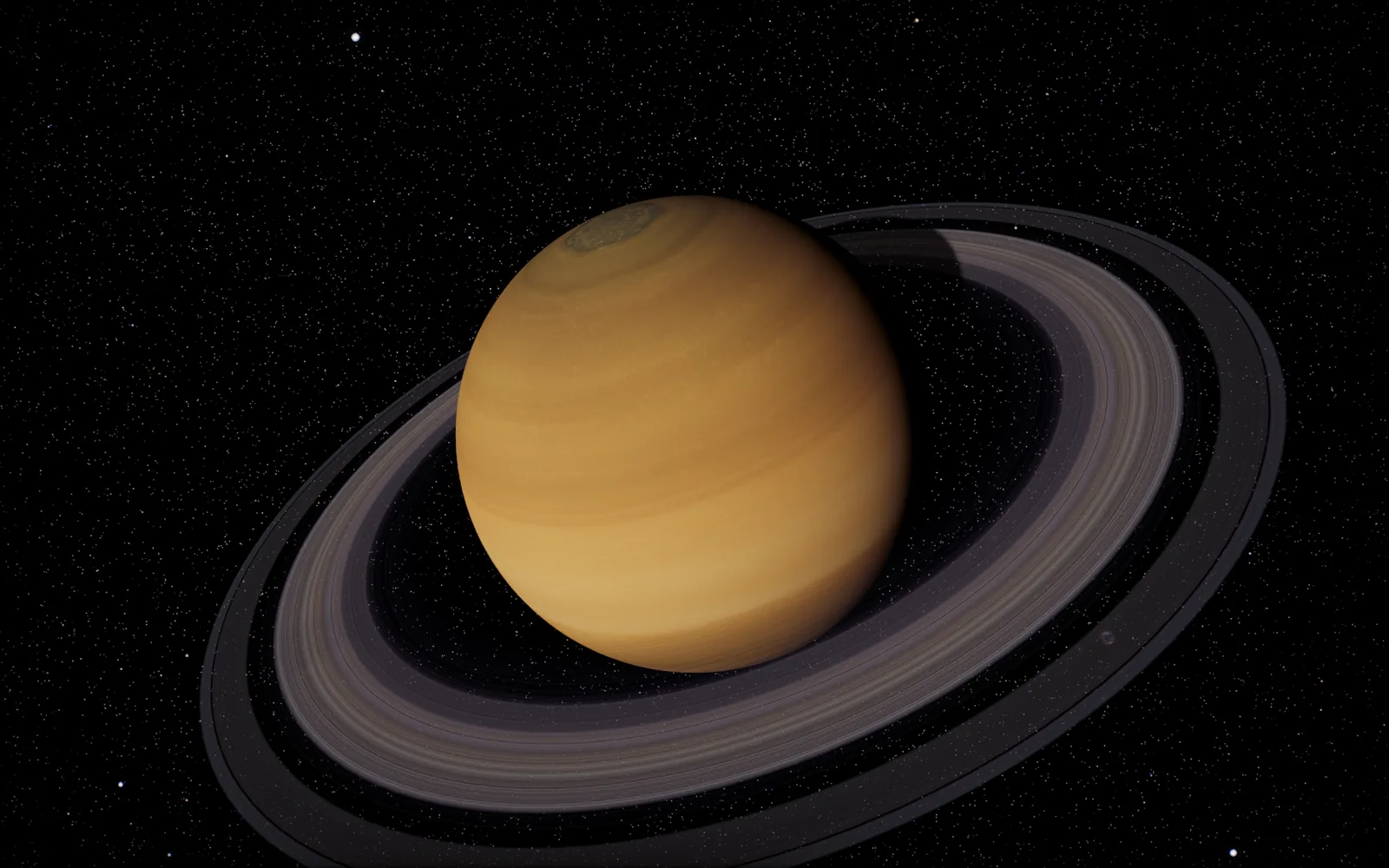
Open the 3D viewer →- Saturn The brightest, widest ring system in the solar system, made mostly of water ice. Possibly only tens to a few hundred million years old, though that is still debated.
- Jupiter A faint dust ring discovered by Voyager 1 in 1979, thought to be dust thrown off the small inner moons by meteoroid impacts.
- Uranus 13 known rings, most of them narrow and dark (the two outermost are reddish and blue). The first were found in 1977 from Earth, when they dimmed a star passing behind Uranus; Voyager 2 and Hubble found the rest.
- Neptune At least five main rings of varying brightness; the outermost, Adams, holds four bright clumpy arcs.
The four ring systems at a glance
| Planet | Rings | Made of | Found |
|---|---|---|---|
| Saturn | Main rings A, B and C; fainter D, E, F and G; the faint Phoebe ring far out | Chunks of ice and rock, from dust grains to pieces as big as a house | Seen by Galileo in 1610; Huygens, 1655 |
| Jupiter | Faint, dusty rings | Small, dark particles | Voyager 1, 1979 |
| Uranus | 13 faint rings | Mostly narrow, dark grey inner rings; of the two outer rings, one is reddish and one blue | From Earth, 10 March 1977 |
| Neptune | At least five main rings, with four arcs in the outermost | Dust, gathered into clumps in the Adams ring | Imaged by Voyager 2, August 1989 |
Saturn's rings
Saturn's ring system reaches up to 282,000 km from the planet, yet in the main rings it is typically only about 10 metres thick. The rings are billions of chunks of ice and rock coated in dust. Most range from icy grains the size of dust to pieces as big as a house, and a few are as large as mountains. Water ice makes up about 90 to 95% of the material.
Working outwards from Saturn, the rings are D, C, B, the Cassini Division (a gap 4,700 km wide), A, F, G and E. They were lettered in the order they were discovered, which is why the letters are out of order. The faint Phoebe ring lies much farther out, in the orbit of the moon Phoebe, and the E ring is fed by ice the moon Enceladus jets into space.
Galileo saw the rings in 1610 but took Saturn for a triple planet. Christiaan Huygens is credited with discovering the rings in 1655, and Jean-Dominique Cassini found the division between the A and B rings in 1675. In June 2026 a moon was reported orbiting inside the B ring itself, found in Cassini images from 2009.
How old the rings are is still debated. In the final phase of its mission, NASA's Cassini spacecraft measured their mass at about 41% of the moon Mimas, a result its team read as rings formed 10 to 100 million years ago. Other researchers argue that the ring ice resists being polluted by incoming dust, so the rings could look young and still be ancient.
Jupiter, Uranus and Neptune
Jupiter's rings were a surprise when Voyager 1 found them in 1979. They are made of small, dark particles and are hard to see unless they are lit from behind by the Sun. Data from the Galileo spacecraft suggest the dust is kicked up when meteoroids smash into Jupiter's small inner moons.
Uranus's rings were found from Earth on 10 March 1977. Astronomers on NASA's Kuiper Airborne Observatory and at Perth Observatory in Australia were watching Uranus pass in front of a star, and their observations from before and after it did so revealed the rings. Voyager 2 found two more rings in 1986, and in December 2005 NASA announced a further pair found by the Hubble Space Telescope, the largest twice the diameter of the rings known before. From the planet outwards the 13 are Zeta, 6, 5, 4, Alpha, Beta, Eta, Gamma, Delta, Lambda, Epsilon, Nu and Mu.
Neptune has at least five main rings, named from the planet outwards Galle, Leverrier, Lassell, Arago and Adams. The outermost, Adams, holds four bright clumps of dust called arcs: Liberté, Egalité, Fraternité and Courage. The laws of motion say the arcs should spread out evenly round the ring. Scientists now think the gravity of Galatea, a moon just inside the ring, keeps them bunched.
Why the rocky planets have no rings
Dense rings sit close to the body they circle, usually inside its Roche limit, where tidal forces stop loose material from gathering into a moon. None of the four rocky planets has a ring system today. Mars may get one: its moon Phobos is drifting closer by about 1.8 metres every hundred years, and at that rate it will either crash into Mars in about 50 million years or break up into a ring.
Small worlds with rings
Some much smaller worlds have rings too. In 2014 astronomers reported two narrow rings around Chariklo, a Centaur about 250 km across that orbits between Jupiter and Neptune, found when it passed in front of a star. They were the first rings seen round anything other than a giant planet. The dwarf planet Haumea was found to have a ring in 2017. In 2023 a dense ring was reported around Quaoar, beyond Neptune, well outside its Roche limit, which showed that the limit does not always decide where rings can survive.
See the rings for yourself in the 3D viewer, or read about how many moons Saturn has.
Frequently asked questions
Which planets have rings?
Jupiter, Saturn, Uranus and Neptune: all four giant planets.
Does Earth have rings?
No. None of the rocky planets, Mercury, Venus, Earth and Mars, has a ring system.
How many rings does Saturn have?
NASA lists seven lettered rings: the main A, B and C rings and the fainter D, E, F and G rings, plus the faint Phoebe ring much farther out.
What are Saturn's rings made of?
Chunks of ice and rock coated in dust, from tiny grains to pieces as big as a house, with a few as large as mountains. About 90 to 95% of the material is water ice.
How old are Saturn's rings?
Still debated. Cassini's measurement of their mass suggested they formed 10 to 100 million years ago; other researchers argue they could be far older.
Sources
- NASA Science: Saturn facts
- NASA Science: Saturn exploration
- NASA Science: Jupiter facts
- NASA Science: Uranus facts
- NASA Science: Uranus exploration
- NASA Science: Neptune facts
- NASA NSSDC: Planetary Fact Sheet, which planets have ring systems
- Iess et al. (2019): Measurement and implications of Saturn's gravity field and ring mass, Science 364
- Hyodo, Genda and Madeira (2024): Pollution resistance of Saturn's ring particles during micrometeoroid impact, Nature Geoscience
- Hyodo (2025): Micrometeoroid Pollution Resistance Sustains the Pristine, and Possibly Ancient, Rings of Saturn, EPSC-DPS Joint Meeting 2025 abstract
- Hyodo, Charnoz, Ohtsuki and Genda (2016): Ring formation around giant planets by tidal disruption of a single passing large Kuiper belt object, Saturn's rings, 90 to 95% water ice
- IAU Minor Planet Center: MPEC 2026-M19, S/2009 S 2
- NASA Science: Phobos
- Braga-Ribas et al. (2014): A ring system detected around the Centaur (10199) Chariklo, Nature 508
- Ortiz et al. (2017): The size, shape, density and ring of the dwarf planet Haumea from a stellar occultation, Nature 550
- Morgado et al. (2023): A dense ring of the trans-Neptunian object Quaoar outside its Roche limit, Nature 614