Moon phase prints
The Moon over your night, as it really was.
Its own face, lit to the minute and turned the way you would have seen it from your place. One night, a month of nights or a whole year.
Three ways to keep a Moon.
One night
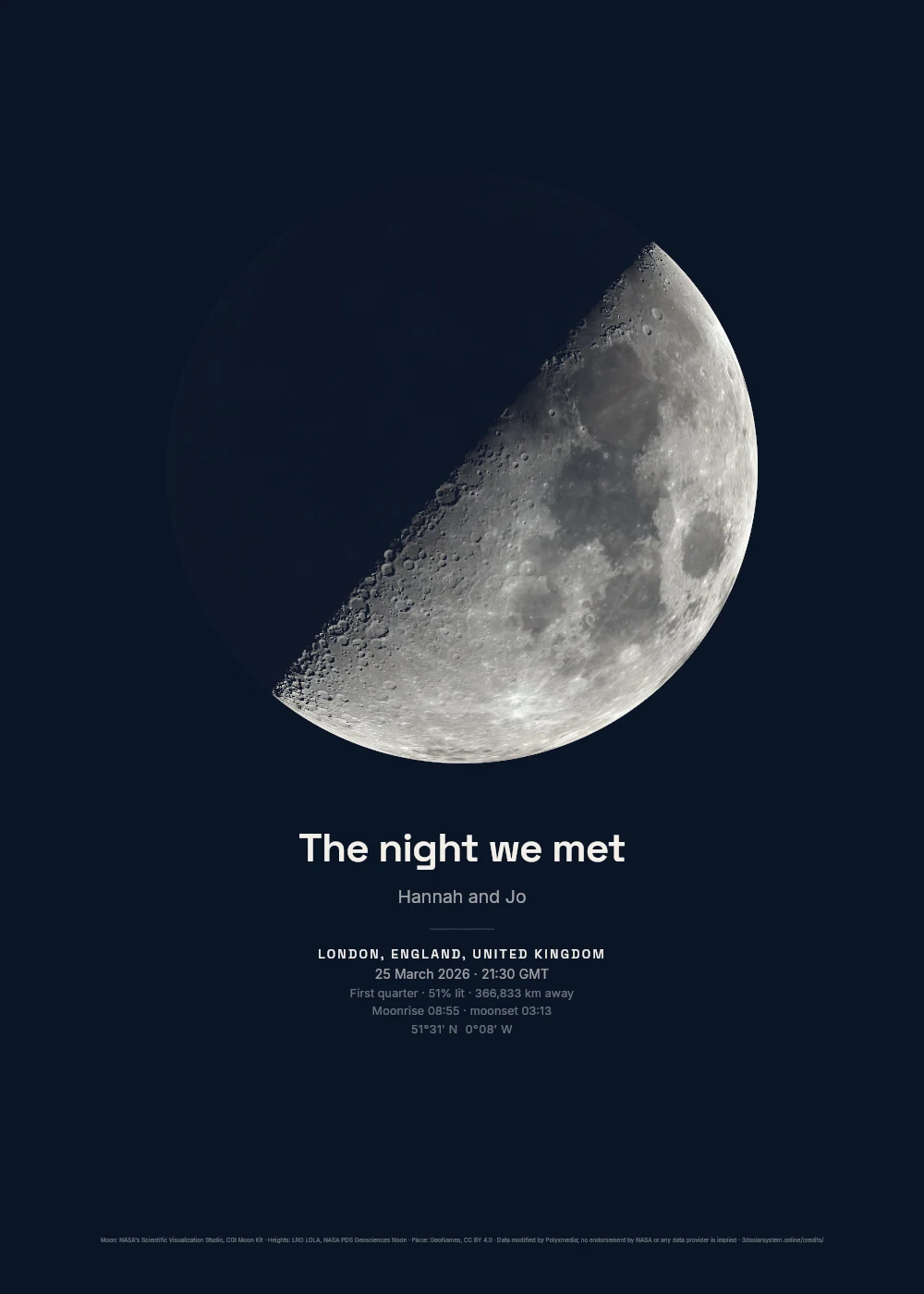
Your Moon, large, as it stood over your place at your minute: its phase, how much of it was lit, how far away it was, and when it rose and set.
Example: London, Wednesday 25 March 2026, 21:30 GMT. First quarter, 51% lit, 366,833 km away, 46° up in the sky.4,1
A month
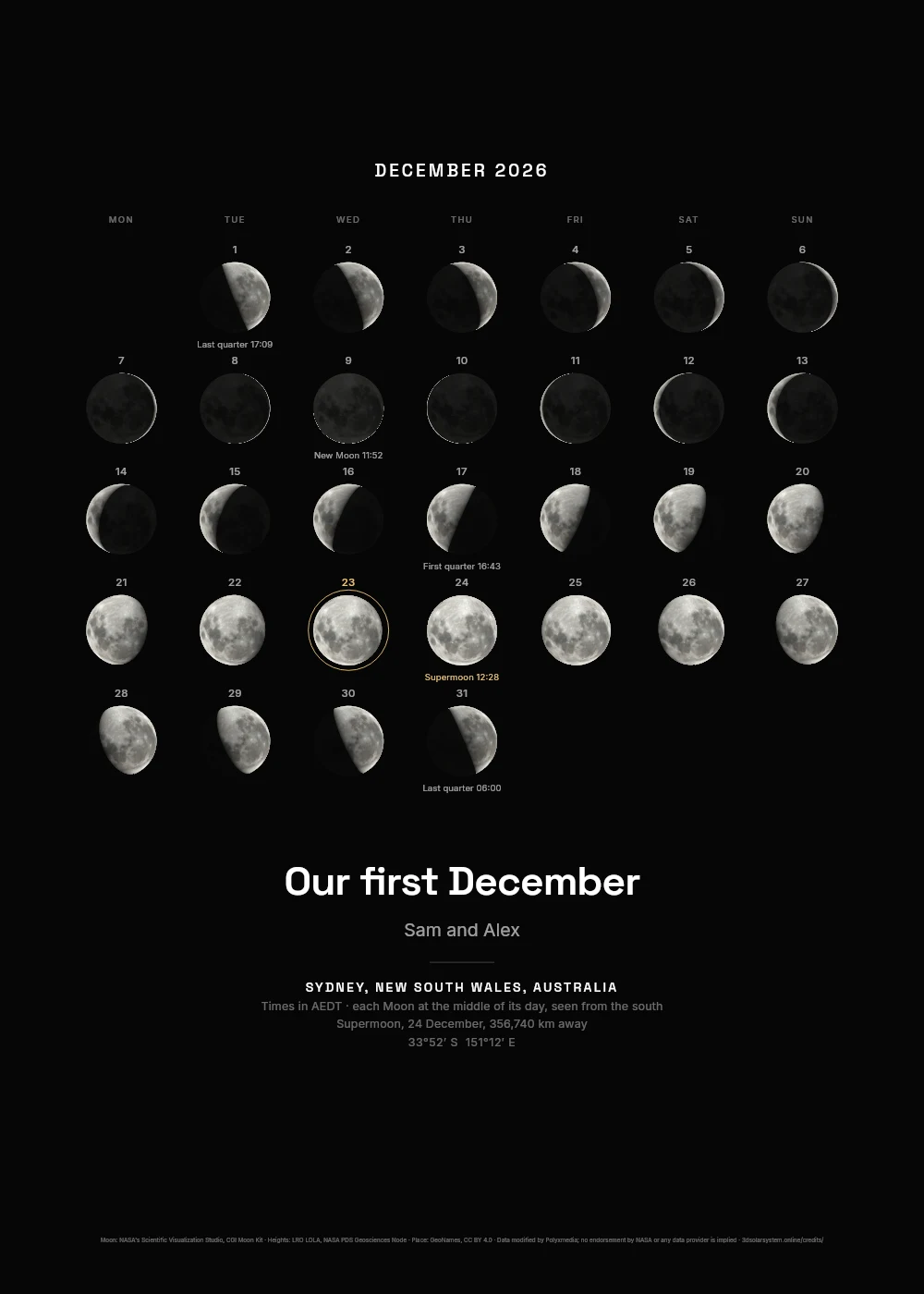
Every night of your month in a calendar, each Moon at the middle of its day, with the new Moon, the quarters and the full Moon at their times, and your day ringed.
Example: Sydney, December 2026, drawn as the southern hemisphere sees it.
A year
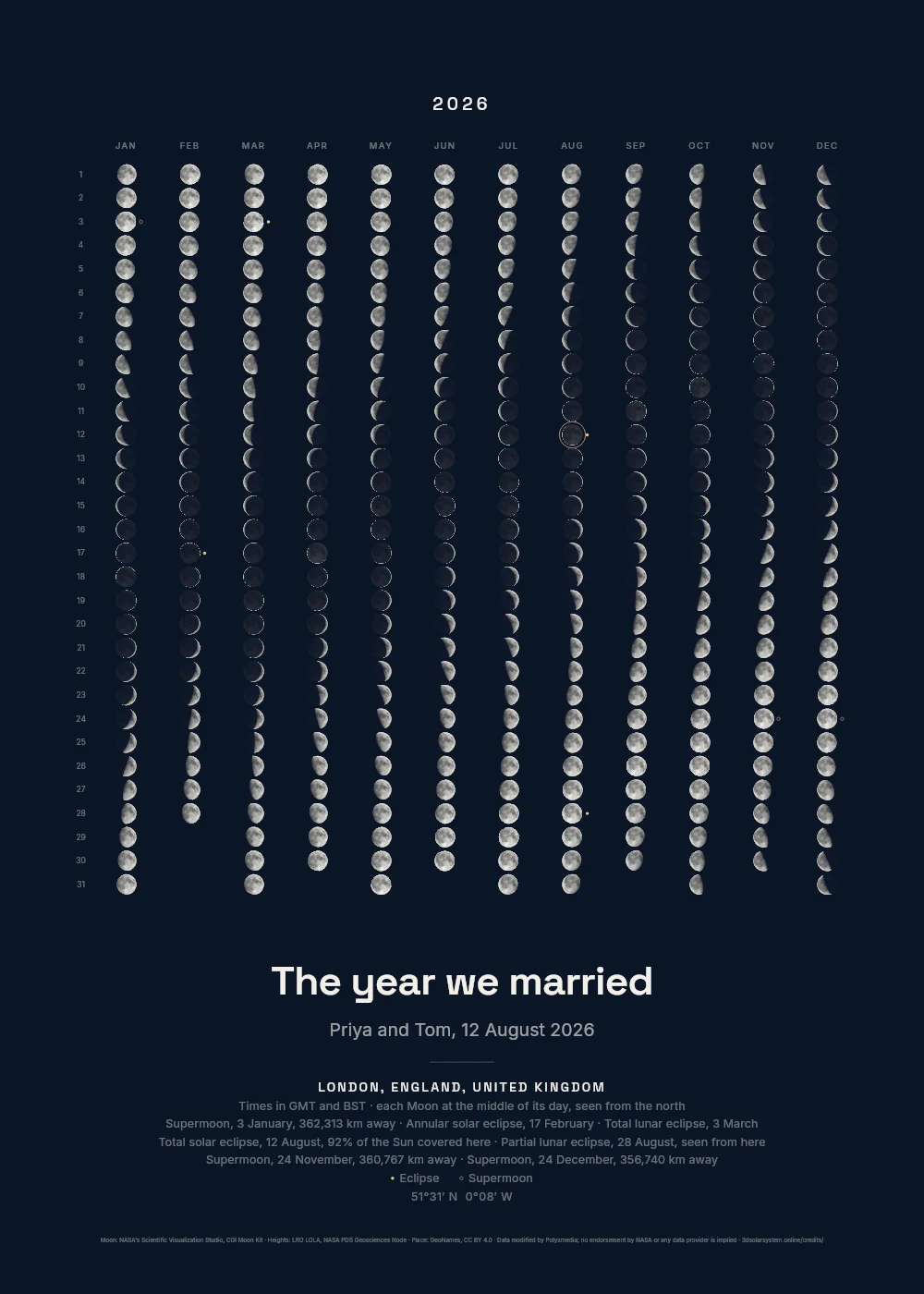
All the nights of your year, a column for each month, with the year's eclipses and supermoons marked and your day ringed.
Example: London, 2026, with 12 August 2026 ringed.
Design yours.
Choose the layout, the place and the date. The print redraws as you go, and the line under it says what the Moon was doing.
How your Moon is made.
- Its own faceThe Moon's surface from NASA's CGI Moon Kit, the colour mosaic made by the Lunar Reconnaissance Orbiter's wide angle camera, with heights from its laser altimeter for the shadows along the line between day and night.5,6
- Lit to the minuteThe phase and the share of the disc that was lit come from the Sun's and the Moon's places at your minute. Our new Moons, quarters and full Moons fall within a minute of the US Naval Observatory's tables.4,1,2
- Turned the way you saw itOn a night print the top of the paper is the point overhead, so the Moon's tilt and its libration, the slow rocking that shows a little more of one edge, are those of your minute, after the IAU's model of how the Moon turns.7,4
- Drawn from where you standFrom the southern hemisphere the Moon's south is at the top and its crescents fill from the other side, and the print shows it so.1
- EclipsesEvery eclipse of the Sun in your month or year, with how much of it was covered at your place, and every total and partial eclipse of the Moon, with whether you could have seen it.3,1
- SupermoonsEach full Moon at 90% or more of the way to its nearest point in that orbit, marked with its distance, by Fred Espenak's definition.8
- Moonrise and moonsetA night print gives the times the Moon rose and set at your place, on its own clock, and they match the US Naval Observatory's to the minute in our tests.2,1
- Any day since 1800For dates before 1972 we allow for the Earth's uneven spin with the formulas NASA's eclipse tables use.9
The Moon in 2026, over London.
What the year print above marks, worked out by the same code: its eclipses and its supermoons, as seen from London. Times are London's.
- A supermoon: the full Moon 362,313 km away.8,1
- Annular eclipse of the Sun, out of sight from London.3,1
- Total eclipse of the Moon, out of sight from London, below its horizon.3,1
- Total eclipse of the Sun, 92% of the Sun covered in London at 19:13.3,1,12
- Partial eclipse of the Moon, seen from London.3,1
- A supermoon: the full Moon 360,767 km away.8,1
- A supermoon: the full Moon 356,740 km away, the closest full Moon of 2026.8,1
Printed and framed.
Choose how your print comes under Printed as, above. Our print lab makes it to order and posts it free to the UK and the US, and the print file comes with it to keep.
The details.
How we work out your Moon
Your Moon starts with a place and a date. We turn the time on that place's clock into universal time with the world time zone database, summer time included,10 and find the place among the towns of GeoNames.11
From there the Moon's place and the Sun's come from the same engine as our Astronomy mode, after Jean Meeus' Astronomical Algorithms,4 seen from your place on the Earth's surface. The Moon's face is turned by the IAU's model of its rotation,7 so its libration is the one of your minute, and lit by the Sun from where the Sun stood.
A month or a year draws each day's Moon at the middle of that day on your clock, and names the new Moon, the quarters and the full Moon at their times. The eclipses are found at each new and full Moon from the Sun's, the Earth's and the Moon's sizes and places, and checked against NASA's tables.4,3,1
What you get
A PNG file of your design at 300 dots per inch, at the size you chose: 30 × 40 cm is 3,543 × 4,724 pixels, 50 × 70 cm is 5,906 × 8,268 pixels, 12 × 16 in is 3,600 × 4,800 pixels, 20 × 28 in is 6,000 × 8,400 pixels. It carries the colour tags print shops read, and the credits for the Moon's maps are written into it.
Straight after payment we make your file at full size, ready to download from your order page, and we email you a link to it that keeps working. The free preview is 1,200 pixels wide, so you can show it round before you buy.
Printing it
Any print shop or online poster printer that takes a 300 dpi file can print it. Order the size you chose so nothing is cropped, and pick a matte paper: it keeps the dark sky deep and the Moon's grey seas clear of reflections.
Nothing printed comes within 5% of the paper's width of an edge, so a lab's trim cuts only background.
The whole sky instead
A star map prints the whole sky over your place at your minute, the Moon among the stars and the planets. The Moon phase pages show tonight's Moon and every phase of any month, free.
Questions about moon phase prints.
What is a moon phase print?
A print of the Moon as it really was over a place you choose: on one night, through one month or across a whole year. Ours draws the Moon's own face from NASA's maps of it, lit to the minute and turned the way someone standing there saw it, with your words, the place and the dates beneath.5,4
Is it the real Moon of my date?
Yes. The phase, the share of the disc that was lit and the Moon's distance are worked out for your minute after Jean Meeus' Astronomical Algorithms, and we test them: every new Moon, quarter and full Moon of six years between 1805 and 2005 falls within a minute of the US Naval Observatory's tables.4,1,2
Which layout should I choose?
One night for a single moment: a birth, a first date, a wedding night. A month for a season that mattered, with your day ringed among its nights. A year for a whole chapter, with its eclipses and supermoons marked. The designer draws your own place and date in each, so you can compare them.
Why does the Moon look different from Australia?
Seen from the southern hemisphere, the Moon's south is at the top of the sky and its crescents fill from the other side. Your print is drawn for your place: a night print turns the Moon as it stood in your sky, and a month or a year is drawn as your half of the world sees it.7,1
What time should I choose?
On a night print, the minute you want to keep, on the clock of the place you pick: the Moon's tilt and how much of it is lit follow the minute. A month or a year needs only the day, which the print rings; each of its Moons is drawn at the middle of its own day.
What if the Moon was below the horizon?
The print still shows the Moon as it was at your minute, lit as it was, and its line of details says it was below the horizon and when it rose. Many people keep the minute anyway, since it is theirs.
Which dates can I choose?
Any day from 1 January 1800 to 31 December 2100. For dates before 1972 we allow for the Earth's uneven spin with the formulas NASA's eclipse tables use, and the clock rules come from the world time zone database, whose own notes say its entries before 1970 are often uncertain.9,10
Which eclipses are marked?
Every eclipse of the Sun in your month or year, total, annular, hybrid or partial, with how much of the Sun was covered at your place if any of it was, and every total and partial eclipse of the Moon, with whether it could be seen from there. Penumbral eclipses of the Moon are left out. We check the eclipses against NASA's tables.3,1
What is a supermoon?
A full Moon at 90% or more of the way from its farthest point in that orbit to its nearest, the definition in Fred Espenak's table of full Moons at perigee. The print marks each one with its distance.8
What do I get when I buy the print file?
A PNG image of your design at 300 dots per inch, at the size you chose (5,906 × 8,268 pixels for 50 × 70 cm), ready for any printer. Straight after payment we make your file at full size, ready to download from your order page, and we email you a link to it that keeps working.
Can you print and frame it for me?
Yes. Choose a poster, a fine art print on Hahnemühle Photo Rag or a framed print under Printed as, at 30 × 40 or 50 × 70 cm. Our print lab makes it to order and posts it free to the UK and the US, and the print file comes with it to keep. A poster costs from £35 and a framed print from £79.
Can I have the Moon without any words?
Yes. Under Style, choose No text for the Moon alone, or Words only for your three lines and nothing else. The credits for the Moon's maps then come with your file, written into it and listed with your order.
Is my location stored?
The place search runs in your browser on the GeoNames list of towns,11 and Use my location asks your browser and keeps the position on your device. Your design is kept in this browser so it is there when you come back, and when you buy, it goes with your order so we can make the file.
Sources
- Our own tests of the Moon against [2], [3] and [8] (tests/moon-prints-sky.test.js, tests/moon-prints-layout.test.js and tests/moon-prints-design.test.js in our code, November 2026): every new Moon, quarter and full Moon of 1805, 1900, 1955, 1969, 1990 and 2005 within a minute of the US Naval Observatory's tables; the Moon's rise, transit and set in London and its transit and set in Sydney within a minute of the Observatory's; every solar eclipse of NASA's tables for 1991 to 2000 and 2011 to 2020 and every partial and total lunar eclipse of 2011 to 2020 of the right kind and within three minutes, and every eclipse of 2026 to 2032 as our sky calendar lists it from NASA's tables; the supermoons of 2026 and 2027 as our Moon phase pages list them; the crescent turned over between London and Sydney.
- Astronomical Applications Department, US Naval Observatory: phases of the Moon, and sun and moon rise, set and transit for one day, read 14 November 2026. aa.usno.navy.mil/data/MoonPhases, aa.usno.navy.mil/data/RS_OneDay
- Espenak, F., NASA Goddard Space Flight Center, eclipse tables by decade: solar eclipses 1991 to 2000 and 2011 to 2020, lunar eclipses 2011 to 2020, read 14 November 2026. eclipse.gsfc.nasa.gov
- Meeus, J. (1998), Astronomical Algorithms, 2nd edition, Willmann-Bell: chapter 47 for the Moon's place, from which the phases are found, chapter 48 for its lit fraction, chapter 54 for the kind of an eclipse and chapter 15 for rising and setting.
- NASA's Scientific Visualization Studio, CGI Moon Kit, from the Lunar Reconnaissance Orbiter's wide angle camera colour mosaic, public domain. svs.gsfc.nasa.gov/4720
- Lunar Orbiter Laser Altimeter, LDEM_64, NASA PDS Geosciences Node, public domain. pds-geosciences.wustl.edu/missions/lro/lola.htm
- Archinal, B. A. et al. (2011), Report of the IAU Working Group on Cartographic Coordinates and Rotational Elements: 2009, Celestial Mechanics and Dynamical Astronomy 109, 101: the Moon's rotation model, table 2.
- Espenak, F., Full Moon at Perigee (Full Supermoon): 2001 to 2100, Astropixels, read 14 November 2026: "Any Full Moon occurring at a Relative Distance of 0.9 or greater is by definition a supermoon." astropixels.com/ephemeris/moon/fullperigee2001.html
- Espenak, F. and Meeus, J. (2006), Polynomial expressions for Delta T, NASA Goddard Space Flight Center. eclipse.gsfc.nasa.gov/SEcat5/deltatpoly.html
- The IANA Time Zone Database and its notes on how reliable old entries are. iana.org/time-zones, theory.html
- GeoNames, CC BY 4.0. geonames.org
- Partial solar eclipse of 12 August 2026 in London, timeanddate.com, read 14 November 2026: greatest at 19:13 BST, magnitude 0.925 (the share of the Sun's diameter covered; the print gives the share of its area). timeanddate.com/eclipse/in/uk/london
The print's own small print credits its data: the Moon from NASA's Scientific Visualization Studio, CGI Moon Kit; its heights from LRO LOLA, NASA PDS Geosciences Node; places from GeoNames (CC BY 4.0). Data modified by Polyxmedia. No endorsement by NASA or any data provider is implied. Every source is on our credits page.
The examples' names are made up; their places, dates and Moons are real. Prices are in pounds sterling. The print file is a digital download. Privacy.