Lesson plan · A level · Ages 16 to 18 · 40 minutes
Why stars have colours
Black-body radiation, Wien's law for the Sun, red Betelgeuse and blue Rigel in Orion, Stefan's law for a star's power and size, and Planck's quanta of 1900.
The lesson
The class treats stars as black bodies, finds where the Sun's light peaks with Wien's law, then looks past the Earth at Orion to compare red Betelgeuse with blue Rigel. They use Stefan's law to compare the two stars' surfaces and to measure the Sun, and finish with Planck's idea of 1900 that radiation comes in quanta.
What they take away
A star's colour tells its temperature: λmax = b/T puts the Sun's peak at 502 nm, Betelgeuse's at 805 nm in the infrared and Rigel's at 240 nm in the ultraviolet. Stefan's law, L = 4πr²σT⁴, gives each square metre of Rigel 128 times the output of one of Betelgeuse's and gives the Sun a radius of 6.96 × 10⁸ m, and Planck's quanta, E = hf, explained the shape of the black-body curve.
Curriculum links
Quoted word for word from the official documents.
OCR A Level Physics A (H556)
-
5.5.2 Electromagnetic radiation from stars, (i)
Read it on ocr.org.ukuse of Wien’s displacement law λmax ∝ 1/T to estimate the peak surface temperature (of a star)
-
5.5.2 Electromagnetic radiation from stars, (j)
Read it on ocr.org.ukluminosity L of a star; Stefan’s law L = 4πr²σT⁴ where σ is the Stefan constant
-
5.5.2 Electromagnetic radiation from stars, (k)
Read it on ocr.org.ukuse of Wien’s displacement law and Stefan’s law to estimate the radius of a star.
-
4.5.1 Photons, (b)
Read it on ocr.org.ukphoton as a quantum of energy of electromagnetic radiation
AQA A-level Physics (7408)
-
3.9.2.3 Classification by temperature, black-body radiation (astrophysics option)
Read it on aqa.org.ukStefan’s law and Wien’s displacement law.
-
3.9.2.3 Classification by temperature, black-body radiation (astrophysics option)
Read it on aqa.org.ukGeneral shape of black-body curves, use of Wien’s displacement law to estimate black-body temperature of sources.
-
3.9.2.3 Classification by temperature, black-body radiation (astrophysics option)
Read it on aqa.org.ukAssumption that a star is a black body.
-
3.9.2.3 Classification by temperature, black-body radiation (astrophysics option)
Read it on aqa.org.ukUse of Stefan’s law to compare the power output, temperature and size of stars
-
3.12.2.4 The discovery of photoelectricity (turning points in physics option)
Read it on aqa.org.ukThe ultraviolet catastrophe and black-body radiation.
-
3.12.2.4 The discovery of photoelectricity (turning points in physics option)
Read it on aqa.org.ukPlanck’s interpretation in terms of quanta.
Step by step
The caption is what the class reads on screen; the talking points are in your notes drawer (N) when you present. Steps marked Pupils only appear only in the pupil lesson.
-
01
Stars glow like black bodies
Presented and for pupilsCaption
A black body absorbs all the radiation that falls on it and gives out a spectrum set by its temperature alone. Most stars shine much like black bodies at a few thousand kelvin.
Talking points
- IAU Office of Astronomy for Education: the spectrum of blackbody radiation "is completely specified by the body's temperature according to known laws", and "Most stars emit light similar to that of a blackbody at a temperature of several thousand kelvins."
- A star has layers at different temperatures, so astronomers use its effective temperature: the temperature of a black body with the same surface area and the same total output (IAU OAE). NASA's Sun Fact Sheet gives the Sun's as 5,772 K.
- AQA 3.9.2.3 lists the "Assumption that a star is a black body."
Ask the class
What is a star's effective temperature?
- The temperature of a black body with the same surface area and the same total output as the starRight answer
- The temperature at the centre of the star
- The temperature of the hottest layer in the star's atmosphere
WhyIAU OAE: "the temperature of a blackbody which has the same surface area and same total energy output as the star." The Sun's is 5,772 K, while NASA's model puts its centre at 1.571 × 10⁷ K.
Sources 1 2 3 17Present from this step
-
02
Wien's law and the Sun
Presented and for pupilsCaption
The hotter a black body, the shorter the wavelength at which its output peaks: λmax = b/T, with b = 2.898 × 10⁻³ m K.
Talking points
- NIST (CODATA 2022) gives Wien's wavelength displacement constant as b = 2.897 771 955 × 10⁻³ m K. AQA's specification rounds it to 2.9 × 10⁻³ m K.
- IAU OAE: "The hotter the body, the shorter the wavelength and the bluer the light it emits its maximum amount of energy at."
- The Sun's peak, 502 nm, lies inside the band from 380 to 700 nanometres that NASA gives for what the human eye can detect.
Ask the class
The Sun's effective temperature is 5,772 K. Using λmax = b/T with b = 2.898 × 10⁻³ m K, find the wavelength at which its output peaks, in nm.
Answer502 nm. Answers from 500 to 504 are marked right.
Whyλmax = 2.898 × 10⁻³ ÷ 5,772 = 5.02 × 10⁻⁷ m = 502 nm. AQA's rounded 2.9 × 10⁻³ m K gives 502.4 nm.
-
03
Betelgeuse, a cool red supergiant
Presented and for pupilsCaption
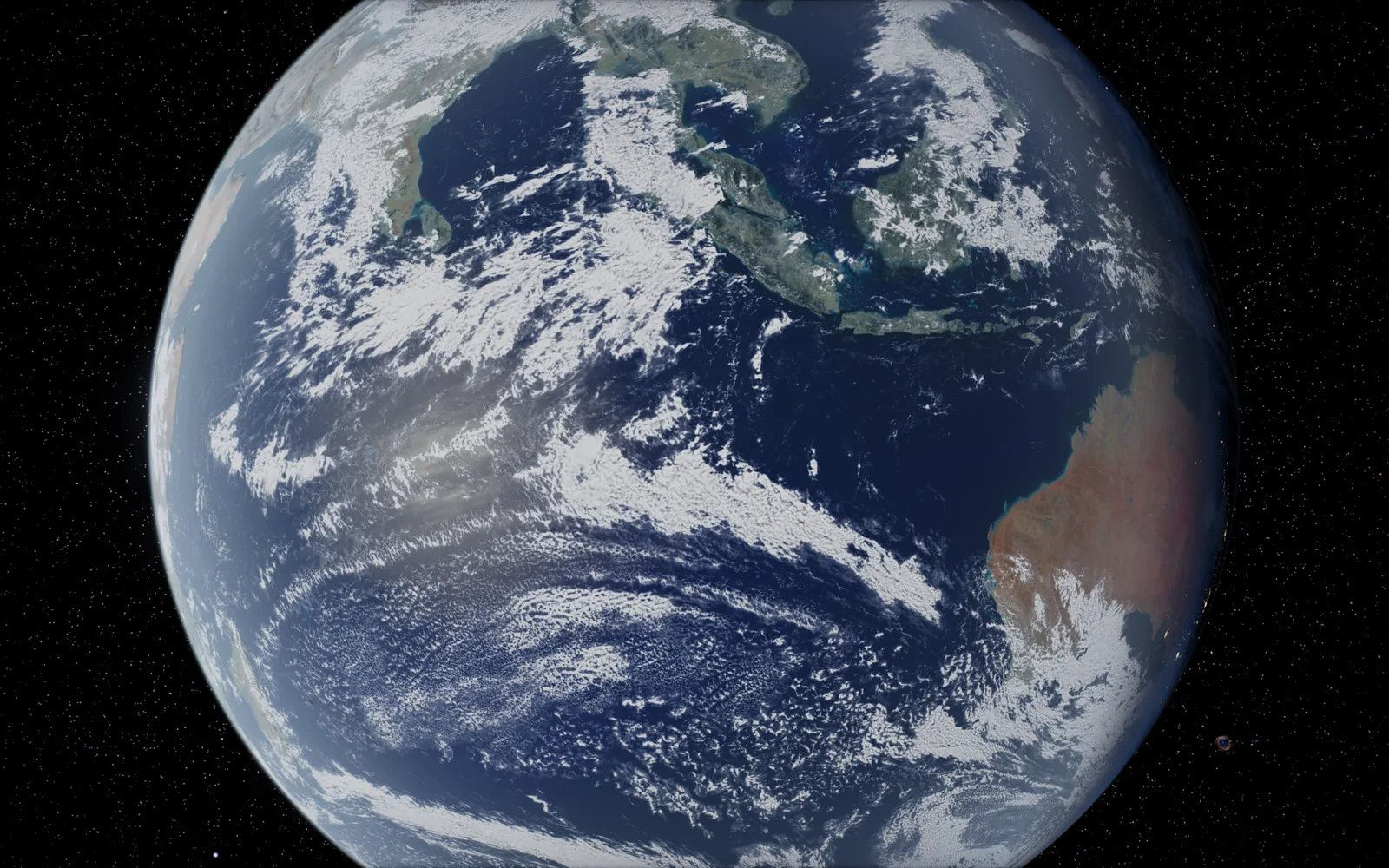
Far beyond the Earth lies Orion. Betelgeuse, the bright star at the figure's top left, is a red supergiant whose surface is at about 3,600 K.
Talking points
- Levesque and Massey (2020) measured Betelgeuse's effective temperature as 3,600 ± 25 K from a spectrum taken on 15 February 2020, during its unusual dimming, a little cooler than earlier measurements.
- SIMBAD lists Betelgeuse as α Orionis, spectral type M1-M2Ia-Iab. In AQA's table of spectral classes, class M stars are red.
- The camera looks past the Earth towards Orion, with the constellation lines drawn on the real star sky. The viewer colours every star from its catalogue colour as a black body of that temperature would look.
Ask the class
Betelgeuse's surface is at about 3,600 K. Using λmax = b/T with b = 2.898 × 10⁻³ m K, find its peak wavelength in nm.
Answer805 nm. Answers from 802 to 808 are marked right.
Whyλmax = 2.898 × 10⁻³ ÷ 3,600 = 8.05 × 10⁻⁷ m = 805 nm, past the 700 nm red end of the visible band, in the infrared (NASA). A black-body curve rises all the way to its peak, so across the visible band Betelgeuse gives out more red light than blue.
-
04
Rigel, a hot blue supergiant
Presented and for pupilsCaption
Rigel, at the figure's bottom right, is a B-type supergiant whose surface is at about 12,100 K, more than three times as hot as Betelgeuse.
Talking points
- Przybilla and colleagues (2010) give HD 34085 an effective temperature of 12,100 ± 150 K. SIMBAD lists HD 34085 as β Orionis, Rigel, spectral type B8Ia.
- In AQA's table of spectral classes, class B stars are blue, at 11,000 to 25,000 K.
- The temperature ratio is 12,100 ÷ 3,600 = 3.36.
Ask the class
Rigel's surface is at about 12,100 K. Using λmax = b/T with b = 2.898 × 10⁻³ m K, find its peak wavelength in nm.
Answer239.5 nm. Answers from 238 to 241 are marked right.
Whyλmax = 2.898 × 10⁻³ ÷ 12,100 = 2.395 × 10⁻⁷ m = 239.5 nm, shorter than the 380 nm violet end of the visible band, in the ultraviolet (NASA). Past its peak a black-body curve only falls, so across the visible band Rigel gives out more blue light than red.
-
05
Stefan's law: power from each square metre
Presented and for pupilsCaption
Stefan's law gives a star of radius r and surface temperature T a luminosity L = 4πr²σT⁴, so each square metre of its surface radiates σT⁴.
Talking points
- NIST (CODATA 2022): σ = 5.670 374 419 × 10⁻⁸ W m⁻² K⁻⁴. OCR's data booklet gives 5.67 × 10⁻⁸ W m⁻² K⁻⁴.
- For the Sun, σT⁴ = 5.670 × 10⁻⁸ × 5,772⁴ = 6.294 × 10⁷ W/m², the surface emission of 62.94 × 10⁶ J m⁻² s⁻¹ in NASA's Sun Fact Sheet.
- IAU OAE, on black-body curves at several temperatures: "Despite the coolest body in this plot peaking in red light, the other hotter bodies all emit more red light than the coolest body."
- A cool star can still be very luminous if it is large enough, since L grows with r² as well as T⁴. AQA asks for Stefan's law to compare "the power output, temperature and size of stars".
Ask the class
Rigel's surface is at about 12,100 K and Betelgeuse's at about 3,600 K. How many times as much power does each square metre of Rigel's surface radiate as each square metre of Betelgeuse's?
Answer128 times. Answers from 125 to 131 are marked right.
WhyPower per square metre is σT⁴, so the ratio is (12,100 ÷ 3,600)⁴ = 3.361⁴ = 128. The temperature ratio alone, 3.36, leaves out the fourth power.
-
06
Measuring the Sun with Wien and Stefan
Presented and for pupilsCaption
Put the two laws together and a star's light gives its size. Try it on the Sun, whose radius we can check.
Talking points
- Wien's law turns the measured peak into a temperature: T = b/λmax = 2.898 × 10⁻³ ÷ 5.02 × 10⁻⁷ = 5,773 K, the Sun's 5,772 K to within the rounding of 502 nm.
- Stefan's law then gives the radius from the luminosity: r = √(L / 4πσT⁴). NASA's Sun Fact Sheet gives a luminosity of 382.8 × 10²⁴ J/s, which is 3.828 × 10²⁶ W, and a mean radius of 695,700 km.
- For a distant star the luminosity comes from its brightness and its distance, and AQA lists the inverse square law with the assumptions in its application. OCR 5.5.2 (k): Wien's and Stefan's laws together estimate the radius of a star.
Ask the class
The Sun's luminosity is 3.828 × 10²⁶ W and its effective temperature 5,772 K. Using L = 4πr²σT⁴ with σ = 5.67 × 10⁻⁸ W m⁻² K⁻⁴, find its radius. Give your answer in units of 10⁸ m.
Answer6.96 × 10⁸ m. Answers from 6.93 to 6.99 are marked right.
Whyr = √(L / 4πσT⁴) = √(3.828 × 10²⁶ ÷ (4π × 5.67 × 10⁻⁸ × 1.110 × 10¹⁵)) = √(4.840 × 10¹⁷) = 6.96 × 10⁸ m, the 695,700 km in NASA's fact sheet.
-
07
Planck's quanta
Presented and for pupilsCaption
Classical physics predicted a black body's output would grow without limit at short wavelengths. In 1900 Max Planck solved this with quanta of energy E = hf.
Talking points
- IAU OAE: the classical prediction "tends to infinity at shorter wavelengths for any blackbody temperature above zero and was dubbed the ‘ultraviolet catastrophe’".
- NobelPrize.org: "Max Planck solved this problem in 1900 by introducing the theory of “quanta”, that is, that radiation consists of quanta with specific energies determined by a new fundamental constant, thereafter called Planck’s constant." His 1918 Nobel Prize in Physics was "in recognition of the services he rendered to the advancement of Physics by his discovery of energy quanta".
- Planck's Nobel biography: the energy for a resonator of frequency ν is hν, with h the universal constant now called Planck's constant. NIST (CODATA 2022): h = 6.626 070 15 × 10⁻³⁴ J s, exact. One electronvolt is 1.602 176 634 × 10⁻¹⁹ J.
- With f = c/λ a photon's energy is also E = hc/λ (OCR 4.5.1).
Ask the class
Find the energy of a photon at the Sun's peak wavelength, 502 nm, in eV. Use h = 6.63 × 10⁻³⁴ J s, c = 3.00 × 10⁸ m s⁻¹ and 1 eV = 1.60 × 10⁻¹⁹ J.
Answer2.48 eV. Answers from 2.46 to 2.5 are marked right.
WhyE = hc/λ = 6.63 × 10⁻³⁴ × 3.00 × 10⁸ ÷ 5.02 × 10⁻⁷ = 3.96 × 10⁻¹⁹ J, and 3.96 × 10⁻¹⁹ ÷ 1.60 × 10⁻¹⁹ = 2.48 eV. NIST's exact constants give 2.47 eV.
-
08
Find the black body at 5,772 K
Pupils onlyCaption
Your turn: use the arrows to step to the body whose light peaks near 502 nm.
Talking points
- The Sun: at 5,772 K (NASA) its peak is at 502 nm. The arrows step through the Sun and the planets in order.
Pupil task
Use the arrows to step to the body whose light peaks near 502 nm.
HintYou worked out its peak in the second step. It comes first in the arrows' order, before Mercury.
The viewer checks the task as the pupil works and says when it is done.
Sources 3 7Open this step as a pupil
Sources
Every fact in this lesson comes from these sources, and each step lists the ones it uses.
- Blackbody Radiation, IAU Office of Astronomy for Education glossary
- Effective Temperature, IAU Office of Astronomy for Education glossary
- Sun Fact Sheet, NASA NSSDCA
- Visible Light, NASA Science
- Infrared Waves, NASA Science
- Ultraviolet Waves, NASA Science
- Wien wavelength displacement law constant, CODATA 2022, NIST
- Stefan-Boltzmann constant, CODATA 2022, NIST
- Planck constant, CODATA 2022, NIST
- Electron volt in joules, CODATA 2022, NIST
- Levesque and Massey (2020), Betelgeuse Just Isn't That Cool, The Astrophysical Journal Letters 891, L37 (arXiv:2002.10463)
- Przybilla et al. (2010), Mixing of CNO-cycled matter in massive stars, Astronomy and Astrophysics 517, A38 (arXiv:1005.2278)
- Betelgeuse (alf Ori), SIMBAD astronomical database, CDS (CfA mirror)
- Rigel (bet Ori), SIMBAD astronomical database, CDS (CfA mirror)
- Max Planck, Facts, the Nobel Prize in Physics 1918, NobelPrize.org
- Max Planck, Biographical, the Nobel Prize in Physics 1918, NobelPrize.org
- AQA AS and A-level Physics specification (7407, 7408), version 1.3
- OCR A Level Physics A (H556) specification, version 3.0