Lesson plan · A level · Ages 16 to 18 · 40 minutes
Fingerprints in sunlight
Electron energy levels, emission and absorption spectra, hf = ΔE for hydrogen's Balmer lines, the dark Fraunhofer lines in sunlight, and helium, found in the Sun before it was found on Earth.
The lesson
The class builds hydrogen's energy levels from NIST's data, works out the photons its electrons give out, and finds the red 656.28 nm line the Sun is photographed in. They then read the dark lines in sunlight as Fraunhofer and Kirchhoff did, and follow helium from a yellow line in the Sun in 1868 to a gas in a London laboratory in 1895.
What they take away
An atom's electrons have only certain energies, all negative, and a drop between two levels gives a photon with hf = ΔE, which the same atom can also absorb. Each element has its own set of lines, so the dark lines in sunlight show what the Sun is made of: hydrogen, sodium and the rest, and helium, found in the Sun 27 years before it was found on Earth.
Curriculum links
Quoted word for word from the official documents.
OCR A Level Physics A (H556)
-
5.5.2 Electromagnetic radiation from stars, (a)
Read it on ocr.org.ukenergy levels of electrons in isolated gas atoms
-
5.5.2 Electromagnetic radiation from stars, (b)
Read it on ocr.org.ukthe idea that energy levels have negative values
-
5.5.2 Electromagnetic radiation from stars, (c)
Read it on ocr.org.ukemission spectral lines from hot gases in terms of emission of photons and transition of electrons between discrete energy levels
-
5.5.2 Electromagnetic radiation from stars, (d)
Read it on ocr.org.ukthe equations hf = ΔE and hc/λ = ΔE
-
5.5.2 Electromagnetic radiation from stars, (e)
Read it on ocr.org.ukdifferent atoms have different spectral lines which can be used to identify elements within stars
-
5.5.2 Electromagnetic radiation from stars, (f)
Read it on ocr.org.ukcontinuous spectrum, emission line spectrum and absorption line spectrum
AQA A-level Physics (7408)
-
3.2.2.3 Energy levels and photon emission
Read it on aqa.org.ukLine spectra (eg of atomic hydrogen) as evidence for transitions between discrete energy levels in atoms.
-
3.2.2.3 Energy levels and photon emission
Read it on aqa.org.ukhf = E₁ − E₂
-
3.2.2.3 Energy levels and photon emission
Read it on aqa.org.ukIn questions, energy levels may be quoted in J or eV.
-
3.9.2.4 Principles of the use of stellar spectral classes (astrophysics option)
Read it on aqa.org.ukTemperature related to absorption spectra limited to Hydrogen Balmer absorption lines: requirement for atoms in an n = 2 state.
Step by step
The caption is what the class reads on screen; the talking points are in your notes drawer (N) when you present. Steps marked Pupils only appear only in the pupil lesson.
-
01
Energy levels in hydrogen
Presented and for pupilsCaption
An electron in an atom can only have certain energies, its energy levels. Counted from zero for an electron just set free, they are negative: for hydrogen, about −13.6 eV ÷ n².
Talking points
- IAU Office of Astronomy for Education: "An energy level is a discrete allowed quantum energy state within an atom or molecule. It is measured in electron volts (eV)."
- NIST gives hydrogen's ionisation energy as 13.598433 eV, so its lowest level, n = 1, is at −13.6 eV. From NIST's table of levels, n = 2 is at −3.40 eV, n = 3 at −1.51 eV and n = 4 at −0.850 eV: −13.6 ÷ n² to three figures.
- Zero is set at a free electron, so a bound electron has to gain energy to reach it, and every level is negative. AQA: "In questions, energy levels may be quoted in J or eV." One electronvolt is 1.602 176 634 × 10⁻¹⁹ J (NIST).
Ask the class
An electron in hydrogen is in the n = 2 level, at −13.6 ÷ 2² eV. How much energy must it gain to escape from the atom, in eV?
Answer3.4 eV. Answers from 3.38 to 3.42 are marked right.
Why−13.6 ÷ 4 = −3.40 eV, so the electron needs 3.40 eV to reach zero, where it is free. NIST's table of levels gives 3.3996 eV.
-
02
A drop gives a photon
Presented and for pupilsCaption
When an electron drops to a lower level, the atom gives out one photon carrying the difference in energy: hf = ΔE, so hc/λ = ΔE.
Talking points
- IAU OAE: when an electron moves from a higher level to a lower one "this causes a photon to be emitted with an energy equal to the energy difference between the two levels."
- Hydrogen's drop from n = 3 to n = 2 releases 13.6 × (1/4 − 1/9) = 1.89 eV. NIST measures this line, hydrogen alpha, in air, with its strongest component at 656.285 nm, joining the n = 2 and n = 3 levels.
- NASA's pictures of the Sun in hydrogen alpha pass only light from this line, "6562.8 angstroms or 656.28 nanometers" in the red, and show filaments across the solar disc that the Sun's ordinary light hides.
Ask the class
Hydrogen alpha has a wavelength of 656.28 nm. Using E = hc/λ with h = 6.63 × 10⁻³⁴ J s, c = 3.00 × 10⁸ m s⁻¹ and 1 eV = 1.60 × 10⁻¹⁹ J, find the energy of one of its photons in eV.
Answer1.89 eV. Answers from 1.88 to 1.9 are marked right.
WhyE = 6.63 × 10⁻³⁴ × 3.00 × 10⁸ ÷ 6.5628 × 10⁻⁷ = 3.03 × 10⁻¹⁹ J = 1.89 eV, the gap between n = 3 (−1.51 eV) and n = 2 (−3.40 eV).
-
03
Hydrogen's visible lines
Presented and for pupilsCaption
Every drop that ends on n = 2 gives a line in hydrogen's Balmer series. The first three lie in the visible band, at 656, 486 and 434 nm.
Talking points
- NIST's strong lines of hydrogen, measured in air, with the levels each joins: 656.285 nm (n = 3 to 2), 486.136 nm (4 to 2) and 434.046 nm (5 to 2), each the strongest component of its line. All three lie inside the 380 to 700 nm that NASA gives for human eyesight.
- AQA 3.9.2.4 relates a star's temperature to its "Hydrogen Balmer absorption lines: requirement for atoms in an n = 2 state." Absorbing a Balmer photon lifts an electron from n = 2 to a higher level.
Ask the class
Using E = −13.6 eV ÷ n², find the wavelength of the photon given out when hydrogen's electron drops from n = 4 to n = 2, in nm. Use h = 6.63 × 10⁻³⁴ J s, c = 3.00 × 10⁸ m s⁻¹ and 1 eV = 1.60 × 10⁻¹⁹ J.
Answer487 nm. Answers from 485 to 489 are marked right.
WhyΔE = 13.6 × (1/4 − 1/16) = 2.55 eV = 4.08 × 10⁻¹⁹ J, so λ = hc/ΔE = 6.63 × 10⁻³⁴ × 3.00 × 10⁸ ÷ 4.08 × 10⁻¹⁹ = 4.875 × 10⁻⁷ m, about 487.5 nm. With NIST's constants the same sum gives 486.2 nm, and NIST measures the line at 486.136 nm in air.
-
04
Three kinds of spectrum
Presented and for pupilsCaption
A black body gives a continuous spectrum and a hot gas gives bright emission lines. Gas in front of a continuous source absorbs the same wavelengths, leaving dark lines.
Talking points
- IAU OAE: "If the amount of energy varies smoothly with wavelength (or photon energy, or frequency), the spectrum is called continuous. In contrast, sharp dips or peaks in a spectrum at certain wavelengths are called absorption and emission lines, respectively."
- IAU OAE: "a photon may be absorbed by an atom or molecule if its energy is the same as the energy difference between the present level and a higher level." So an element absorbs at the same wavelengths it gives out.
- NASA: "Each element in the periodic table can appear in gaseous form and will produce a series of bright lines unique to that element."
- NASA's Sun Fact Sheet puts the bottom of the photosphere at 6,600 K and its top at 4,400 K, so light from below passes up through cooler gas.
Ask the class
Light from deep in the Sun passes up through the gas above it. What kind of spectrum reaches us?
- A continuous spectrum crossed by dark absorption linesRight answer
- Bright emission lines on a dark background
- A continuous spectrum with no lines at all
WhyIAU OAE: "in visible light, stars show continuous spectra with absorption lines." Atoms in the gas absorb the photons whose energies match the gaps between their levels.
Sources 1 2 13 14Present from this step
-
05
Fraunhofer's dark lines
Presented and for pupilsCaption
From 1814 Joseph von Fraunhofer mapped hundreds of dark lines in sunlight. Decades later Gustav Kirchhoff matched them to the lines of elements measured in flames.
Talking points
- Fraunhofer-Gesellschaft: around 1814 Fraunhofer found 574 dark lines with a spectrometer of his own invention; William Hyde Wollaston had seen dark lines about 1802. NASA: Fraunhofer labelled the strongest A, B, C, D and so on, and "Scientists still call these the Fraunhofer lines today."
- NASA: Robert Bunsen and Kirchhoff made the first systematic study of flame spectra, in Heidelberg between 1855 and 1863, and Kirchhoff decoded the Sun's spectrum: "The dark lines and their position indicated that the sun contained such familiar elements as sodium, magnesium, iron, calcium, copper, and zinc."
- NIST lists the two strongest lines of neutral sodium at 588.995 nm and 589.592 nm, measured in air.
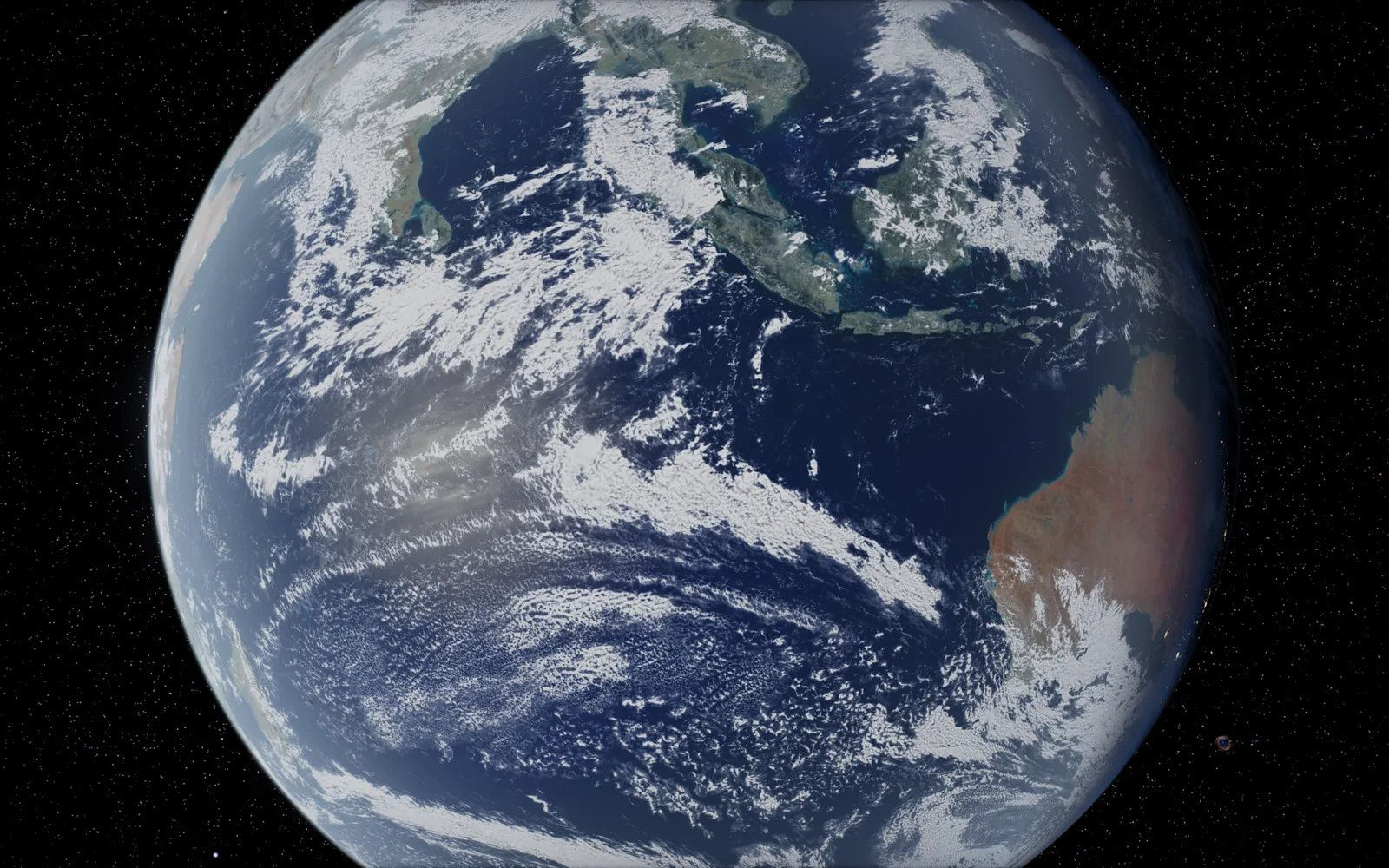
- Fraunhofer saw his lines in the sunlight that reaches the Earth, the light on the day side in this view.
Ask the class
Sunlight has a pair of dark lines at 589.0 nm and 589.6 nm. What do they show?
- Sodium in the SunRight answer
- Hydrogen in the Sun
- Elements the Sun lacks
WhyNIST lists neutral sodium's two strongest lines at 588.995 and 589.592 nm; hydrogen's visible lines are near 656, 486 and 434 nm. A dark line means gas in the Sun absorbed that wavelength, so sodium is there, as Kirchhoff found.
Sources 7 15 16Present from this step
-
06
Helium, found in the Sun first
Presented and for pupilsCaption
A yellow line seen in sunlight in 1868 matched no known metal. Lockyer named its element helium, after the Greek Sun, and it was found on Earth in 1895.
Talking points
- Royal Society of Chemistry: in 1868 Pierre Janssen travelled to India to measure the solar spectrum during a total eclipse and saw a new yellow line; Lockyer recorded the same line from London and, taking the new element for a metal, named it helium after Helios, the Greek personification of the Sun.
- RSC: "For over 20 years, no sign of the metal helium was detected on earth." In 1895 William Ramsay, in London, found helium in the gas given off when a radioactive uranium mineral was treated with acid, and Per Teodor Cleve and Nils Abraham Langlet found it independently in Uppsala.
- NASA's Sun Fact Sheet lists the photosphere's major elements as hydrogen, 90.965%, and helium, 8.889%.
Ask the class
Put these in the order they happened, earliest first.
They start in this order: Ramsay finds helium on Earth, Fraunhofer maps the dark lines in sunlight, Janssen and Lockyer see a new yellow line in the Sun, Bunsen and Kirchhoff study the lines of elements in flames.
Answer
- Fraunhofer maps the dark lines in sunlight
- Bunsen and Kirchhoff study the lines of elements in flames
- Janssen and Lockyer see a new yellow line in the Sun
- Ramsay finds helium on Earth
WhyFraunhofer from 1814, Bunsen and Kirchhoff between 1855 and 1863, the new yellow line in 1868, and Ramsay's helium on Earth in 1895 (Fraunhofer-Gesellschaft, NASA, RSC).
Sources 14 15 16 17Present from this step
-
07
Where Ramsay found helium
Pupils onlyCaption
Your turn: helium was named for the Sun in 1868. Use the arrows to step to the planet where William Ramsay found it 27 years later.
Talking points
- RSC: Ramsay discovered helium in London in 1895.
Pupil task
Use the arrows to step to the planet where helium was found in 1895.
HintRamsay worked in London, on the third planet from the Sun.
The viewer checks the task as the pupil works and says when it is done.
Sources 17Open this step as a pupil
-
08
Reading a star from afar
Presented and for pupilsCaption
Rigel's spectrum, read the same way, shows helium making up about a third of its surface by mass. Rigel is at Orion's bottom right.
Talking points
- NASA: "astronomers can identify what kinds of stuff are in stars from the lines they find in the star's spectrum", and from the lines can find "the temperature and density of that element in the star".
- Przybilla and colleagues (2010) analysed HD 34085 from its spectrum: effective temperature 12,100 ± 150 K, surface helium 0.32 ± 0.04 by mass, and the amounts of carbon, nitrogen and oxygen. SIMBAD lists HD 34085 as β Orionis, Rigel.
- OCR 5.5.2 (e): different atoms have different spectral lines, which identify the elements within stars.
Ask the class
Explain how dark lines in a star's spectrum show which elements it contains.
AnswerWritten in the pupil’s own words, up to 400 characters. It is not marked.
Sources 13 18 19 21Present from this step
Sources
Every fact in this lesson comes from these sources, and each step lists the ones it uses.
- Energy Level, IAU Office of Astronomy for Education glossary
- Spectrum, IAU Office of Astronomy for Education glossary
- Atomic Data for Hydrogen (ionization energy), NIST Handbook of Basic Atomic Spectroscopic Data
- Energy Levels of Neutral Hydrogen, NIST Handbook of Basic Atomic Spectroscopic Data
- Strong Lines of Hydrogen, NIST Handbook of Basic Atomic Spectroscopic Data
- Persistent Lines of Neutral Hydrogen (lines with their levels), NIST Handbook of Basic Atomic Spectroscopic Data
- Strong Lines of Sodium, NIST Handbook of Basic Atomic Spectroscopic Data
- Planck constant, CODATA 2022, NIST
- Speed of light in vacuum, CODATA 2022, NIST
- Electron volt in joules, CODATA 2022, NIST
- Our Sun in the Light of the Hydrogen Alpha Spectral Line, NASA Scientific Visualization Studio
- Visible Light, NASA Science
- Spectra, Imagine the Universe, NASA Goddard
- Sun Fact Sheet, NASA NSSDCA
- Technology Through Time, Issue 39: Solar Spectroscopy, NASA Sun-Earth Day 2006 (archived at NASA SPDF)
- Joseph von Fraunhofer, Fraunhofer-Gesellschaft
- Helium, Periodic Table, Royal Society of Chemistry
- Przybilla et al. (2010), Mixing of CNO-cycled matter in massive stars, Astronomy and Astrophysics 517, A38 (arXiv:1005.2278)
- Rigel (bet Ori), SIMBAD astronomical database, CDS (CfA mirror)
- AQA AS and A-level Physics specification (7407, 7408), version 1.3
- OCR A Level Physics A (H556) specification, version 3.0