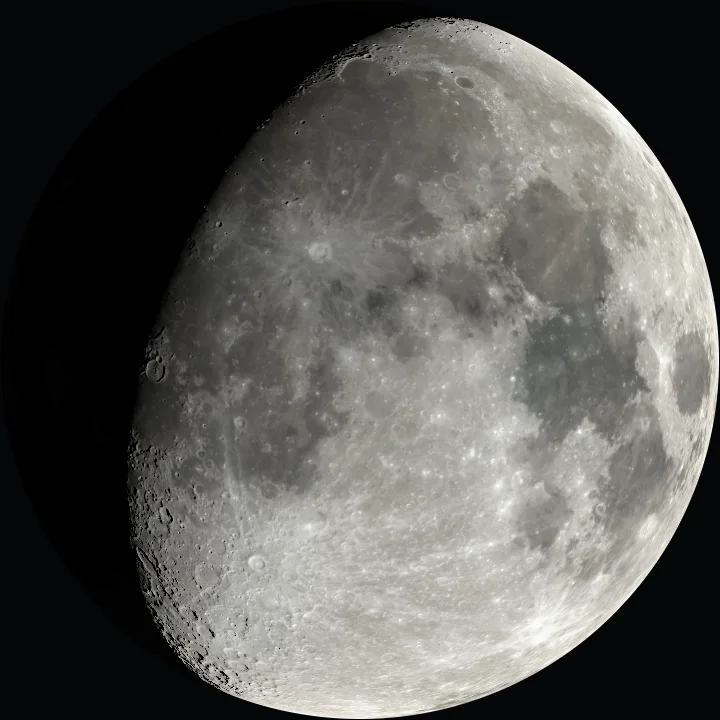
The Moon today
Waxing gibbous
79% lit11.2 days old
Choose a birthday to see its Moon.
Keep this Moon as a printEnter a birthday to see the Moon that day as it really looked: its phase, how much of it was lit, and when it rose and set where you were born.
The Moon today
Waxing gibbous
79% lit11.2 days old
Choose a birthday to see its Moon.
Keep this Moon as a printSecond birthday
Choose a date
Keep this Moon as a print
Your birthday Moon as a print: the Moon of that day drawn large from NASA's maps of its face, lit as it was and tilted as it looked from the place, with your words, the place, the date and its phase under it.
The print file is £19, to print at home or anywhere. Posters start at £35 and framed prints at £79, printed to order and posted free to the UK and the US.
Each print is one date, so two birthdays make two prints. Each Moon above has its own button.
The Moon is always half lit by the Sun. Which phase you were born under depends on where the Moon was in its 29.5-day orbit round the Earth that day.
The finder places the Moon and the Sun for your birthday with Jean Meeus's lunar theory, the one our 3D viewer and our Moon phase calendars use, on the clock of the date itself: the Earth's turning has drifted against atomic time over two centuries, and a phase in 1850 needs that drift to land on the right minute. The four main phases are the moments the US Naval Observatory uses, when the Moon is 0, 90, 180 and 270 degrees east of the Sun. We checked the finder against USNO's tables for fourteen birthdays from 1805 to 2088, from Chicago to Auckland: it names every day as USNO does, and its phase times, moonrises and moonsets agree to the minute.
The Moon in the picture is drawn by the renderer our moon phase prints use, from NASA's maps of the Moon's face, with the libration of that moment, so the face is turned the way it really was, and earthshine on the dark side.
Enter your date of birth at the top of this page. The finder works out the Moon for that day from the same lunar theory as our Moon phase calendars and prints, and names the day as the US Naval Observatory does: by the main phase if one fell that day, and otherwise as a waxing or waning crescent or gibbous Moon. It works for any date from 1800 to 2100.
No. The phase is the same from everywhere on Earth at the same moment, so the date gives it. A place adds when the Moon rose and set there and draws it tilted as it looked from there. A time gives the Moon at that minute and whether it was above the horizon. Close to midnight the place can change the date, and with it the name of the day's phase, so with a place the finder takes the date and time on the clock there. Without one it takes them on your own clock.
That the Moon was full on your birthday: it stood opposite the Sun in the sky, with the whole of its near side lit. Each main phase is a moment, and the finder names the day it falls on. Full Moons come every 29.5 days on average, so about one day in 30 has one. The finder reads nothing more into it: the phase is where the Moon was in its orbit.
The number of days since the last new Moon, as the US Naval Observatory defines it. It runs from 0 at new Moon to about 29.5 just before the next, so a full Moon is about 15 days old.
No. Twelve of the Moon's months come to 354.4 days, about 11 days short of a year, so the Moon on your birthday is about 11 days further on in its cycle each year. It comes back to nearly the same phase every 19 years: 235 of the Moon's months take almost exactly 19 years, the Metonic cycle.
With a place, the Moon is drawn as someone standing there and facing it would have seen it, the top of the picture straight up from their horizon. The crescent leans with the hour and the latitude, and south of the equator the Moon appears the other way up, lit on the left while it waxes. Without a place it is drawn north up, as the Moon phase calendars draw it, or south up if you chose that on the Moon phase page.
Yes. Press "Add a second birthday" and the two Moons sit side by side, with how far apart they are in the Moon's cycle. It is a nice way to see a couple's or a family's Moons together. Each print is of one date, so two birthdays make two prints.
Yes. "Keep this Moon" opens the moon phase print designer on the same day, place and time, ready to add your words. The print file is £19, posters start at £35 and framed prints at £79, posted free to the UK and the US. Each print is one date.