Birthday moon phase prints
The Moon the day they were born.
The real Moon over the town they were born in, lit as it was on the night they arrived and turned the way it stood in that sky. For a birthday at any age, from a first to a hundredth.
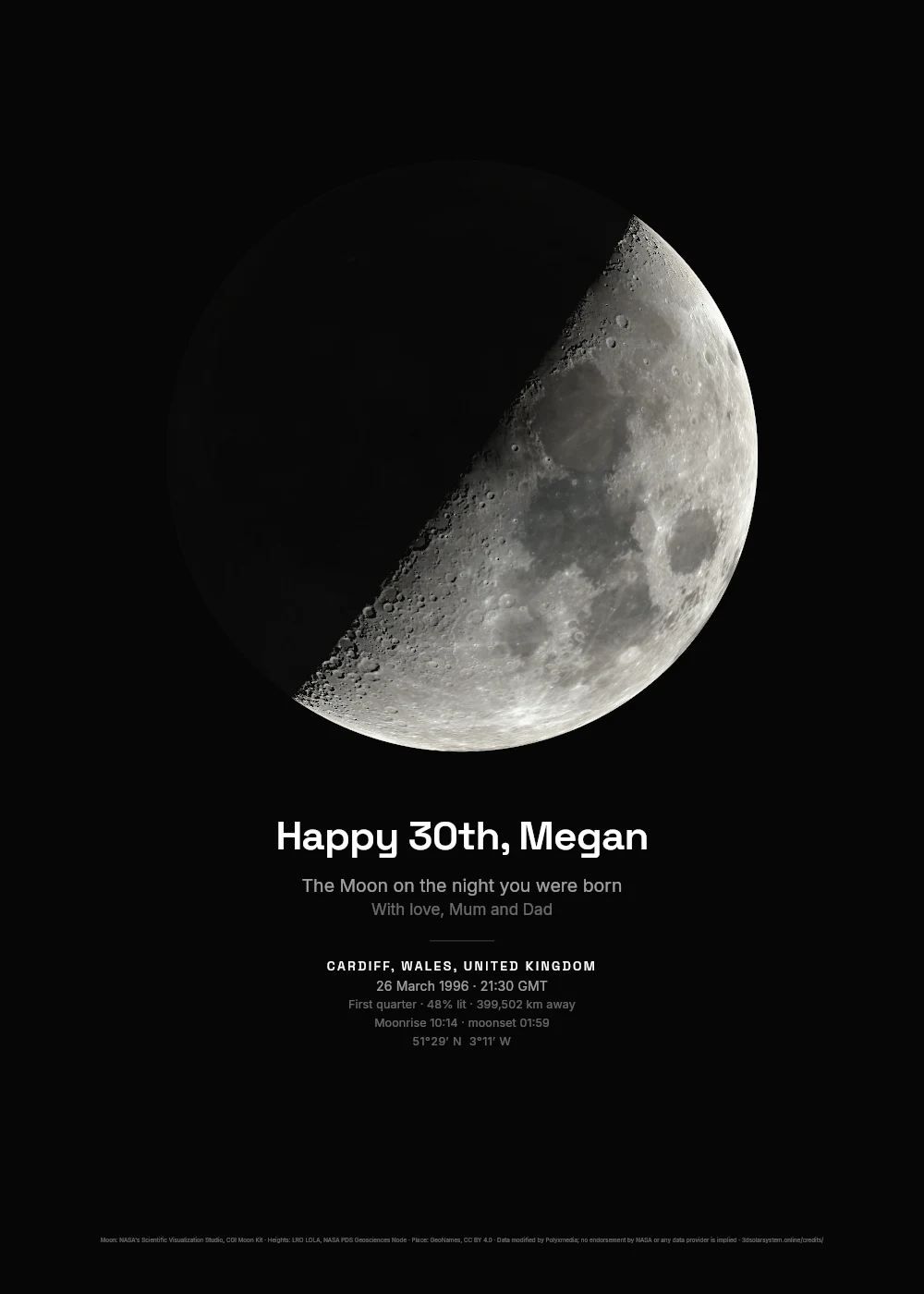
The Moon that night.
Over Cardiff at 21:30 GMT on 26 March 1996, worked out by the same code that draws the print.1
- First quarter, 48% litHow much of the Moon's face was in sunlight at that minute, seen from Cardiff.4,15
- 39° above the horizonIn the west of Cardiff's sky.15
- 399,502 km awayFrom Cardiff to the centre of the Moon.4
- Moonrise 10:14, moonset 01:59On Cardiff's clock: it rose on 26 March and set on 27 March.2
- First quarter, 27 MarchAt 01:30 GMT, 4 hours after this minute.2,1
Drawn by the code that makes your print. Open this example in the designer and change the place, the date and the words to yours.
Choosing the date and the layout.
One night suits a birthday best: the Moon large on the page, as it stood over the place they were born on the night they arrived, with its phase, how much of it was lit, how far away it was and when it rose and set.
Use the time of birth if the family knows it, on the clock of the place they were born, summer time included. If nobody is sure, choose the evening of that day: the Moon's phase changes slowly through a day, and what turns with the clock is its tilt and its height in the sky.
A month needs only the day: every Moon of the month they were born in, in a calendar, with their birthday ringed. A year does the same for the whole year they arrived.
For a birthday before 1970, check the clock. The time zone rules come from the world time zone database, whose own notes say its entries before 1970 are often uncertain,10 so look at the zone the designer gives with the time under your print.
Words for a birthday moon print.
A title and a line under it. Each opens the designer with the words in place, in the layout they suit, ready for your names.
- Happy birthdayThe Moon on the night you were bornUse these words →
- Happy 30thThe Moon the night you arrivedUse these words →
- Born under this MoonHappy birthday from all of usUse these words →
- Forty years of youThe Moon of the day you were bornUse these words →
- Your birthday MoonLit like this the night you arrivedUse these words →
- The month you arrivedEvery Moon of that month, your day ringedUse these words →
A file, a poster or a frame.
Choose how your print comes in the designer, under Printed as. Our print lab makes a paper print to order and posts it free to the UK and the US, and the print file comes with it to keep.
Questions about birthday moon prints.
What if nobody knows the time they were born?
Choose the evening of that day, or the hour the family remembers. The Moon's phase changes slowly through a day; what turns with the clock is its tilt and its height in the sky. A month print needs only the day.
What if the Moon was below the horizon when they were born?
The print still shows the Moon as it was at that minute, lit as it was, and its line of details says it was below the horizon and when it rose. It is still the Moon of their day.
Can I make one for an 80th or a 90th birthday?
Yes. Any day back to 1 January 1800 can be drawn. For dates before 1972 we allow for the Earth's uneven spin with the formulas NASA's eclipse tables use.9
How is it different from a birth moon print?
The Moon is worked out the same way, and the words are for another time of life. Birth moon phase prints are for a new baby; a birthday moon print has words for any age.
Is it the real Moon of my date?
Yes. The phase, the share of the disc that was lit and the Moon's distance are worked out for your minute after Jean Meeus' Astronomical Algorithms, and we test them: every new Moon, quarter and full Moon of six years between 1805 and 2005 falls within a minute of the US Naval Observatory's tables.4,1,2
Can you print and frame it for me?
Yes. Choose a poster, a fine art print on Hahnemühle Photo Rag or a framed print under Printed as, at 30 × 40 or 50 × 70 cm. Our print lab makes it to order and posts it free to the UK and the US, and the print file comes with it to keep. A poster costs from £35 and a framed print from £79.
More occasions.
- Birth moon phase printsThe Moon the night they arrived
- Wedding moon phase printsThe Moon of the day you married
- Anniversary moon phase printsThe Moon of the night it all began
- Memorial moon phase printsA Moon to remember someone by
- Mother's Day moon phase printsThe Moon of a night that is hers
The whole sky of that moment instead: Birthday star maps print the stars, the planets and the Moon over the same place and minute.
Not sure of the date yet? See the Moon's phase on any day, free, then keep the one you want.
Sources
- Our own tests of the Moon against [2], [3] and [8] (tests/moon-prints-sky.test.js, tests/moon-prints-layout.test.js and tests/moon-prints-design.test.js in our code, November 2026): every new Moon, quarter and full Moon of 1805, 1900, 1955, 1969, 1990 and 2005 within a minute of the US Naval Observatory's tables; the Moon's rise, transit and set in London and its transit and set in Sydney within a minute of the Observatory's; every solar eclipse of NASA's tables for 1991 to 2000 and 2011 to 2020 and every partial and total lunar eclipse of 2011 to 2020 of the right kind and within three minutes, and every eclipse of 2026 to 2032 as our sky calendar lists it from NASA's tables; the supermoons of 2026 and 2027 as our Moon phase pages list them; the crescent turned over between London and Sydney.
- Astronomical Applications Department, US Naval Observatory: phases of the Moon, and sun and moon rise, set and transit for one day, read 14 and 17 November 2026. aa.usno.navy.mil/data/MoonPhases, aa.usno.navy.mil/data/RS_OneDay
- Espenak, F., NASA Goddard Space Flight Center, eclipse tables by decade: solar eclipses 1991 to 2000 and 2011 to 2020, lunar eclipses 2011 to 2020, read 14 November 2026. eclipse.gsfc.nasa.gov
- Meeus, J. (1998), Astronomical Algorithms, 2nd edition, Willmann-Bell: chapter 47 for the Moon's place, from which the phases are found, chapter 48 for its lit fraction, chapter 54 for the kind of an eclipse and chapter 15 for rising and setting.
- Espenak, F., Full Moon at Perigee (Full Supermoon): 2001 to 2100, Astropixels, read 14 and 17 November 2026: "Any Full Moon occurring at a Relative Distance of 0.9 or greater is by definition a supermoon." astropixels.com/ephemeris/moon/fullperigee2001.html
- Espenak, F. and Meeus, J. (2006), Polynomial expressions for Delta T, NASA Goddard Space Flight Center. eclipse.gsfc.nasa.gov/SEcat5/deltatpoly.html
- The IANA Time Zone Database and its notes on how reliable old entries are. iana.org/time-zones, theory.html
- JPL Horizons System, NASA Jet Propulsion Laboratory, read 17 and 18 November 2026: the Moon of each example on our occasion pages, from its place at its minute or from the Earth's centre at the middle of its day, its lit share, its height and its distance. ssd.jpl.nasa.gov/horizons
The example's names are made up; its place, its date and its Moon are real. Prices are in pounds sterling. The print file is a digital download. Every data source is on our credits page. Privacy.
Buying for someone? Every gift we sell, from a print file that arrives in minutes to a framed print.