Birthday star maps
The sky on the day they were born.
The stars over the town they were born in, on the night they arrived, for a birthday at any age. The Moon in its real phase and the planets where they stood, decades ago or last year.
- Print file £19, posters from £35, framed from £79
- The print file reaches you by email in minutes.16 Paper prints are posted free to the UK and the US.Free UK delivery on paper and framed prints. The print file reaches you by email in minutes.16Free US delivery on paper and framed prints. The print file reaches you by email in minutes.16
- Damaged or misprinted prints are reprinted or refunded if you tell us within 30 days.

How big it looks at home.
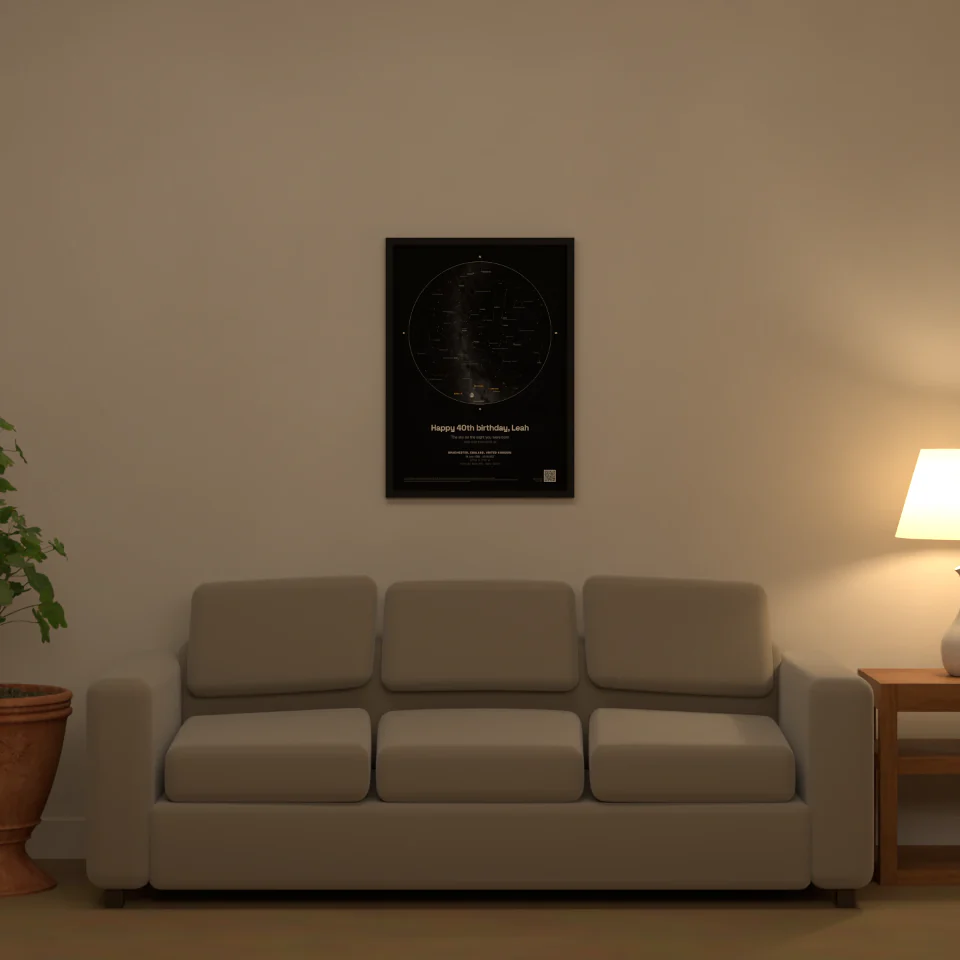
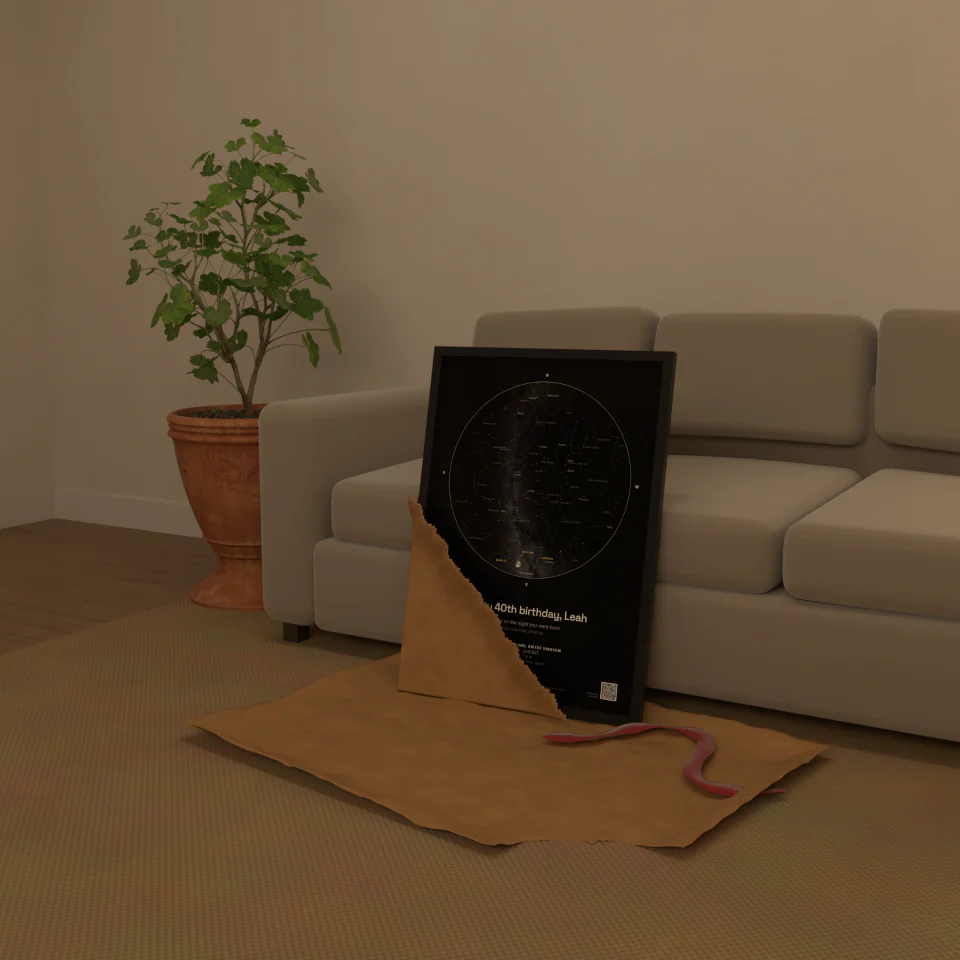
The example above at 50 × 70 cm in its frame, drawn to scale in a room built at real sizes.18
Words for a birthday star map.
A title and a line under it. Each opens the designer with the words in place, ready for your names.
- Happy birthdayThe sky on the night you were bornUse these words →
- Happy 40thThe stars that were there the night you arrivedUse these words →
- Born under these starsHappy birthday from all of usUse these words →
- Fifty years of youThe sky the day it all beganUse these words →
- The day you arrivedThe stars over your first nightUse these words →
- Still our brightest starThe sky the night you were bornUse these words →
Getting the time right.
Use the time on their birth record, or ask the family, who may remember whether they arrived in the morning or late at night. The designer reads the time on the clock of the place they were born, summer time included. If nobody is sure, choose 22:00: the stars turn a little with the hours, while the Moon's phase and the planets stay almost where they were.
For a birthday before 1970, check the clock. The time zone rules come from the world time zone database, whose own notes say its entries before 1970 are often uncertain,7 so look at the zone the designer names beside the time.
The Moon and the planets move on from one birthday to the next, so the sky on their print, with its Moon and its planets, belongs to the day they were born. See it for yourself: look round their date and this year's, free, on our night sky page.
Questions about birthday star maps.
What if nobody knows the time they were born?
Choose 22:00, or the hour the family remembers. The stars turn a little through the night, so the chart shifts with the time, while the Moon's phase and the planets stay almost where they were.
Can I make one for a 50th, a 60th or an 80th birthday?
Yes. Any date from 1 January 1800 to the end of 2200 works, so the sky over a grandparent's birth is worked out from the same planetary theory and star catalogue as last year's.
How is it different from a birth star map?
The sky is the same; the words are for another time of life. Birth star maps are for a new baby, with words for their first days. A birthday star map has words for any age, from a first birthday to a hundredth.
Can I add their name and age?
Yes. The title takes up to 48 characters and each of the two lines under it up to 80, so a name, an age and a message all fit. The place, the date and time and the coordinates are printed under your words.
How accurate is the star map?
We test it. For four reference moments our chart is checked against JPL's Horizons system and the US Naval Observatory: the planets land within 3 arcseconds, the Moon within 12 and the bright navigational stars within 1.5. On a 50 × 70 cm print the worst of them is less than 0.03 mm from where it belongs.1,2,3
What do I get when I buy the print file?
A PNG image of your design at 300 dots per inch, at the size you chose (5,906 × 8,268 pixels for 50 × 70 cm), ready for any printer. Straight after payment we make your file at full size, ready to download from your order page, and we email you a link to it that keeps working.
What the sky held that night.
Over Manchester at 23:10 on 19 July 1986, the night of the example at the top of this page, worked out by the same engine that draws the print.1
- The Moon, 96% litA waxing gibbous, low in the south.
- MarsLow in the south.
- SaturnLow in the south-west.
- 4,206 starsEvery star to magnitude 6.5 above the horizon, the brightest of them Arcturus.
More occasions.
- Wedding star mapsThe sky over the day you married
- Birth star mapsThe sky the moment they arrived
- Anniversary star mapsThe sky of the night it all began
- The night we met star mapsThe real sky of your first night
- Memorial star mapsA sky to remember someone by
- Christmas star mapsA gift of the sky on a night that is theirs
- Valentine's Day star mapsThe sky of the night you met, as a gift
- Mother's Day star mapsThe sky of a night that is hers
Not sure of the night yet? See the night sky on any date, free, then keep the one you want.
The Moon of that day on its own: Birthday moon phase prints draw its real face, lit as it was, for one night, a month or a year.
Sources
- Our own test of the chart against [2] and [3] for four reference moments (tests/prints-chart.test.js in our code, October 2026): planets within 3″, the Moon within 12″, the navigational stars within 1.5″; under 0.03 mm on a 50 × 70 cm print.
- JPL Horizons System, NASA Jet Propulsion Laboratory. ssd.jpl.nasa.gov/horizons
- Astronomical Applications Department, US Naval Observatory. aa.usno.navy.mil/data
- The IANA Time Zone Database and its notes on how reliable old entries are. iana.org/time-zones, theory.html
- Our own code (api/prints/_fulfil.js, api/prints/_render.js and api/_email.js, November 2026): as soon as Stripe confirms the payment we email the buyer the link to their print file and make the file at full size on our server, and a paper print goes to the lab nearest the buyer, posted free to the UK and the US (src/prints/physical.js).
- The rooms in the pictures of the print at home: rendered by us in Blender at real sizes (scripts/prints/scale/scene.py in our code), with the sofa and the frame modelled to measure, the frame after Prodigi's classic frame. The plant, side table, vase and fir tree are Poly Haven models, CC0 1.0. polyhaven.com/license, prodigi.com classic frames
The example's names are made up. Prices are in pounds sterling; the print file is a digital download. Every data source is on our credits page.
Buying for someone? Every gift we sell, from a print file that arrives in minutes to a framed print.