Lesson plan · First steps · Ages 5 to 7 · 15 minutes
Day and night on a spinning Earth
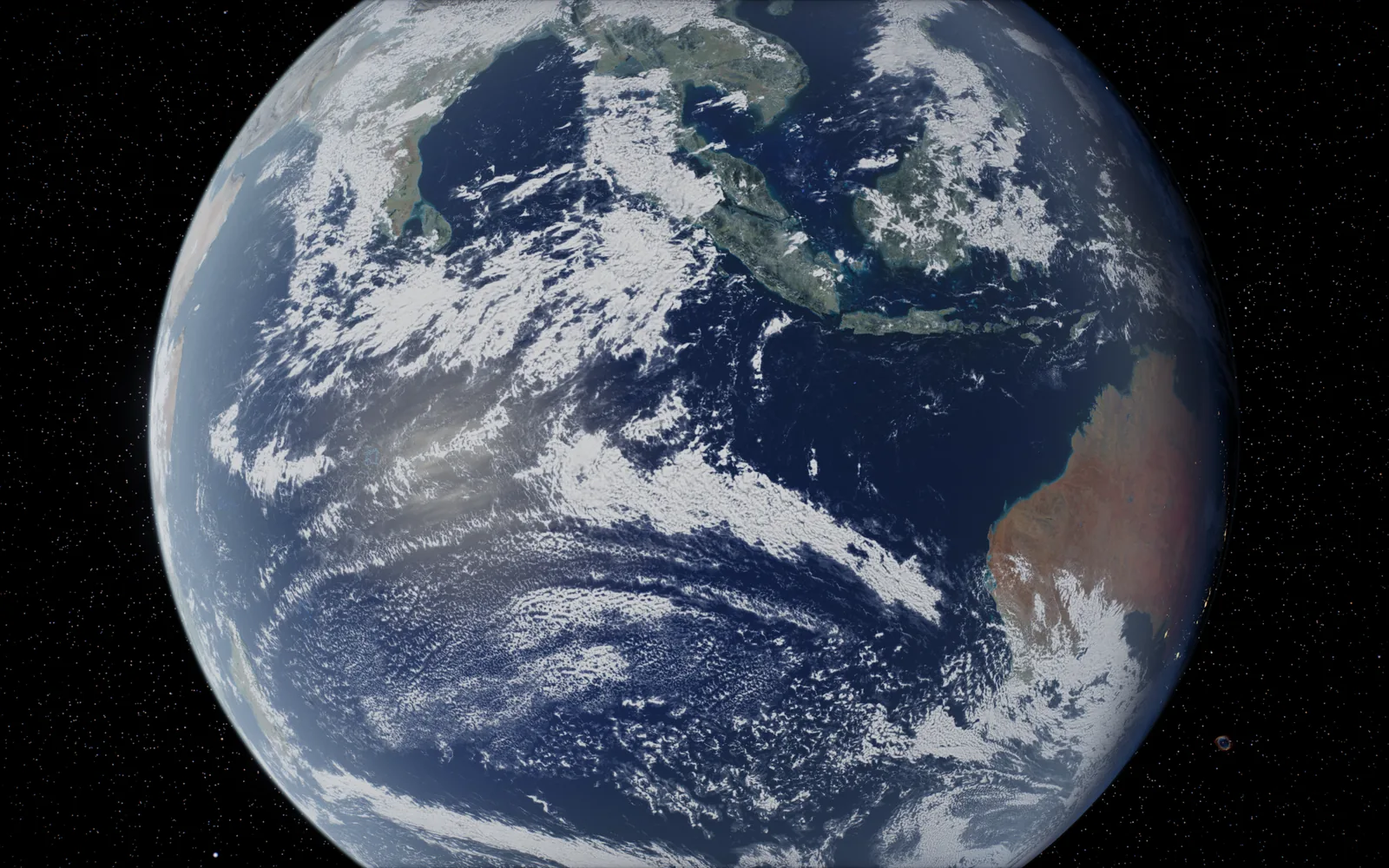
Earth spins round once a day, so we turn into the Sun's light for day and away from it for night.
The lesson
The class watches Earth spin in the Sun's light and sees London turn from day into night and back. Pupils then stop the clock when London is in the sunshine.
What they take away
Earth spins round once every day. The side facing the Sun has day and the side facing away has night, and as Earth turns the Sun seems to rise, cross the sky and set.
Curriculum links
Quoted word for word from the official documents.
England national curriculum
-
Key stage 1, years 1 and 2: Working scientifically
Read it on gov.ukusing their observations and ideas to suggest answers to questions
Next Generation Science Standards (NGSS)
-
1-ESS1-1
Read it on nextgenscience.orgUse observations of the sun, moon, and stars to describe patterns that can be predicted.
Step by step
The caption is what the class reads on screen; the talking points are in your notes drawer (N) when you present. Steps marked Pupils only appear only in the pupil lesson.
-
01
Day in London
Presented and for pupilsCaption
The Sun shines on one side of Earth, and that side has day.
Talking points
- NASA: the Sun is the only object in our solar system that shines with its own light, and that light lights up half of our planet.
- We are looking down on Earth from above the North Pole. It is midday in London: the US Naval Observatory gives 12:08 as the moment the Sun is highest over Greenwich on 20 March 2027.
- The London marker sits at Greenwich, on longitude 0 degrees.
Ask the class
Look at London. Is it day or night there?
- DayRight answer
- Night
WhyLondon is on the side of Earth facing the Sun, so it is daytime there.
Sources 1 8 9Present from this step
-
02
Round and round
Presented and for pupilsCaption
Earth spins round and round, and one whole turn takes a day.
Talking points
- Met Office: each day the Earth spins round on its axis once, and this is what gives us night and day.
- NASA Space Place: Earth spins around its axis, making one complete turn each day.
- NASA's Earth Fact Sheet gives the length of a day as 24 hours, and its notes define that as the time the Sun takes to come back to the noon position in the sky. The clock runs at an hour a second, so a whole day takes 24 seconds.
- The stick through Earth is its axis, the imaginary line from the North Pole to the South Pole that it spins around.
Sources 2 3 4 5Present from this step
-
03
Night in London
Presented and for pupilsCaption
When London turns away from the Sun, it is night there.
Talking points
- It is midnight in London. The Sun is still shining on the other side of Earth.
Ask the class
Why does night come?
- Our side of Earth turns away from the SunRight answer
- The Sun switches off
WhyThe Sun keeps shining all the time. At night our side of Earth has turned away from it.
Sources 1 2Present from this step
-
04
The Sun seems to move
Presented and for pupilsCaption
The Sun seems to travel across the sky during the day because Earth is turning.
Talking points
- NGSS gives this pattern as an example for first grade: the Sun and the Moon appear to rise in one part of the sky, move across the sky, and set.
- NASA StarChild: Earth spins towards the east, and that is why the Sun, the Moon, the planets and the stars all rise in the east and make their way westward across the sky.
- This is the view from the Sun. Watch London come in at the dawn edge, come nearest the middle of the disc at midday and leave by the evening edge.
Sources 6 7Present from this step
-
05
Morning, midday, evening
Presented and for pupilsCaption
Every day the Sun comes up in the morning, is highest at midday and goes down in the evening.
Talking points
- US Naval Observatory times for Greenwich on 20 March 2027: sunrise 06:03, Sun highest 12:08, sunset 18:13 UTC. UK clocks read the same that day, since they go forward to British Summer Time on 28 March 2027 (GOV.UK). The scene opens at sunrise.
- NASA StarChild: the Sun rises in the east and sets in the west. Point out which side of the playground the Sun comes up on.
Ask the class
Put these in order, starting with the first one each day.
They start in this order: Sunset, Sunrise, Midday.
Answer
- Sunrise
- Midday
- Sunset
WhyFirst the Sun rises in the morning, then it is highest at midday, then it sets in the evening.
Sources 6 8 9 10Present from this step
-
06
Stop in the sunshine
Pupils onlyCaption
Your turn: stop the clock when London is in the sunshine.
Talking points
- The check passes when it is between 7 in the morning and 5 in the afternoon in London (local mean solar time) and the clock is paused. On 20 March 2027 the US Naval Observatory gives sunrise at 06:03 and sunset at 18:13 at Greenwich, so every moment that counts is in daylight.
- The clock runs at an hour a second, so London spends about 12 seconds on the sunny side.
Pupil task
Watch London go round. Press Pause when it is on the bright side.
HintWait until London has turned into the light, then press Pause.
The viewer checks the task as the pupil works and says when it is done.
Sources 8 9Open this step as a pupil
-
07
One turn a day
Presented and for pupilsCaption
Day, then night, then day again: Earth keeps on turning.
Talking points
- Met Office: each day the Earth spins round on its axis once, and it takes one year to go all the way round the Sun.
Ask the class
How long does Earth take to spin round once?
- One dayRight answer
- One year
WhyEarth spins round once every day. Going all the way round the Sun takes a year.
Sources 2 4Present from this step
Sources
Every fact in this lesson comes from these sources, and each step lists the ones it uses.
- Moon Phases, NASA Science
- Our seasons, Met Office for Schools
- What Causes the Seasons?, NASA Space Place
- Earth Fact Sheet, NASA NSSDCA
- Notes on the Planetary Fact Sheets, NASA NSSDCA
- Why does the Sun rise in the east and set in the west?, NASA StarChild
- 1-ESS1-1 Earth's Place in the Universe, Next Generation Science Standards
- Sun rise, set and transit at Greenwich, 20 March 2027, US Naval Observatory
- Airy transit circle, An Etymological Dictionary of Astronomy and Astrophysics, Paris Observatory
- When do the clocks change?, GOV.UK