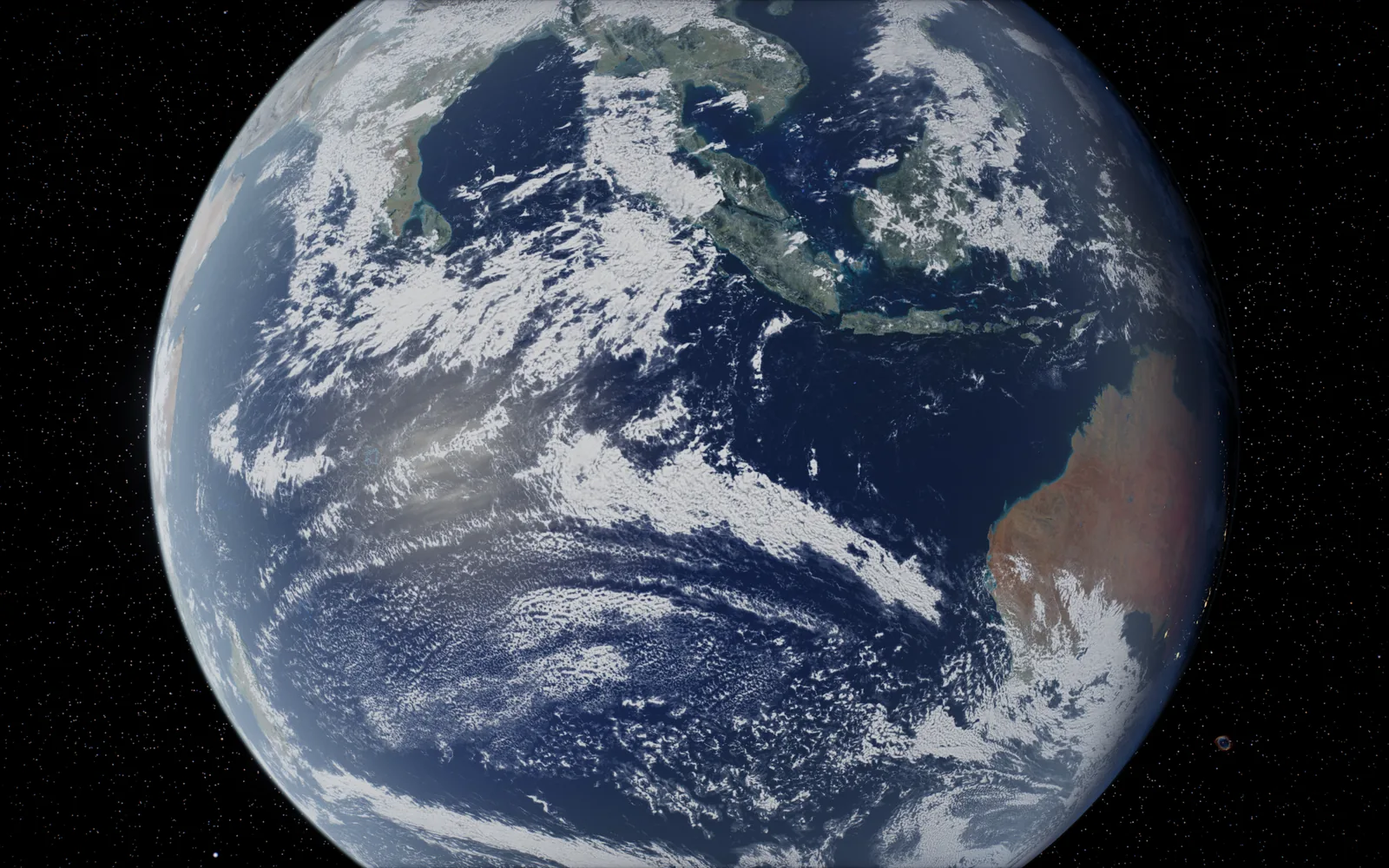
Lesson plan · First steps · Ages 5 to 7 · 15 minutes
The four seasons
Spring, summer, autumn and winter: in summer the days are long and the Sun climbs high, and in winter the days are short and the Sun stays low.
The lesson
The class watches Earth travel round the Sun, names the four seasons in order, and compares a long summer day and a short winter day in London. Pupils then run the clock and stop it in summer.
What they take away
Earth goes round the Sun once a year, and its tilt means our part of Earth leans towards the Sun in summer and away from it in winter. Summer has long days and a high midday Sun, winter has short days and a low one, and in spring and autumn the days grow longer or shorter.
Curriculum links
Quoted word for word from the official documents.
England national curriculum
-
Key stage 1, year 1: Seasonal changes
Read it on gov.ukobserve changes across the 4 seasons
-
Key stage 1, year 1: Seasonal changes
Read it on gov.ukobserve and describe weather associated with the seasons and how day length varies
Next Generation Science Standards (NGSS)
-
1-ESS1-2
Read it on nextgenscience.orgMake observations at different times of year to relate the amount of daylight to the time of year.
Step by step
The caption is what the class reads on screen; the talking points are in your notes drawer (N) when you present. Steps marked Pupils only appear only in the pupil lesson.
-
01
Round the Sun
Presented and for pupilsCaption
Earth travels all the way round the Sun once every year.
Talking points
- Met Office: the Earth orbits around the Sun, taking one year to make a complete orbit.
- The clock runs at a week a second, so a whole year takes about 52 seconds.
- Sizes and distances in this view are not to scale.
Sources 1Present from this step
-
02
Four seasons
Presented and for pupilsCaption
Each year has four seasons: spring, summer, autumn and winter.
Talking points
- Met Office: in the UK spring begins in March and ends in May, summer starts in June and finishes at the end of August, autumn runs from September to November and winter from December to February.
- Met Office: summer is the warmest season and winter the coldest.
- In the Southern Hemisphere the seasons come the other way round. NASA Space Place: the two poles are at opposite ends of Earth, so they have opposite timing for the seasons.
- Sizes and distances in this view are not to scale.
Ask the class
Put the seasons in order, starting with spring.
They start in this order: Autumn, Winter, Spring, Summer.
Answer
- Spring
- Summer
- Autumn
- Winter
WhySpring, then summer, then autumn, then winter, and then spring comes round again.
Sources 1 2 3Present from this step
-
03
Summer
Presented and for pupilsCaption
In summer our part of Earth leans towards the Sun, so we get more sunshine.
Talking points
- Met Office: it is summer in the UK when the northern hemisphere is tilted towards the Sun.
- NASA Space Place: when the North Pole points towards the Sun, more sunlight reaches the northern half of the planet, which leads to summer.
- Many people think summer comes when Earth is nearest the Sun. NASA Space Place says that idea is incorrect: the Northern Hemisphere has winter when Earth is closest to the Sun and summer when it is farthest away.
- The stick through Earth is its axis. Its pointed end is the North Pole, leaning towards the Sun in June. US Naval Observatory: the June solstice of 2027 is on 21 June.
Sources 1 3 4Present from this step
-
04
Long summer days
Presented and for pupilsCaption
In summer London stays in the sunshine for most of each turn, so the days are long.
Talking points
- The clock runs at an hour a second. Watch how long London stays on the bright side.
- US Naval Observatory, Greenwich on 21 June 2027: sunrise 03:43 and sunset 20:21 UTC, 16 hours 38 minutes of daylight. On 22 December 2027 it is 08:03 to 15:53 UTC, only 7 hours 50 minutes.
- Met Office: the summer solstice, on 21 or 22 June, gives the UK its longest day and shortest night.
Ask the class
When are the days longest?
- In summerRight answer
- In winter
WhyIn summer our part of Earth leans towards the Sun, so we spend longer in its light each day.
Sources 1 6 8 12Present from this step
-
05
A high summer Sun
Presented and for pupilsCaption
At midday in summer the Sun climbs high up in the sky.
Talking points
- US Naval Observatory: at midday in Greenwich on 21 June 2027 (12:02 UTC) the Sun is about 62 degrees above the horizon. At midday on 22 December 2027 (11:58 UTC) it is only about 15 degrees up. Straight overhead would be 90 degrees.
- This is the view from the Sun. The marked point has the Sun straight overhead, and the nearer a place is to it, the higher the Sun climbs in that place's sky.
- Never look at the Sun to see how high it is, even with dark glasses on: the national curriculum asks that pupils are warned it is not safe.
-
06
Winter
Presented and for pupilsCaption
In winter our part of Earth leans away from the Sun, so the days are short and the Sun stays low.
Talking points
- Met Office: in winter the northern hemisphere is fully tilted away from the Sun, and December to February are the coldest months of the year with the shortest days. The winter solstice, on 21 or 22 December, gives the UK its shortest day and longest night.
- US Naval Observatory, Greenwich on 22 December 2027: 7 hours 50 minutes of daylight, and the Sun only about 15 degrees up at midday.
- The clock runs at an hour a second. Watch how soon London goes back into the dark.
Ask the class
In winter, where is the Sun at midday?
- High up in the sky
- Low down in the skyRight answer
WhyIn winter our part of Earth leans away from the Sun, so even at midday the Sun stays low in the sky.
Sources 1 8 10 12Present from this step
-
07
Spring and autumn
Presented and for pupilsCaption
In spring the days get longer, and in autumn they get shorter.
Talking points
- Met Office: in spring the days get longer and warmer, and in autumn the temperatures get cooler and the days get shorter.
- Met Office: the two equinoxes come halfway between the solstices and mark the start of spring and autumn, when the northern hemisphere is tilted neither towards nor away from the Sun.
- US Naval Observatory, Greenwich: 12 hours 10 minutes of daylight on 20 March 2027 (06:03 to 18:13 UTC) and on 23 September 2027 (05:47 to 17:57 UTC). At midday on 20 March the Sun is about 38 degrees up.
-
08
Stop in summer
Pupils onlyCaption
Your turn: run the clock and stop it in summer.
Talking points
- The clock runs at a week a second. The check passes when the clock is paused between about 2 June and 29 August, inside the Met Office's UK summer (June, July and August). It reads the Sun's position along its yearly path, a longitude of 72 to 156 degrees.
- The Next equinox or solstice button jumps to the June solstice, inside the window. The clock keeps running after a jump, so the pupil still has to press Pause before it leaves summer.
Pupil task
Watch the date. Press Pause when it is summer.
HintSummer is June, July and August. Stop the clock in July to be sure, when the North Pole leans towards the Sun.
The viewer checks the task as the pupil works and says when it is done.
Sources 1 4Open this step as a pupil
Sources
Every fact in this lesson comes from these sources, and each step lists the ones it uses.
- Our seasons, Met Office for Schools
- The four seasons, Met Office
- What Causes the Seasons?, NASA Space Place
- Earth's Seasons and Apsides, 2027, US Naval Observatory
- Sun rise, set and transit at Greenwich, 20 March 2027, US Naval Observatory
- Sun rise, set and transit at Greenwich, 21 June 2027, US Naval Observatory
- Sun rise, set and transit at Greenwich, 23 September 2027, US Naval Observatory
- Sun rise, set and transit at Greenwich, 22 December 2027, US Naval Observatory
- Sun's altitude at Greenwich, 21 June 2027 12:02 UTC, US Naval Observatory
- Sun's altitude at Greenwich, 22 December 2027 11:58 UTC, US Naval Observatory
- Sun's altitude at Greenwich, 20 March 2027 12:08 UTC, US Naval Observatory
- Airy transit circle, An Etymological Dictionary of Astronomy and Astrophysics, Paris Observatory
- National curriculum in England: science programmes of study, Department for Education