Lesson plan · Ages 11 to 14 · 20 minutes
The scale of the Solar System
How big the Sun and planets really are, how far apart they are, and how long sunlight takes to reach us.
The lesson
The class lines up the Sun, the planets and Pluto at their true sizes, works out how many Earths fit across Jupiter and the Sun, then switches to true distances. They finish by timing sunlight on its way to Earth.
What they take away
About 11 Earths fit across Jupiter and about 109 across the Sun, and the planets are tiny compared with the gaps between them. Even light, at 299,792 km a second, takes about 8 minutes 19 seconds to cross the 149.6 million km from the Sun to Earth.
Curriculum links
Quoted word for word from the official documents.
England national curriculum
-
Key stage 3: Physics, space physics
Read it on gov.ukthe light year as a unit of astronomical distance
Next Generation Science Standards (NGSS)
-
MS-ESS1-3
Read it on nextgenscience.orgAnalyze and interpret data to determine scale properties of objects in the solar system.
Step by step
The caption is what the class reads on screen; the talking points are in your notes drawer (N) when you present. Steps marked Pupils only appear only in the pupil lesson.
-
01
True sizes
Presented and for pupilsCaption
Here are Pluto, the eight planets and the Sun at their true sizes, side by side, smallest first.
Talking points
- The line-up runs Pluto, Mercury, Mars, Venus, Earth, Neptune, Uranus, Saturn, Jupiter and the Sun. NASA's diameters put them in that order.
- Only the sizes are to scale here. In space the bodies are very far apart, which comes later in the lesson.
Sources 1 3Present from this step
-
02
Our planet
Presented and for pupilsCaption
Earth is 12,756 km across at the equator. Keep it in mind as the yardstick for the rest.
Talking points
- NASA's Planetary Fact Sheet gives each diameter across the equator: 12,756 km for Earth.
- The line-up draws each world from its average diameter. For Earth that is 12,742 km (twice NASA's mean radius of 6,371 km), too small a difference to see.
Sources 1 2 4Present from this step
-
03
The biggest planet
Presented and for pupilsCaption
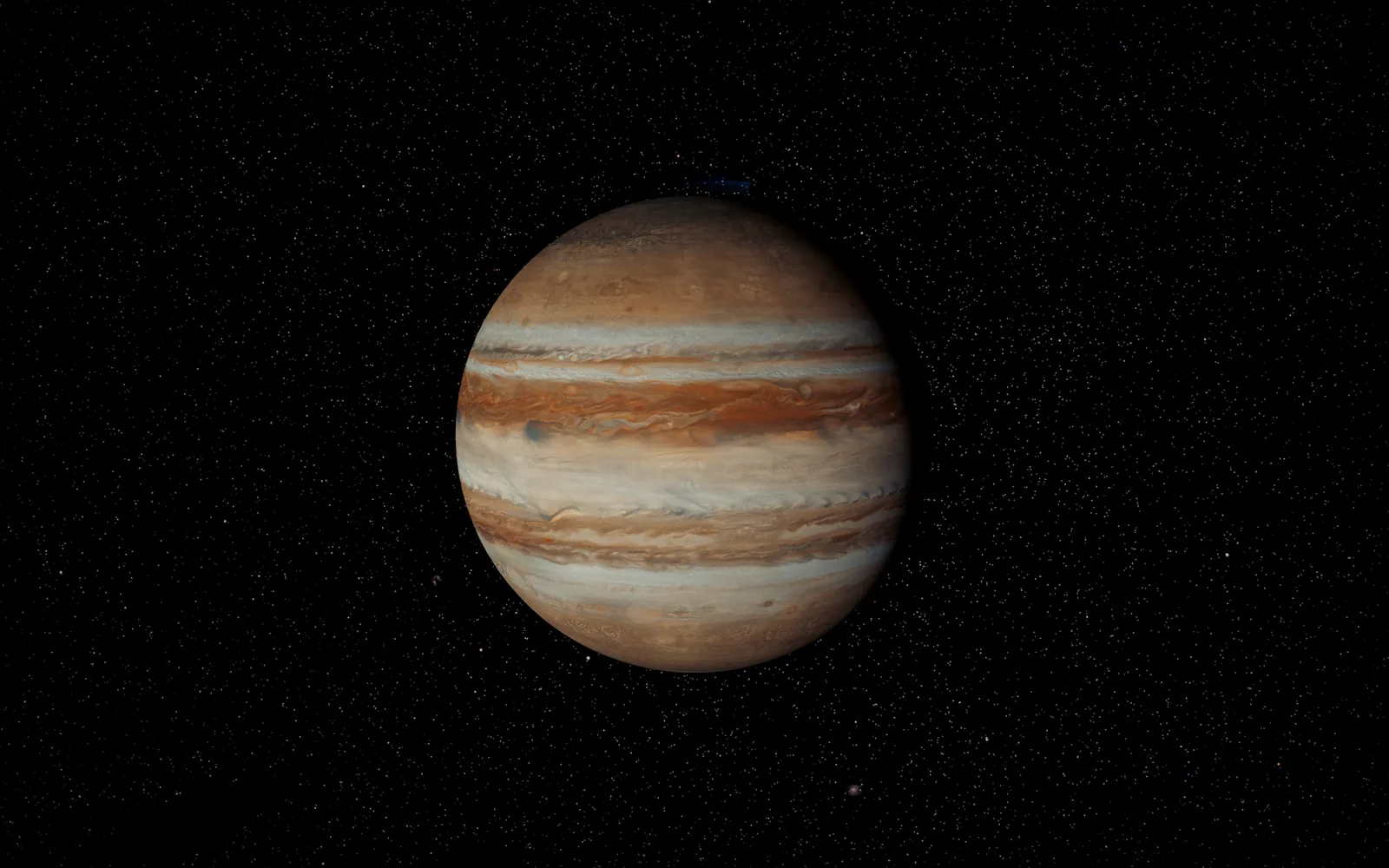
Jupiter is the largest planet. It is about 11 times wider than Earth.
Talking points
- NASA: Jupiter is the largest planet in our Solar System and 11 times wider than Earth.
- From NASA's fact sheet: 142,984 km ÷ 12,756 km = 11.2 across the equator.
Ask the class
About how many Earths would fit side by side across Jupiter?
- 2
- 11Right answer
- 109
- 1,000
WhyJupiter is about 11 times wider than Earth. NASA also says 1,000 Earths could fit inside Jupiter if it were a hollow shell. That number counts the space inside Jupiter, its volume, so it is much bigger than the number across.
Sources 1 5Present from this step
-
04
The Sun
Presented and for pupilsCaption
The Sun is far bigger than any planet. How many Earths would fit across it?
Talking points
- NASA Sun Fact Sheet: mean radius 695,700 km, which it lists as 109.2 times Earth's mean radius of 6,371 km. Using Earth's equatorial radius of 6,378 km instead gives 109.1. Either way, about 109 Earths across, rounded to the nearest whole Earth.
- Answers from 104 to 114 are marked correct.
Ask the class
How many Earths would fit side by side across the Sun?
Answer109 Earths. Answers from 104 to 114 are marked right.
WhyAbout 109. NASA gives the Sun's radius as 695,700 km and Earth's as 6,371 km, and 695,700 ÷ 6,371 = 109.2.
Sources 3 4Present from this step
-
05
True distances
Presented and for pupilsCaption
Now the distances are true as well. The planets become tiny dots, because the space between them is so huge.
Talking points
- NASA: Earth is on average 149.6 million km from the Sun. Astronomers use a unit close to this distance, the astronomical unit (au), which the IAU fixes at exactly 149,597,870,700 metres.
- NASA: Jupiter is on average 778.5 million km from the Sun (about 5.2 au) and Neptune 4,515 million km (about 30 au).
- The labels mark where the bodies are. At true scale most of them are too small to see from this far out.
Ask the class
Put these in order of distance from the Sun, closest first.
They start in this order: Neptune, Earth, Jupiter, Mars.
Answer
- Earth
- Mars
- Jupiter
- Neptune
WhyNASA's average distances from the Sun: Earth 149.6, Mars 228.0, Jupiter 778.5 and Neptune 4,515 million km.
Sources 1 2 7Present from this step
-
06
How long sunlight takes
Presented and for pupilsCaption
Light travels about 299,792 km every second. Even so, sunlight takes about 8 minutes 19 seconds to reach Earth.
Talking points
- The speed of light is exactly 299,792,458 metres a second (NIST CODATA), and 1 au is exactly 149,597,870,700 metres (IAU).
- 149,597,870,700 ÷ 299,792,458 = 499.0 seconds, which is 8 minutes 19 seconds. Earth's distance from the Sun changes through the year, from 147.1 to 152.1 million km (NASA), so the time runs from about 8 minutes 11 seconds to 8 minutes 27 seconds.
- Distances to the stars are often given in light years. A light year is the distance light travels in one year (a Julian year of 365.25 days): the IAU gives it as 9,460,730,472,580.8 km, and notes that professional astronomers more often use another unit, the parsec.
Ask the class
Sunlight takes about 499 seconds to reach Earth. How many whole minutes is that?
Answer8 minutes.
Why499 ÷ 60 = 8.3, so it is 8 whole minutes and 19 seconds more.
Sources 4 7 8Present from this step
-
07
Find Saturn
Pupils onlyCaption
Your turn. Step along the line-up and stop on Saturn.
Talking points
- NASA: Saturn is the second largest planet in our Solar System, so in this smallest-first line-up it is the stop just before Jupiter.
Pupil task
Use the arrows or the strip of stops to move along the line-up. Stop on Saturn.
HintSaturn is the second largest planet, so it comes just before Jupiter.
The viewer checks the task as the pupil works and says when it is done.
Sources 1 6Open this step as a pupil
Sources
Every fact in this lesson comes from these sources, and each step lists the ones it uses.
- Planetary Fact Sheet (metric), NASA NSSDCA
- Notes on the Planetary Fact Sheets, NASA NSSDCA
- Sun Fact Sheet, NASA NSSDCA
- Earth Fact Sheet, NASA NSSDCA
- Jupiter Facts, NASA Science
- Planets, NASA Science
- Measuring the Universe: the IAU and astronomical units, International Astronomical Union
- Speed of light in vacuum, CODATA value, NIST