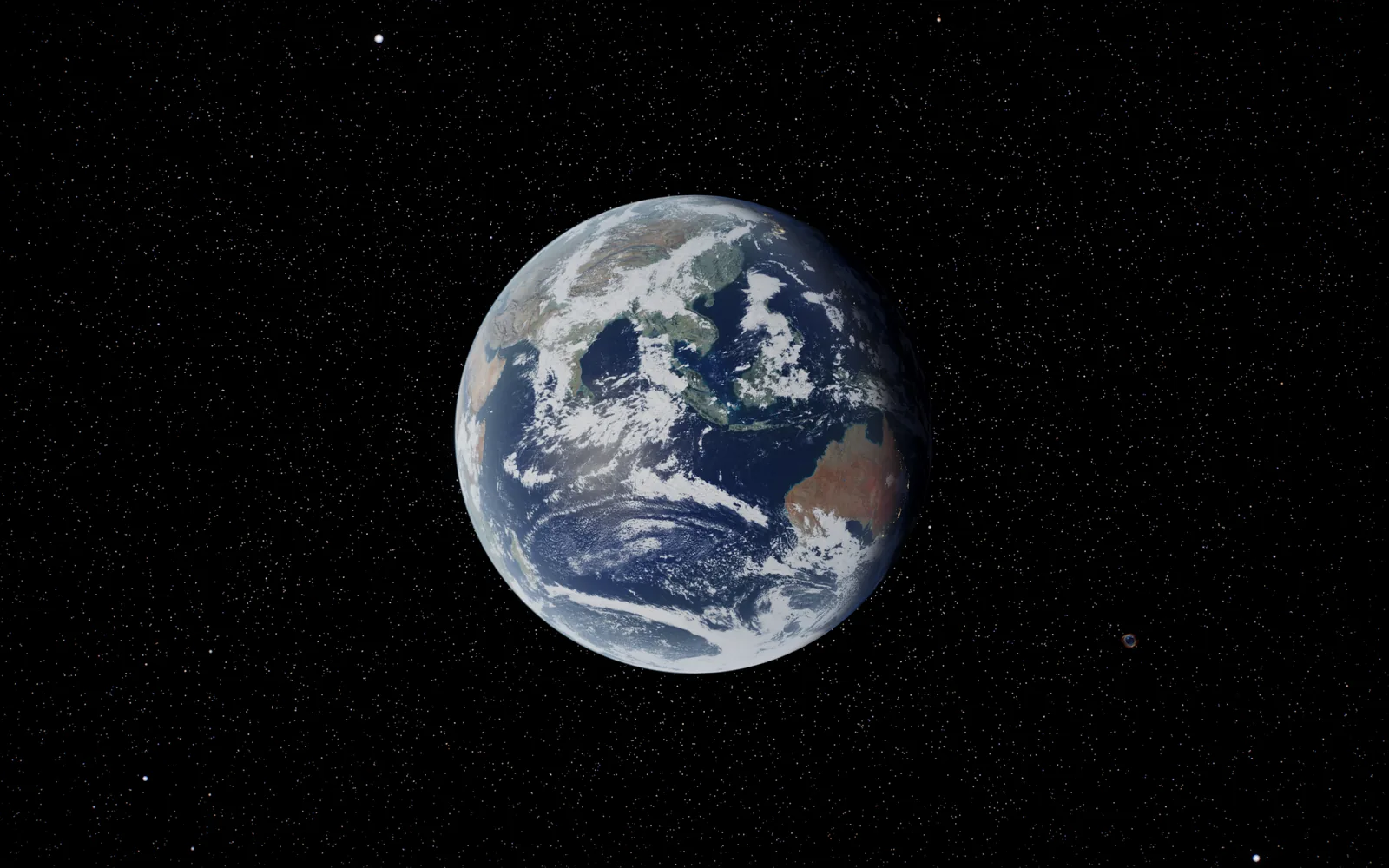
Lesson plan · Ages 11 to 14 · 25 minutes
Why we have seasons
Earth's tilted axis gives each hemisphere its summer and winter, and changes how long the days are.
The lesson
The class sees Earth's tilted axis, then visits the June solstice, the December solstice and an equinox in 2027 and compares day length in London and Sydney. They find out why being closer to the Sun does not cause summer.
What they take away
Earth's axis is tilted by about 23.4 degrees and keeps pointing the same way as Earth goes round the Sun, so each hemisphere takes turns leaning towards it. The hemisphere leaning towards the Sun gets more direct sunlight and longer days, and has summer.
Curriculum links
Quoted word for word from the official documents.
England national curriculum
-
Key stage 3: Physics, space physics
Read it on gov.ukthe seasons and the Earth’s tilt, day length at different times of year, in different hemispheres
Next Generation Science Standards (NGSS)
-
MS-ESS1-1
Read it on nextgenscience.orgDevelop and use a model of the Earth-sun-moon system to describe the cyclic patterns of lunar phases, eclipses of the sun and moon, and seasons.
Step by step
The caption is what the class reads on screen; the talking points are in your notes drawer (N) when you present. Steps marked Pupils only appear only in the pupil lesson.
-
01
A tilted planet
Presented and for pupilsCaption
Earth's spin axis is tilted. It leans about 23.4 degrees from straight up.
Talking points
- NASA gives Earth's obliquity, the tilt of its axis from a line at right angles to its orbit, as 23.44 degrees.
- USNO: the axis stays nearly fixed in direction in space as Earth goes round the Sun once a year.
Sources 1 2 5Present from this step
-
02
June: summer in the north
Presented and for pupilsCaption
In June the North Pole leans towards the Sun. It is summer in the north and winter in the south.
Talking points
- USNO gives the June solstice of 2027 as 21 June at 14:11 UTC. The scene opens at the solstice as the viewer's own ephemeris finds it, a few minutes before that time.
- USNO: at a solstice the axis is most tilted towards or away from the Sun. The hemisphere tilted towards the Sun has its longest day and the other its shortest.
- NASA Space Place: it is summer in June in the Northern Hemisphere because the Sun's rays hit that part of Earth more directly than at any other time of the year.
Ask the class
It is June. Which hemisphere is having summer?
- The Northern HemisphereRight answer
- The Southern Hemisphere
- Both of them
WhyIn June the North Pole leans towards the Sun, so the Northern Hemisphere gets the most direct sunlight.
-
03
December: summer in the south
Presented and for pupilsCaption
Six months later the South Pole leans towards the Sun. Now it is summer in Sydney and winter in London.
Talking points
- USNO gives the December solstice of 2027 as 22 December at 02:42 UTC.
- USNO: six months after the June solstice Earth is on the opposite side of the Sun, so the Northern Hemisphere is tilted away from the Sun and has winter. The axis itself still points the same way.
-
04
Long days and short days
Presented and for pupilsCaption
In June, London spends most of each turn in sunlight. Sydney spends most of it on the night side.
Talking points
- The clock runs at an hour a second. Watch how long each city stays on the lit side.
- USNO, sunrise to sunset on 21 June 2027: Greenwich (London) 16 hours 38 minutes, Sydney 9 hours 54 minutes.
- USNO, sunrise to sunset on 22 December 2027: Greenwich 7 hours 50 minutes, Sydney 14 hours 25 minutes.
Ask the class
On 21 June 2027 London gets 16 hours 38 minutes of daylight. About how much does Sydney get on the same day?
- About 16 and a half hours
- About 10 hoursRight answer
- Exactly 12 hours
WhySydney is in the Southern Hemisphere, which leans away from the Sun in June. The US Naval Observatory gives it 9 hours 54 minutes of daylight that day.
-
05
An equinox
Presented and for pupilsCaption
At an equinox the Sun is overhead at the equator. London and Sydney both get about 12 hours of daylight.
Talking points
- USNO gives the March equinox of 2027 as 20 March at 20:25 UTC.
- USNO glossary: an equinox is the time at which the centre of the Sun crosses the Earth's equator.
- USNO, sunrise to sunset on 20 March 2027: Greenwich 12 hours 10 minutes, Sydney 12 hours 9 minutes.
- This view is from the Sun, so the point with the Sun overhead is in the middle of the disc.
-
06
Closest in January
Presented and for pupilsCaption
Earth is closest to the Sun in early January, during the northern winter and the southern summer. So distance from the Sun does not cause the seasons.
Talking points
- USNO, 2027: perihelion (closest to the Sun) on 3 January at 02:33 UTC, aphelion (farthest) on 5 July at 05:06 UTC. The scene opens at perihelion.
- NASA gives perihelion as 147.1 million km and aphelion as 152.1 million km, a difference of about 5 million km.
- USNO: Earth's orbit is very close to a perfect circle, and the change in distance is too weak to cause the seasons.
- Sizes and distances in this view are not to scale.
Ask the class
Why is it warmer in summer?
- Earth is closer to the Sun in summer
- Our half of Earth leans towards the Sun, so its rays hit us more directlyRight answer
- The Sun gives out more heat in summer
WhyEarth is closest to the Sun in early January, which is winter in the north and summer in the south, so distance cannot be the cause. Summer comes when your hemisphere leans towards the Sun and gets its rays more directly.
Sources 1 3 4 5Present from this step
-
07
Find the June solstice
Pupils onlyCaption
Your turn. Run the clock forward to the June solstice and pause it there.
Talking points
- The check passes when the Sun's apparent longitude is within 2 degrees of 90 degrees. The USNO glossary defines a solstice as the moment the Sun's apparent longitude is 90 or 270 degrees, and 90 degrees is the June one. The Sun moves about 1 degree a day along its yearly path (360 degrees in a 365.24-day year), so that is about two days either side.
Pupil task
Play the clock and speed it up. Pause it at the June solstice, when the North Pole leans most towards the Sun.
HintThe June solstice is around 21 June. Watch the date and slow the clock down as you get close.
The viewer checks the task as the pupil works and says when it is done.
Sources 1 4 6Open this step as a pupil
-
08
Explain it
Presented and for pupilsCaption
The tilt stays the same all year. As Earth goes round the Sun, first one hemisphere and then the other leans towards it.
Talking points
- NASA Space Place: as Earth orbits the Sun its tilted axis always points in the same direction, so different parts of Earth get the Sun's direct rays through the year.
- A good answer says that in December the Southern Hemisphere leans towards the Sun, so Sydney gets more direct sunlight and longer days, while London leans away.
Ask the class
Explain to a friend why Sydney has summer when London has winter.
AnswerWritten in the pupil’s own words, up to 280 characters. It is not marked.
Sources 3 5Present from this step
Sources
Every fact in this lesson comes from these sources, and each step lists the ones it uses.
- Earth Fact Sheet, NASA NSSDCA
- Notes on the Planetary Fact Sheets, NASA NSSDCA
- What Causes the Seasons?, NASA Space Place
- Earth's Seasons and Apsides, 2027, US Naval Observatory
- The Seasons and the Earth's Orbit, US Naval Observatory
- Astronomical Almanac Glossary, US Naval Observatory
- Sun and Moon rise and set for one day (Greenwich and Sydney, 20 March, 21 June and 22 December 2027), US Naval Observatory
- What is the Prime Meridian, and why is it in Greenwich?, Royal Museums Greenwich
- Stand on the Prime Meridian, Royal Observatory Greenwich, Royal Museums Greenwich
- Airy transit circle, An Etymological Dictionary of Astronomy and Astrophysics, Paris Observatory
- Sydney (Observatory Hill) site information, Australian Bureau of Meteorology