New Horizons · 14 July 2015, 11:10 UTC
Pluto in true colour
About forty minutes before its closest pass, New Horizons scanned Pluto in colour: Sputnik Planitia, the bright, craterless plain of nitrogen and methane ice in Pluto's heart, beside the cratered highlands of Cthulhu Regio.

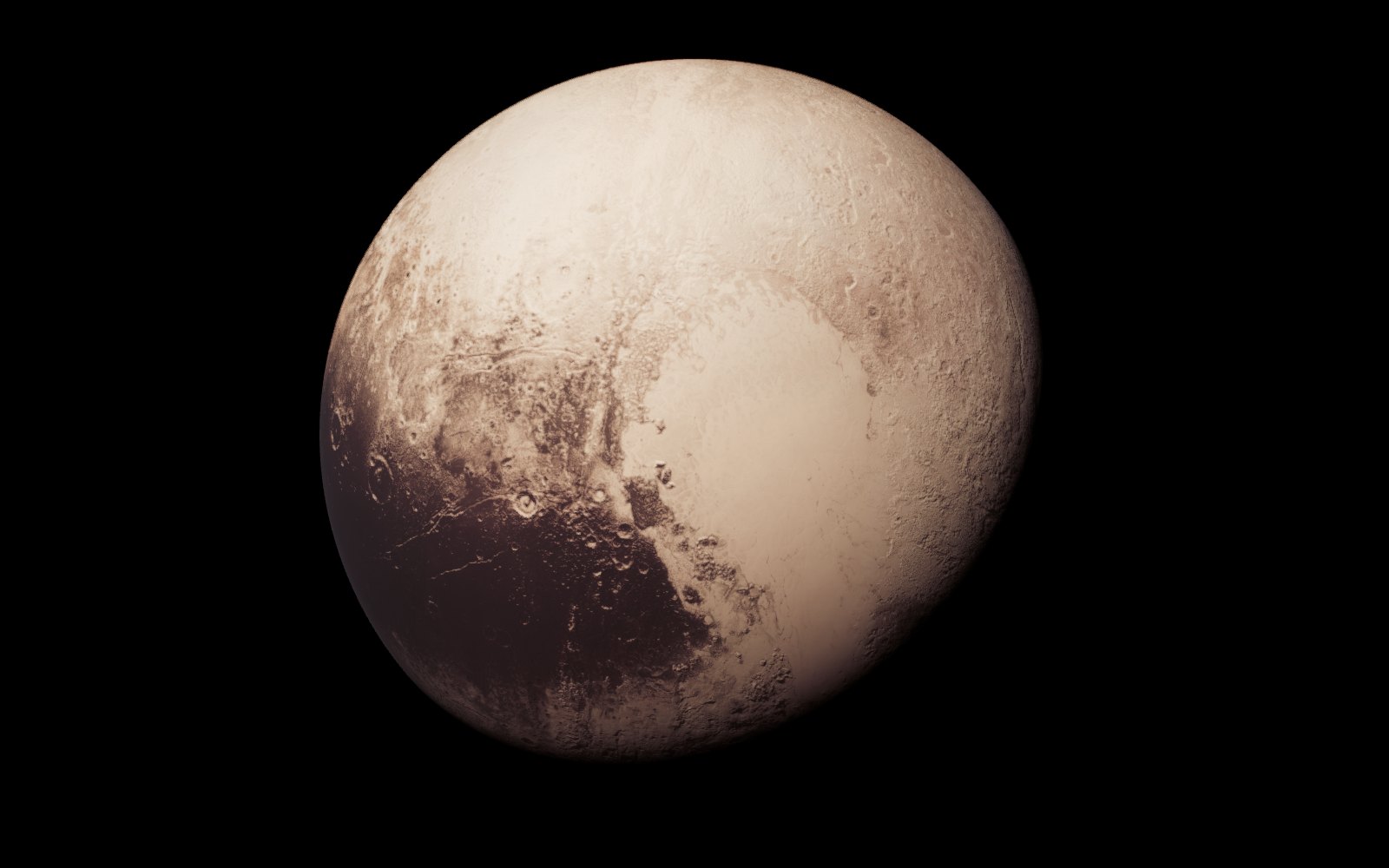
Slide between them
The original laid over the live view at the same scale, as the viewer does when you press Both or Original. Drag across the picture, or use the arrow keys.
Where it was taken from
New Horizons was about 34,000 km from Pluto at 11:10 UTC on 14 July 2015.
The live view puts the viewer's camera right there. The clock goes to that moment, everything switches to true scale, and the camera sits where the spacecraft was, its position from JPL Horizons, NASA's ephemeris service, for that moment [5]. The lens matches the published picture, 4.6° from top to bottom, and the camera is turned to the picture's own orientation, so the original lies over the view at the same scale.
Where the two differ
NASA gives the range as 35,445 km; the scan's PDS timing and JPL Horizons put it 33,050 to 34,880 km from Pluto's centre.
Everything in the live view comes from the viewer's own maps and its own light, drawn at one instant. The geometry comes from the spacecraft's position, the lens and the picture's orientation, so where everything was, how big it looked and which way it was lit should all line up with the original.
The facts
- New Horizons took this colour scan on 14 July 2015 as it raced toward Pluto; NASA gives the range as 35,445 km. [1]
- NASA calls it the most accurate natural-colour image of Pluto taken by New Horizons, released in 2018 from a refined calibration of the colour camera's data. [1]
- Sputnik Planitia, the bright icy plain in Pluto's heart, is rich in nitrogen and methane. [1]
- The picture is a single scan by the MVIC colour camera, with no data from any other instrument. [1]
- New Horizons passed closest to Pluto about 40 minutes later, at 11:49 UT. [2]
- At its closest it was 7,750 miles, about 12,500 km, from Pluto's surface. [3]
- West of the heart lie the cratered highlands of Cthulhu. [4]
Open it live
In the viewer the clock runs on from the moment at real pace, so you can watch the scene move the way it did after the shutter closed. Press Both or Original to lay the original over it, or drag to look around from where New Horizons was.
Open it live in 3D → All eight as a Mac screensaver
The other seven

 The Blue Marble

 Earthrise
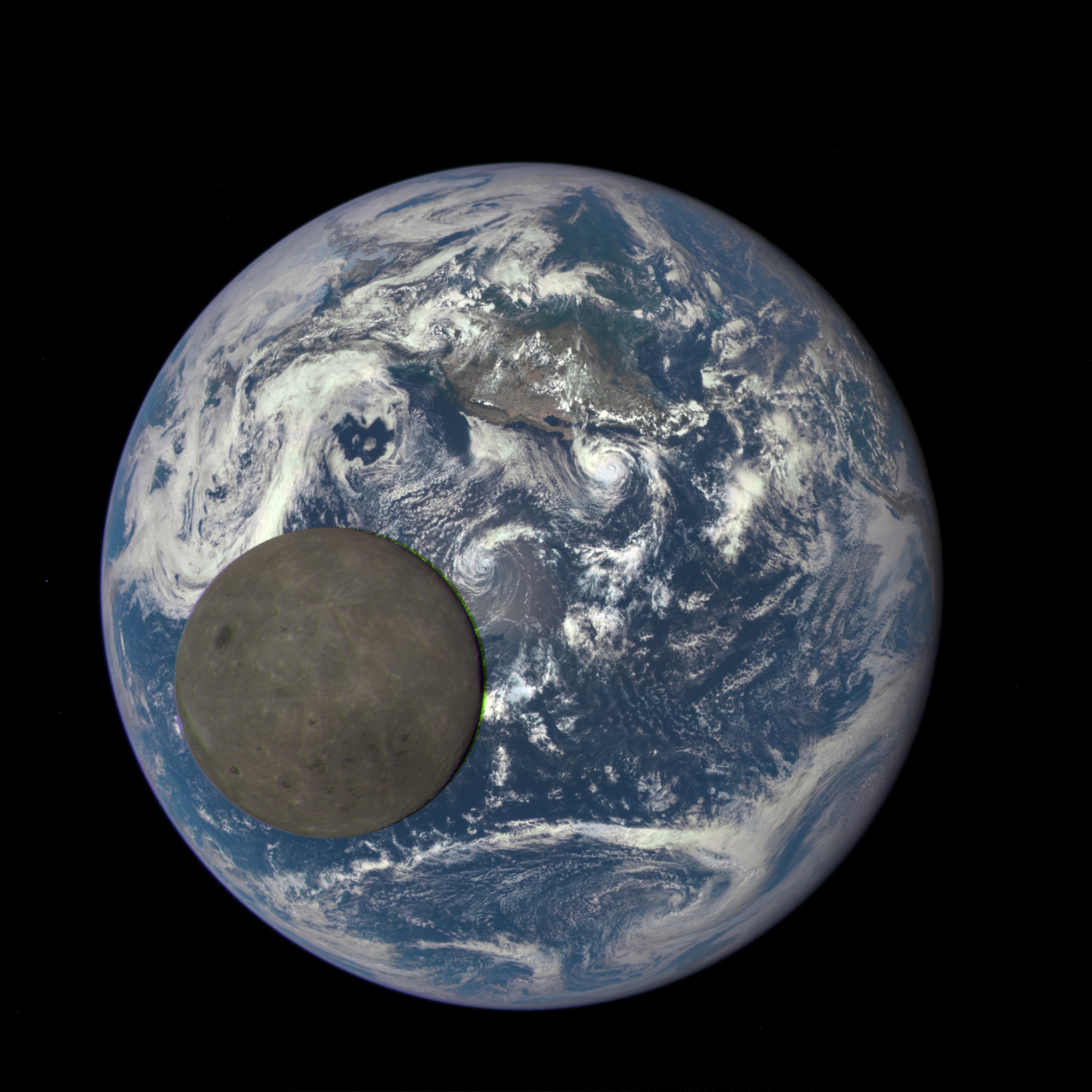
 The Moon crossing the Earth
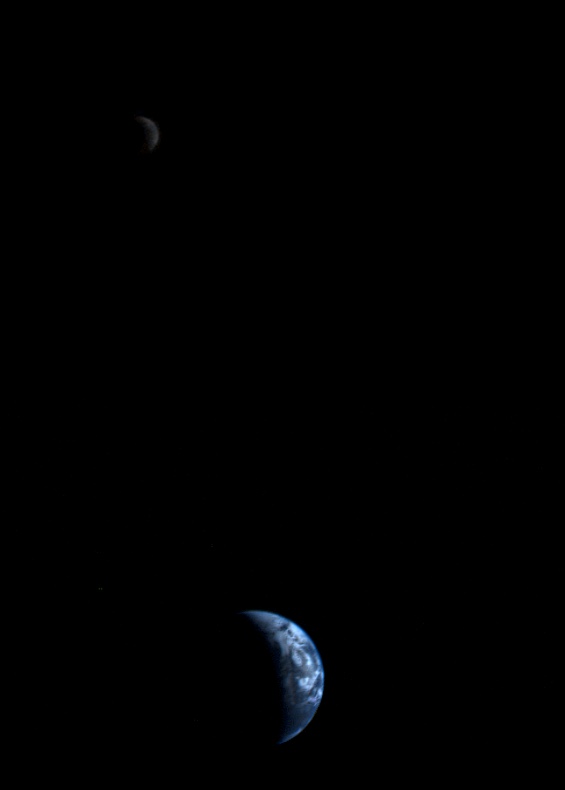
 The Earth and Moon, together

 Pale Blue Dot

 The Day the Earth Smiled
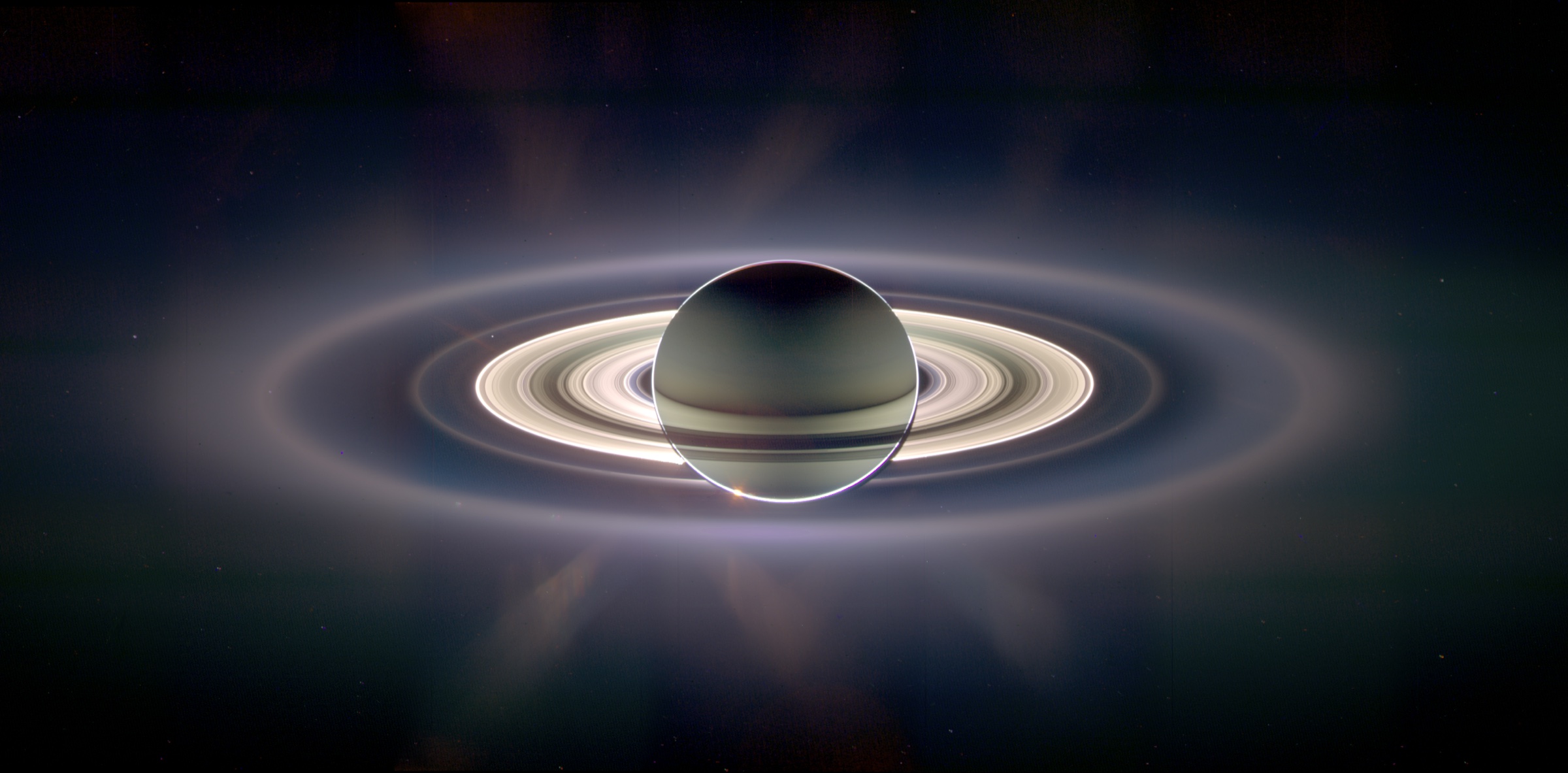
 In Saturn's Shadow
All the famous photos, and how the views are made
Sources
- NASA Science: True Colors of Pluto
- NASA Science: New Horizons
- NASA (svs.gsfc.nasa.gov): 11913
- NASA Photojournal: Putting Plutos Geology on the Map
- NASA JPL: Horizons ephemeris system
Original picture: NASA/Johns Hopkins University Applied Physics Laboratory/Southwest Research Institute, from NASA Science: True Colors of Pluto. The New Horizons team makes its pictures available for non-commercial educational and public information use, which is how this free page shows it. New Horizons usage policy. The live view is ours, rendered by the Our Solar System viewer.