There's a scene in the 3D solar system that drops you straight onto the Moon, at Hadley Base, the spot where Apollo 15 landed in 1971, with a lander on its legs and a rover strapped to its deck. You unfold the ramp, drive the rover down it and head off across the plain, and the ground under your wheels is the Moon's real shape, measured by a laser from orbit.
It lives in rocketry mode, in the Experiences row at the Space Center. Nothing is charged to your career and there's no launch to fly first, you just pick Moon Rover and you're there.
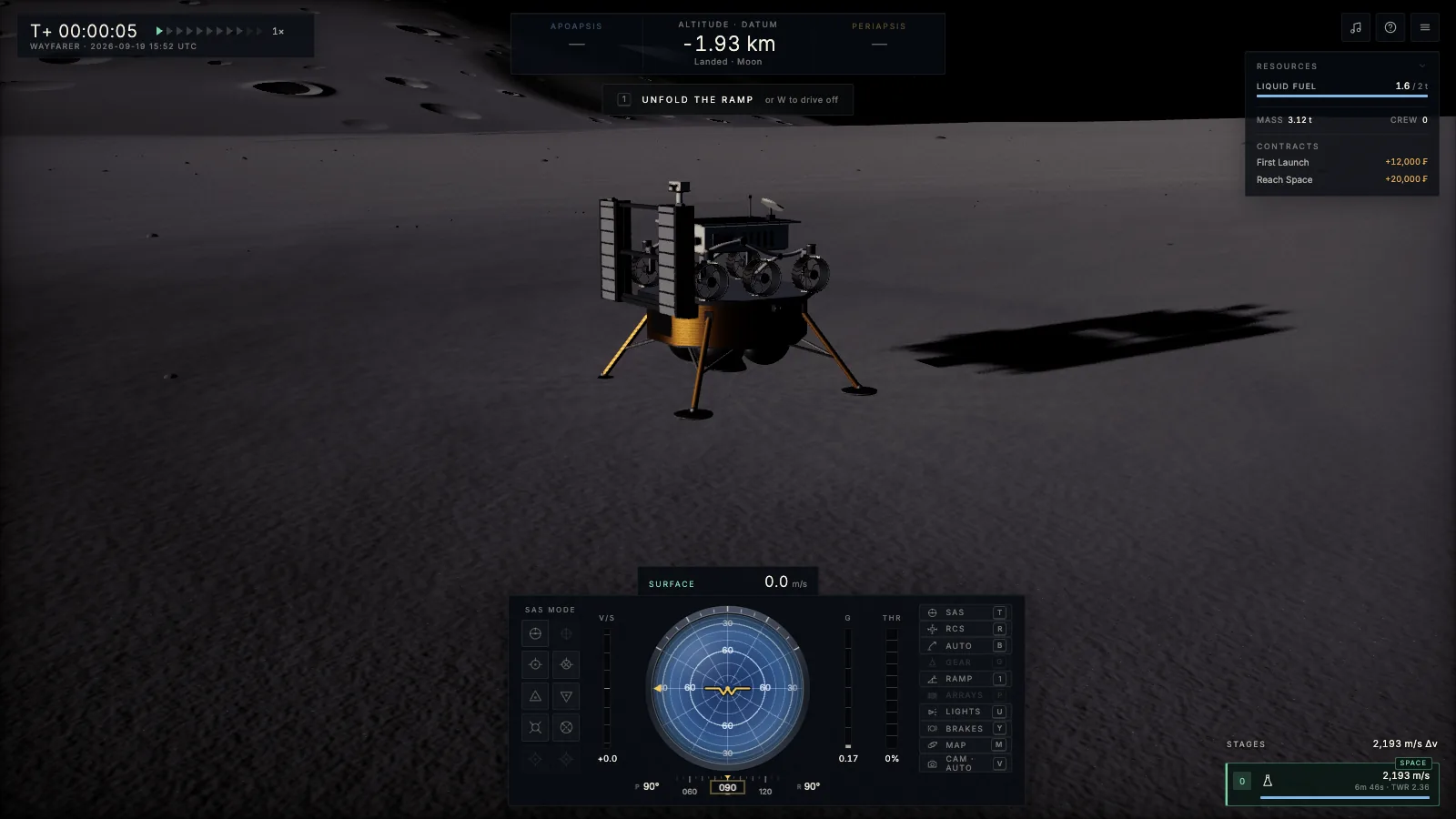
The ground is real
The heights come from LOLA, the Lunar Orbiter Laser Altimeter on NASA's Lunar Reconnaissance Orbiter, which has been pinging the surface with a laser since 2009. The terrain streams in tiles at finer and finer detail as you get closer, down to the USGS mosaic at about 118 meters between samples, so the hills on the horizon and the lie of the land under the lander are where they are on the Moon.
The color of the ground is data too, from NASA's CGI Moon Kit albedo map with detail from LRO's wide-angle camera laid over it. The important bit is that it's albedo, the brightness of the surface itself with no shadows baked in, so the lighting you see is the lighting of the moment you're there rather than whatever the sun was doing when the photo was taken.
Below what the data can resolve, the small craters are placed procedurally, using the same crater counting law planetary scientists use to date surfaces, so the dimples and pits close up follow the statistics of the real thing. Then there are pebbles, grit, and a photographic regolith texture for the last hundred meters around you.
Why it's always morning
When the scene loads, the clock moves forward to the next time the Sun sits between 14 and 30 degrees above the horizon at Hadley. That's morning light on the Moon, low enough to throw long shadows and bring out every bump in the ground, which is also why the Apollo crews landed in the lunar morning. At noon with the Sun overhead the Moon goes flat and it's genuinely hard to judge distance.
The sky is black in full daylight, with no stars, because a camera exposed for sunlit ground can't see them, and no Apollo photo shows any either. I get asked about that one a lot.
Unfold, release, drive
Press 1, or W, and the lander's ramp unfolds. The two segments swing down and the angle adjusts until its foot meets the actual ground under it, so the ramp always lands flush with the terrain rather than hovering or sinking. Press again and the rover is released, and control switches to it.
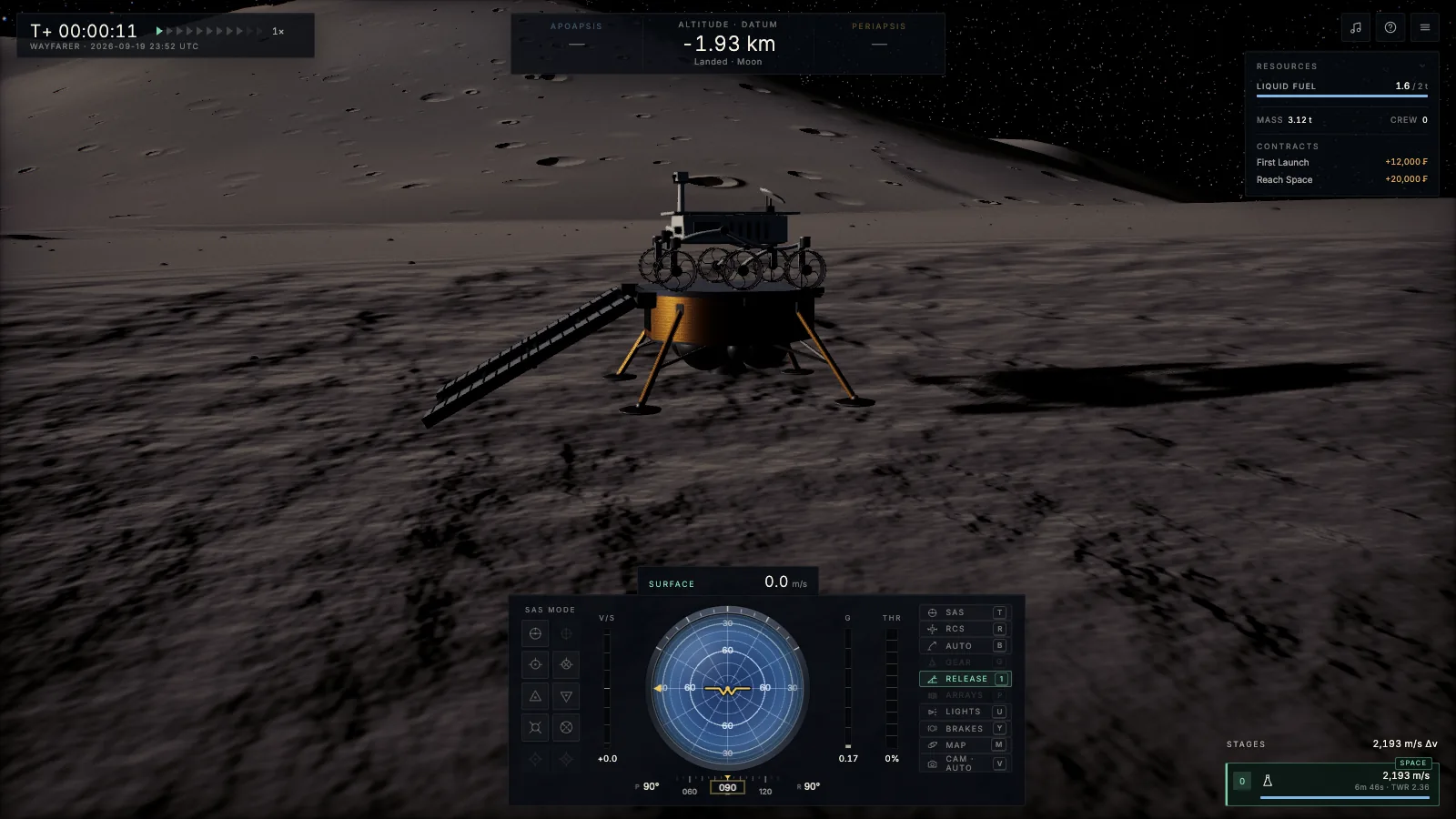
The rover drives on W and S, steers on A and D, brakes on B, and Y sets the parking brake. It also parks itself once it's been stopped on four wheels for a second.
There's a lot going on under that. Each wheel is its own spring and damper, with its own grip, and the wheels are allowed to droop below the chassis the way a rocker-bogie suspension does on a real rover. Without that droop, a rigid rover sitting at the edge of the deck in a sixth of Earth's gravity teeters on its back wheels and falls off, which I found out the hard way. The speed control also eases off going downhill and when the wheels are hanging, the same way rover drive software does, otherwise a ramp gets taken as a jump.
Tracks, dust and the blast zone
Every wheel lays a track as it goes, pressed into the regolith with the cleat pattern in it, so you can look back and see exactly where you've been. The dust is my favorite part. Each grain gets kicked off a wheel according to the rover's speed and slip, and then follows a clean parabola in the Moon's gravity until it lands, because there's no air to slow it down. That's the "rooster tail" you see in the Apollo 16 rover footage, and once you've watched real grains do it the fake puffy smoke you get in most games looks wrong forever.
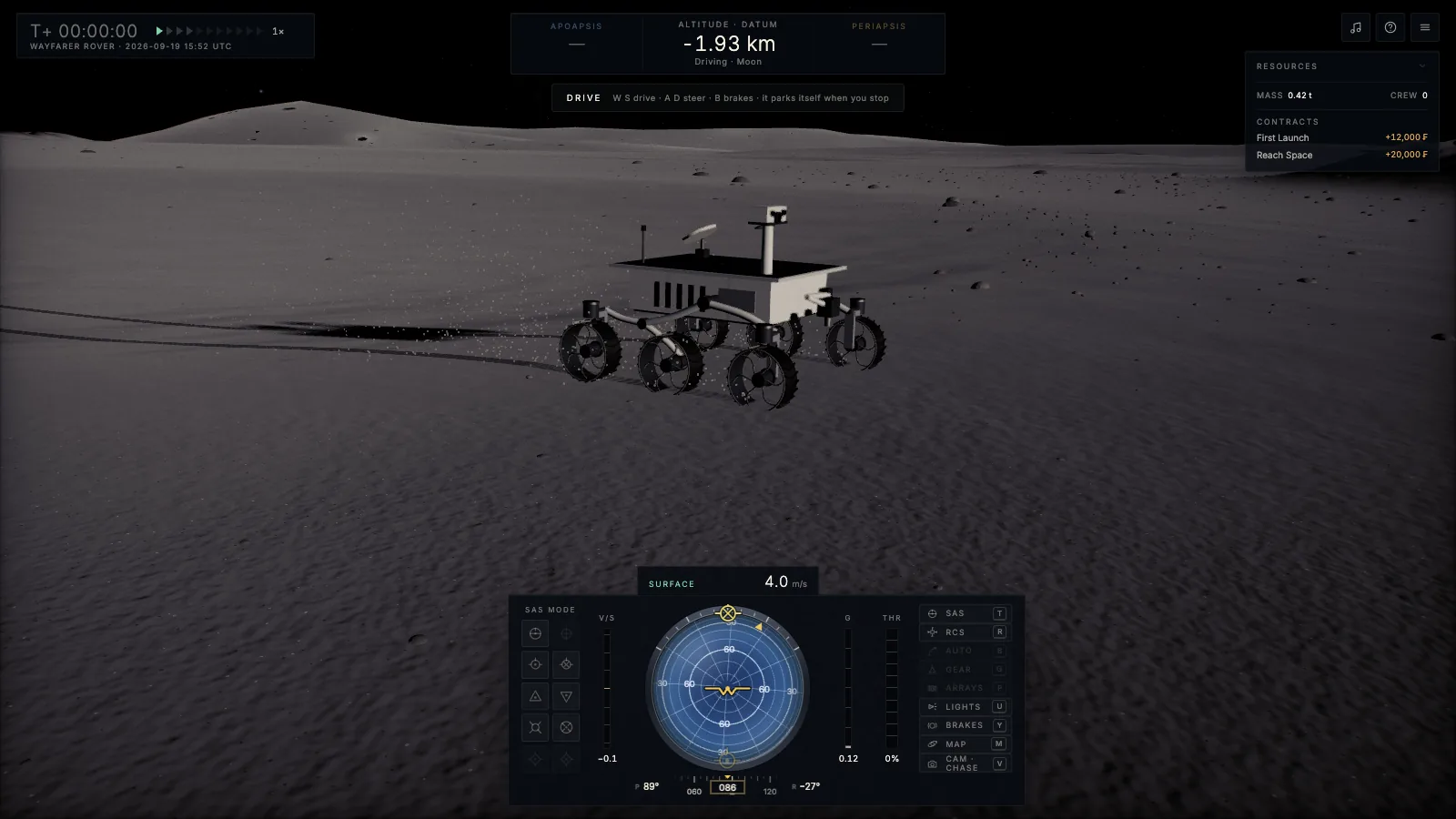
The lander leaves its mark too. The ground under a craft that landed on its engines is scoured brighter than the regolith around it, the way the descent engines of the Apollo landers left a lighter patch you can still see from orbit today.
One thing that surprised me
The Moon keeps the same face toward Earth, so its spin follows its orbit, and its orbit isn't a perfect circle. That means the Moon's spin rate actually wobbles over the month. My first version used the average rate, and the ground slid under a parked rover at up to a third of a meter per second, so the rover crept off the deck on its own like a shopping cart rolling across a parking lot. Now the spin comes straight from the ephemeris and everything stays put.
Where it fits
The Moon Rover scene is the fastest way into rocketry mode, and there's a Mars version at Jezero Crater using the same lander and rover. If you'd rather read about the Moon itself first, its page has the facts, and the 3D viewer will show you where it is in the sky tonight.
It's a small thing, driving a little rover around a crater, but knowing the ridge ahead is really there gives it a weight I didn't expect when I started building it.