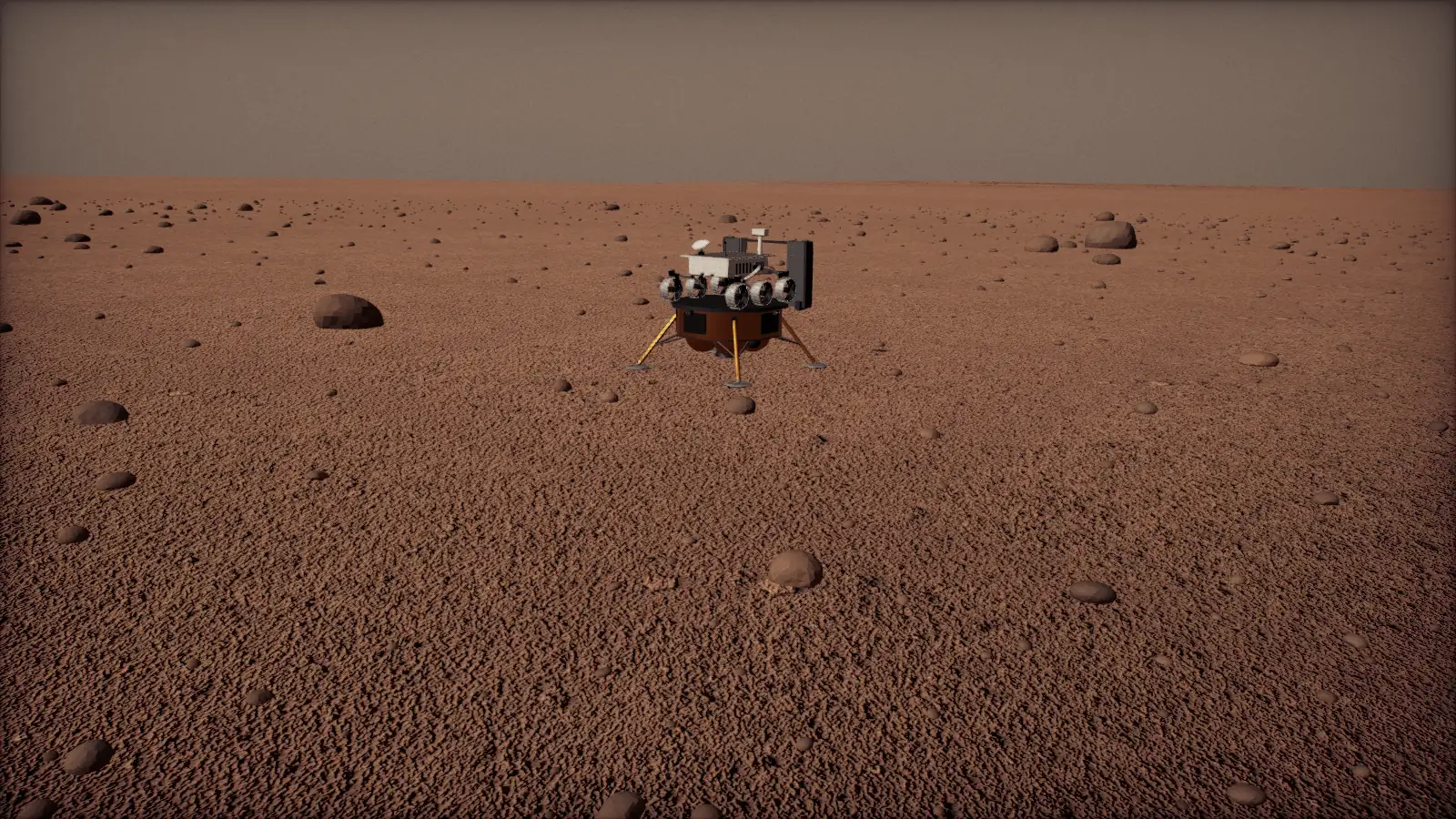
The Mars Rover scene sets you down on the floor of Jezero Crater, at the coordinates where NASA's Perseverance rover landed in February 2021, 18.44 degrees north and 77.45 degrees east. A lander stands on its legs with a rover folded on its deck, the ramp faces west toward the old river delta, and the whole of Mars is yours to drive across.
It's the sibling of the Moon rover scene at Hadley Base. Same lander, same Prospector rover, same controls, a very different planet, and getting the difference right turned out to be most of the work.
Why Jezero
Jezero is a crater about 45 km across on the western edge of Isidis Planitia, and around three and a half billion years ago it held a lake. A river cut through the crater wall and dumped sediment into it, and that fan-shaped delta is still sitting there, which is exactly why NASA sent Perseverance. River deltas on Earth are very good at burying and keeping traces of life, so if Mars ever had any, a dried-out delta is a sensible place to go looking.
You get to the scene through rocketry mode, in the Experiences row at the Space Center, and like the Moon scene there's no launch and no cost, you pick Mars Rover and you're on the ground.
What's real and what isn't
Let me be clear about this, because the Moon scene set a high bar. On the Moon the ground under you is real, built from laser altimetry. There's no equivalent Mars height data streaming into the scene yet, so at Jezero the site, the latitude, the gravity, the air and the light are real, and the terrain itself is procedural, shaped to feel like a crater floor rather than traced from one. It's on the list, Mars has good elevation data from orbit and it'll come.
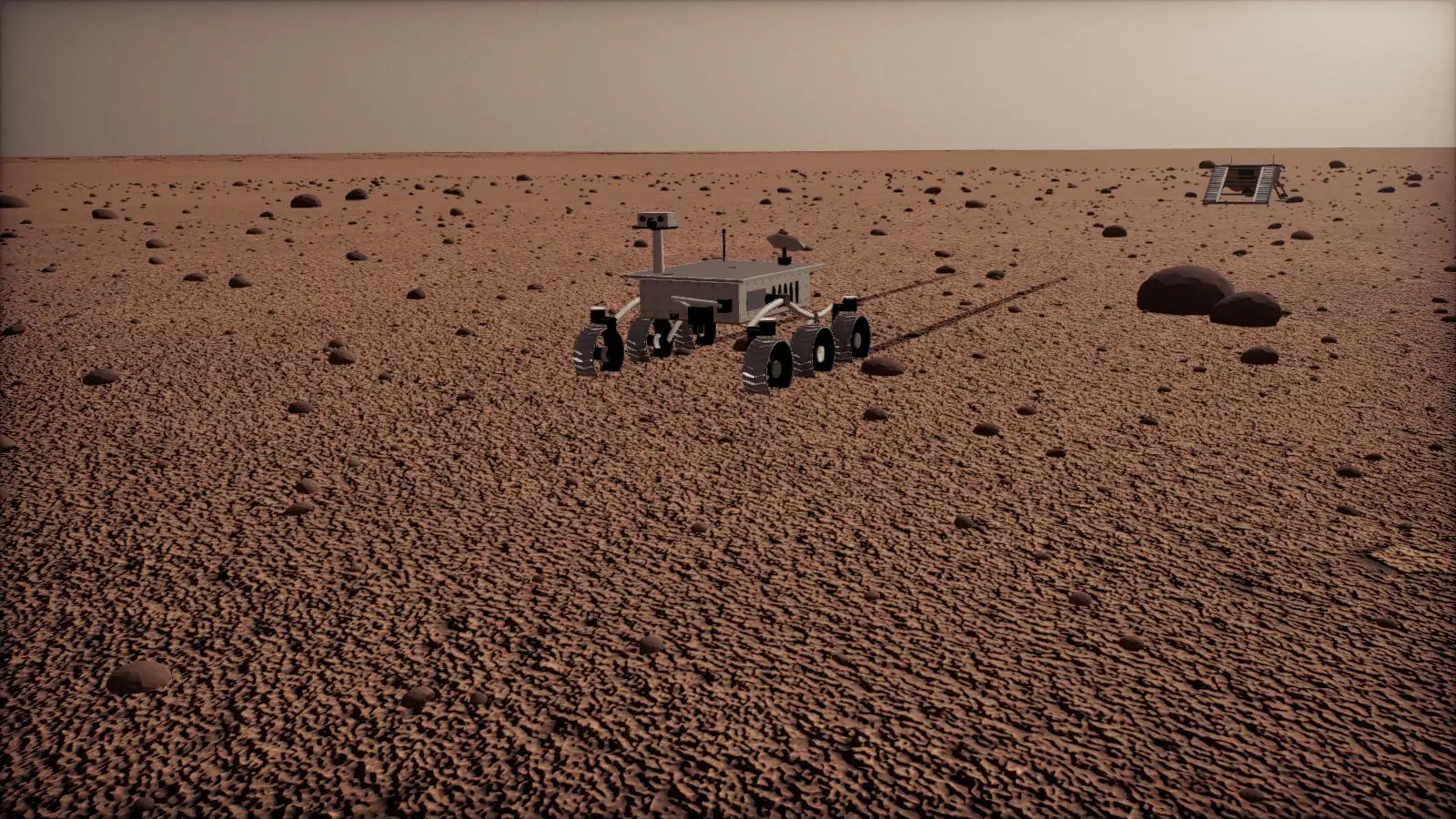
What makes the ground read as Mars is everything sitting on it. The rocks are scattered at about eight times the density of the Moon's plains, because every rover photo from Mars shows a surface littered with them, and without them the ground looks like an empty parking lot. The color comes from the regolith material tinted to the rusty browns and tans in the rover images, and the sky is that washed-out butterscotch you get when fine dust hangs in thin air and scatters the light.
Light on Mars
The scene picks a time when the Sun is between 25 and 45 degrees up, which is a bit higher than the Moon scene uses. Mars sits about one and a half times further from the Sun than Earth does, so sunlight there is a bit under half as bright, and the dusty air softens the shadows and warms them up. A long-shadow dawn that looks great on the airless Moon just reads as murky on Mars, mid-morning looks right.
Driving, and the dust
The controls are the same as on the Moon. Press 1 and the ramp unfolds until its foot meets the ground, press 1 again and the rover rolls free and you take over. W and S drive, A and D steer, B brakes, and 2 switches back to the lander.
The rover's physics are identical on both worlds, so everything you feel comes from the planet under it. Mars pulls at 3.71 m/s², a bit over a third of Earth's gravity and more than twice the Moon's, so the rover feels planted in a way it never does at Hadley, and it takes slopes with a lot less drama.
The dust is where the two scenes really part ways. On the Moon every grain kicked off a wheel flies a perfect arc, because there's no air at all. Mars does have air, just not much of it, the surface density is about 0.020 kg per cubic meter against Earth's 1.2, around a sixtieth as thick. That's enough to matter, so each grain is still thrown on an arc but bleeds speed as it flies and drops a little short, and the plume comes out a dusty ochre instead of lunar grey. It's a small change in the code and a big change in how the scene feels, the Moon looks sharp and silent and Mars looks weathered.
One thing I'll own up to, the lander doesn't scour a bright blast zone into the Martian ground the way it does on the Moon yet. On the Moon that effect comes from the Moon's own surface shader, and Mars needs its own.
Why bother with two
Driving the same rover on two worlds is honestly the best way I've found to feel the difference between them. Gravity, air and light are just numbers on a compare page until you've watched the same wheel throw the same grain of dust and seen it land in a different place.
If you want the facts first, Mars has its own page with its size, its moons and every mission that's been there, and How far is Mars from Earth has the distance. Then go and drive around Jezero for a bit, it's a nice place to be.